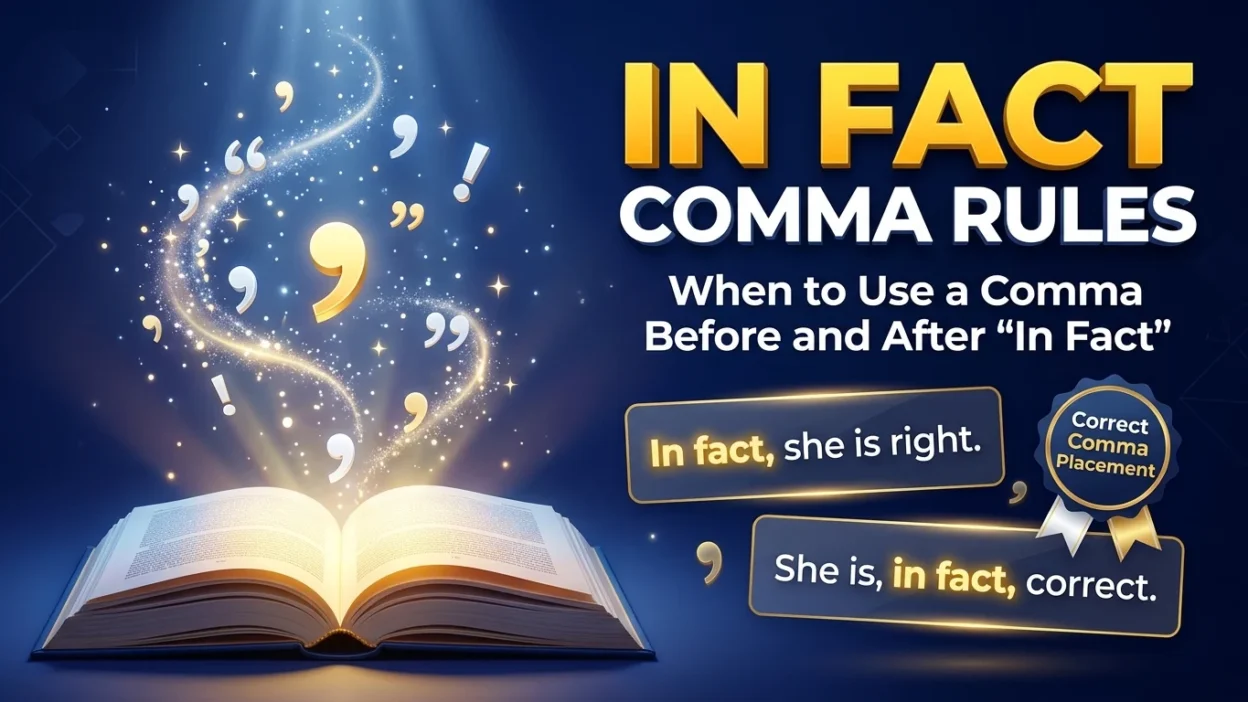
The phrase “in fact” is commonly used in English to add information, emphasize a point, correct a misunderstanding, or introduce something that supports a previous statement. However, many writers are unsure if they should place a comma before or after it. Understanding the correct in fact comma rules can make your writing clearer, smoother, and more grammatically accurate.
The good news is that using commas with “in fact” is not difficult once you understand its position in a sentence. When “in fact” introduces a sentence or interrupts a sentence as a parenthetical expression, it is usually followed by or surrounded by commas. When it appears at the end of a sentence or connects two independent clauses, punctuation depends on the sentence structure. This guide explains all the important rules with simple examples so you can use “in fact” confidently in everyday, academic, and professional writing.
Quick Answer: Do You Put a Comma After or Before In Fact?
Yes, “in fact” usually takes a comma when it introduces a sentence or interrupts a sentence. Use a comma after it at the beginning, and commas around it when it appears in the middle as an interrupting expression. When connecting two independent clauses, use a semicolon or start a new sentence instead of joining them with only a comma.
Why Do People Confuse In Fact Comma Rules?
Writers often confuse the punctuation because “in fact” can appear in different positions within a sentence.
It can introduce a complete sentence, interrupt an existing sentence, or appear at the end of a statement. Each position can require different punctuation.
For example:
- Beginning: In fact, she is an excellent writer.
- Middle: She is, in fact, an excellent writer.
- End: She is an excellent writer, in fact.
The phrase itself does not change its meaning significantly, but its position affects how commas are used.
First Word: In
“In” is a preposition that can express a position, condition, or relationship. However, in the expression “in fact,” it is part of a fixed phrase that means something is true, real, or supported by evidence.
Examples:
- In fact, I already knew the answer.
- She is in fact responsible for the project.
- In fact, the situation is more complicated than it appears.
When “in fact” is used as an introductory expression, place a comma after the complete phrase, not between “in” and “fact.”
Correct: In fact, he was right.
Incorrect: In, fact he was right.
Second Word: Fact
“Fact” is a noun that refers to something known or proven to be true.
When combined with “in,” the phrase “in fact” works as an adverbial expression. It adds emphasis, provides clarification, or introduces information that supports or corrects an earlier statement.
Examples:
- In fact, the meeting was canceled.
- The book is, in fact, very interesting.
- He did not fail. In fact, he received the highest score.
Remember that “fact” is not a separate introductory word in this expression. Punctuation applies to the complete phrase “in fact.”
In Fact Comma Rules: Comparison Table
| Position | Correct punctuation | Example |
|---|---|---|
| Beginning | Comma after | In fact, I agree. |
| Middle | Commas around it | She is, in fact, correct. |
| End | Usually no comma required before it | I agree, in fact. |
| Between independent clauses | Semicolon or period | He was tired; in fact, he was exhausted. |
| After a conjunction | Depends on sentence structure | And in fact, she agreed. |
When to Use Each In Fact Comma Rule
1. Use a Comma After In Fact at the Beginning
When “in fact” starts a sentence, place a comma immediately after it.
This comma separates the introductory expression from the main statement.
Examples:
- In fact, I have already completed the assignment.
- In fact, she speaks three languages.
- In fact, we should leave earlier.
2. Use Commas Around In Fact in the Middle
When “in fact” interrupts the main sentence, use a comma before and after it.
This is especially common when the phrase adds emphasis or extra information.
Examples:
- He is, in fact, a very talented musician.
- The plan is, in fact, quite simple.
- They were, in fact, waiting for us.
The sentence should remain grammatically complete if you remove the interrupting expression.
For example:
She is, in fact, very intelligent.
Without “in fact”:
She is very intelligent.
3. Use Appropriate Punctuation Before In Fact at the End
When “in fact” appears at the end of a sentence, a comma may be used to create a pause or emphasize the expression. However, it is not always necessary.
Examples:
- I knew the answer, in fact.
- The decision was correct, in fact.
For smoother writing, placing “in fact” at the beginning or in the middle is often more natural.
4. Use a Semicolon Between Two Independent Clauses
Do not join two complete sentences using only a comma before “in fact.”
Incorrect:
- She was tired, in fact, she went straight to bed.
Correct:
- She was tired; in fact, she went straight to bed.
- She was tired. In fact, she went straight to bed.
A semicolon or full stop prevents a comma splice.
15 Examples of In Fact With Correct Commas
Here are 15 practical examples showing how to use “in fact” correctly.
- In fact, I have never visited London.
- In fact, she is the best student in our class.
- He is, in fact, much older than he looks.
- The movie was, in fact, better than I expected.
- In fact, we finished the work ahead of schedule.
- She does not dislike coffee. In fact, she drinks it every morning.
- The task is, in fact, easier than it seems.
- In fact, my brother already knows about the surprise.
- They were, in fact, planning to visit us.
- The restaurant was expensive; in fact, it was the most expensive place in town.
- In fact, you made the right decision.
- His explanation was, in fact, completely accurate.
- I was not disappointed. In fact, I was very pleased.
- The weather is, in fact, getting colder.
- She is not just a good teacher. In fact, she is an inspiring educator.
Common Mistakes When Using In Fact
Even experienced writers sometimes make punctuation mistakes with “in fact.” Here are some common errors to avoid.
Mistake 1: Forgetting the Comma After In Fact
Incorrect: In fact I enjoyed the movie.
Correct: In fact, I enjoyed the movie.
When “in fact” introduces a sentence, use a comma after it.
Mistake 2: Placing a Comma Between In and Fact
Incorrect: In, fact, she was right.
Correct: In fact, she was right.
Never separate the two words with a comma.
Mistake 3: Using Only a Comma to Join Complete Sentences
Incorrect: He was not angry, in fact, he was happy.
Correct: He was not angry. In fact, he was happy.
Alternatively:
He was not angry; in fact, he was happy.
Mistake 4: Forgetting the Second Comma in the Middle
Incorrect: She is, in fact very talented.
Correct: She is, in fact, very talented.
When “in fact” interrupts a sentence, use a comma on both sides.
Mistake 5: Adding Unnecessary Commas
Incorrect: I think, in fact, that she is right.
Correct: I think, in fact, that she is right.
The first example is actually acceptable if the writer intends to emphasize the interrupting expression. However, in a straightforward sentence, this is often smoother:
I think that she is right.
Do not add commas simply because a sentence contains “in fact.”
Memory Trick: How to Remember In Fact Comma Rules
Use this simple trick:
Beginning = One comma after it.
In fact, she is right.
Middle = Two commas around it.
She is, in fact, right.
End = Comma is optional depending on emphasis and sentence structure.
She is right, in fact.
Between complete sentences = Use a semicolon or full stop.
She is right; in fact, everyone agrees.
Remember: The position of “in fact” determines its punctuation.
American vs British English: Are the Comma Rules Different?
The basic comma rules for “in fact” are the same in American and British English.
Both varieties generally use a comma after “in fact” when it introduces a sentence and commas around it when it interrupts a sentence.
- In fact, she is very talented.
- He is, in fact, an excellent speaker.
- In fact, she is very talented.
- He is, in fact, an excellent speaker.
There may be differences in individual editorial styles, but the fundamental punctuation principles remain the same.
Similar Words and Expressions
Several expressions have similar punctuation patterns to “in fact.” Learning them can help you improve your writing.
| Expression | Example |
|---|---|
| Actually | Actually, I agree with you. |
| Indeed | Indeed, she is very talented. |
| As a matter of fact | As a matter of fact, I know him. |
| Certainly | Certainly, we can help you. |
| In reality | In reality, things are different. |
| To be honest | To be honest, I was surprised. |
| In truth | In truth, he was innocent. |
| For example | For example, you can start with this sentence. |
These expressions can introduce or interrupt sentences, so their punctuation depends on how they are used.
Final Verdict: What Are the Correct In Fact Comma Rules?
The correct punctuation for “in fact” depends mainly on its position in a sentence.
- At the beginning: Use a comma after it.
- In the middle: Use commas around it when it is an interrupting expression.
- At the end: A comma may be used for emphasis, but it is not always necessary.
- Between two independent clauses: Use a semicolon or full stop to avoid a comma splice.
The most important rule is to understand the sentence structure rather than automatically adding commas whenever you see “in fact.”
Frequently Asked Questions (FAQs)
1. Do You Always Put a Comma After In Fact?
No, you do not always need a comma after “in fact.” When it introduces a sentence, use a comma after it. When it appears in the middle or at the end, punctuation depends on its grammatical role and the sentence structure.
2. Is There a Comma Before In Fact?
Sometimes. When “in fact” interrupts a sentence, place a comma before it and another comma after it. For example: “She is, in fact, very intelligent.”
3. Should You Put a Comma Before and After In Fact?
Yes, when “in fact” is used as an interrupting expression in the middle of a sentence. For example: “The answer is, in fact, quite simple.” However, commas are not required around it in every sentence.
4. Can You Start a Sentence With In Fact?
Yes. Starting a sentence with “in fact” is grammatically correct. Place a comma after the phrase.
Example: “In fact, I completely agree with your opinion.”
5. Is In Fact a Transition Word?
Yes. “In fact” is a transitional expression that adds emphasis, provides clarification, or introduces information that supports or corrects a previous statement.
Example: “He is a talented athlete. In fact, he has won several national competitions.”
6. Can You Use In Fact Without a Comma?
Yes. Depending on its position and function, “in fact” can appear without commas.
Example: “I know in fact that he is telling the truth.”
However, this construction is less natural in everyday English than “I know, in fact, that he is telling the truth.”
7. What Is the Difference Between In Fact and Actually?
Both expressions can emphasize information or correct a misunderstanding. “In fact” often introduces supporting information or strengthens a statement, while “actually” commonly introduces a correction or surprising detail.
Examples:
- In fact, she is the manager.
- Actually, she is the manager, not her assistant.
Remember This
- Use a comma after “in fact” when it starts a sentence.
- Use two commas when it interrupts a sentence.
- Do not put a comma between “in” and “fact.”
- Do not join two independent clauses with only a comma.
- A comma at the end is optional when it helps express emphasis.
Conclusion
Understanding the comma rules for “in fact” makes your English writing clearer and more professional. The phrase can appear at the beginning, middle, or end of a sentence, but its punctuation depends on its position and function. In most everyday situations, you will use a comma after it at the beginning or commas around it when it interrupts a sentence.
The easiest way to remember the rules is to focus on sentence structure. Use the correct punctuation to separate introductory and interrupting expressions, and choose a semicolon or full stop when connecting independent clauses. With these simple rules and examples, you can use “in fact” naturally and confidently in emails, essays, conversations, and academic writing.

Adam Cody is a passionate writer at SleepCout, exploring coded dreams, dream meanings, sleep science, lucid dreaming, and symbolism through engaging, well-researched articles that inspire curiosity and self-discovery.