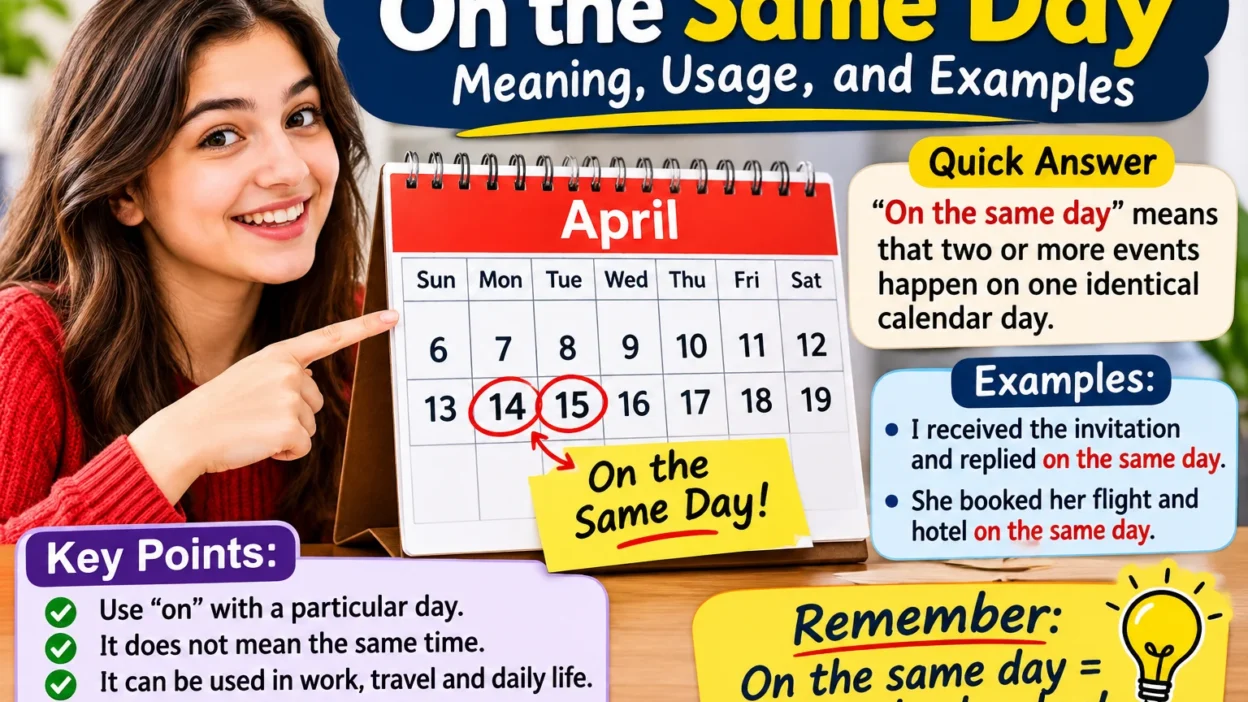
The phrase “on the same day” means that something happens on the exact day when another event takes place or when a particular date is mentioned. It emphasizes that two or more actions, events, or situations occur on one identical calendar day, even if they happen at different times. For example, “I received the invitation and replied on the same day” means both actions happened on that particular day.
English learners often encounter this expression in everyday conversations, emails, stories, business communication, and written instructions. Understanding how to use it correctly can help you explain schedules, describe events, and talk about things that happen without waiting until another day. Although it looks simple, it is useful to understand its grammar, sentence structure, and difference from similar expressions such as “the same day” and “in the same day.”
Quick Answer
“On the same day” means on one identical calendar day as another event or a previously mentioned date. It is used to show that two things happen on that particular day. For example: “She submitted her application and received a confirmation on the same day.”
Why Do People Confuse It?
People sometimes confuse “on the same day” with expressions such as “the same day,” “in the same day,” and “within the same day.”
These phrases are related, but they do not always communicate the same meaning.
The main reason for confusion is that English uses different prepositions to describe time.
- On the same day: Refers to a particular calendar day.
- The same day: Often works as a shorter expression with a similar meaning.
- In the same day: Can emphasize that multiple things happen during one day.
- Within the same day: Means something happens before that day ends.
Understanding these differences makes your English more natural and accurate.
First Word: On
“On” is a preposition commonly used with specific days and dates.
We use “on” when talking about a particular day of the week, a calendar date, or a special day.
Examples:
- I have a meeting on Monday.
- Her birthday is on June 15.
- We met on the first day of school.
- The package arrived on the same day.
In the expression “on the same day,” the word “on” connects an event to a particular calendar day.
Second Word: The Same Day
“The same day” refers to the identical day that has already been mentioned or understood from the context.
The word “same” shows that two things share one particular date.
Examples:
- We started the project on the same day.
- They arrived the same day.
- I called him on the same day.
The expression can appear with or without “on,” depending on sentence structure.
For example:
- I received the email on the same day.
- I received the email the same day.
Both sentences are correct and communicate that the email arrived that day.
On the Same Day vs Similar Expressions: Comparison Table
| Expression | Meaning | Example |
|---|---|---|
| On the same day | On an identical calendar day | We met on the same day. |
| The same day | That identical day | She called me the same day. |
| In the same day | During one particular day | I completed three tasks in the same day. |
| Within the same day | Before the day ends | You will receive a response within the same day. |
| On that day | On a previously identified day | We traveled on that day. |
When to Use On the Same Day
Use “on the same day” when you want to connect two events that happen on one identical calendar date.
1. When Two Events Happen on One Date
Use this expression to explain that two separate events occur on the same calendar day.
Example: I graduated and started my new job on the same day.
2. When Describing Deliveries
It is useful when discussing deliveries, orders, and customer services.
Example: The company received the order and shipped it on the same day.
3. When Talking About Meetings
You can use it to explain that two meetings or appointments take place on one date.
Example: We attended two important meetings on the same day.
4. When Describing Personal Experiences
Use it when sharing experiences or telling stories.
Example: I met my best friend and found my first job on the same day.
5. When Discussing Deadlines
It can also describe tasks completed on a particular date.
Example: Both reports were submitted on the same day.
15 Examples of On the Same Day in Sentences
Here are 15 practical examples to help you understand how to use this phrase naturally.
- I received your message and replied on the same day.
- They got married and moved into their new house on the same day.
- The company announced the results on the same day.
- She booked her flight and hotel on the same day.
- We finished the project on the same day.
- He visited the doctor and collected his medicine on the same day.
- The two students joined our class on the same day.
- I placed an order and received a confirmation on the same day.
- The school organized two different events on the same day.
- My brother arrived in London on the same day I arrived in Paris.
- She passed her driving test and celebrated with her family on the same day.
- The documents were signed and delivered on the same day.
- We received the invitation and confirmed our attendance on the same day.
- The shop opened and welcomed its first customers on the same day.
- He completed his training and received his certificate on the same day.
These examples show how the expression works in personal conversations, education, business, travel, and everyday situations.
Common Mistakes to Avoid
Although “on the same day” is easy to understand, English learners sometimes make mistakes when using it.
Mistake 1: Using the Wrong Preposition
Incorrect: I met her at the same day.
Correct: I met her on the same day.
Use “on” when referring to a particular day.
Mistake 2: Confusing It With Within the Same Day
Incorrect understanding: “On the same day” always means within 24 hours.
Correct understanding: It refers to the same calendar date, not necessarily a full 24-hour period.
For example, an event at 11 p.m. and another at 1 a.m. the following day do not happen on the same calendar day.
Mistake 3: Adding Unnecessary Words
Incorrect: I received it on the same identical day.
Correct: I received it on the same day.
The word “same” already communicates the idea of identical timing.
Mistake 4: Confusing Same Day With Every Day
“Same day” refers to one particular shared date, while “every day” means each day.
- We met on the same day.
- I exercise every day.
These expressions have different meanings.
Memory Trick: How to Remember On the Same Day
Remember this simple rule:
ON = A Particular Calendar Day
When you talk about something happening on a specific day, use “on.”
Examples:
- On Monday
- On my birthday
- On the first day
- On the same day
Think of “on” as connecting an event to a date on the calendar. This makes it easier to remember the correct expression.
American vs British English
The phrase “on the same day” is standard in both American English and British English.
There is no significant difference in its spelling, meaning, or basic grammatical usage.
| American English | British English |
|---|---|
| On the same day | On the same day |
| We received it on the same day. | We received it on the same day. |
| The order arrived on the same day. | The order arrived on the same day. |
Both varieties also commonly use the shorter expression “the same day.”
For example:
- American English: I called her the same day.
- British English: I called her the same day.
Both are natural and correct.
Similar Words and Expressions
Several English expressions have meanings related to “on the same day.” Learning them will help you choose the right phrase in different situations.
1. The Same Day
Refers to the identical calendar day.
Example: We received the results the same day.
2. On That Day
Refers to a particular day already mentioned.
Example: I was traveling on that day.
3. Simultaneously
Means that two or more things happen at exactly the same time.
Example: Both students answered simultaneously.
4. At the Same Time
Means that two or more events happen at an identical moment or during an overlapping period.
Example: The two meetings started at the same time.
5. Within 24 Hours
Means during a period of 24 hours.
Example: You will receive an email within 24 hours.
6. That Very Day
Emphasizes that something happened on that exact day, often sooner than expected.
Example: She received the job offer that very day.
Final Verdict
“On the same day” is a correct and commonly used English expression that means something happens on the identical calendar day as another event or a previously mentioned date.
Use it when describing appointments, meetings, deliveries, personal experiences, deadlines, or other events that share one calendar date.
Remember that “on the same day” does not necessarily mean two things happen at the same time. They can happen hours apart and still occur on the same calendar day.
Frequently Asked Questions (FAQs)
1. What does on the same day mean?
“On the same day” means that two or more events happen on one identical calendar date. For example, “I submitted my application and received a reply on the same day.”
2. Is on the same day grammatically correct?
Yes. “On the same day” is grammatically correct and commonly used in spoken and written English. The preposition “on” is appropriate because the expression refers to a particular calendar day.
3. Is it correct to say the same day or on the same day?
Both expressions are correct. “On the same day” uses the preposition “on,” while “the same day” can function as a shorter time expression. For example, “I called her the same day” and “I called her on the same day” are both correct.
4. What is the difference between on the same day and at the same time?
“On the same day” means events happen on one identical calendar date, even if they occur hours apart. “At the same time” means events happen at the same moment or during an overlapping period.
5. Can I use on the same day at the beginning of a sentence?
Yes. You can begin a sentence with “On the same day” to emphasize when an event happened.
Example: “On the same day, the school announced the examination results.”
6. What is another way to say on the same day?
Depending on the context, you can use “the same day,” “that very day,” or “on that day.” However, these alternatives may have slightly different meanings and should be selected carefully.
7. Does on the same day mean within 24 hours?
No. It normally refers to one calendar date rather than a rolling 24-hour period. For example, 10 p.m. on Monday and 2 a.m. on Tuesday are within four hours of each other, but they are not on the same calendar day.
Remember This
- On the same day means on one identical calendar date.
- Use “on” with particular days and dates.
- Two events can happen hours apart and still be on the same day.
- “The same day” is also a correct alternative in many sentences.
- “At the same time” means something different because it focuses on the moment rather than the date.
Conclusion
“On the same day” is a useful English expression for describing two or more events that happen on one identical calendar date. It is commonly used in everyday conversations, business communication, education, travel, and storytelling. Understanding its meaning and correct preposition will help you communicate clearly and avoid common grammar mistakes.
The easiest way to remember this expression is to connect “on” with a particular calendar date. if you are discussing appointments, deliveries, meetings, or personal experiences, you can confidently use “on the same day” whenever events happen on one shared date.

Charles Kyle is a passionate writer and dream researcher at SleepCout, dedicated to exploring coded dreams, lucid dreaming, dream symbolism, and sleep science. He creates engaging, well-researched content that helps readers understand their dreams and discover the fascinating connection between technology, imagination, and the sleeping mind.