English learners often find “conform with” and “conform to” confusing because both expressions are grammatically correct and describe following or agreeing with something. However, they are not always interchangeable. The preposition you choose depends on the relationship between the subject and the thing being followed or agreed with.
The good news is that the difference is easy to understand once you know how each expression works. “Conform to” is generally used when someone follows rules, standards, expectations, laws, or requirements. “Conform with” is commonly used when something agrees with, matches, or is consistent with another thing, such as a policy, specification, or established standard. In this guide, you will learn their meanings, grammatical differences, practical examples, and common mistakes so you can use both expressions confidently.
Quick Answer
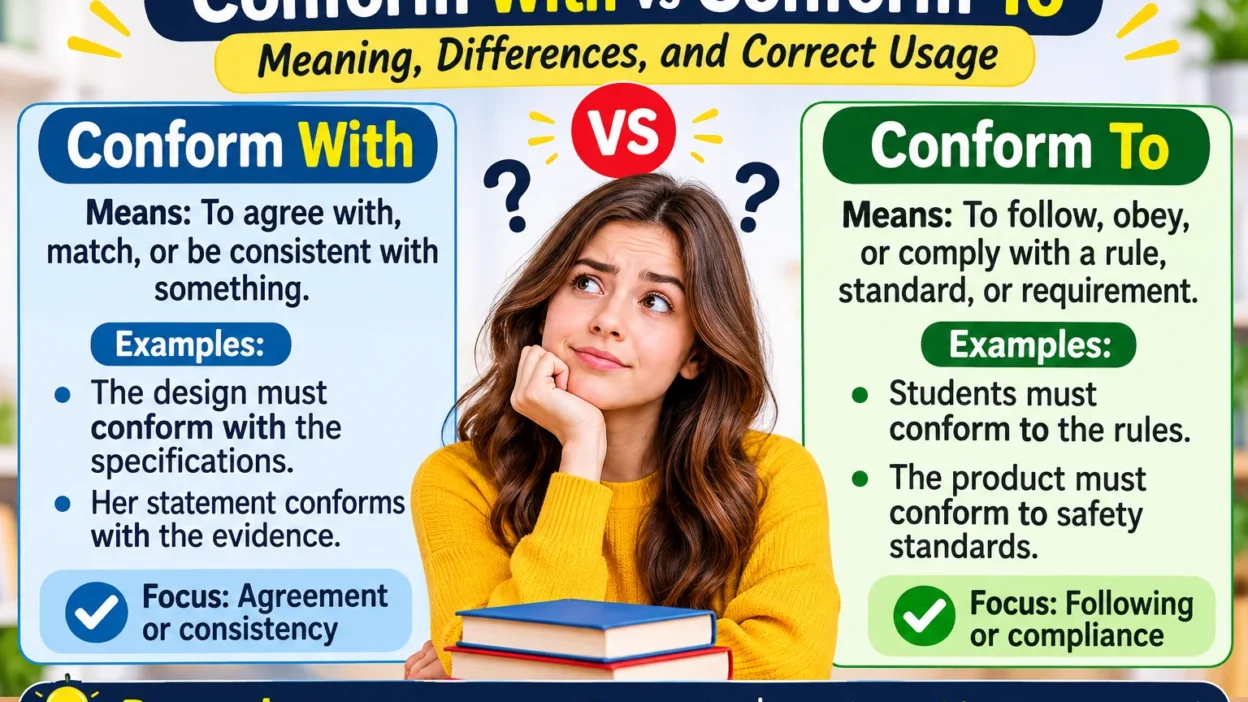
Conform to means to follow or obey a rule, standard, expectation, or requirement. Conform with means to agree with, match, or be consistent with something. For example, “Students must conform to school rules” and “The design must conform with the specifications.”
Why People Confuse Conform With vs Conform To
People confuse these expressions because both use the verb conform, which means to follow, agree with, or act according to something.
They also appear in similar contexts, particularly when discussing rules, standards, policies, and requirements.
However, their typical grammatical relationships are slightly different:
- Conform to: Emphasizes following or complying with something.
- Conform with: Emphasizes agreement, consistency, or compatibility with something.
Remember that usage can overlap, especially in formal and technical English. The context helps determine which preposition sounds most natural.
First Word: Conform With
Meaning of Conform With
Conform with means to be consistent with, agree with, or match something.
It is often used when describing if a document, design, product, decision, or action meets certain specifications or agrees with an established requirement.
The expression is particularly common in formal, professional, and technical writing.
Examples of Conform With
- The building design must conform with local specifications.
- Your report should conform with the company’s guidelines.
- The product does not conform with the required specifications.
- His explanation conforms with the available evidence.
- The new policy must conform with existing regulations.
In these examples, conform with describes agreement or consistency between two things.
Second Word: Conform To
Meaning of Conform To
Conform to means to follow, obey, or behave according to a particular rule, standard, expectation, or requirement.
It is commonly used when talking about people, organizations, products, systems, and processes that must meet established expectations.
This is generally the more common choice when emphasizing compliance or following rules.
Examples of Conform To
- Students must conform to school rules.
- All employees are expected to conform to company policies.
- The building must conform to safety standards.
- She refused to conform to social expectations.
- Every product must conform to industry regulations.
In these sentences, conform to emphasizes following an established rule, standard, or expectation.
Conform With vs Conform To: Comparison Table
| Feature | Conform With | Conform To |
|---|---|---|
| Basic meaning | Agree with or match | Follow or comply with |
| Main emphasis | Consistency | Compliance |
| Common use | Specifications and evidence | Rules and expectations |
| Tone | Formal | Formal and general |
| Example | Conform with the evidence | Conform to the rules |
| Grammatical role | Verb + preposition | Verb + preposition |
Important: These are general usage tendencies, not absolute grammatical rules. Both expressions can sometimes be used with standards, specifications, and regulations.
When to Use Each
Knowing the context makes choosing the correct preposition much easier.
When to Use Conform With
Use conform with when you want to emphasize that something agrees with or matches another thing.
Common contexts include:
- Evidence: His statement conforms with the available evidence.
- Specifications: The machine conforms with the technical specifications.
- Guidelines: The document conforms with the recommended guidelines.
- Policies: The proposal conforms with the existing policy.
- Requirements: The design conforms with the stated requirements.
When to Use Conform To
Use conform to when you want to emphasize following or complying with an established standard or expectation.
Common contexts include:
- Rules: Everyone must conform to the rules.
- Laws: Businesses must conform to applicable laws.
- Standards: The product conforms to international standards.
- Expectations: He does not want to conform to society’s expectations.
- Traditions: Some people prefer to conform to traditional customs.
10+ Examples of Conform With vs Conform To
Here are practical examples to help you understand the difference.
Examples Using Conform With
- The report conforms with the company’s official guidelines.
- Her statement conforms with the facts presented in court.
- The design must conform with the technical specifications.
- This decision does not conform with our original agreement.
- The results conform with the research findings.
- The document conforms with the required format.
Examples Using Conform To
- Every student must conform to the classroom rules.
- Employees are required to conform to workplace policies.
- The company must conform to environmental regulations.
- She does not want to conform to society’s expectations.
- All equipment must conform to safety standards.
- The organization expects its members to conform to its code of conduct.
Examples in Everyday Conversations
- You don’t have to conform to everyone else’s opinions.
- Our plans should conform with the agreed schedule.
- Children are often encouraged to conform to social expectations.
- The final design should conform with the client’s instructions.
Common Mistakes
Even advanced English learners sometimes misuse these expressions. Here are some mistakes to avoid.
Mistake 1: Thinking Both Expressions Always Mean Exactly the Same Thing
Although they overlap, their usual emphasis is different.
- Less precise: The employee conforms with the rules.
- More natural: The employee conforms to the rules.
Mistake 2: Using the Wrong Preposition
Remember the common patterns:
- Incorrect: Students must conform with the school rules.
- Better: Students must conform to the school rules.
Mistake 3: Forgetting That Conform Is a Verb
Conform is a verb, so it can change according to the subject and tense.
- Present: She conforms to the rules.
- Past: She conformed to the rules.
- Present continuous: They are conforming to the standards.
Mistake 4: Confusing Conform With Confirm
These words have different meanings.
- Conform: To follow a rule or match a standard.
- Confirm: To establish that something is true or correct.
Example: Please confirm that the product conforms to safety standards.
Mistake 5: Using Conform Without Understanding the Context
Choose the preposition according to the relationship you want to describe.
- Agreement or consistency: conform with.
- Following or compliance: conform to.
Memory Trick: How to Remember the Difference
Use this simple trick:
- TO = Toward a rule: Think of moving toward or following a particular standard.
- WITH = In agreement with: Think of two things matching or agreeing with each other.
For example:
- Conform to the rules.
- Conform with the evidence.
This simple association can help you remember which expression to use when writing or speaking English.
American vs British English
Both conform with and conform to are accepted in American and British English.
There is no major spelling difference between the two expressions.
However, conform to is widely used in both varieties, particularly when discussing compliance with rules, laws, regulations, and standards.
Conform with is also used in both varieties, especially in formal writing when discussing consistency with specifications, policies, evidence, and requirements.
Examples:
- American English: The product must conform to federal standards.
- British English: The product must conform to British standards.
- Both varieties: The report should conform with the agreed specifications.
The main difference is the context, not the country.
Similar Words
Understanding related words can help you expand your vocabulary and use conform with and conform to more accurately.
| Word or Phrase | Meaning | Example |
|---|---|---|
| Comply with | Follow a rule or requirement | Comply with the law. |
| Adhere to | Follow a rule or principle | Adhere to the policy. |
| Abide by | Accept and follow a rule | Abide by the rules. |
| Conform to | Follow a standard | Conform to expectations. |
| Agree with | Have the same opinion or be consistent | Agree with the evidence. |
| Match | Be the same or correspond | Match the specifications. |
| Comply with | Act according to a requirement | Comply with regulations. |
| Be consistent with | Not contradict something | Be consistent with the facts. |
These expressions are related, but they are not always interchangeable. For example, agree with often refers to opinions, while comply with specifically emphasizes following requirements.
Final Verdict: Conform With or Conform To?
Both expressions are grammatically correct, but they are generally used in slightly different contexts.
Choose conform to when you mean following or obeying rules, laws, standards, expectations, or requirements.
Choose conform with when you mean agreeing with, matching, or being consistent with something.
For most situations involving rules and compliance, conform to is the natural choice. When discussing consistency with evidence, specifications, or an established arrangement, conform with can be appropriate.
Frequently Asked Questions (FAQs)
1. Is it conform with or conform to?
Both are correct. Conform to generally means to follow or obey something, while conform with usually means to agree with or be consistent with something.
2. What does conform to mean?
Conform to means to follow, obey, or act according to a particular rule, standard, expectation, or requirement.
Example: All employees must conform to company policies.
3. What does conform with mean?
Conform with means to agree with, match, or be consistent with something.
Example: The report conforms with the available evidence.
4. Can conform with and conform to be used interchangeably?
Sometimes, yes. Both expressions can describe agreement with standards or requirements. However, conform to usually emphasizes compliance, while conform with often emphasizes consistency.
5. Which is more common: conform with or conform to?
Conform to is generally more common, particularly in contexts involving rules, regulations, laws, and expectations.
6. Is conform to formal English?
Yes. Conform to is a standard expression used in formal, academic, legal, professional, and everyday English.
7. What is another word for conform to?
Common alternatives include comply with, adhere to, abide by, and follow. The best alternative depends on the sentence and context.
Remember This
- Conform to = Follow, obey, or comply with something.
- Conform with = Agree with, match, or be consistent with something.
- Both expressions are grammatically correct.
- Conform to is generally more common when discussing rules and standards.
- Always consider the context before choosing a preposition.
Conclusion
Understanding the difference between conform with and conform to can make your English writing clearer and more natural. Although both expressions are correct, they usually communicate slightly different relationships. Use conform to when talking about following rules, standards, laws, or expectations. Use conform with when describing agreement or consistency with something.
The easiest way to remember the difference is to associate to with following a standard and with with agreement or consistency. With regular practice and the examples in this guide, you can use both expressions confidently in everyday conversations, academic writing, and professional communication.

Alice Allison is the Administrator at SleepCout, ensuring smooth operations while supporting a platform dedicated to coded dreams, dream interpretation, and insightful content that inspires curiosity, creativity, and imagination.