Have you ever wondered if to write fiancé or fiancée when talking about someone who is engaged to be married? Although these two words look almost identical and have the same pronunciation, they have different meanings based on gender. Choosing the correct spelling can make your writing clearer and more accurate.
The difference between fiancé and fiancée is simple: fiancé refers to a man who is engaged to be married, while fiancée refers to a woman who is engaged to be married. words come from French and are commonly used in English to describe someone who has accepted a marriage proposal but has not yet married. In this guide, you will learn their meanings, spelling differences, pronunciation, and practical examples so you can use each word confidently.
Quick Answer: Fiancé vs Fiancée
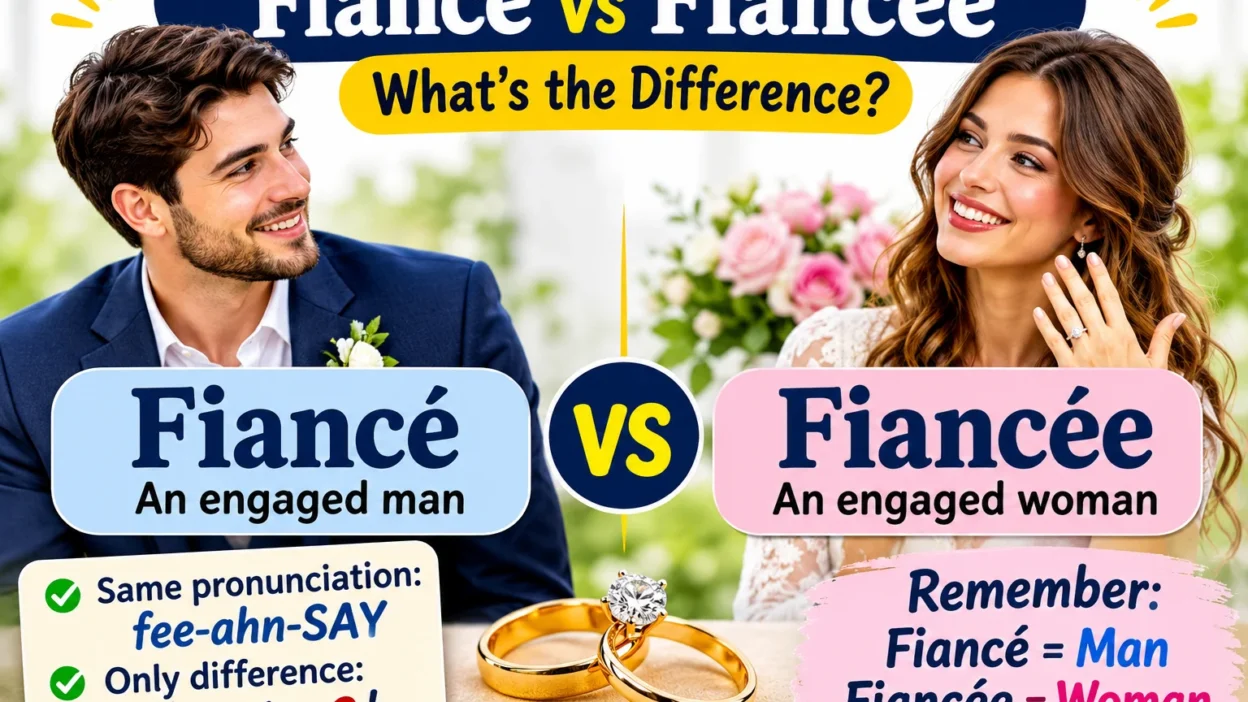
Fiancé refers to a man who is engaged to be married. Fiancée refers to a woman who is engaged to be married. The only spelling difference is the extra final e in fiancée. such as people words are pronounced the same way: fee-ahn-SAY.
Why Do People Confuse Fiancé and Fiancée?
People often confuse these words because they:
- Have almost identical spellings.
- Share the same pronunciation in English.
- Have the same basic meaning of an engaged person.
- Come from the same French word.
- Differ only in the final letter e.
The main thing to remember is that the extra e in fiancée indicates the feminine form.
For example:
- My fiancé is planning our wedding. (A man)
- My fiancée is planning our wedding. (A woman)
such as people sentences are correct, but the spelling depends on the person’s gender.
1. Fiancé: Meaning, Definition, and Examples
Fiancé (pronounced fee-ahn-SAY) is a noun that refers to a man who is engaged to be married.
It describes a man who has agreed to marry someone but has not yet become a husband.
Definition: A man who is formally engaged to marry another person.
Examples:
- My fiancé proposed to me last December.
- Her fiancé bought her a beautiful engagement ring.
- I am introducing my fiancé to my family tonight.
- Sarah’s fiancé is planning a surprise wedding celebration.
- My fiancé and I are choosing our wedding venue.
- Her fiancé works as a software engineer.
- I cannot wait to marry my fiancé next year.
Example in context:
“Emma’s fiancé surprised her with a romantic dinner to celebrate their engagement.”
In this sentence, fiancé refers to the man Emma plans to marry.
2. Fiancée: Meaning, Definition, and Examples
Fiancée (pronounced fee-ahn-SAY) is a noun that refers to a woman who is engaged to be married.
It describes a woman who has accepted a marriage proposal but has not yet become a wife.
Definition: A woman who is formally engaged to marry another person.
Examples:
- My fiancée is excited about our upcoming wedding.
- His fiancée loves flowers and romantic dinners.
- I introduced my fiancée to my parents yesterday.
- John’s fiancée is a talented artist.
- My fiancée and I are planning our honeymoon.
- He bought a beautiful necklace for his fiancée.
- Her fiancée will arrive at the wedding venue tomorrow.
Example in context:
“James introduced his fiancée to his colleagues during the office celebration.”
In this sentence, fiancée refers to the woman James plans to marry.
Fiancé vs Fiancée: Comparison Table
Here is a simple comparison to help you understand the difference.
| Feature | Fiancé | Fiancée |
|---|---|---|
| Meaning | Engaged man | Engaged woman |
| Gender | Masculine | Feminine |
| Origin | French | French |
| Pronunciation | Fee-ahn-SAY | Fee-ahn-SAY |
| Part of speech | Noun | Noun |
| Spelling | One final e | Two final e’s |
| Example | Her fiancé is kind. | His fiancée is kind. |
Important: such as people words have the same pronunciation in English. The difference is in their written forms and meanings.
When to Use Fiancé vs Fiancée
Choosing between these words depends on the person you are describing.
Use Fiancé When Referring to a Man
Use fiancé when the person who is engaged to be married is a man.
Examples:
- My fiancé is coming to visit tomorrow.
- Her fiancé works in London.
- I met my sister’s fiancé last weekend.
Use Fiancée When Referring to a Woman
Use fiancée when the person who is engaged to be married is a woman.
Examples:
- My fiancée is choosing her wedding dress.
- His fiancée is very friendly.
- I am taking my fiancée to dinner.
What If You Do Not Know the Person’s Gender?
If you want to use a gender-neutral expression, you can simply say:
- My partner is getting married soon.
- My future spouse is a wonderful person.
- My betrothed is arriving shortly.
The word partner is especially useful in everyday English.
14 Examples of Fiancé and Fiancée in Sentences
These examples show how to use such as people words naturally in everyday conversations.
| No. | Sentence | Correct Word |
|---|---|---|
| 1 | My fiancé is very supportive. | Fiancé |
| 2 | Her fiancée is a doctor. | Fiancée |
| 3 | I met your fiancé yesterday. | Fiancé |
| 4 | His fiancée loves traveling. | Fiancée |
| 5 | My fiancé gave me an engagement ring. | Fiancé |
| 6 | Her fiancée is planning the wedding. | Fiancée |
| 7 | Emma’s fiancé is from Canada. | Fiancé |
| 8 | John’s fiancée is a teacher. | Fiancée |
| 9 | I invited my fiancé to the party. | Fiancé |
| 10 | He introduced his fiancée to his friends. | Fiancée |
| 11 | My fiancé and I enjoy cooking together. | Fiancé |
| 12 | My fiancée wants a small wedding. | Fiancée |
| 13 | Her fiancé surprised her with flowers. | Fiancé |
| 14 | His fiancée is moving to another city. | Fiancée |
Common Mistakes When Using Fiancé and Fiancée
Even experienced English speakers sometimes mix up these spellings. Here are some common mistakes to avoid.
1. Using Fiancé for a Woman
Incorrect: My fiancé is choosing her wedding dress.
Correct: My fiancée is choosing her wedding dress.
The feminine spelling is fiancée.
2. Using Fiancée for a Man
Incorrect: My fiancée proposed to me last month. (When referring to a man.)
Correct: My fiancé proposed to me last month.
Use fiancé for a man.
3. Thinking They Have Different Pronunciations
such as people words are pronounced exactly the same way in standard English.
The extra e in fiancée changes the spelling, not the pronunciation.
4. Adding Unnecessary Letters
Incorrect: Fiancè or fiancéé.
Correct: Fiancé or fiancée.
Pay attention to the accent marks and final letters.
5. Confusing Engagement With Marriage
A fiancé or fiancée is someone who is engaged but not yet married.
After the wedding, the person becomes a husband, wife, or spouse.
Memory Trick: How to Remember Fiancé vs Fiancée
Here is an easy trick to remember the difference:
- Fiancé = Man: One final e.
- Fiancée = Woman: Two final e’s.
Think of the extra e in fiancée as representing the feminine form.
Another simple way to remember it is:
Fiancée has an extra E for the feminine ending.
Once you remember this spelling pattern, you will find it much easier to choose the correct word.
Fiancé vs Fiancée in American and British English
There is no difference in the basic meaning or spelling of fiancé and fiancée between American and British English.
such as people varieties use:
- Fiancé for an engaged man.
- Fiancée for an engaged woman.
such as people words are pronounced similarly in American and British English, although individual accents may affect the exact sound.
The distinction is based on the traditional French masculine and feminine forms, not on regional English spelling rules.
Similar Words Related to Fiancé and Fiancée
Understanding related vocabulary can help you discuss relationships and marriage more naturally.
| Word | Meaning |
|---|---|
| Fiancé | A man who is engaged to be married |
| Fiancée | A woman who is engaged to be married |
| Betrothed | A person who is engaged to be married |
| Engaged | Having formally agreed to marry |
| Spouse | A married husband or wife |
| Partner | A person in a romantic relationship |
| Bride-to-be | A woman who is going to get married |
| Groom-to-be | A man who is going to get married |
| Husband | A married man |
| Wife | A married woman |
Note: Betrothed is a useful gender-neutral alternative when you do not want to specify if the engaged person is a man or a woman.
Final Verdict: Fiancé or Fiancée?
The difference between fiancé and fiancée is their gender-specific meaning.
- Fiancé: Use this word for a man who is engaged to be married.
- Fiancée: Use this word for a woman who is engaged to be married.
such as people words have the same pronunciation and refer to someone who is engaged but not yet married.
If you remember that fiancée has an extra e for the feminine form, you can easily avoid this common spelling mistake.
Frequently Asked Questions (FAQs)
1. What is the difference between fiancé and fiancée?
Fiancé refers to a man who is engaged to be married, while fiancée refers to a woman who is engaged to be married. The feminine form has an additional final e.
2. Is fiancé male or female?
Fiancé is the masculine form. It describes a man who is engaged to be married.
3. Is fiancée male or female?
Fiancée is the feminine form. It describes a woman who is engaged to be married.
4. Are fiancé and fiancée pronounced the same?
Yes. such as people words are pronounced fee-ahn-SAY in English. Their difference is in spelling and meaning, not pronunciation.
5. Can I use fiancé for such as people genders?
Traditionally, fiancé refers to a man and fiancée refers to a woman. If you want a gender-neutral alternative, use words such as partner, spouse-to-be, or betrothed.
6. What is the plural of fiancé and fiancée?
The plural of fiancé is fiancés, while the plural of fiancée is fiancées.
Examples:
- The two fiancés attended the ceremony.
- The two fiancées are planning their weddings.
7. Are fiancé and fiancée French words?
Yes. such as people words come from French. They are derived from the French verb fiancer, meaning to promise or engage someone in marriage.
8. Is a fiancé or fiancée already a husband or wife?
No. A fiancé or fiancée is someone who is engaged to be married. The person becomes a husband or wife after getting married.
Remember This
- Fiancé = An engaged man.
- Fiancée = An engaged woman.
- such as people words are pronounced the same way.
- Fiancée has one extra final e.
- such as people words describe people who are engaged but not yet married.
Conclusion
Understanding the difference between fiancé and fiancée is easy once you remember their gender-specific meanings. Fiancé refers to an engaged man, whereas fiancée refers to an engaged woman. Although their pronunciation is identical, their spellings are different.
The next time you write about an engagement, remember the extra e in fiancée. This simple spelling rule will help you use such as people words correctly in conversations, messages, emails, and everyday writing.

Alice Allison is the Administrator at SleepCout, ensuring smooth operations while supporting a platform dedicated to coded dreams, dream interpretation, and insightful content that inspires curiosity, creativity, and imagination.