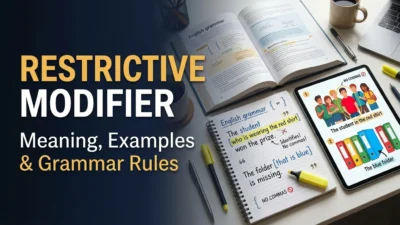
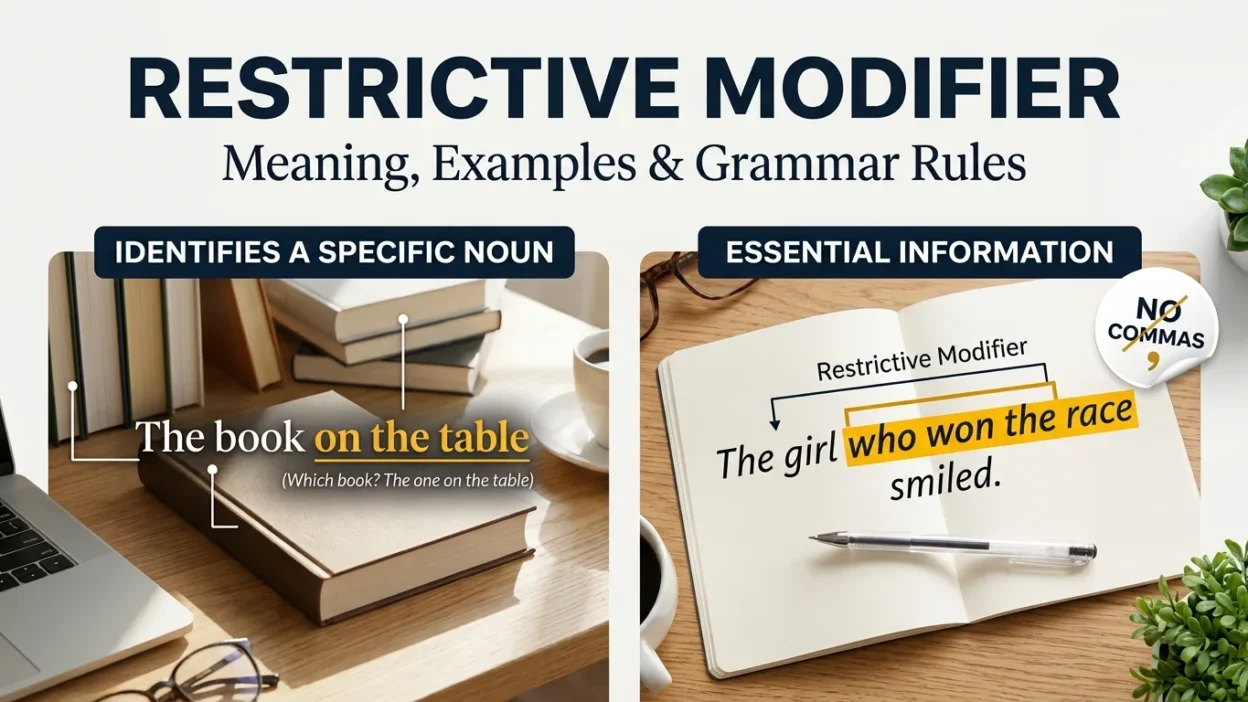
A restrictive modifier is a word, phrase, or clause that provides essential information about a noun or pronoun. It helps identify exactly which person, place, thing, or idea the sentence refers to. Without a restrictive modifier, the meaning of the sentence may become unclear or change significantly. For example, in “The students who studied passed the exam,” the phrase “who studied” identifies which students passed.
Restrictive modifiers are important in English grammar because they help writers communicate precise meanings. They appear in everyday conversations, academic writing, professional documents, and formal essays. Understanding them also makes it easier to use commas correctly and distinguish restrictive modifiers from nonrestrictive modifiers. Although the term may sound complicated, the concept is simple once you understand how essential information works in a sentence. In this guide, you will learn the definition of a restrictive modifier, explore common types, compare restrictive and nonrestrictive modifiers, and practice using them through clear examples.
Quick Answer: What Is a Restrictive Modifier?
A restrictive modifier is a word, phrase, or clause that provides essential information needed to identify or limit the meaning of a noun or pronoun. It is generally not separated from the rest of the sentence by commas. For example, “The book on the table is mine” uses “on the table” to identify which book is meant.
Why Do People Confuse Restrictive Modifiers?
People often confuse restrictive modifiers with nonrestrictive modifiers because both add information to a sentence. The main difference is whether the information is essential to the intended meaning.
A restrictive modifier narrows the meaning of a noun. A nonrestrictive modifier adds extra information that can usually be removed without changing the noun’s identity.
Consider these examples:
- Restrictive: The employees who arrived early received breakfast.
- Nonrestrictive: The employees, who arrived early, received breakfast.
In the first sentence, “who arrived early” identifies a particular group of employees. In the second, the phrase presents the employees as an already identified group and adds that they arrived early.
The punctuation helps readers understand the intended meaning.
What Is a Restrictive Modifier?
A restrictive modifier limits or identifies the noun or pronoun it modifies. The information it provides is essential to the intended reference.
1. Restrictive Adjectives
An adjective can restrict the meaning of a noun by specifying which one or what kind.
Examples:
- The red car belongs to my sister.
- I prefer fresh vegetables.
- She chose the larger room.
In these examples, the adjectives help narrow the meaning of the nouns.
2. Restrictive Phrases
A phrase can identify a particular person or thing by adding necessary details.
Examples:
- The girl in the blue dress is my cousin.
- The keys under the sofa are mine.
- Students from our school joined the competition.
The bold phrases help specify which girl, keys, and students the speaker means.
3. Restrictive Clauses
A restrictive clause is a dependent clause that identifies or limits a noun. It is often called a restrictive relative clause or defining relative clause.
Examples:
- The man who called you is waiting outside.
- The cake that she baked tastes delicious.
- People who exercise regularly may improve their fitness.
The clauses identify particular people or things rather than simply adding optional details.
What Is a Nonrestrictive Modifier?
A nonrestrictive modifier adds extra information about a noun that is already identifiable in context. Removing the modifier usually leaves the basic reference intact.
Examples:
- My brother, who lives in London, is visiting us.
- The Eiffel Tower, which is in Paris, attracts many visitors.
- Our teacher, a talented musician, plays the piano beautifully.
The modifiers provide additional information rather than distinguishing one brother, tower, or teacher from others.
Nonrestrictive modifiers are generally set off by commas in writing.
Restrictive Modifier vs. Nonrestrictive Modifier: Comparison Table
| Feature | Restrictive modifier | Nonrestrictive modifier |
|---|---|---|
| Purpose | Identifies or limits a noun | Adds extra information |
| Importance | Essential to the intended reference | Supplementary |
| Commas | Usually no commas | Usually separated by commas |
| Removal | May change or obscure the intended meaning | Usually preserves the basic reference |
| Example | The dog that barked woke me. | My dog, which is old, sleeps all day. |
| Common clause name | Defining relative clause | Non-defining relative clause |
Important: The distinction depends on meaning and context, not simply on the presence of a particular word. A modifier that is restrictive in one sentence may be nonrestrictive in another.
When Should You Use a Restrictive Modifier?
Use a restrictive modifier when your reader needs the information to identify the specific noun or pronoun you mean.
Use it to identify a particular person
- The student who won the competition received a medal.
- The woman wearing glasses is our new manager.
These modifiers distinguish particular people from others.
Use it to identify a particular object
- The phone on my desk is broken.
- The documents that you requested are ready.
The modifiers tell the reader which phone and documents are being discussed.
Use it to specify a group
- Children who read regularly often develop stronger vocabulary.
- Cars with electric engines produce no tailpipe emissions.
The modifiers narrow the meaning to particular groups of children and cars.
Use it to make instructions precise
- Submit the forms that require a signature.
- Contact employees working on the evening shift.
The modifiers help prevent confusion about which forms or employees are intended.
12 Restrictive Modifier Examples in Sentences
Here are practical examples showing how restrictive modifiers work in everyday English.
1. The boy who broke the window apologized. “Who broke the window” identifies which boy apologized.
2. The shoes under the bed are dirty. “Under the bed” identifies which shoes are dirty.
3. Students who complete their assignments receive feedback. “Who complete their assignments” specifies the students being discussed.
4. The book that I borrowed is interesting. “That I borrowed” identifies the particular book.
5. People living near the airport hear frequent aircraft noise. “Living near the airport” identifies the people affected.
6. The house with the green door belongs to my uncle. “With the green door” identifies the house.
7. The woman who teaches mathematics is absent today. “Who teaches mathematics” identifies the woman.
8. The food stored in the refrigerator is still fresh. “Stored in the refrigerator” specifies which food is fresh.
9. The employees who work remotely joined the meeting online. “Who work remotely” identifies the employees who joined online.
10. The letter that arrived yesterday is from my friend. “That arrived yesterday” identifies the letter.
11. Anyone interested in joining should register today. “Interested in joining” limits the reference to interested people.
12. The road leading to the village is closed. “Leading to the village” identifies the road.
Common Mistakes With Restrictive Modifiers
Even experienced English learners sometimes make mistakes when using restrictive modifiers. These are the most common problems to avoid.
Mistake 1: Adding unnecessary commas
Incorrect for the intended restrictive meaning:
– The students, who passed the test received certificates.
Correct:
– The students who passed the test received certificates.
The restrictive clause should not be separated from the noun by commas. If the clause ends the sentence, no comma is needed before it.
Mistake 2: Confusing restrictive and nonrestrictive information
Compare:
- The cars that were damaged were repaired.
- The cars, which were damaged, were repaired.
The first sentence can indicate that only the damaged cars were repaired. The second presents the cars as an identified group and adds that they were damaged.
The second sentence may be appropriate when the context establishes that all the relevant cars were damaged.
Mistake 3: Assuming every clause beginning with “who” is restrictive
A clause beginning with “who” can be restrictive or nonrestrictive.
- The woman who called me is my aunt.
- My aunt, who called me yesterday, is visiting.
The intended meaning and punctuation determine the distinction.
Mistake 4: Removing information that identifies the noun
Consider:
“The student who sits near the window is absent.”
If you remove “who sits near the window,” the sentence becomes “The student is absent.” That may still be grammatical, but it may no longer identify the intended student clearly.
Mistake 5: Treating all modifiers as clauses
A restrictive modifier does not have to contain a subject and verb.
For example, “the house on the corner” contains the restrictive prepositional phrase “on the corner.” It is not a relative clause.
What Is an Easy Memory Trick for Restrictive Modifiers?
Remember this simple rule:
Restrictive = Required to identify.
Ask yourself three questions:
- Does this information tell me which person or thing is meant?
- Would removing it change or obscure the intended meaning?
- Is the modifier limiting the noun rather than merely adding a comment?
If the information is essential to the intended reference, the modifier is likely restrictive. In ordinary writing, do not put commas around it.
For nonrestrictive modifiers, remember the opposite: the noun is already identifiable, and the modifier adds extra information.
Restrictive Modifiers in American vs. British English
The basic grammatical distinction between restrictive and nonrestrictive modifiers is the same in American and British English. Both varieties use these modifiers to distinguish essential information from supplementary information.
There are a few differences in common usage and style.
American English
American English commonly uses that in restrictive relative clauses referring to things.
Examples:
- The book that I bought is excellent.
- The car that we rented was comfortable.
American English also uses which in restrictive clauses, although many American style guides prefer that for restrictive clauses and which for nonrestrictive clauses.
British English
British English also uses that in restrictive clauses and frequently uses which in restrictive clauses referring to things.
Examples:
- The book that I bought is excellent.
- The book which I bought is excellent.
Both are grammatical in British English when the clause is restrictive.
Is comma usage different?
The fundamental rule is the same in both varieties: restrictive modifiers generally do not take commas, while nonrestrictive modifiers generally do.
For clear writing, focus on whether the information is essential to the intended meaning rather than relying only on the choice between that and which.
Similar Words and Related Grammar Terms
Understanding these related terms can make restrictive modifiers easier to recognize.
1. Restrictive Clause
A restrictive clause is a clause that limits or identifies a noun.
Example: “The people who arrived late missed the introduction.”
The clause “who arrived late” identifies the people who missed the introduction.
2. Relative Clause
A relative clause modifies a noun or pronoun and often begins with who, whom, whose, which, or that.
Example: “The laptop that I purchased works well.”
Relative clauses can be restrictive or nonrestrictive.
3. Defining Relative Clause
A defining relative clause is another name for a restrictive relative clause, particularly in British English grammar terminology.
Example: “The person who called left a message.”
The clause defines which person is meant.
4. Nonrestrictive Modifier
A nonrestrictive modifier adds supplementary information about an identifiable noun.
Example: “Sara, who lives next door, is a doctor.”
The clause adds information about Sara rather than identifying which Sara is meant.
5. Appositive
An appositive is a noun or noun phrase placed next to another noun to identify or explain it.
Example: “My friend Daniel is a skilled photographer.”
Depending on the context, “Daniel” may identify which friend is meant. An appositive can be restrictive or nonrestrictive.
6. Adjective Phrase
An adjective phrase is a group of words that functions as an adjective.
Example: “The students eager to learn asked many questions.”
The phrase “eager to learn” describes the students and may restrict the reference depending on the context.
Final Verdict: What Does Restrictive Modifier Mean?
A restrictive modifier is a grammatical element that identifies or limits the meaning of a noun or pronoun. It can be a single word, a phrase, or a clause. Its purpose is to help readers understand exactly which person, object, place, or group a sentence refers to.
The most important distinction is between restrictive and nonrestrictive information. Restrictive modifiers generally appear without commas because they contribute to the intended reference. Nonrestrictive modifiers usually appear between commas because they add supplementary information about an already identifiable noun.
Learning this distinction will help you write clearer sentences, punctuate relative clauses correctly, and communicate your ideas more precisely.
Frequently Asked Questions
1. What is a restrictive modifier in simple words?
A restrictive modifier is a word, phrase, or clause that tells readers exactly which person or thing you mean. For example, in “The girl with the red bag is my sister,” the phrase “with the red bag” identifies the girl.
2. Does a restrictive modifier need commas?
A restrictive modifier generally does not need commas because its information is essential to the intended meaning. For example, “The books on the shelf belong to me” uses “on the shelf” to identify the books.
3. What is the difference between a restrictive and a nonrestrictive modifier?
A restrictive modifier identifies or limits a noun, while a nonrestrictive modifier adds extra information about an already identifiable noun. Restrictive modifiers generally do not use commas; nonrestrictive modifiers usually do.
4. Can a restrictive modifier be one word?
Yes. A restrictive modifier can be a single word, a phrase, or a clause. For example, in “The red car is mine,” the adjective “red” helps identify which car is meant.
5. What is an example of a restrictive relative clause?
“The student who won the prize thanked her teacher.” The clause “who won the prize” identifies which student thanked her teacher, so it is restrictive.
6. Are restrictive modifiers and defining clauses the same?
Not exactly. A defining clause is a type of restrictive modifier. More specifically, a defining relative clause identifies or limits the noun it modifies. Restrictive modifiers also include single words and phrases.
7. Can “which” introduce a restrictive modifier?
Yes. For example, “The jacket which I ordered has arrived” uses “which I ordered” restrictively because it identifies the jacket. American style guides often prefer that in restrictive clauses referring to things, while British English commonly uses both that and which.
Remember This
- A restrictive modifier identifies or limits a noun or pronoun.
- It can be a word, phrase, or clause.
- It provides information essential to the intended reference.
- Restrictive modifiers generally do not take commas.
- Nonrestrictive modifiers add supplementary information and usually require commas.
- Meaning and context determine whether a modifier is restrictive.
Conclusion
Restrictive modifiers are an important part of English grammar because they help readers identify exactly what a sentence means. By using descriptive words, phrases, and clauses, you can narrow the meaning of a noun and make your writing more precise. Examples such as “the student who won” and “the keys under the table” show how these modifiers work in everyday communication.
The easiest way to recognize a restrictive modifier is to ask whether the information helps identify the intended person or thing. If it does, the modifier is generally restrictive and should not be separated by commas. With regular practice, you can distinguish restrictive modifiers from nonrestrictive ones and use them confidently in conversations, essays, emails, and professional writing.

John Tyler is a dream researcher and content writer at SleepCout, sharing insightful articles about coded dreams, dream meanings, symbolism, sleep psychology, and practical guidance to help readers understand their dreams.