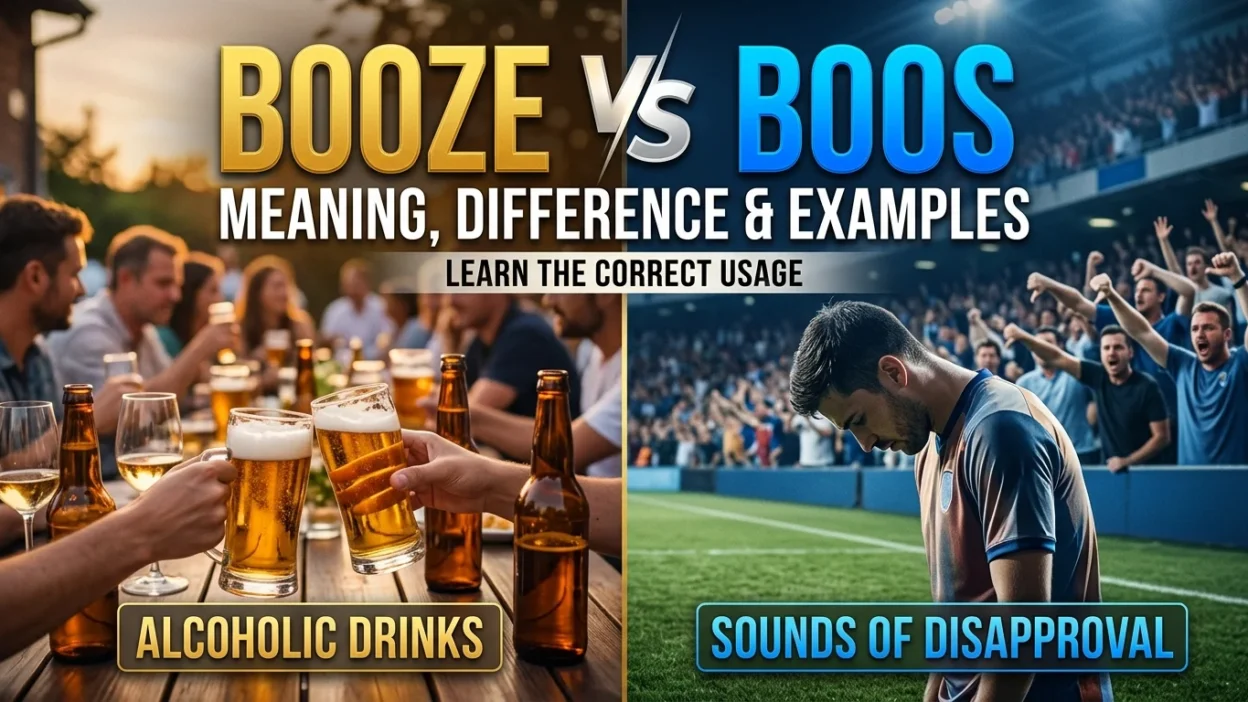
The words booze and boos sound similar, but they have completely different meanings. Booze refers to alcoholic drinks, while boos are sounds people make to show disapproval or dissatisfaction. Understanding the difference between these words can help you improve your vocabulary, spelling, and everyday English.
Although both words are pronounced similarly, their meanings depend on their spelling and context. You might see booze in a conversation about a party, a bar, or alcoholic beverages. In contrast, boos often appears in discussions about sports games, public performances, or audiences reacting negatively to someone. Both words are common in informal English, but they are used in very different situations.
In this guide, you will learn what booze and boos mean, how to use them correctly, and how to distinguish them through practical examples. Whether you are an English learner, a student, or someone who wants to avoid common spelling mistakes, this comparison will make the difference easy to remember.
Quick Answer: What Is the Difference Between Booze and Boos?
Booze is an informal word for alcoholic drinks, such as beer, wine, and spirits. Boos is the plural of boo, meaning sounds made to express disapproval. For example, “They bought booze for the party” refers to alcohol, while “The crowd gave the player boos” describes a negative audience reaction.
Why Do People Confuse Booze and Boos?
People often confuse booze and boos because the words look similar and have nearly identical pronunciations in many English accents.
However, the spelling provides a useful clue:
- Booze: Contains the letter z and refers to alcoholic drinks.
- Boos: Ends with s and refers to expressions of disapproval.
Both words can appear in casual conversations, entertainment, and social situations. Their meanings, however, are determined by the context in which they are used.
For example, a sentence about a party might use booze, while a sentence about a football match might use boos.
What Does Booze Mean?
Booze is an informal noun meaning alcoholic drinks. It can refer to beer, wine, whiskey, vodka, and other beverages containing alcohol.
The word is commonly used in casual conversations rather than formal writing. It can also be used as a verb meaning to drink alcohol, particularly when referring to drinking heavily.
Examples of Booze in Sentences
- We bought some booze for the celebration.
- The restaurant does not serve booze.
- He decided to stay away from booze for a month.
- They talked about the effects of booze on health.
- Some guests brought their own booze to the party.
Is Booze Formal or Informal?
Booze is generally informal. In professional, academic, or medical writing, words such as alcohol and alcoholic beverages are usually more appropriate.
For example:
- Informal: He stopped drinking booze.
- Formal: He stopped consuming alcohol.
Both sentences communicate a similar idea, but the second sounds more neutral and professional.
What Does Boos Mean?
Boos is the plural form of the noun boo. A boo is a sound people make to express disapproval, disappointment, or dissatisfaction with a person, performance, decision, or event.
The word boos can also be the third-person singular form of the verb boo, meaning to express disapproval by making that sound.
Examples of Boos in Sentences
- The player heard boos from the crowd.
- The audience responded with loud boos.
- The referee ignored the boos from the spectators.
- Fans gave the team boos after the disappointing match.
- Some people boo the performers when they dislike a show.
Is Boos a Noun or a Verb?
Boos can function as either a noun or a verb, depending on the sentence.
- Noun: The singer heard boos after the performance.
- Verb: The audience boos whenever the referee makes a controversial decision.
In the first sentence, boos refers to sounds. In the second, it describes an action performed by the audience.
Booze vs. Boos: Comparison Table
| Feature | Booze | Boos |
|---|---|---|
| Meaning | Alcoholic drinks | Sounds of disapproval |
| Part of speech | Noun; sometimes a verb | Plural noun or verb |
| Tone | Informal | Usually informal |
| Example | They purchased booze. | The crowd shouted boos. |
| Common context | Parties, bars, drinking | Sports, concerts, performances |
| Related word | Alcohol | Boo |
| Typical use | Talking about alcoholic beverages | Expressing or describing disapproval |
When Should You Use Booze or Boos?
Choosing the correct word becomes easy when you consider what you want to communicate.
Use Booze When Talking About Alcohol
Choose booze when the sentence refers to alcoholic beverages or drinking alcohol.
Examples:
- The store sells booze.
- They decided not to bring booze to the gathering.
- Too much booze can negatively affect your health.
Remember that booze is a casual term, so alcohol may be better in formal contexts.
Use Boos When Talking About Disapproval
Choose boos when describing negative reactions from an audience or a group of people.
Examples:
- The politician received boos during the speech.
- The referee heard boos from the spectators.
- The audience filled the theater with boos.
Remember that boos express disapproval, not approval or celebration.
12 Examples of Booze and Boos in Sentences
These examples show how each word works in everyday English.
Examples Using Booze
1. We bought booze for the weekend party. Here, booze means alcoholic drinks.
2. The hotel does not allow guests to bring their own booze. The word refers to alcohol.
3. He decided to avoid booze during his fitness challenge. It means he chose not to consume alcohol.
4. The conversation eventually turned to booze and nightlife. The sentence discusses drinking and social activities.
5. They served food but no booze at the event. The word refers to alcoholic beverages.
6. She wanted to learn more about the risks associated with booze. Here, it means alcohol.
Examples Using Boos
7. The referee received boos after the controversial decision. The crowd expressed disapproval.
8. The singer continued performing despite the boos. The audience made sounds of dissatisfaction.
9. The fans responded with boos when their team lost. The word describes a negative reaction.
10. The actor heard a few boos from the back of the theater. Some audience members expressed disapproval.
11. The crowd’s boos became louder as the speech continued. The word refers to sounds made by the audience.
12. The audience boos the comedian when a joke falls flat. Here, boos describes the action of expressing disapproval.
Common Mistakes When Using Booze and Boos
Even though the difference is straightforward, these words can be confused in writing.
Mistake 1: Using Booze to Mean Disapproval
Incorrect: The crowd gave the player booze.
Correct: The crowd gave the player boos.
Boos describes the crowd’s negative reaction. Booze refers to alcoholic drinks.
Mistake 2: Using Boos to Mean Alcohol
Incorrect: They bought some boos for the party.
Correct: They bought some booze for the party.
Use booze when referring to alcohol.
Mistake 3: Assuming the Words Are Interchangeable
Incorrect: The restaurant stopped serving boos.
Correct: The restaurant stopped serving booze.
The correct word depends on the meaning of the sentence.
Mistake 4: Forgetting the Informal Meaning of Booze
Although booze is widely understood, it may sound too casual in formal reports or academic assignments.
Instead of writing “Alcoholic booze can affect concentration,” write “Alcohol can affect concentration.”
Memory Trick: How to Remember Booze vs. Boos
Use this simple trick to keep the two words separate.
- Booze = Beverages: Both words begin with B, and booze refers to alcoholic beverages.
- Boos = Bad reactions: Think of a disappointed audience shouting “Boo!” The plural form is boos.
Another helpful trick is to picture two different situations:
- A party with bottles of beer and wine represents booze.
- A stadium crowd expressing disappointment represents boos.
If you remember these two scenes, you will be less likely to confuse the words.
American vs. British English: Booze and Boos
Both booze and boos are used in American and British English. Their basic meanings remain the same in both varieties.
| Word | American English | British English |
|---|---|---|
| Booze | Informal term for alcohol | Informal term for alcohol |
| Boos | Sounds expressing disapproval | Sounds expressing disapproval |
The main difference is often the surrounding vocabulary and pronunciation rather than the meaning of these words.
For example:
- American English: The fans booed the referee.
- British English: The supporters booed the referee.
Both sentences describe the same kind of reaction.
Similarly, speakers in both countries may use booze when discussing alcoholic beverages informally. In more formal contexts, alcohol is suitable in either variety.
Similar Words to Booze and Boos
Learning related words can help you expand your vocabulary and understand these terms more clearly.
Words Similar to Booze
- Alcohol: A general term for the substance found in alcoholic beverages.
- Liquor: An alcoholic drink, often referring to distilled spirits.
- Beer: An alcoholic beverage made through fermentation.
- Wine: An alcoholic beverage usually made from fermented grapes or other fruits.
- Spirits: Distilled alcoholic beverages such as whiskey, rum, and vodka.
These words are related to booze, but they are not always interchangeable in every sentence.
Words Similar to Boos
- Jeers: Mocking or insulting remarks or sounds.
- Taunts: Remarks intended to provoke or ridicule someone.
- Catcalls: Loud calls or whistles directed at someone, sometimes to express disapproval.
- Disapproval: An expression or feeling of not approving of something.
- Heckling: Interrupting a speaker or performer with hostile or critical comments.
These terms describe different forms of negative reactions, although their exact meanings vary.
Final Verdict: Booze or Boos?
The correct word depends on your intended meaning.
Use booze when talking about alcoholic drinks or drinking alcohol informally. Use boos when describing sounds people make to express disapproval, such as at a sports match or public performance.
For example, “They brought booze to the party” is correct when referring to alcoholic beverages. “The crowd responded with boos” is correct when describing an audience’s negative reaction.
Although the words look similar, they have distinct meanings. Choosing the correct spelling will make your writing clearer and help you communicate more accurately.
Frequently Asked Questions
1. What is the main difference between booze and boos?
Booze is an informal word for alcoholic drinks, while boos are sounds people make to express disapproval. The words have different meanings even though their pronunciations are similar.
2. Is booze a slang word?
Yes, booze is an informal word commonly used to refer to alcohol. It is appropriate in casual conversations but may be less suitable for academic or professional writing.
3. Is boos the plural of boo?
Yes. Boos is the plural of the noun boo. For example, “The performer heard several boos from the audience.”
4. Can boos be used as a verb?
Yes. Boos is also the third-person singular present-tense form of the verb boo. For example, “The crowd boos the referee.”
5. Are booze and boos pronounced the same?
In many English accents, they sound very similar, but the final sounds differ: booze ends with a /z/ sound, while boos typically ends with an /s/ sound. The distinction may be subtle in rapid speech.
6. Is booze the same as alcohol?
In everyday conversation, booze generally means alcoholic drinks. However, alcohol is more neutral and appropriate for formal, scientific, or medical contexts.
7. What is another word for boos?
Depending on the context, alternatives include jeers, expressions of disapproval, and sounds of dissatisfaction. These words describe negative reactions but do not have exactly identical meanings.
8. How can I remember the difference between booze and boos?
Remember that booze refers to beverages containing alcohol, while boos are sounds made by a dissatisfied crowd. Thinking of a party for booze and a disappointed stadium audience for boos makes the distinction easier to recall.
Remember This
- Booze = Alcoholic drinks.
- Boos = Sounds expressing disapproval.
- Booze is generally an informal noun, although it can also be a verb.
- Boos can be a plural noun or a verb.
- Use the context of your sentence to choose the correct word.
Conclusion
Understanding the difference between booze and boos is simple once you connect each word with its meaning. Booze refers to alcoholic drinks, whereas boos describe sounds of disapproval made by an audience or group. Although their spellings are similar, they are used in very different situations.
To avoid mistakes, remember the party and the crowd: a party might involve booze, while a disappointed crowd might respond with boos. Practice using both words in your own sentences, and you will find it easier to recognize and use them correctly in everyday English.

John Tyler is a dream researcher and content writer at SleepCout, sharing insightful articles about coded dreams, dream meanings, symbolism, sleep psychology, and practical guidance to help readers understand their dreams.