
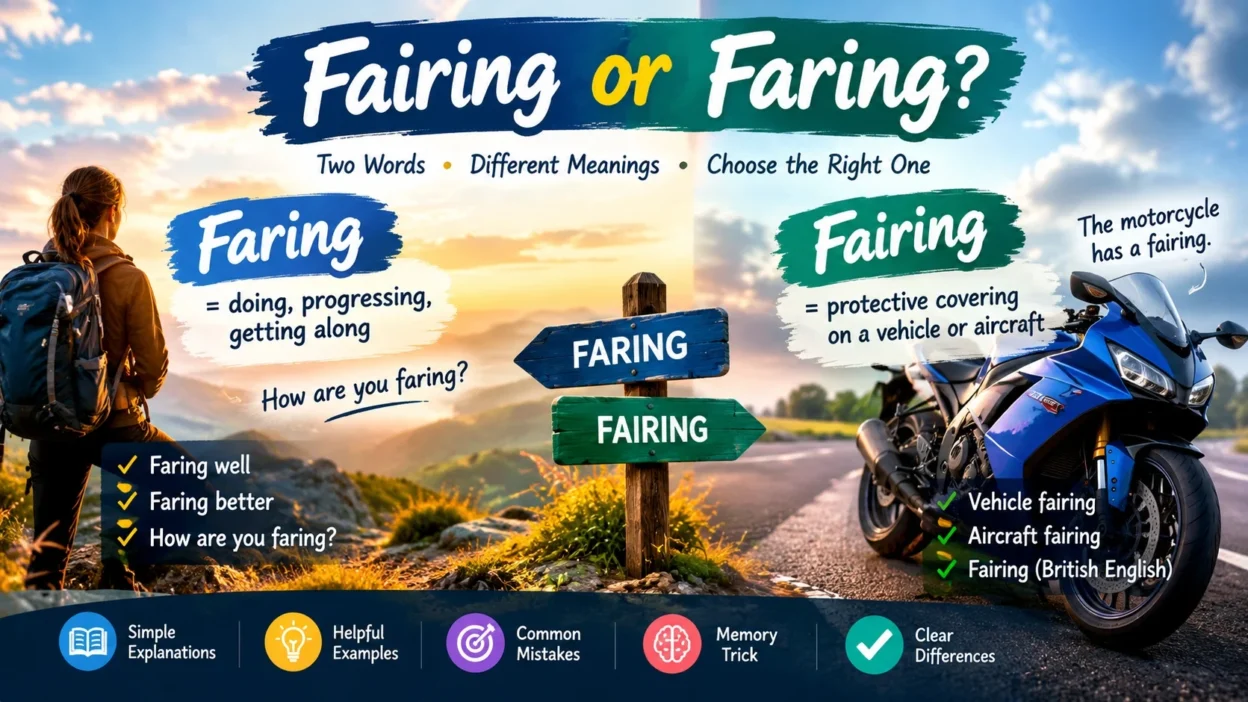
If you are wondering if the correct word is “fairing” or “faring,” the answer depends on what you mean. Faring is usually used as a verb meaning doing, progressing, or getting along, while fairing is mainly a noun referring to a protective covering on a vehicle or aircraft. In British English, fairing can also mean a gift or item bought at a fair.
These two words sound almost identical, which makes them easy to confuse. However, they have completely different meanings and grammatical uses. Understanding the difference will help you choose the right spelling in sentences such as “How are you faring?” and “The motorcycle has a new fairing.”
Quick Answer: Fairing vs. Faring
Faring is the present participle of fare and means doing or progressing, as in “How are you faring?” Fairing is usually a noun for a protective covering on a vehicle or aircraft. In British English, it can also mean an item purchased at a fair.
Why Do People Confuse “Fairing” and “Faring”?
People often confuse fairing and faring because they are pronounced very similarly. The extra i in fairing is easy to overlook, especially when writing quickly.
The words also look related because both contain the ending -ing. However, they come from different base words and have different meanings.
- Faring → from fare
- Fairing → from fair
The easiest way to understand them is to focus on the word they come from.
If the sentence is about how someone is doing or progressing, use faring.
If it is about a protective covering on a vehicle or aircraft, use fairing.
What Does “Faring” Mean?
Faring is the present participle of the verb fare.
The verb fare means to do, progress, or get along in a particular situation.
For example:
How are you faring in your new job?
Here, faring means “how are you doing?”
Another example is:
The team is faring well this season.
This means the team is doing well or performing successfully.
Common Uses of “Faring”
You will often see faring used when talking about:
- How someone is doing
- Progress in a situation
- Performance
- Success or failure
- How something is developing
Common expressions include:
- faring well
- faring badly
- faring better
- faring worse
- faring poorly
- faring successfully
Examples of “Faring”
- How are you faring at your new school?
- She is faring well in her new position.
- The company is faring better than expected.
- How did you fare during the interview?
- The small business is faring poorly this year.
What Does “Fairing” Mean?
Fairing has several meanings, but the most common modern technical meaning is a covering or structure designed to reduce air resistance or protect parts of a vehicle.
Fairings are commonly associated with:
- Motorcycles
- Aircraft
- Bicycles
- Rockets
- Cars
- Other vehicles or machines
For example:
The motorcycle’s front fairing was damaged in the accident.
The fairing is the outer covering around part of the motorcycle.
On an aircraft, a fairing can cover or blend structural parts to create a smoother shape and reduce aerodynamic drag.
“Fairing” as an Item Bought at a Fair
In British English, fairing can also have another meaning.
A fairing may refer to a small gift, souvenir, or item traditionally bought at a fair.
For example:
She bought some traditional fairings for her children.
This meaning is less common in everyday modern English than the vehicle-related meaning.
Fairing vs. Faring: Comparison Table
| Word | Meaning | Part of Speech | Example |
|---|---|---|---|
| Faring | Doing or progressing | Verb form | How are you faring? |
| Fairing | Protective covering on a vehicle or aircraft | Noun | The motorcycle fairing is cracked. |
| Fairing | An item bought at a fair, especially in British English | Noun | They bought traditional fairings at the fair. |
The most important distinction is simple: faring is connected to fare, while fairing is connected to fair.
When Should You Use “Faring”?
Use faring when you are talking about how someone or something is doing, progressing, or performing.
Example 1
How are you faring in your new job?
Meaning: How are you doing in your new job?
Example 2
The students are faring well in their exams.
Meaning: The students are doing well.
Example 3
The restaurant is faring better than expected.
Meaning: The restaurant is doing better than expected.
Example 4
How is your project faring?
Meaning: How is your project progressing?
A useful test is to replace faring with doing. If the sentence still makes sense, faring is probably correct.
When Should You Use “Fairing”?
Use fairing when referring to a physical covering or structure, especially on a vehicle or aircraft.
Example 1
The mechanic replaced the motorcycle’s fairing.
Example 2
The aircraft has a lightweight fairing around the structure.
Example 3
The damaged fairing needs to be repaired.
Example 4
The bike’s side fairing was scratched.
In these examples, fairing refers to a physical component rather than someone’s performance or progress.
10+ Examples of Fairing and Faring
Here are examples that make the difference easier to remember.
- How are you faring in your new job?
→ How are you doing in your new job? - The students are faring well in their final exams.
→ The students are performing well. - How is the new business faring?
→ How is the business progressing? - The team is faring better this year.
→ The team is doing better. - The motorcycle needs a new fairing.
→ It needs a new protective body covering. - The mechanic repaired the damaged fairing.
→ The mechanic repaired the vehicle’s covering. - The aircraft’s fairing helps create a smoother shape.
→ The fairing is a structural/aerodynamic covering. - How are the new employees faring?
→ How are the new employees doing? - The company is faring poorly in the current market.
→ The company is performing poorly. - The front fairing was removed from the motorcycle.
→ The protective covering was removed. - She is faring much better after changing schools.
→ She is doing much better. - The engineers designed a lightweight fairing.
→ They designed a lightweight protective/aerodynamic covering.
Common Mistakes With Fairing and Faring
Mistake 1: Writing “How are you fairing?”
This is one of the most common errors.
How are you fairing?
How are you faring?
The intended meaning is “How are you doing?” Therefore, the correct word is faring.
Mistake 2: Writing “The motorcycle needs a new faring”
When you mean the motorcycle’s protective body covering, the correct spelling is fairing.
The motorcycle needs a new faring.
The motorcycle needs a new fairing.
Mistake 3: Thinking “fair” and “fare” have the same meaning
They do not.
Fair can refer to something reasonable, attractive, or a public event.
Fare can refer to the price of a journey or, as a verb, how someone does or progresses.
Because faring comes from fare, not fair, its spelling does not contain “ai.”
Mistake 4: Using “fairing” when you mean “doing”
If you can replace the word with doing, choose faring.
How are you faring?
not:
How are you fairing?
An Easy Memory Trick
Use this simple trick:
FARing = How are you FARing in life?
Think of fare as the source word:
fare → faring
If you are talking about doing or progressing, remember FAR.
For a vehicle covering, think:
FAIR → FAIRing
So:
- Faring = doing/progressing
- Fairing = covering/structure
Another quick test is:
Can I replace the word with doing?
If yes → faring.
Is it a physical covering on a vehicle or aircraft?
If yes → fairing.
Fairing vs. Faring in American and British English
The basic distinction between faring and fairing is the same in American and British English.
Faring is used as the -ing form of fare in both varieties.
For example:
How are you faring?
This is grammatically correct in both American and British English.
Fairing is also used in both varieties when referring to a protective or aerodynamic covering.
The additional meaning of fairing as a gift or souvenir associated with a fair is more closely associated with British usage and traditional contexts.
So, regardless of whether you use American or British English, the key distinction remains:
faring = doing/progressing
fairing = protective covering
Similar Words You Should Know
Understanding related words can make the difference even clearer.
Fare
Fare can mean to do or progress:
How did you fare on the test?
It can also mean the price paid for transportation:
The bus fare was expensive.
Fared
Fared is the past tense of fare.
She fared well during the competition.
Faring
Faring is the -ing form of fare.
The company is faring well.
Fair
Fair has several meanings, including reasonable, attractive, or an event where people gather to buy and enjoy things.
We visited the summer fair.
Fairing
Fairing is commonly a protective or aerodynamic covering.
The motorcycle’s fairing was replaced.
These words may look similar, but their meanings are different.
Final Verdict: Fairing or Faring?
The correct word depends entirely on your meaning.
Use faring when you mean doing, progressing, or getting along.
How are you faring?
Use fairing when you mean a protective or aerodynamic covering, especially on a motorcycle, aircraft, or other vehicle.
The motorcycle’s fairing is damaged.
And in British English, fairing can also refer to a gift or item traditionally bought at a fair.
The easiest rule is: fare → faring for progress, while fair → fairing for a covering or fair-related item.
Frequently Asked Questions
Is “How are you fairing?” correct?
No, not when you mean “How are you doing?” The correct sentence is “How are you faring?” The word comes from the verb fare.
What is the difference between fairing and faring?
Faring means doing or progressing and comes from fare. Fairing usually means a protective covering on a vehicle or aircraft and comes from fair.
Is “faring well” correct?
Yes. Faring well means doing well or progressing successfully.
For example:
The business is faring well.
What is a fairing on a motorcycle?
A fairing is a covering or body panel fitted to part of a motorcycle. It can help protect components and, depending on its design, improve aerodynamic performance.
Is faring the same as doing?
In many contexts, yes. Faring can mean doing, progressing, or getting along.
For example:
How are you faring?
can mean:
How are you doing?
Is fairing a real word?
Yes. Fairing is a standard English word. It commonly refers to a protective or aerodynamic covering. In British English, it can also refer to an item bought at a fair.
What is the past tense of fare?
The past tense of fare is fared.
For example:
She fared well in the competition.
The -ing form is faring.
Remember This
Faring = doing or progressing
Fairing = a protective covering
Think:
FARE → FARING
“How are you faring?”
FAIR → FAIRING
“The motorcycle has a fairing.”
If you remember these two connections, you will rarely confuse fairing and faring again.
Conclusion
Although fairing and faring sound almost the same, they have different meanings. Faring comes from the verb fare and describes how someone or something is doing or progressing. It commonly appears in phrases such as “faring well,” “faring poorly,” and “How are you faring?”
Fairing, on the other hand, is primarily a noun for a protective or aerodynamic covering, especially on vehicles and aircraft. It can also have a traditional fair-related meaning in British English. When choosing between the two, simply identify the meaning first: if you mean doing, choose faring; if you mean a covering, choose fairing.

Adam Cody is a passionate writer at SleepCout, exploring coded dreams, dream meanings, sleep science, lucid dreaming, and symbolism through engaging, well-researched articles that inspire curiosity and self-discovery.