
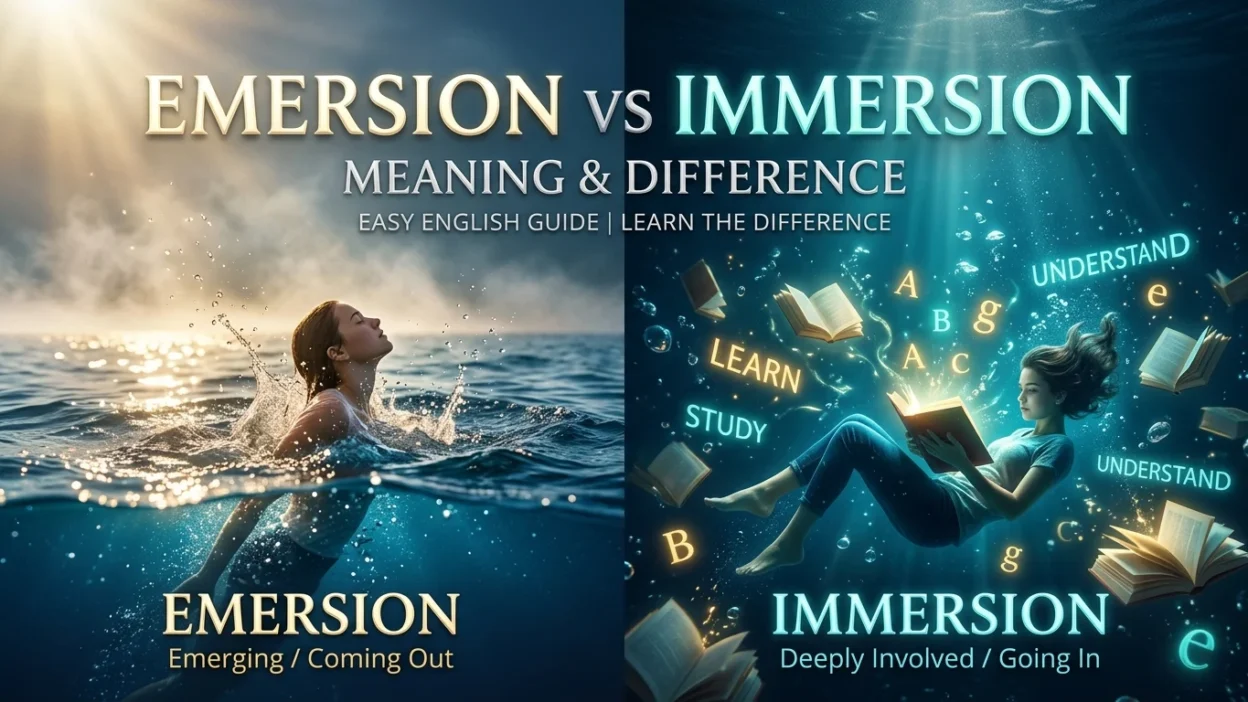
If you have ever written “emersion” when you meant “immersion,” you are not alone. These two words look and sound similar, but they have very different meanings. Understanding the difference can help you write more accurately in school, work, academic writing, and everyday English.
Immersion is the much more common word. It usually means being deeply involved in something or being completely surrounded by something, especially a liquid. Emersion, on the other hand, is a specialized word that generally describes the act of emerging from or becoming visible after being hidden or covered. Because emersion is uncommon, many English learners confuse it with immersion.
Quick Answer: Emersion vs Immersion
Immersion means being deeply involved in something or being placed completely into a surrounding substance, especially water. Emersion means emerging from something or becoming visible after being hidden or covered. For language learning, education, and being deeply involved in an activity, use immersion, not emersion.
Why Do People Confuse Emersion and Immersion?
The confusion comes mainly from their similar spelling and pronunciation.
Both words contain -mersion, which comes from a Latin root associated with dipping or emerging. However, their prefixes change the meaning:
- im- relates to going into
- e- relates to going out of or emerging
Compare these basic ideas:
- Immersion → into
- Emersion → out of
This simple distinction explains much of the difference between the two words.
What Does the First Word, “Emersion,” Mean?
Emersion is a noun meaning the act or process of emerging from something or becoming visible after being hidden.
It is a relatively uncommon and specialized English word.
For example:
The emersion of the moon from behind the clouds was clearly visible.
In astronomy, emersion can refer to a celestial object becoming visible again after being occulted or hidden by another object.
The word can also be used more generally when something comes out of or becomes visible from something that previously concealed it.
Simple Meaning of Emersion
Emersion = the act of emerging or becoming visible.
Think of something that was hidden and then comes out.
What Does the Second Word, “Immersion,” Mean?
Immersion is much more common and has several related meanings.
Its most literal meaning is the act of putting something completely into a liquid or another surrounding substance.
For example:
The immersion of the vegetables in water helped clean them.
But immersion is also frequently used figuratively.
It can describe becoming deeply involved in an activity, subject, culture, or experience.
For example:
Language immersion helped her improve her Spanish quickly.
Here, she is not physically being placed in a liquid. Instead, she is surrounded by opportunities to hear, speak, and use the language.
Simple Meaning of Immersion
Immersion = being completely surrounded by something or deeply involved in something.
Think of going into an environment or experience.
Emersion vs Immersion: Comparison Table
| Feature | Emersion | Immersion |
|---|---|---|
| Basic meaning | Emerging or becoming visible | Being placed into or deeply involved |
| Frequency | Uncommon | Very common |
| Typical use | Astronomy and specialized contexts | Education, water, culture, technology, experiences |
| Direction | Out of / emerging | Into / surrounded by |
| Example | The emersion of the object | Immersion in water |
| Language learning | Usually incorrect | Correct |
| Common phrase | Emersion from concealment | Language immersion |
When Should You Use “Emersion”?
Use emersion when you specifically mean emerging from something or becoming visible after being hidden.
It is particularly useful in specialized scientific or astronomical contexts.
Examples
- The emersion of the star was observed through the telescope.
- Scientists recorded the emersion of the object after the eclipse.
- The moon’s emersion from behind the obstruction was visible.
- The emersion marked the end of the period during which the object was hidden.
Because emersion is uncommon, it should not automatically replace immersion simply because the words look similar.
When Should You Use “Immersion”?
Use immersion when talking about:
- Being completely surrounded by water
- Deep involvement in an activity
- Language learning
- Cultural experiences
- Education
- Virtual reality
- Becoming deeply focused on something
Examples
- Swimming involves immersion in water.
- Language immersion can help students practice naturally.
- She became completely absorbed through immersion in the new culture.
- The game provides an engaging immersive experience.
- The treatment requires immersion of the object in liquid.
10+ Examples of Emersion and Immersion
Here are practical examples that make the difference easier to understand.
Examples With “Emersion”
- The telescope captured the emersion of the star.
- Scientists observed the emersion of the planet from behind the moon.
- The object’s emersion was recorded at a precise time.
- The astronomer waited for the emersion of the celestial body.
- The emersion made the previously hidden object visible again.
Examples With “Immersion”
- The child enjoyed immersion in the swimming pool.
- Language immersion helped him learn French.
- Cultural immersion gave her a better understanding of local traditions.
- The virtual reality headset creates a sense of immersion.
- The teacher uses immersion to encourage students to communicate in English.
- The device was tested after immersion in water.
- Reading novels can provide deep immersion in another world.
What Are the Most Common Mistakes?
The biggest mistake is using emersion when you mean immersion.
For example:
I want to improve my English through language emersion.
I want to improve my English through language immersion.
Another common mistake is assuming that emersion is simply an alternative spelling of immersion. It is not.
Watch These Examples
She experienced cultural emersion.
She experienced cultural immersion.
The student joined an English emersion program.
The student joined an English immersion program.
The phone was tested through water emersion.
The phone was tested through water immersion.
What Is an Easy Memory Trick?
Use this simple trick:
IM = IN → Immersion
If something goes into water or you become deeply involved in an activity, think immersion.
E = EXIT → Emersion
If something comes out or becomes visible after being hidden, think emersion.
Remember:
Immersion = IN
Emersion = EMERGE
This connection can help you remember which word to choose.
Emersion vs Immersion in American and British English
There is no major American-versus-British spelling difference that changes the basic distinction between these words.
Immersion has the same core meaning in both American and British English.
Emersion also retains its specialized meaning in both varieties, although it is relatively uncommon in everyday conversation.
So if you are writing for an American or British audience, the important issue is meaning, not regional spelling.
For common situations involving language learning, education, culture, or being submerged in liquid, immersion is the appropriate word.
Similar Words to Know
Learning related words can make the distinction even clearer.
Immerse
Immerse is the verb related to immersion.
She immersed herself in her studies.
It means to involve yourself deeply in something or put something completely into a substance.
Immersive
Immersive is an adjective describing something that creates a feeling of deep involvement.
The museum offers an immersive experience.
Emerge
Emerge means to come out, appear, or become visible.
The sun emerged from behind the clouds.
This is closely connected to the basic idea behind emersion.
Emergence
Emergence means the process of appearing or coming into existence.
The emergence of new technology changed the industry.
Final Verdict: Emersion or Immersion?
The correct choice depends entirely on what you mean.
Choose immersion when you mean being deeply involved, surrounded by something, or placed into a liquid or environment.
Choose emersion when you mean emerging from something or becoming visible after being hidden, especially in specialized contexts such as astronomy.
For everyday English, immersion is the word you will use far more often.
If you are talking about language immersion, cultural immersion, immersion in water, or immersion in an activity, do not use emersion.
Frequently Asked Questions
Is “emersion” a real word?
Yes. Emersion is a real English word, but it is uncommon. It generally refers to emerging from something or becoming visible after being hidden, particularly in specialized contexts.
Is it “language emersion” or “language immersion”?
The correct phrase is language immersion. It describes learning a language by being surrounded by opportunities to hear, speak, read, and use that language.
What is the difference between emersion and immersion?
Emersion refers to emerging or becoming visible, while immersion refers to being placed into something or becoming deeply involved in an environment, activity, or experience.
Is “immersion” the opposite of “emersion”?
They can express contrasting directions conceptually. Immersion involves going into or being surrounded by something, while emersion involves coming out or becoming visible. However, they are not always used as direct opposites in everyday English.
What does immersion mean in education?
In education, immersion means learning through extensive exposure to a subject or environment. Language immersion, for example, gives learners frequent opportunities to use the target language.
What does emersion mean in astronomy?
In astronomy, emersion can describe a celestial object becoming visible again after being hidden or occulted by another object.
Which word is more common: emersion or immersion?
Immersion is much more common in modern everyday English. Emersion is relatively rare and is more likely to appear in specialized scientific or technical contexts.
How can I remember the difference?
Remember IM = IN for immersion. Think of going into water or deeply into an experience. For emersion, think EMERGE, meaning to come out or become visible.
Remember This
Immersion = going in, being surrounded, or becoming deeply involved.
Emersion = coming out, emerging, or becoming visible.
If you are unsure and your sentence is about language learning, culture, education, water, or deep involvement, you probably need immersion.
Conclusion
The difference between emersion vs immersion is mainly about direction and meaning. Immersion describes going into something, being surrounded by it, or becoming deeply involved in it. It is the standard word in common phrases such as language immersion and cultural immersion.
Emersion is a legitimate but much less common word associated with emerging or becoming visible after being hidden. Remember “immersion = in” and “emersion = emerge,” and you will be able to choose the correct word with confidence.

John Tyler is a dream researcher and content writer at SleepCout, sharing insightful articles about coded dreams, dream meanings, symbolism, sleep psychology, and practical guidance to help readers understand their dreams.