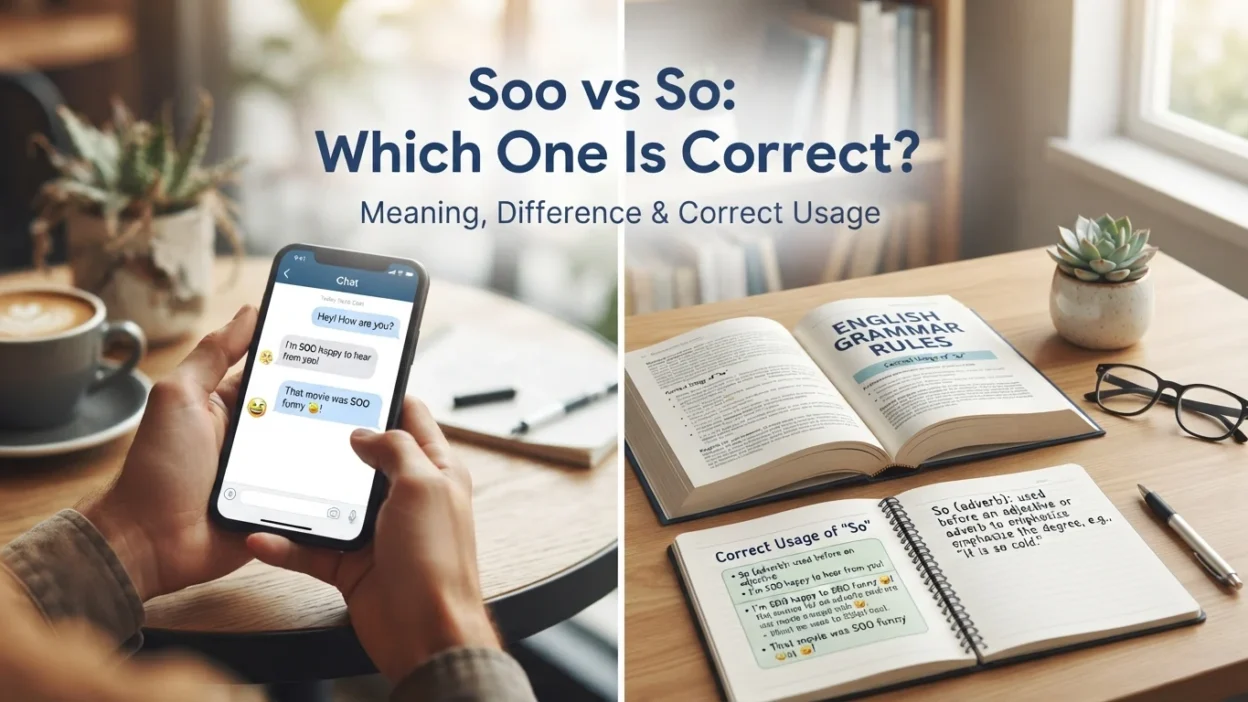
If you are wondering if “soo” or “so” is correct, the standard English word is “so.” It can mean “to such a degree,” “therefore,” or “in this way.” “Soo” is generally not the standard spelling of “so” in formal or everyday English. You may see “soo” in casual texting, social media, usernames, or as a playful spelling, but it should not normally be used in academic or professional writing.
Understanding the difference is useful because “so” is an extremely common English word. It can work as an adverb, conjunction, or part of common expressions such as “so good,” “so much,” “so that,” and “I think so.” If you are writing an essay, email, school assignment, or professional message, choose “so.”
Quick Answer: Soo vs So
“So” is the correct standard English spelling. It is used to express degree, result, agreement, or manner. “Soo” is usually an informal or playful spelling used online rather than a standard English word. For formal writing, schoolwork, business communication, and correct English, always use “so.”
Why Do People Confuse “Soo” and “So”?
The confusion usually comes from pronunciation and informal online writing.
When people want to emphasize the word “so” in texting, they may stretch it visually:
- “That was sooo funny!”
- “I am sooo tired.”
- “Soo, what are we doing?”
Here, “sooo” is not standard spelling. It is a stylistic way of showing emphasis or a drawn-out pronunciation.
Some people also write “soo” accidentally because they hear a longer vowel sound when saying “so.” However, in standard English, the spelling is so.
First Word: “Soo”
Is “soo” a correct English word?
In ordinary modern standard English, “soo” is not the normal spelling of the common word “so.”
You may encounter “soo” in:
- Text messages
- Social media posts
- Informal chats
- Usernames
- Brand names
- Playful writing
- Deliberately misspelled words
For example:
“Soo, what happened?”
In casual messaging, the writer may simply be using a playful version of “so.”
However, this spelling is not appropriate when you need standard English.
Incorrect in standard writing:
I am soo happy to see you.
Correct:
I am so happy to see you.
Second Word: “So”
“So” is the standard and correct word.
It has several important uses in English.
1. “So” to show degree
It can mean to a very great degree.
- She is so kind.
- The movie was so interesting.
- I am so tired.
- This coffee is so hot.
2. “So” to show a result
“So” can introduce a consequence or result.
- It was raining, so we stayed home.
- I was hungry, so I made dinner.
- He studied hard, so he passed the exam.
3. “So” to mean “in this way”
- Hold the box so.
- If you do it so, it will be easier.
4. “So” for agreement
We commonly use “so” in expressions such as:
- I think so.
- I hope so.
- I suppose so.
- I believe so.
Soo vs So: Comparison Table
| Feature | Soo | So |
|---|---|---|
| Standard English spelling | Usually no | Yes |
| Common in formal writing | No | Yes |
| Common in texting | Sometimes | Yes |
| Used for emphasis online | Sometimes | Yes |
| Used in academic writing | Avoid | Correct |
| Used in professional writing | Avoid | Correct |
| Standard dictionary form for the common word | No | Yes |
| Example | “I am soo tired.” | “I am so tired.” |
When Should You Use “Soo” or “So”?
Use “so” in standard English
Choose so when writing:
- School assignments
- Essays
- Emails
- Reports
- Articles
- Applications
- Business messages
- Professional communication
- Formal documents
Example:
She was so excited about the opportunity.
Use “soo” only as informal styling
You may see soo in casual online communication when someone intentionally changes the spelling for a particular tone.
For example:
“Soo… what happened next?”
This can suggest hesitation or a conversational tone. However, it is better understood as informal internet-style writing, not the standard spelling.
10+ Examples of “So” in Sentences
- The weather is so beautiful today.
- I was so tired after work.
- She speaks English so clearly.
- The test was so difficult.
- He was hungry, so he ordered a sandwich.
- I think so.
- I hope so.
- Please place the books so.
- It was so cold that we stayed inside.
- She was so happy to hear the news.
- He worked hard, so he finished early.
- Why are you so worried?
Informal “Soo” Examples
You might encounter these online:
- “Soo, what are you doing?”
- “I am soo excited!”
- “That was soo funny!”
- “Soo… are you coming?”
These examples are understandable in casual communication, but they should normally be changed to so in standard writing.
Common Mistakes
Mistake 1: Using “soo” in formal writing
Incorrect:
I am soo grateful for your help.
Correct:
I am so grateful for your help.
Mistake 2: Thinking “soo” is the standard spelling
The pronunciation of so does not make soo its standard spelling.
Correct:
She is so happy.
Mistake 3: Using “soo” in academic work
Avoid internet-style spellings in essays and assignments.
Better:
The experiment was so successful that the researchers repeated it.
Mistake 4: Confusing emphasis with spelling
Writers sometimes use extra letters to express emotion:
“That was sooo good!”
This is a stylistic choice, not a new standard spelling.
Memory Trick: Remember “So”
Think:
So = Standard
Both words begin with S, but remembering “So = Standard” can help you choose the correct spelling.
If you are writing something that needs correct English, use so.
Soo may appear in casual internet writing, but so is the standard choice.
American vs British English
There is no important American-versus-British spelling difference between so and soo in standard English.
American English uses:
so
British English also uses:
so
The informal spelling soo can appear in online communication regardless of whether the writer uses American or British English.
Therefore, this is not primarily an American vs. British English issue. It is a difference between standard spelling and informal or playful writing.
Similar Words and Forms
Several words and expressions are related to so but have different functions.
So
The food is so delicious.
Too
Too can mean “also” or indicate an excessive degree.
The coffee is too hot to drink.
Very
Very increases the degree of an adjective or adverb.
She is very happy.
Such
Such is commonly used before a noun phrase.
It was such a beautiful day.
Therefore
Therefore can introduce a logical result and is more formal than “so.”
The road was closed; therefore, we took another route.
Final Verdict: Soo or So?
For standard English, “so” is the correct spelling.
Use so in everyday standard writing, education, professional communication, and formal contexts. “Soo” may appear in casual texting or social media as a playful or expressive spelling, but it is not normally the standard form of the word.
So when you are unsure, remember:
Correct standard spelling: SO
FAQs About Soo vs So
Is “soo” a correct spelling of “so”?
No, not in standard English. So is the normal and correct spelling. “Soo” may be used informally online as a playful or expressive spelling.
Is “soo” a real word?
“Soo” can appear in particular names, informal expressions, or other specialized contexts, but it is not the standard spelling of the common English word so.
Can I use “soo” in texting?
You can encounter or use it in very casual texting, especially to create emphasis or a conversational tone. However, so is the standard spelling.
Is “sooo” grammatically correct?
“Sooo” is an informal stylistic spelling used to emphasize or stretch the pronunciation of “so.” It is not appropriate for formal writing.
Should I write “so” in an essay?
Yes. Use so in essays, assignments, reports, and other standard forms of writing.
Is “soo” British English?
No. Soo is not the standard British spelling of so. British and American standard English both use so.
Why do people write “soo” online?
People may write “soo” to make their writing sound more conversational, emotional, hesitant, or exaggerated. It is usually a stylistic choice rather than standard spelling.
Remember This
- So = standard and correct spelling.
- Soo = usually informal, playful, or nonstandard.
- Use so in school, work, and formal writing.
- Sooo may be used online for emphasis, but it is still informal.
- American and British English both use so.
Conclusion
The difference between soo and so is simple: so is the standard English word, while soo is generally an informal or playful spelling found in casual online communication. Although readers can usually understand “soo,” it should not replace so in formal or standard writing.
When writing an essay, email, article, report, or professional message, choose so. Whether you are using it to express degree, show a result, indicate agreement, or form a common expression, so is the spelling you can rely on.

Charles Kyle is a passionate writer and dream researcher at SleepCout, dedicated to exploring coded dreams, lucid dreaming, dream symbolism, and sleep science. He creates engaging, well-researched content that helps readers understand their dreams and discover the fascinating connection between technology, imagination, and the sleeping mind.