
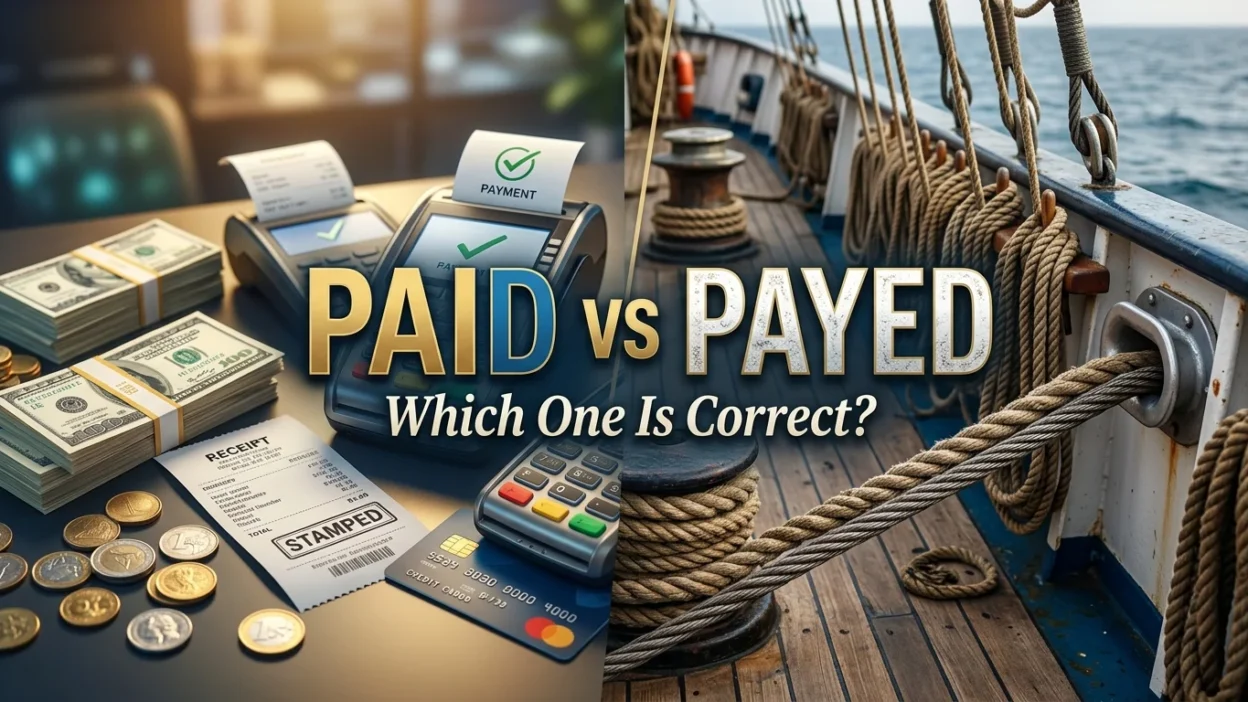
If you have ever wondered if the correct word is paid or payed, you are not alone. These two words look almost identical, but they are not interchangeable in standard English. Paid is the normal past tense and past participle of the verb pay, while payed has a much narrower use, mainly in specific nautical contexts.
For everyday English, paid is almost always the word you need. You write “I paid the bill,” “She paid for dinner,” and “They have paid the fee.” Payed is generally used when talking about certain nautical actions, such as paying out a rope or cable. Understanding this small difference can help students, ESL learners, and anyone writing professionally avoid a common spelling and grammar mistake.
Quick Answer
Paid is the standard past tense and past participle of pay: “I paid the bill.” Payed is a rare word used mainly in nautical language, especially for letting out or loosening a rope, cable, or line. For ordinary situations involving money, paid is the correct choice.
Why Do People Confuse Paid and Payed?
The confusion comes from the fact that pay is an irregular verb. Many English verbs form their past tense by adding -ed, such as:
- walk → walked
- work → worked
- call → called
- open → opened
Because of this pattern, it may seem logical to write:
- pay → payed
However, the standard past form of pay is paid, not payed, when the verb refers to giving money or settling an amount.
The spelling payed does exist, but it has a specialized meaning and is uncommon in everyday English.
First Word: Paid
Paid is the past tense and past participle of pay when talking about money, debts, bills, salaries, costs, or other ordinary forms of payment.
Examples of Paid
- I paid the bill yesterday.
- She paid for the tickets.
- We have paid the full amount.
- He paid me $50 for the work.
- They paid their rent on time.
The word paid can also be used in expressions that are not directly about handing over cash.
For example:
- She paid attention in class.
- He paid a heavy price for his mistake.
- They paid tribute to the fallen soldiers.
In these expressions, paid is still the correct form.
Second Word: Payed
Payed is a legitimate but uncommon word. It is mainly associated with nautical terminology.
In nautical usage, payed can refer to letting out, loosening, or releasing a rope, cable, or line.
For example:
- The sailors payed out the rope.
- The crew payed out more cable.
- The anchor line was payed out slowly.
You are unlikely to need payed in ordinary writing unless you are discussing sailing, ships, ropes, cables, or another specialized nautical context.
Paid vs Payed: Comparison Table
| Word | Meaning | Common Use | Example |
|---|---|---|---|
| Paid | Past tense/past participle of pay | Money and general expressions | I paid the bill. |
| Payed | Specialized nautical form | Letting out a rope, cable, or line | The crew payed out the rope. |
The simplest rule is: Use paid when talking about money.
When Should You Use Paid?
Use paid when the meaning involves payment or the common non-financial expressions formed with pay.
Use Paid for Money
- I paid the cashier.
- She paid the invoice.
- We paid the tuition fee.
- He paid for the meal.
- They paid their employees.
Use Paid in Common Expressions
Paid attention
Please pay attention to the instructions.
Past tense:
She paid attention during the lesson.
Paid a price
He paid a high price for his decision.
Paid a visit
We paid a visit to our grandparents.
Paid tribute
The community paid tribute to the firefighter.
In all of these examples, paid is correct.
When Should You Use Payed?
Use payed only in specialized contexts where it has its particular nautical meaning.
One common construction is payed out, meaning that a rope, cable, or line was allowed to run out or was released gradually.
For example:
The sailors payed out the line as the boat moved away.
This is very different from:
The sailors paid the bill.
The first sentence concerns a nautical line. The second concerns money.
10+ Examples of Paid vs Payed
Here are practical examples to make the difference clear:
- I paid for my new shoes.
- She paid the electricity bill.
- We paid the restaurant before leaving.
- He has already paid the fee.
- They paid their employees on Friday.
- I paid attention to every detail.
- She paid a large amount for the car.
- We paid our respects to the family.
- The crew payed out the rope slowly.
- The sailors payed out additional cable.
- The captain ordered the crew to pay out the line.
- I paid for the online course last week.
Notice that almost every everyday example uses paid. The specialized nautical examples use payed.
Common Mistakes With Paid and Payed
Mistake 1: Using Payed for Money
Incorrect:
I payed the bill yesterday.
Correct:
I paid the bill yesterday.
Mistake 2: Assuming Every Past Tense Ends in -ed
English has many irregular verbs:
- go → went
- buy → bought
- take → took
- see → saw
- pay → paid
So you cannot always create a past-tense verb simply by adding -ed.
Mistake 3: Thinking Payed Is Always Wrong
It is not completely wrong. Payed has a specialized nautical use.
The better rule is not “payed is never a word.” Instead, remember:
Paid = ordinary English use
Payed = specialized nautical use
Mistake 4: Writing “Have Payed”
When talking about a completed financial payment, use have paid:
We have paid the invoice.
Not:
We have payed the invoice.
A Simple Memory Trick
Think of the i in paid as standing for income or money.
PAID → MONEY
If money is involved, choose paid.
If you are talking about a ship letting out a rope or cable, payed may be appropriate.
Another easy question to ask yourself is:
“Am I talking about paying money?”
If the answer is yes, use paid.
American vs British English
There is no major American-versus-British difference between paid and payed in ordinary financial English.
Both American and British English use:
I paid the bill.
She has paid for the tickets.
The specialized word payed can also appear in nautical contexts in both varieties of English.
Therefore, choosing paid is not a matter of choosing American English over British English. It is the standard choice for ordinary uses of pay.
Similar Words
Several words can create similar confusion because their past forms do not follow the simple -ed pattern.
Pay → Paid
I paid the bill.
Say → Said
She said hello.
Lay → Laid
He laid the book on the table.
Buy → Bought
We bought a new computer.
Bring → Brought
She brought her notebook.
Teach → Taught
The teacher taught the lesson.
Learning common irregular verbs can make English grammar much easier because you begin to recognize their past forms naturally.
Final Verdict
For almost every everyday situation, paid is the correct word.
Use paid when you are talking about:
- money
- bills
- fees
- salaries
- purchases
- debts
- attention
- prices
- visits
- tribute
- other common expressions with pay
Use payed only in specialized nautical contexts, particularly when referring to letting out or releasing a rope, cable, or line.
So, if you are writing a normal sentence such as “I ___ the bill,” the answer is definitely paid.
FAQs About Paid vs Payed
Is “payed” a correct word?
Yes, payed is a real word, but it has a specialized use. It is mainly found in nautical language, particularly when referring to letting out a rope, cable, or line.
Is it “I paid” or “I payed”?
The correct everyday form is “I paid.”
For example:
I paid for the groceries.
Is “payed” ever correct?
Yes. Payed can be correct in specialized nautical contexts, such as “The crew payed out the rope.”
Why is the past tense of pay “paid”?
Pay is an irregular verb. Its standard past tense and past participle are paid, rather than the regular payed.
Is “paid” used in both American and British English?
Yes. Paid is the standard form in both American and British English when talking about ordinary payments.
Should I write “have paid” or “have payed”?
Use have paid when referring to an ordinary payment.
We have paid the bill.
What is the easiest way to remember paid vs payed?
Remember: paid is for normal English and money. Payed is mainly for specialized nautical situations involving ropes, cables, or lines.
Remember This
Paid = the normal past tense of pay.
Payed = a rare, specialized nautical term.
When in doubt, especially when talking about money, choose paid.
Conclusion
The difference between paid and payed is simple once you know the context. Paid is the standard past tense and past participle of pay, and it is the form you should use for bills, purchases, salaries, fees, debts, and common expressions such as “paid attention.” It is the correct choice for virtually all everyday writing.
Payed has a much narrower role. It can appear in nautical language when referring to letting out a rope, cable, or line. For students, ESL learners, and general writers, the most useful rule is straightforward: if you mean ordinary payment, use paid. This one distinction will help you avoid one of the most common spelling mistakes involving the verb “pay.”