Understanding the difference between an independent clause and a dependent clause is an important step toward becoming a better English writer. Both types of clauses help us express ideas, connect information, and build meaningful sentences. However, they serve different purposes. An independent clause expresses a complete thought, while a dependent clause needs additional information to make sense as a complete sentence.
If you are learning English, preparing for an exam, or improving your grammar, knowing how these clauses work will help you avoid sentence fragments and write more clearly. You will also learn how to combine clauses using conjunctions, recognize their different structures, and identify them in everyday writing. With a few simple rules and practical examples, distinguishing between independent and dependent clauses becomes much easier.
Quick Answer: Independent Clause vs Dependent Clause
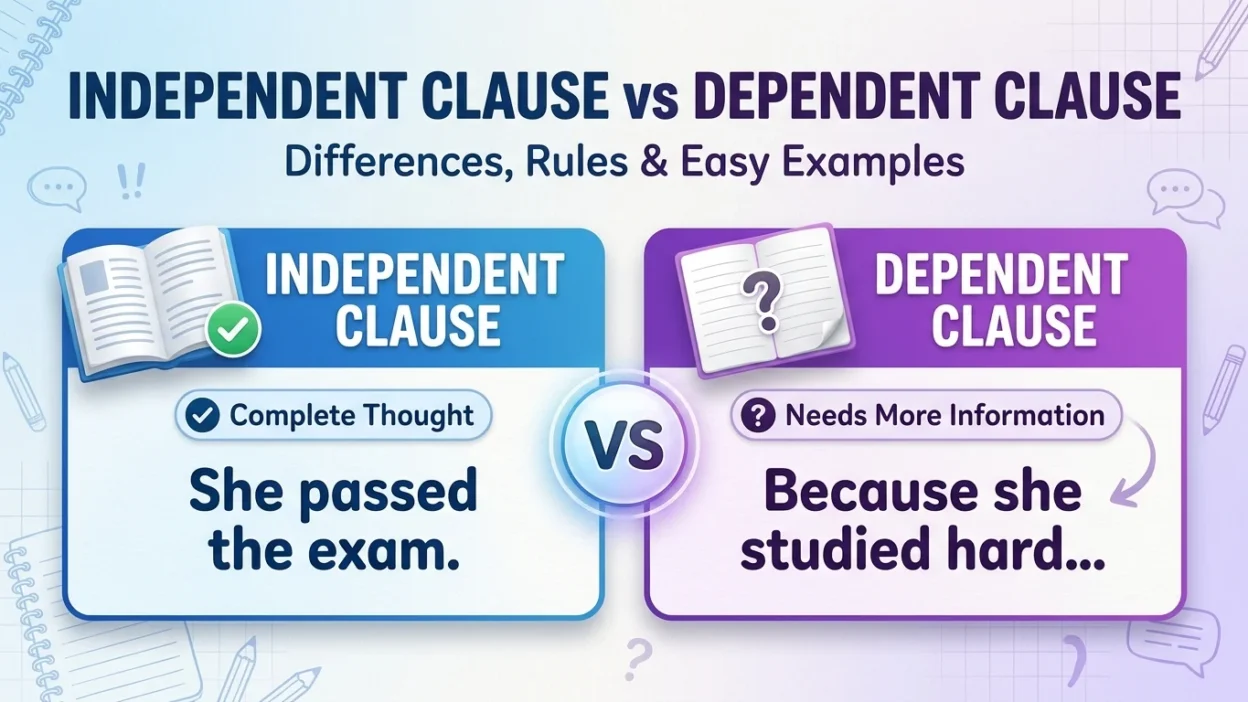
An independent clause contains a subject and a verb and expresses a complete thought, so it can stand alone as a sentence. A dependent clause also contains a subject and a verb, but it does not express a complete thought on its own. It depends on an independent clause to complete its meaning.
Example:
- Independent clause: She passed the exam.
- Dependent clause: Because she studied hard.
The first example is a complete sentence. The second leaves the reader wondering what happened because she studied hard.
Why Do People Confuse Independent and Dependent Clauses?
Independent and dependent clauses are often confused because both can contain a subject and a verb. Their main difference is not whether they have these two elements but whether they express a complete thought.
Consider these examples:
- Independent clause: The children played outside.
- Dependent clause: While the children played outside.
Both clauses contain the subject the children and the verb played. However, the first expresses a complete idea, while the second introduces a time relationship without completing the thought.
Words such as because, although, when, if, and while often introduce dependent clauses. These words indicate that the clause is connected to another idea.
Understanding this difference helps you recognize complete sentences and avoid common grammatical errors.
What Is an Independent Clause?
An independent clause is a group of words containing a subject and a predicate that expresses a complete thought. It can stand alone as a grammatically complete sentence.
Independent clauses are also called main clauses because they can express the principal idea of a sentence.
Structure of an Independent Clause
A basic independent clause follows this pattern:
Subject + Verb + Complete Thought
Examples:
- Birds fly.
- My sister enjoys reading.
- The teacher explained the lesson.
- We went to the library yesterday.
Each example communicates a complete idea without needing another clause.
Key Characteristics of an Independent Clause
An independent clause generally has these characteristics:
- It contains a subject and a predicate.
- It expresses a complete thought.
- It can stand alone as a sentence.
- It may contain an object or additional details.
- It can be combined with other clauses to form longer sentences.
For example:
I finished my homework before dinner.
The subject is I, and the verb is finished. The clause communicates a complete thought, so it can stand alone.
More Examples of Independent Clauses
- The sun is shining.
- Ahmed plays football.
- My parents live in Lahore.
- The baby is sleeping.
- We watched a movie.
Each example makes sense as a complete sentence.
What Is a Dependent Clause?
A dependent clause is a group of words containing a subject and a verb that does not express a complete thought on its own. It depends on an independent clause to complete its meaning.
A dependent clause is also called a subordinate clause because it depends on another clause within the sentence.
Structure of a Dependent Clause
A common pattern is:
Subordinating Word + Subject + Verb + Incomplete Thought
Examples:
- Because I was tired
- Although she studied hard
- When the rain stopped
- If you need help
These groups of words contain subjects and verbs, but they leave the reader expecting more information.
For instance:
Because I was tired.
This is not normally a complete sentence because the word because introduces a reason without explaining what happened as a result.
A complete version would be:
Because I was tired, I went to bed early.
Here, because I was tired is the dependent clause, while I went to bed early is the independent clause.
Key Characteristics of a Dependent Clause
A dependent clause generally has these characteristics:
- It contains a subject and a verb.
- It does not express a complete thought on its own.
- It depends on another clause for a complete sentence.
- It often begins with a subordinating conjunction or a relative pronoun.
- It can appear before or after an independent clause.
For example:
Although the weather was cold, we went outside.
The dependent clause is Although the weather was cold, and the independent clause is we went outside.
Three Common Types of Dependent Clauses
Dependent clauses commonly perform three grammatical functions.
1. Adverbial Clause
An adverbial clause explains when, why, how, where, or under what condition something happens.
Example: We stayed inside because it was raining.
The dependent clause because it was raining explains why we stayed inside.
2. Adjective Clause
An adjective clause, also called a relative clause, describes a noun or pronoun.
Example: The woman who lives next door is a doctor.
The dependent clause who lives next door describes the woman.
3. Noun Clause
A noun clause functions like a noun within a sentence.
Example: I know what you mean.
The dependent clause what you mean functions as the object of the verb know.
Independent Clause vs Dependent Clause: Comparison Table
| Feature | Independent Clause | Dependent Clause |
|---|---|---|
| Meaning | Expresses a complete thought | Does not express a complete thought on its own |
| Subject | Contains a subject or understood subject | Contains a subject or understood subject |
| Verb | Contains a verb or verb phrase | Contains a verb or verb phrase |
| Can stand alone? | Yes | No, in standard sentence use |
| Other name | Main clause | Subordinate clause |
| Common beginning | May begin directly with a subject | Often begins with a subordinating word or relative word |
| Main purpose | Expresses a complete idea | Adds information to another clause or performs a grammatical function |
| Example | She smiled. | When she smiled |
| Complete sentence by itself? | Yes | Usually no |
| Example in a sentence | I called my friend because I needed help. | I called my friend because I needed help. |
In the final example, I called my friend is the independent clause, while because I needed help is the dependent clause.
When Should You Use an Independent or Dependent Clause?
Both clause types are useful, but they serve different purposes in writing.
When to Use an Independent Clause
Use an independent clause when you want to communicate a complete idea directly.
Examples:
- The train arrived late.
- I enjoy learning English.
- She completed the assignment.
- The students listened carefully.
Independent clauses are especially useful for short statements, instructions, and clear explanations.
You can also join two independent clauses to create a compound sentence.
Example:
I wanted to go outside, but it started raining.
The two independent clauses are:
- I wanted to go outside.
- It started raining.
They are joined by the coordinating conjunction but.
When to Use a Dependent Clause
Use a dependent clause when you want to provide additional information, such as a reason, condition, time, contrast, or description.
Examples:
- Because I was hungry
- When the meeting ended
- Although he was nervous
- If you finish early
These clauses become part of complete sentences when combined appropriately with independent clauses.
For example:
- Because I was hungry, I made a sandwich.
- When the meeting ended, everyone left.
- Although he was nervous, he gave a speech.
- If you finish early, you can go home.
Dependent clauses help writers explain relationships between ideas and create more varied sentences.
15 Examples of Independent and Dependent Clauses
The following examples show how both clause types work in everyday English.
Example 1: Because
Sentence: Because it was raining, we stayed home.
- Independent clause: We stayed home.
- Dependent clause: Because it was raining.
The dependent clause explains the reason for staying home.
Example 2: Although
Sentence: Although she was tired, she finished her work.
- Independent clause: She finished her work.
- Dependent clause: Although she was tired.
The dependent clause expresses contrast.
Example 3: When
Sentence: When the bell rang, the students left the classroom.
- Independent clause: The students left the classroom.
- Dependent clause: When the bell rang.
The dependent clause explains when the students left.
Example 4: If
Sentence: If you practice every day, you will improve your English.
- Independent clause: You will improve your English.
- Dependent clause: If you practice every day.
The dependent clause expresses a condition.
Example 5: While
Sentence: While my mother cooked dinner, I set the table.
- Independent clause: I set the table.
- Dependent clause: While my mother cooked dinner.
The dependent clause indicates that two activities happened during the same period.
Example 6: Before
Sentence: Finish your homework before you watch television.
- Independent clause: Finish your homework.
- Dependent clause: Before you watch television.
The independent clause gives an instruction, and the dependent clause indicates when to complete it.
Example 7: After
Sentence: After the movie ended, we went home.
- Independent clause: We went home.
- Dependent clause: After the movie ended.
The dependent clause establishes a time relationship.
Example 8: Who
Sentence: The boy who won the race received a medal.
- Independent clause: The boy received a medal.
- Dependent clause: Who won the race.
The dependent clause identifies which boy received the medal.
Example 9: Which
Sentence: I bought a book that explains English grammar.
- Independent clause: I bought a book.
- Dependent clause: That explains English grammar.
The dependent clause describes the book.
Example 10: Unless
Sentence: Unless you hurry, you will miss the bus.
- Independent clause: You will miss the bus.
- Dependent clause: Unless you hurry.
The dependent clause expresses a condition.
Example 11: Since
Sentence: Since I had some free time, I cleaned my room.
- Independent clause: I cleaned my room.
- Dependent clause: Since I had some free time.
Here, since introduces a reason.
Example 12: Even Though
Sentence: Even though the test was difficult, he passed it.
- Independent clause: He passed it.
- Dependent clause: Even though the test was difficult.
The dependent clause introduces a contrast.
Example 13: Wherever
Sentence: Wherever she goes, she makes new friends.
- Independent clause: She makes new friends.
- Dependent clause: Wherever she goes.
The dependent clause indicates a place-related relationship.
Example 14: Noun Clause
Sentence: I believe that she is honest.
- Independent clause: I believe.
- Dependent clause: That she is honest.
The dependent clause functions as the object of believe.
Example 15: Two Independent Clauses and One Dependent Clause
Sentence: I finished my homework, and I went outside because the weather was pleasant.
- Independent clause 1: I finished my homework.
- Independent clause 2: I went outside.
- Dependent clause: Because the weather was pleasant.
This example combines two independent clauses with one dependent clause to express related ideas.
Common Mistakes When Using Independent and Dependent Clauses
Understanding the definitions is important, but recognizing common mistakes will help you use clauses correctly.
Mistake 1: Writing a Dependent Clause as a Complete Sentence
Incorrect: Because I missed the bus.
Correct: Because I missed the bus, I arrived late.
The first example leaves the thought incomplete in ordinary writing. The second adds an independent clause.
Mistake 2: Assuming Every Clause With a Subject and Verb Is Independent
Incorrect assumption: Although she was happy is an independent clause because it has a subject and a verb.
Correct explanation: Although she was happy is dependent because the subordinating conjunction although makes it introduce a contrast without expressing a complete thought.
Mistake 3: Using a Comma Between Two Independent Clauses Without a Conjunction
Incorrect: I was hungry, I made a sandwich.
Correct: I was hungry, so I made a sandwich.
You can also use a semicolon:
I was hungry; I made a sandwich.
The original sentence contains a comma splice.
Mistake 4: Forgetting the Comma After an Introductory Dependent Clause
Incorrect: When the class ended we went home.
Correct: When the class ended, we went home.
A dependent clause placed before the main clause is generally followed by a comma.
Mistake 5: Thinking a Long Clause Must Be Independent
Incorrect assumption: A long clause is always independent.
Correct explanation: Clause length does not determine independence.
For example, Although the students had studied carefully for several weeks is dependent even though it contains several words.
Easy Memory Trick: Independent vs Dependent Clause
Use this simple memory trick:
Independent = Independent thought.
An independent clause can stand on its own and communicate a complete idea.
Example: The dog barked.
Dependent = Depends on another clause.
A dependent clause needs a main clause to complete its meaning in ordinary sentence use.
Example: Because the dog barked.
Complete sentence: Because the dog barked, the baby woke up.
The Stand-Alone Test
To identify a clause, ask yourself:
Can these words stand alone as a complete sentence in the intended context?
- She went home. — Independent clause.
- Because she went home. — Dependent clause.
- When the sun set. — Dependent clause.
- The sun set. — Independent clause.
This test is useful for students, English learners, and anyone who wants to improve sentence structure.
Remember that the test concerns grammatical completeness, not whether a statement provides every detail a reader might want.
Independent Clause vs Dependent Clause in American and British English
There is no fundamental difference between American and British English in the definitions of independent and dependent clauses.
Both varieties use independent clauses to express complete thoughts and dependent clauses to perform subordinate grammatical functions.
For example:
American English: Although it was raining, we went to the mall.
British English: Although it was raining, we went to the shopping centre.
The clause structure is the same. The main difference is the vocabulary: Americans commonly say mall, while British speakers often use shopping centre.
Punctuation conventions are also broadly similar for these clause structures, although punctuation choices can vary by writing style and context.
Similar Grammar Terms You Should Know
Independent and dependent clauses are related to several other grammar terms. Understanding these distinctions makes sentence analysis easier.
Independent Clause vs Main Clause
These terms generally refer to the same grammatical concept.
Example: I stayed home because I was sick.
The clause I stayed home is the independent clause and the main clause.
Dependent Clause vs Subordinate Clause
These terms also generally refer to the same concept.
Example: Although it was late, we continued working.
The clause Although it was late is a dependent or subordinate clause.
Clause vs Phrase
A clause typically contains a subject and a predicate, while a phrase is a group of words that functions as a unit but does not contain a complete subject-predicate structure.
Examples:
- Clause: The baby cried.
- Phrase: After the long journey.
The phrase after the long journey does not contain a subject and a verb.
Simple Sentence vs Complex Sentence
A simple sentence contains one independent clause.
Example: The children played outside.
A complex sentence contains one independent clause and at least one dependent clause.
Example: The children played outside while their mother cooked dinner.
Compound Sentence vs Complex Sentence
A compound sentence contains at least two independent clauses.
Example: I called him, but he did not answer.
A complex sentence contains an independent clause and at least one dependent clause.
Example: I called him because I needed help.
A sentence can also be compound-complex if it contains at least two independent clauses and one or more dependent clauses.
Final Verdict: Independent Clause vs Dependent Clause
The main difference between an independent clause and a dependent clause is whether it expresses a complete thought on its own.
An independent clause can stand alone as a complete sentence, while a dependent clause cannot normally stand alone in formal writing because it relies on another clause to complete its meaning.
For example:
- Independent: I went to bed.
- Dependent: Because I was tired.
- Combined: Because I was tired, I went to bed.
Learn to identify the subject, verb, and complete thought in each clause. Once you understand these basic features, you will find it easier to construct correct sentences, recognize sentence fragments, and improve your writing.
Frequently Asked Questions
1. What is the main difference between an independent and a dependent clause?
An independent clause expresses a complete thought and can stand alone as a sentence. A dependent clause contains a subject and a verb but does not express a complete thought on its own.
Example: She smiled is independent, while when she smiled is dependent.
2. Can a dependent clause be a complete sentence?
In standard formal writing, a dependent clause generally cannot stand alone as a complete sentence. It needs an independent clause to complete its meaning.
For example, Because I was tired is a fragment in ordinary use. Because I was tired, I went to bed is a complete sentence.
In dialogue and informal writing, fragments may be used intentionally for emphasis or as answers to questions.
3. How can I identify an independent clause?
Look for a subject and a predicate, then determine whether the clause expresses a complete thought.
Example: The students finished their work.
This is an independent clause because it communicates a complete idea.
4. What words usually introduce dependent clauses?
Common subordinating conjunctions include because, although, if, when, while, since, unless, before, after, and until.
Relative words such as who, whom, whose, which, and that can also introduce dependent relative clauses.
Example: The woman who called you is my teacher.
5. Can a sentence contain two independent clauses?
Yes. A sentence can contain two or more independent clauses.
Example: I studied for the test, and my brother watched television.
The independent clauses are I studied for the test and my brother watched television. They are joined by the coordinating conjunction and.
6. What is the difference between a dependent clause and a phrase?
A dependent clause typically contains a subject and a predicate but does not express a complete thought. A phrase functions as a grammatical unit without containing a complete subject-predicate structure.
Examples:
- Dependent clause: Because she was late
- Phrase: After the meeting
7. Can a dependent clause come before an independent clause?
Yes. A dependent clause can appear at the beginning, middle, or end of a sentence, depending on its function.
Examples:
- Beginning: When the rain stopped, we went outside.
- Middle: The boy who won the race received a prize.
- End: We went outside when the rain stopped.
An introductory dependent clause is generally followed by a comma.
8. What are the three main types of dependent clauses?
The three common types are noun clauses, adjective clauses, and adverbial clauses.
- Noun clause: I know what she wants.
- Adjective clause: The book that I borrowed is interesting.
- Adverbial clause: We stayed home because it was raining.
Each type performs a different grammatical function within a sentence.
Remember This
- Independent clause: Expresses a complete thought and can stand alone.
- Dependent clause: Does not express a complete thought on its own.
- Subject and verb: Both types generally contain these elements.
- Subordinating conjunctions: Words such as because, although, and when often introduce dependent clauses.
- Sentence fragment: A dependent clause used alone is usually a fragment in formal writing.
- Complete sentence: Combining a dependent clause with an appropriate independent clause creates a complete sentence.
Conclusion
Understanding independent clause vs dependent clause is essential for building clear, grammatically correct sentences. An independent clause communicates a complete thought, while a dependent clause adds information about reasons, time, conditions, descriptions, and other relationships. Recognizing these differences helps you understand how sentences work and how ideas connect.
The easiest way to remember the difference is to apply the stand-alone test. If a clause expresses a complete thought, it can function as an independent clause. If it needs another clause to complete its meaning, it is dependent. Practice identifying both types in everyday sentences, and you will gradually become more confident in reading, writing, and speaking English.

Charles Kyle is a passionate writer and dream researcher at SleepCout, dedicated to exploring coded dreams, lucid dreaming, dream symbolism, and sleep science. He creates engaging, well-researched content that helps readers understand their dreams and discover the fascinating connection between technology, imagination, and the sleeping mind.