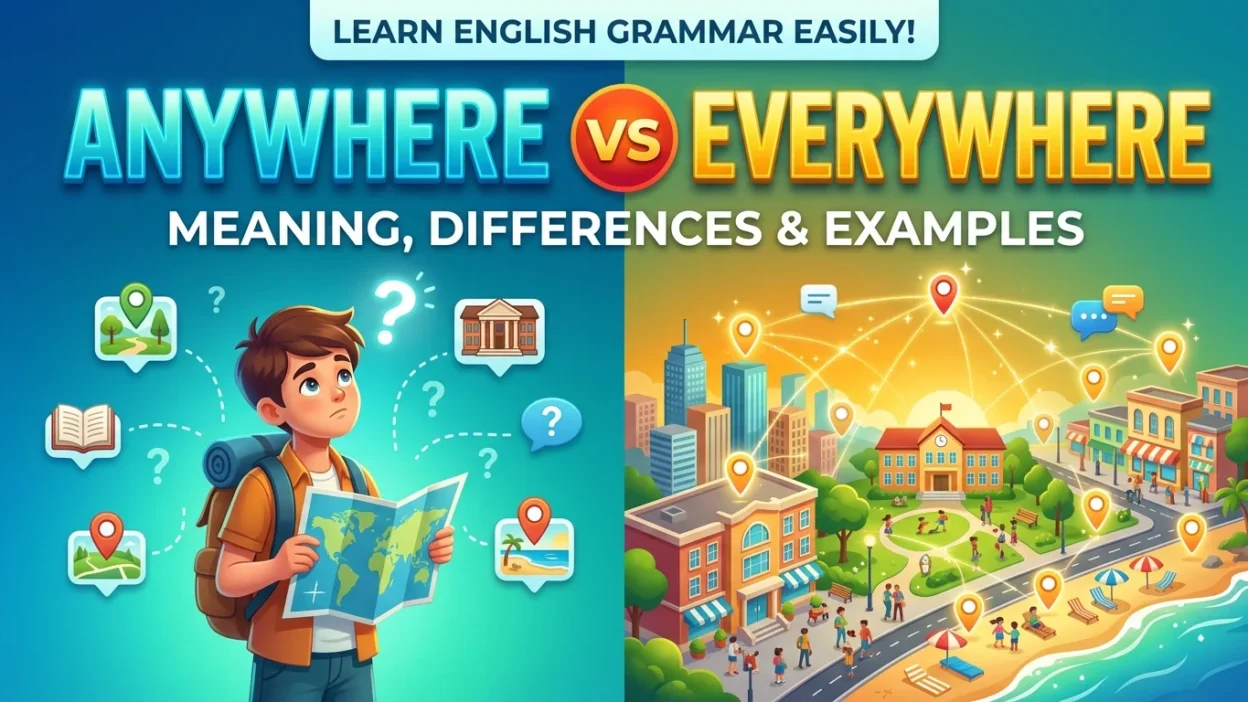
Have you ever wondered if to use anywhere or everywhere in a sentence? These two English words look similar because they both refer to places, but they have different meanings. Understanding the difference between anywhere and everywhere can help you speak more naturally, write more clearly, and avoid common English grammar mistakes.
The main difference is that anywhere refers to any place, while everywhere refers to all places or every place. For example, “You can sit anywhere” means you can choose any available place to sit. In contrast, “I looked everywhere” means you searched all the places you could think of. Although both words can describe locations, they are not always interchangeable. Learning when to use each word is especially helpful for students, ESL learners, and anyone improving their everyday English.
Quick Answer: Anywhere vs Everywhere
Anywhere means any place or no specific place. It is often used in questions, negative sentences, and sentences about freedom of choice. Everywhere means all places or every place within a particular area. Use anywhere when referring to any possible location and everywhere when referring to locations collectively.
Why Do People Confuse Anywhere and Everywhere?
People often confuse anywhere and everywhere because both words contain the word where and refer to places. However, the first part of each word changes its meaning.
- Any + where = Anywhere: Any place, whichever place, or no particular place.
- Every + where = Everywhere: Every place or all places within a relevant area.
Consider these examples:
- You can find a seat anywhere. (Any suitable seat is fine.)
- You can find flowers everywhere in the garden. (Flowers are present throughout the garden.)
The difference is between choosing or referring to any possible place and describing all places.
What Does Anywhere Mean?
Anywhere means any place, whichever place, or a place that is not specified. It often appears when someone has freedom to choose a location, asks whether something is possible in a location, or says that something does not happen in any location.
When Is Anywhere Used?
Use anywhere in these situations:
1. To express freedom of choice
When someone can choose any location, use anywhere.
- You can park anywhere in this area.
- I would love to travel anywhere in Europe.
- Sit anywhere you like.
2. In questions about locations
Anywhere is common when asking whether a person or thing can be found in a place.
- Have you seen my phone anywhere?
- Is there anywhere we can get some food?
- Can we go anywhere interesting this weekend?
3. In negative sentences
Anywhere often appears with words such as not, can’t, don’t, and didn’t.
- I can’t find my keys anywhere.
- We didn’t go anywhere yesterday.
- There isn’t anywhere to sit.
4. To describe a lack of restrictions
Anywhere can indicate that a person or thing is not restricted to one location.
- You can work from anywhere with a reliable internet connection.
- She is happy to travel anywhere for her job.
What Does Everywhere Mean?
Everywhere means every place or all places within a particular area or relevant context. It describes something that is present, happening, or found throughout multiple locations.
When Is Everywhere Used?
Use everywhere in these situations:
1. To describe something found in all places
- There are books everywhere in the library.
- We saw colorful decorations everywhere.
- People were celebrating everywhere in the city.
2. To describe a thorough search
- I looked everywhere for my wallet.
- She searched everywhere for her missing notebook.
- We checked everywhere before leaving the house.
3. To describe widespread activity
- News of the victory spread everywhere.
- Tourists were taking pictures everywhere.
- During the festival, music could be heard everywhere in the neighborhood.
4. To emphasize that something is widespread
- Smartphones are everywhere these days.
- You can see advertisements everywhere in the city.
- Her artwork is displayed everywhere in the building.
In these examples, everywhere emphasizes that something occurs throughout a relevant area rather than at just one possible location.
Anywhere vs Everywhere: Comparison Table
| Feature | Anywhere | Everywhere |
|---|---|---|
| Meaning | Any place or no specific place | Every place or all places |
| Main idea | Possibility, choice, or an unspecified location | All locations within a relevant area |
| Common use | Questions, negative sentences, and choices | Statements about widespread presence or activity |
| Example | You can sit anywhere. | People were sitting everywhere. |
| Meaning of the example | You can choose any suitable seat. | People occupied many places throughout the area. |
| Negative sentence | I couldn’t find it anywhere. | There wasn’t rubbish everywhere. |
| Question | Did you go anywhere? | Is there evidence of damage everywhere? |
| Can it suggest freedom? | Yes | Usually not |
| Can it suggest widespread presence? | Not by itself | Yes |
| Easy memory tip | Any place | Every place |
When Should You Use Anywhere or Everywhere?
Choosing the correct word becomes easier when you focus on what you want to communicate.
Use Anywhere When You Mean Any Place
Choose anywhere when the location is not specified or when any suitable location is acceptable.
Examples:
- You can buy this book anywhere online.
- I don’t want to go anywhere tonight.
- Is there anywhere nearby to eat?
- She can study anywhere she feels comfortable.
Simple rule: If you mean any place, use anywhere.
Use Everywhere When You Mean All Places
Choose everywhere when you want to describe something found or happening throughout a relevant area.
Examples:
- Snow covered everywhere in the village.
- I searched everywhere for my glasses.
- There were balloons everywhere at the party.
- The news was everywhere on social media.
Simple rule: If you mean all places, use everywhere.
Remember that everywhere does not always mean literally every location in the world. Its scope depends on the context. For example, “There was mud everywhere” usually means mud was spread throughout the relevant area.
12 Examples of Anywhere vs Everywhere in Sentences
The following examples show how the two words work in everyday English.
| No. | Sentence | Meaning |
|---|---|---|
| 1 | You can sit anywhere you like. | You may choose any suitable place to sit. |
| 2 | I looked everywhere for my phone. | I searched all the places I could think of. |
| 3 | Did you go anywhere yesterday? | Did you visit any place yesterday? |
| 4 | There were flowers everywhere in the garden. | Flowers were spread throughout the garden. |
| 5 | I couldn’t find my wallet anywhere. | I couldn’t find it in any place I checked. |
| 6 | You can travel anywhere with enough planning. | You can choose from many possible destinations. |
| 7 | The children left toys everywhere. | Toys were scattered throughout the relevant area. |
| 8 | Is there anywhere we can park? | Is there any place available for parking? |
| 9 | I see this brand everywhere. | I see the brand in many places. |
| 10 | She didn’t go anywhere after work. | She did not visit any place after work. |
| 11 | We searched everywhere for the missing dog. | We checked all the places we could think of. |
| 12 | You can find information about the topic almost anywhere online. | Information is available in many possible online locations. |
More Examples in Everyday Conversations
Conversation 1: Choosing a seat
A: Where should I sit?
B: You can sit anywhere.
Here, anywhere means the person can choose any suitable seat.
Conversation 2: Looking for a lost item
A: Have you seen my keys?
B: No, I’ve looked everywhere.
Here, everywhere means the person has searched all the relevant places.
Conversation 3: Planning a trip
A: Where would you like to go on vacation?
B: Anywhere with beautiful beaches!
Here, anywhere expresses freedom of choice.
Conversation 4: Describing a messy room
A: Why is your room so messy?
B: There are clothes everywhere!
Here, everywhere emphasizes that clothes are scattered throughout the room.
Common Mistakes With Anywhere and Everywhere
Even English learners who understand the basic difference sometimes use these words incorrectly. Here are common mistakes and their corrections.
Mistake 1: Using Everywhere When You Mean Any Place
Incorrect: You can sit everywhere you like.
Correct: You can sit anywhere you like.
Why? The speaker is offering a choice of seats, not saying that someone can sit in every location simultaneously.
Mistake 2: Using Anywhere to Describe Widespread Presence
Incorrect: I looked anywhere for my missing phone.
Correct: I looked everywhere for my missing phone.
Why? The sentence describes a search across all relevant places. Everywhere is the natural choice.
Mistake 3: Forgetting the Negative Structure
Incorrect: I can’t find my bag everywhere.
Correct: I can’t find my bag anywhere.
Why? In a negative sentence, anywhere commonly means that the item cannot be found in any place.
Mistake 4: Assuming Everywhere Always Means the Whole World
Incorrect assumption: Everywhere always refers to every place on Earth.
Correct understanding: Everywhere refers to all relevant places in the context.
For example, “There was food everywhere” usually refers to the room, table, or event being discussed.
Mistake 5: Using Anywhere and Everywhere Interchangeably
Incorrect: I saw colorful lights anywhere during the festival.
Correct: I saw colorful lights everywhere during the festival.
Why? The sentence describes lights appearing throughout the festival area, so everywhere is more appropriate.
What Is an Easy Memory Trick for Anywhere vs Everywhere?
Use this simple memory trick:
- ANYWHERE = ANY place.
- EVERYWHERE = EVERY place.
Think of anywhere as a choice and everywhere as a collection of locations.
For example:
- “Choose anywhere” means you can choose any suitable place.
- “Look everywhere” means search all the relevant places.
You can also remember the difference with two simple questions:
Are you talking about any possible location? Use anywhere.
Are you talking about all locations in an area? Use everywhere.
This trick works well for everyday conversations, school assignments, and English grammar exercises.
Anywhere vs Everywhere in American and British English
There is no major difference in the meaning of anywhere and everywhere between American and British English. Both varieties use the words in essentially the same way.
| Situation | American English | British English |
|---|---|---|
| Offering a choice | You can sit anywhere. | You can sit anywhere. |
| Describing widespread presence | There are people everywhere. | There are people everywhere. |
| Asking about a place | Is there anywhere to eat? | Is there anywhere to eat? |
| Describing a search | I looked everywhere. | I looked everywhere. |
The main distinction is meaning, not regional usage. English speakers in both the United States and the United Kingdom use anywhere for any place and everywhere for all relevant places.
Similar Words: Somewhere, Nowhere, Anywhere, and Everywhere
Anywhere and everywhere belong to a group of English words that describe places. Understanding the related words can make their meanings easier to remember.
| Word | Meaning | Example |
|---|---|---|
| Somewhere | In or at an unspecified place | I left my notebook somewhere. |
| Anywhere | Any place or no specific place | You can sit anywhere. |
| Nowhere | Not in any place | There is nowhere to park. |
| Everywhere | In or at all relevant places | We saw flowers everywhere. |
Anywhere vs Somewhere
Anywhere often expresses an open choice, appears in questions, or is used in negative sentences. Somewhere usually refers to an unspecified place that exists or is being considered.
- You can go anywhere you want.
- I want to go somewhere quiet.
The first sentence allows an open choice of destinations. The second suggests a particular kind of place without naming it.
Anywhere vs Nowhere
Anywhere refers to any place, while nowhere means no place.
- I can’t find my phone anywhere.
- There is nowhere to sit.
The first sentence says the speaker cannot find the phone in any place. The second says that no suitable place to sit is available.
Everywhere vs Somewhere
Everywhere refers to all relevant places, while somewhere refers to one unspecified place.
- I looked everywhere for my glasses.
- I left my glasses somewhere in the house.
The first sentence describes a broad search. The second identifies an unknown location where the glasses were left.
Final Verdict: Anywhere or Everywhere?
The difference between anywhere and everywhere is simple once you understand the words any and every.
Use anywhere when referring to any possible place, an unspecified location, or freedom of choice. It is especially common in questions and negative sentences.
Use everywhere when describing all places within a relevant area, especially when something is present, happening, or being searched for throughout that area.
Compare these two sentences:
- You can go anywhere. (You can choose any destination.)
- I looked everywhere. (I searched all the relevant places.)
Although the words are related, they communicate different ideas. Choosing the correct one makes your English clearer and more natural.
Frequently Asked Questions
1. What is the main difference between anywhere and everywhere?
Anywhere means any place or an unspecified place, while everywhere means all places within a relevant area. For example, “You can sit anywhere” offers a choice, whereas “People were sitting everywhere” describes people spread throughout an area.
2. Can I use anywhere and everywhere interchangeably?
No, not in most contexts. Anywhere usually expresses possibility, choice, or an unspecified location. Everywhere describes all relevant locations. Replacing one with the other can change the meaning of a sentence.
3. Is anywhere used in negative sentences?
Yes. Anywhere is common in negative sentences because it can mean “in any place.” For example, “I can’t find my keys anywhere” means the speaker cannot find the keys in any of the places checked.
4. Does everywhere mean all over the world?
Not necessarily. Everywhere means all relevant places, and the context determines the area. In “There were toys everywhere,” the word usually refers to the room or area being discussed, not the entire world.
5. What is the difference between anywhere and somewhere?
Anywhere refers to any place or an unspecified location, often in questions, negative statements, and expressions of choice. Somewhere generally refers to one unspecified place. For example, “Can we go anywhere?” asks about possible destinations, while “Let’s go somewhere quiet” suggests an unspecified quiet place.
6. Which is correct: “I looked anywhere” or “I looked everywhere”?
“I looked everywhere” is the natural choice when you mean that you searched all the relevant places. “I looked anywhere” is generally unnatural for this meaning. A more suitable sentence would be “I looked anywhere I could think of,” although “I looked everywhere I could think of” is usually more natural.
7. Is everywhere one word or two words?
Everywhere is written as one word. Anywhere, somewhere, and nowhere are also single words. These are compound words used to refer to places.
8. What is the easiest way to remember anywhere vs everywhere?
Remember that anywhere means “any place,” while everywhere means “every place.” Use anywhere for choices and possibilities, and use everywhere to describe something found or happening throughout a relevant area.
Remember This
- Anywhere = any place.
- Everywhere = every place.
- Use anywhere when offering a choice or asking about possible locations.
- Use anywhere in many negative sentences, such as “I couldn’t find it anywhere.”
- Use everywhere when describing something spread throughout an area.
- The surrounding context determines which word is correct.
Conclusion
Understanding anywhere vs everywhere is an important step toward using English more accurately. Although both words refer to places, anywhere focuses on possible locations or freedom of choice, while everywhere describes all relevant locations. Remembering this distinction can help you avoid common mistakes in everyday conversations and written English.
The easiest way to master these words is to practice them in real sentences. Say “You can sit anywhere” when someone can choose a place, and say “I looked everywhere” when describing a thorough search. With regular practice, you will find it much easier to choose the right word naturally.

Adam Cody is a passionate writer at SleepCout, exploring coded dreams, dream meanings, sleep science, lucid dreaming, and symbolism through engaging, well-researched articles that inspire curiosity and self-discovery.