
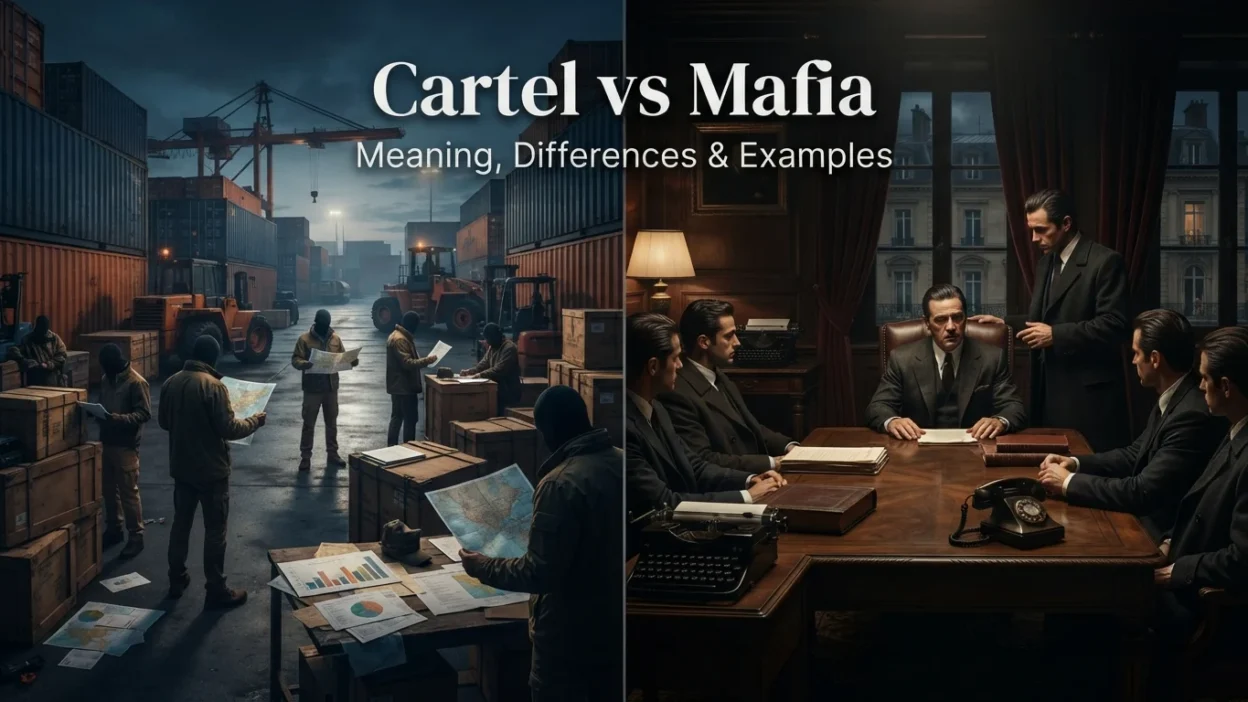
When you hear cartel and mafia, both words may bring to mind organized criminal groups, illegal businesses, violence, and secret networks. Because they can overlap in how they operate, it is easy to think they mean the same thing. However, cartel vs mafia is an important distinction: the two terms describe different types of organized groups.
A cartel is generally an organized agreement or association between separate groups or businesses that cooperate to control a market or illegal trade. A mafia, by contrast, usually refers to a structured criminal organization with a hierarchy, long-term membership, and a broader range of criminal activities. The exact meaning can depend on context, especially because mafia can also refer specifically to historical groups such as the Sicilian Mafia.
Quick Answer: Cartel vs Mafia
A cartel is a group or alliance that cooperates to control a particular market or trade, often illegally. A mafia is a structured criminal organization whose members operate under an established hierarchy and may engage in extortion, illegal gambling, trafficking, corruption, and other crimes. The terms can overlap, but they are not synonyms.
Why Do People Confuse Cartel and Mafia?
People often confuse these words because both can describe organized crime. Both may involve secrecy, leadership structures, violence, corruption, and illegal profits.
The main difference is their organizational purpose and usage.
A cartel often emphasizes cooperation or control of a particular market or trade. The word can also be used outside crime—for example, economists may discuss companies forming a cartel to restrict competition.
Mafia more commonly describes a criminal organization or organized-crime network with a durable internal structure. It may earn money from several illegal activities rather than focusing on one particular market.
What Does “Cartel” Mean?
A cartel is an association or agreement among separate parties that cooperate to achieve a shared goal, especially by controlling prices, production, supply, territory, or trade.
The word is used in both legal-economic and criminal contexts.
Cartel in Business
In economics, a cartel can involve independent companies agreeing to limit competition. They might coordinate prices or production instead of competing normally.
For example:
Several companies secretly agree to keep their prices artificially high.
That arrangement can violate competition laws.
Cartel in Organized Crime
In discussions of organized crime, cartel often refers to a large criminal organization involved in controlling an illegal market, such as drug production, trafficking, or distribution.
For example:
Authorities investigated a cartel accused of controlling parts of an illegal drug supply chain.
So, cartel does not automatically mean mafia, and it does not always refer to crime.
What Does “Mafia” Mean?
Mafia is commonly used for a structured criminal organization, especially one associated historically with Sicily and later with organized-crime groups in other countries.
A mafia-type organization may have:
- A hierarchy of leaders and members
- Long-term organizational relationships
- Rules or codes of conduct
- Territorial influence
- Extortion
- Illegal gambling
- Smuggling or trafficking
- Corruption
- Money laundering
- Protection rackets
The capitalized Mafia can specifically refer to the Sicilian criminal tradition, while lowercase mafia can be used more broadly for organized criminal groups.
Cartel vs Mafia: Comparison Table
| Feature | Cartel | Mafia |
|---|---|---|
| Basic meaning | An alliance or association formed around a shared goal | A structured criminal organization |
| Main idea | Cooperation and control | Organized criminal power and hierarchy |
| Can be legal? | Yes, historically and conceptually; many cartels are illegal under competition law | Generally refers to criminal activity |
| Criminal use | Often associated with controlling an illegal trade | Often associated with multiple criminal activities |
| Structure | Can consist of separate groups cooperating | Usually has an established internal hierarchy |
| Activities | Often focused on a particular market or trade | May operate across several criminal activities |
| Example context | Drug-trafficking cartel | Sicilian Mafia |
| Word usage | Business, economics, and organized crime | Primarily organized crime |
When Should You Use “Cartel”?
Use cartel when you are talking about an alliance or coordinated group whose members cooperate to control a market, trade, supply, territory, or similar activity.
Examples
- “The companies were accused of forming a price cartel.”
- “The authorities investigated an international drug cartel.”
- “Several groups reportedly cooperated as a cartel.”
- “The cartel allegedly controlled part of the illegal supply chain.”
- “Economists studied how the cartel affected competition.”
Remember that cartel has a broader meaning than criminal organization.
When Should You Use “Mafia”?
Use mafia when referring to a structured criminal organization or, in a more specific historical context, the Sicilian Mafia.
Examples
- “The investigation focused on an alleged mafia organization.”
- “The novel portrays a powerful mafia family.”
- “The police investigated suspected mafia activity.”
- “The film tells a fictional story about a mafia boss.”
- “The Sicilian Mafia has a long and documented history.”
The word mafia is particularly common in discussions of organized crime, crime fiction, and popular culture.
Cartel vs Mafia: 10+ Examples
Here are practical examples showing how the words differ:
- The government investigated a cartel accused of controlling the illegal trade.
- Several companies were accused of forming a cartel to manipulate prices.
- The authorities arrested members of an alleged mafia organization.
- The movie follows a fictional mafia family.
- The cartel allegedly coordinated the production and distribution of illegal goods.
- The investigation uncovered alleged connections between organized-crime figures and corrupt officials.
- A cartel may consist of separate groups cooperating toward a common objective.
- A mafia organization may maintain a hierarchy of leaders and subordinate members.
- The journalist wrote about the economic effects of a suspected cartel.
- The documentary examines the history of the Sicilian Mafia.
- Police launched an investigation into alleged cartel activity.
- The fictional character was portrayed as a powerful mafia boss.
Common Mistakes
Mistake 1: Treating the Words as Exact Synonyms
It is not always correct to replace cartel with mafia.
A cartel describes a particular kind of association or coordinated group, while mafia generally refers to a criminal organization.
Mistake 2: Assuming Every Cartel Is Criminal
The word cartel can appear in economics and business discussions.
For example:
“The companies formed a cartel to coordinate prices.”
The sentence describes an anticompetitive arrangement, not necessarily a drug-trafficking organization.
Mistake 3: Assuming Mafia Means Only the Sicilian Mafia
Historically, Mafia has a specific connection to Sicily. In modern English, however, mafia is also commonly used more broadly for organized criminal groups.
Context determines the intended meaning.
Mistake 4: Using “Mafia” for Any Group of Criminals
A group of criminals is not automatically a mafia. The term generally suggests a more organized, durable criminal structure.
Memory Trick: Cartel vs Mafia
A simple way to remember the difference is:
Cartel = Cooperation and Control
Mafia = Membership and Organized Crime
Think of cartel as emphasizing coordination around a market or activity, while mafia emphasizes a structured criminal organization.
American vs British English
Both cartel and mafia are used in American and British English.
There is no major American-versus-British spelling difference for these words.
However, their frequency can depend on context. American media often uses cartel when discussing organized groups involved in drug trafficking, while British English also uses cartel frequently in economic and competition-law contexts.
Mafia is similarly understood in both varieties of English.
Similar Words
Several related words can overlap with cartel and mafia, but they are not identical.
- Gang — a group of people, often involved in criminal activity.
- Syndicate — an organized group formed to carry out a particular activity; it can refer to organized crime.
- Crime family — a term often used for a mafia-related criminal organization.
- Organized crime — criminal activity carried out through structured, continuing groups or networks.
- Mob — an informal term often used for organized criminals collectively.
- Consortium — a group of organizations or individuals working together, usually in a legitimate context.
- Alliance — a general term for groups cooperating toward a shared objective.
These words should be chosen according to the specific situation rather than treated as interchangeable.
Final Verdict
Cartel and mafia are related but different terms.
A cartel is fundamentally about coordination or cooperation among separate parties, often to control a market, trade, supply, or other activity. In organized-crime contexts, the word commonly describes groups involved in controlling illegal markets.
A mafia is generally a structured criminal organization with an established network or hierarchy and involvement in organized criminal activity.
The simplest distinction is:
Cartel = a coordinated alliance or group focused on control or cooperation.
Mafia = a structured criminal organization.
Frequently Asked Questions
Is a cartel the same as a mafia?
No. A cartel and a mafia can both be involved in organized crime, but they are not exact synonyms. Cartel emphasizes cooperation or control, while mafia generally refers to a structured criminal organization.
Is a cartel always illegal?
No. The word cartel can describe an economic arrangement between companies, although many forms of price-fixing and market manipulation are illegal under competition laws. In criminal contexts, cartel commonly refers to organized groups controlling illegal markets.
What is the main difference between a cartel and a mafia?
The main difference is organization and purpose. A cartel generally involves coordinated parties seeking control over a market or activity, whereas a mafia generally refers to a continuing criminal organization with an internal structure.
Can a mafia be part of a cartel?
In some contexts, separate organized-crime groups can cooperate in ways that could be described as cartel-like. However, whether the term cartel is appropriate depends on the specific organization and activity being described.
Which word is used for drug-trafficking groups?
Cartel is commonly used in reporting and general discussion of large organized groups involved in drug trafficking. Mafia can also describe organized criminal groups involved in drug trafficking, but the terms emphasize different aspects of organization.
Is “Mafia” a proper noun?
Mafia is capitalized when referring specifically to the historical Sicilian Mafia as a proper name. The lowercase mafia can be used as a general term for a criminal organization or mafia-like group.
What is another word for mafia?
Depending on context, related terms include organized-crime group, criminal organization, crime family, syndicate, and mob. These terms are not perfect synonyms and can have different meanings.
Remember This
Cartel usually emphasizes cooperation, coordination, or control, especially over a market or trade.
Mafia usually emphasizes a structured and continuing criminal organization.
So, when comparing cartel vs mafia, don’t automatically treat them as interchangeable. The surrounding context tells you which word is more precise.
Understanding this distinction helps you use both terms accurately in everyday English, news writing, academic discussions, and conversations about organized crime.
Conclusion
The difference between cartel and mafia is mainly a difference in how the organization is described. Cartel focuses on coordinated action or control, and it can be used in both economic and criminal contexts. Mafia generally describes a structured criminal organization, with the word also having a specific historical connection to Sicily.
If you remember only one thing, remember this: a cartel is characterized by coordinated control or cooperation, while a mafia is characterized by an organized criminal structure. Although the two concepts can overlap in real-world situations, choosing the right term depends on what you are describing.

John Tyler is a dream researcher and content writer at SleepCout, sharing insightful articles about coded dreams, dream meanings, symbolism, sleep psychology, and practical guidance to help readers understand their dreams.