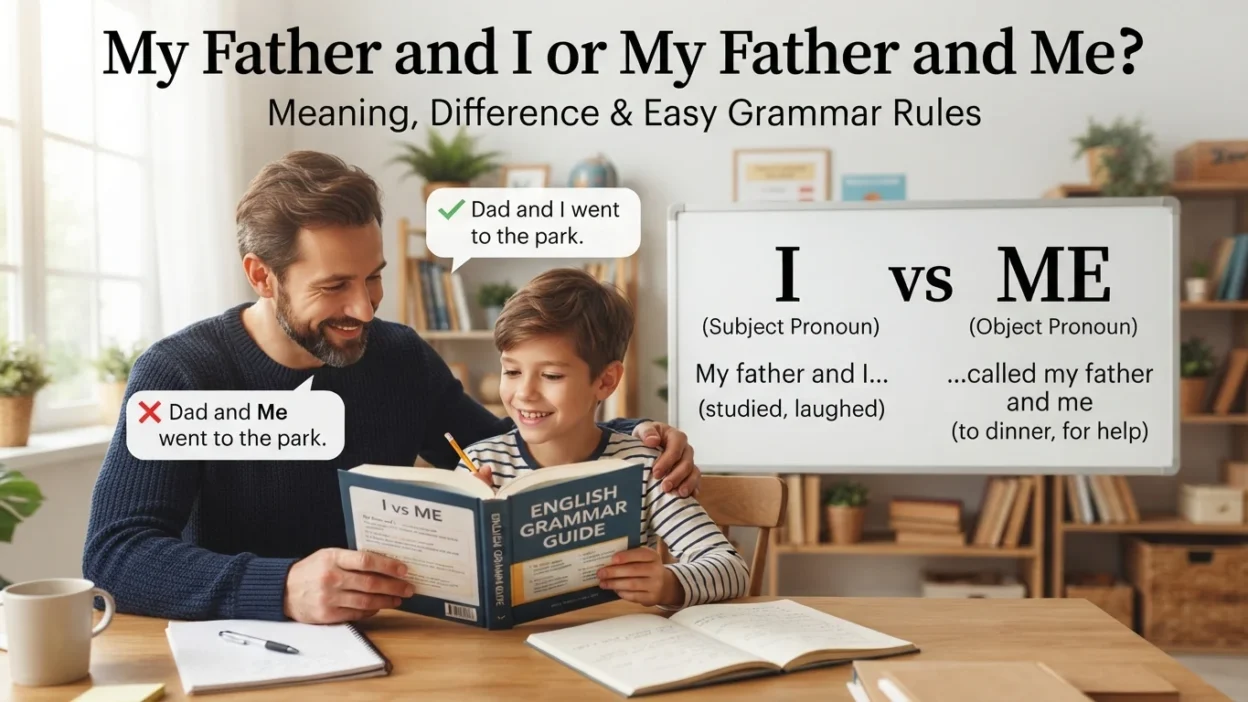
When you are talking about yourself and your father, should you say “my father and I” or “my father and me”? Both expressions can be correct, but they are used in different grammatical positions. The key is to determine whether the phrase is acting as the subject or the object of the sentence.
Use “my father and I” when you and your father perform the action. Use “my father and me” when the action happens to you and your father. This simple subject-versus-object rule works in most everyday sentences and can help you avoid one of the most common pronoun mistakes in English.
Quick Answer
“My father and I” is correct when the phrase is the subject: My father and I went shopping. “My father and me” is correct when the phrase is the object: She invited my father and me. Remove “my father” mentally and check whether I or me sounds correct.
Why Do People Confuse “My Father and I” and “My Father and Me”?
The confusion happens because English speakers often hear “my father and I” in formal sentences and begin using it everywhere.
However, I and me have different grammatical functions:
- I = subject pronoun
- Me = object pronoun
The presence of “my father and” does not change this rule.
Compare:
- My father and I went to the store.
- The teacher spoke to my father and me.
In the first sentence, the two people perform the action. In the second, they receive the action.
First Word: “I”
I is a subject pronoun. Use it when you are the person performing the action.
Examples:
- I called my father.
- My father and I went fishing.
- My father and I watched a movie.
- My father and I are visiting London.
A useful test is to remove “my father and.”
My father and I went home.
→ I went home. ✓
The sentence still works, so “my father and I” is correct.
Second Word: “Me”
Me is an object pronoun. Use it when you receive the action or when the pronoun follows a preposition.
Examples:
- My mother called me.
- She invited my father and me.
- The teacher spoke to my father and me.
- The gift was given to my father and me.
Try removing “my father and.”
She invited my father and me.
→ She invited me. ✓
Therefore, “my father and me” is correct.
My Father and I vs My Father and Me
| Phrase | Grammatical role | Example | Correct? |
|---|---|---|---|
| My father and I | Subject | My father and I went outside. | ✓ |
| My father and me | Object | She called my father and me. | ✓ |
| My father and I | Object | She called my father and I. | ✗ |
| My father and me | Subject | My father and me went outside. | ✗ in standard English |
The important point is that neither phrase is always correct or always incorrect. The correct choice depends on its role in the sentence.
When Should You Use “My Father and I”?
Use “my father and I” when the phrase is the subject.
Examples
- My father and I went to the park.
- My father and I enjoy cooking together.
- My father and I watched the football match.
- My father and I visited our relatives.
- My father and I are planning a trip.
- My father and I work together.
In each sentence, my father and I perform the action.
A Simple Test
Remove “my father and.”
My father and I went shopping.
→ I went shopping.
Because I is correct by itself, my father and I is correct.
When Should You Use “My Father and Me”?
Use “my father and me” when the phrase is the object.
Examples
- She invited my father and me to dinner.
- The teacher spoke to my father and me.
- They gave my father and me some advice.
- He drove my father and me home.
- The doctor talked with my father and me.
- The manager thanked my father and me.
Again, remove “my father and.”
She invited my father and me.
→ She invited me.
Because me is correct after invited, the original phrase should be my father and me.
10+ Examples of “My Father and I” vs “My Father and Me”
“My Father and I”
- My father and I went fishing.
- My father and I had breakfast together.
- My father and I visited the museum.
- My father and I love old movies.
- My father and I are working on a project.
- My father and I traveled to another city.
“My Father and Me”
- My uncle invited my father and me.
- She gave my father and me a present.
- The guide showed my father and me around the city.
- He asked my father and me a question.
- They waited for my father and me.
- The teacher called my father and me into the office.
Common Mistakes
Mistake 1: Using “I” after a verb
❌ She invited my father and I.
✅ She invited my father and me.
The verb invited needs an object, so me is correct.
Mistake 2: Using “me” as the subject
❌ My father and me went shopping.
✅ My father and I went shopping.
The phrase is the subject, so I is required in standard English.
Mistake 3: Choosing “I” because it sounds formal
Some people think I is always more formal or grammatically correct.
That is not true.
The teacher spoke to my father and me.
Using I here does not make the sentence more formal; it makes it grammatically incorrect in standard English.
Mistake 4: Forgetting the “remove the other person” test
When you are unsure, temporarily remove “my father and.”
- ___ went to school → I went to school ✓
- She called ___ → She called me ✓
This quickly reveals the correct pronoun.
Memory Trick
Remember:
I = I do the action.
Me = the action happens to me.
For example:
- My father and I went home. → We did the action.
- She called my father and me. → We received the action.
Another quick trick:
I = subject
Me = object
If you can replace the phrase with we, choose my father and I.
If you can replace it with us, choose my father and me.
American vs British English
The basic distinction between I and me is the same in both American and British English.
For example:
- American English: My father and I went home.
- British English: My father and I went home.
And:
- American English: She spoke to my father and me.
- British English: She spoke to my father and me.
There may be differences in informal speech and regional usage, but the standard subject/object distinction remains the same.
Similar Words and Expressions
The same principle applies to other coordinated pronoun phrases.
My mother and I / My mother and me
- My mother and I went shopping.
- She called my mother and me.
My brother and I / My brother and me
- My brother and I play tennis.
- They invited my brother and me.
My friend and I / My friend and me
- My friend and I studied together.
- The teacher helped my friend and me.
The name of the other person does not change the rule. You still need to determine whether the pronoun is a subject or object.
Final Verdict
Both “my father and I” and “my father and me” can be grammatically correct.
Use:
- My father and I → when the phrase is the subject
- My father and me → when the phrase is the object
For example:
My father and I went to the store.
The shopkeeper helped my father and me.
The easiest way to choose is to remove “my father and” and see whether I or me fits the sentence.
Frequently Asked Questions
Is “my father and I” always correct?
No. “My father and I” is correct when the phrase functions as the subject. If it functions as an object, use “my father and me.”
Is “my father and me” grammatically correct?
Yes. “My father and me” is correct when the phrase is an object, such as in “She invited my father and me.”
Which is correct: “my father and I went” or “my father and me went”?
“My father and I went” is correct because the phrase is the subject of went.
Which is correct: “between my father and I” or “between my father and me”?
“Between my father and me” is correct because between is a preposition and requires an object pronoun.
Can I say “my father and I” after a preposition?
In standard English, normally no. After a preposition such as to, for, with, between, or from, use me.
- with my father and me
- for my father and me
- between my father and me
How can I quickly remember the difference?
Remove “my father and.” If I works, use my father and I. If me works, use my father and me.
Is “my father and me” informal English?
Not necessarily. It is completely standard when me is grammatically required as the object.
Remember This
My father and I = subject.
My father and me = object.
Ask yourself: Who is doing the action? Use I.
Ask yourself: Who is receiving the action? Use me.
Conclusion
The difference between “my father and I” and “my father and me” is simple once you understand subject and object pronouns. I is used when you are part of the subject performing the action, while me is used when you are part of the object receiving the action.
When you are unsure, remove “my father and” from the sentence. If the remaining sentence needs I, choose “my father and I.” If it needs me, choose “my father and me.” This quick test works in most everyday situations and makes the choice much easier.

John Tyler is a dream researcher and content writer at SleepCout, sharing insightful articles about coded dreams, dream meanings, symbolism, sleep psychology, and practical guidance to help readers understand their dreams.