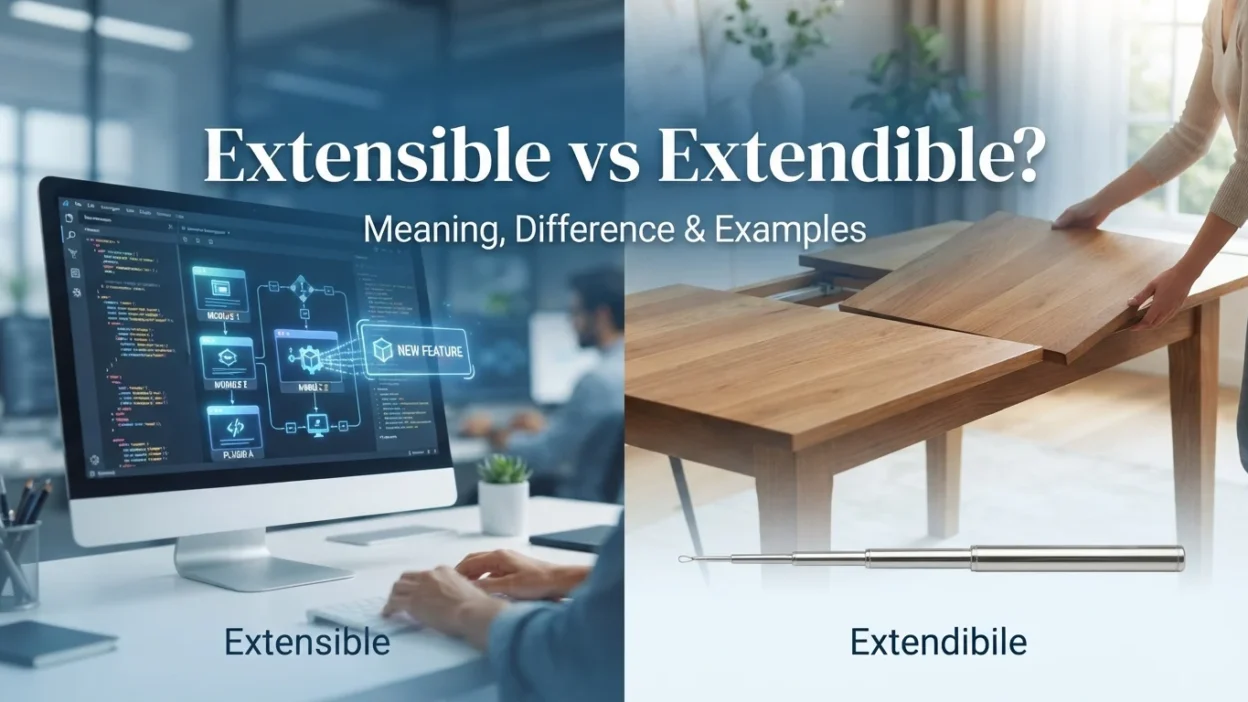
When you want to describe something that can be made longer, larger, or more capable, you may wonder whether extensible or extendible is the correct word. Both words are real English words, and both are related to the verb extend, but they are not always used in exactly the same way.
The main difference is that extensible commonly describes something that can be expanded, enlarged, or developed further, especially a system, software, design, or structure. Extendible generally means something that can physically or practically be extended, lengthened, or prolonged. In many situations, the words can overlap, but their typical contexts are different.
Quick Answer
Extensible and extendible both mean “capable of being extended,” but extensible is much more common when discussing systems, software, designs, or things that can be expanded with additional features. Extendible is more often used for something that can physically be lengthened or whose duration can be prolonged.
Why Do People Confuse Extensible and Extendible?
The confusion is understandable because both words come from extend, and their meanings overlap.
The suffix -ible and -able can both help form adjectives describing possibility. As a result, extensible and extendible can both suggest that something is capable of being extended.
However, English usage has developed different preferences for these words.
For example:
- Extensible software can be expanded by adding new features or components.
- An extendible table can be physically made longer.
- An extendible contract can have its duration prolonged.
There are also contexts where either word might be understood, although one will usually sound more natural.
What Does Extensible Mean?
Extensible is an adjective meaning capable of being extended, expanded, or developed further.
It is especially common when talking about software, computer systems, architectures, frameworks, designs, and other systems that can accept additional functionality.
Examples of Extensible
- The software has an extensible architecture.
- We need an extensible platform for future development.
- The framework is highly extensible.
- This design is flexible and extensible.
- The system was built to be extensible.
In technology, extensible often suggests that something was designed so that new components or capabilities can be added without completely replacing the existing system.
Extensible in Technology
You will frequently encounter phrases such as:
- extensible software
- extensible framework
- extensible platform
- extensible architecture
- extensible system
- extensible design
- extensible API
For example:
The application uses an extensible architecture that allows developers to add new features.
Here, extensible is natural because the application can be expanded with additional functionality.
What Does Extendible Mean?
Extendible means capable of being extended.
It can describe something that can be made longer, larger, or continue for a longer period.
For example:
- an extendible table
- an extendible ladder
- an extendible contract
- an extendible deadline
- an extendible agreement
Consider this sentence:
The contract is extendible for another six months.
Here, extendible means that the contract can be prolonged.
The word is perfectly understandable, but in some contexts, extensible may also be used depending on the intended meaning and field.
Extensible vs Extendible: Comparison Table
| Feature | Extensible | Extendible |
|---|---|---|
| Basic meaning | Capable of being extended or expanded | Capable of being extended |
| Common context | Software, systems, frameworks, designs | Physical objects, periods, contracts |
| Common idea | Expansion or addition | Lengthening or prolongation |
| Technology use | Very common | Less common |
| Example | An extensible software platform | An extendible table |
| Related verb | Extend | Extend |
| Grammar | Adjective | Adjective |
The distinction is not absolute. Context matters, and dictionaries may give overlapping definitions.
When Should You Use Extensible?
Use extensible when you are talking about something that can be expanded, developed, or enhanced, particularly a system or structure designed to accommodate additions.
Use “extensible” for:
- software
- computer systems
- frameworks
- platforms
- architectures
- programming languages
- designs
- models
- systems
Examples
The framework is highly extensible.
We chose an extensible platform for the project.
The software has an extensible plugin system.
The architecture is designed to be extensible.
In these examples, the focus is on adding capabilities rather than simply making something physically longer.
When Should You Use Extendible?
Use extendible when something can be lengthened or prolonged.
Use “extendible” for:
- tables
- ladders
- poles
- physical structures
- contracts
- deadlines
- agreements
- periods of time
Examples
We bought an extendible dining table.
The deadline is extendible under certain conditions.
The contract is extendible for one additional year.
This ladder is extendible to five meters.
In these examples, extendible emphasizes the possibility of extending the object’s size or the duration of something.
10+ Examples of Extensible and Extendible
Here are examples that show the difference more clearly.
- The software has an extensible architecture.
The architecture can accommodate additional features. - This is an extensible framework.
Developers can expand its functionality. - The platform was designed to be extensible.
New capabilities can be added later. - The application uses an extensible plugin system.
Additional plugins can expand its functionality. - The dining table is extendible.
Its physical length can be increased. - The contract is extendible by mutual agreement.
Its duration can be prolonged. - The deadline is extendible in exceptional circumstances.
The period can be made longer. - We purchased an extendible ladder.
The ladder can be lengthened. - The system has an extensible design.
It can be developed with additional functionality. - The agreement is extendible for another six months.
Its duration can continue beyond the original period. - The framework provides an extensible interface.
Developers can add new components or functions. - We need an extendible table for large family gatherings.
The table can physically become longer.
Common Mistakes
Mistake 1: Treating the Words as Completely Different
The two words have overlapping meanings. It would be incorrect to assume that extensible always means one thing and extendible always means something completely different.
Both can refer to something capable of being extended.
Mistake 2: Using “Extendible” for Every Technology Context
Although extendible can technically express the idea of something being capable of extension, extensible is generally the more natural choice in many technical contexts.
For example:
The software is extensible.
sounds more natural than:
The software is extendible.
Mistake 3: Assuming “Extensible” Only Means Physical Extension
Extensible does not necessarily mean physically longer.
It can refer to expanding functionality, capabilities, scope, or structure.
The platform is extensible.
Here, nobody is suggesting that the physical platform becomes longer.
Mistake 4: Ignoring Context
The surrounding noun often tells you which adjective is more natural.
Compare:
- extensible software
- extendible table
The first concerns functionality, while the second concerns physical length.
Memory Trick
A simple way to remember the difference is:
Extensible = expandable
Think of software, systems, and designs that can grow with new features.
Extendible = extendable in length or duration
Think of a table that gets longer or a contract that lasts longer.
A useful shortcut is:
Extensible → expand capabilities
Extendible → extend length or time
This is not an absolute grammar rule, but it is a useful guide for choosing the more natural word.
American vs British English
Both extensible and extendible can be found in English varieties, including American and British English.
The difference is generally more about context and conventional usage than a strict American-versus-British distinction.
In technical writing, extensible is particularly common because technology often involves systems that can be expanded with additional functionality.
For physical objects or periods of time, extendible may be used, although extendable is also a common alternative.
For example:
- extensible software
- extendible contract
- extendable table
Actual word choice can depend on the industry, publication, and writer.
Similar Words
Several words are closely related to extensible and extendible.
Extendable
Extendable means capable of being extended.
The table has an extendable surface.
This is a very useful alternative, especially for physical objects.
Expandable
Expandable means capable of becoming larger or more extensive.
The storage system is expandable.
Expandible
Expandible exists but is much less common than expandable in ordinary modern English.
Flexible
Flexible means capable of adapting or changing easily.
The system has a flexible design.
It does not necessarily mean that something can literally be extended.
Prolongable
Prolongable means capable of being continued for a longer period.
The agreement is prolongable under certain conditions.
This word is more specialized and less common in everyday English.
Final Verdict
Both extensible and extendible are legitimate words, and both relate to the idea of something being capable of extension.
Choose extensible when you are describing something that can be expanded, developed, or enhanced, especially software, systems, frameworks, architectures, and designs.
Choose extendible when you mean something can be lengthened or prolonged, particularly a physical object, contract, deadline, or period.
When talking about technology, extensible is usually the more natural choice.
Frequently Asked Questions
Is extensible or extendible correct?
Both extensible and extendible are correct English words. The better choice depends on context. Extensible is especially common for systems and software, while extendible often describes something whose physical size or duration can be increased.
Is extensible the same as extendible?
They have closely related meanings and can overlap. Both can mean “capable of being extended.” However, extensible commonly emphasizes expansion or added functionality, while extendible often emphasizes lengthening or prolonging something.
Is extensible or extendable better?
Neither is universally better. Extensible is especially common in technical contexts such as software and system architecture. Extendable is common when describing physical objects or things that can be made longer.
Is software extensible or extendible?
Extensible is generally the more natural choice for software.
For example:
The software has an extensible architecture.
This means developers can add features, components, or functionality.
Is an extendible table correct?
Yes. Extendible table is grammatically correct and means a table that can be made longer. Extendable table is also common.
Is an extendible contract correct?
Yes. An extendible contract can be a contract whose duration can be prolonged. You may also see extendable contract or simply “a contract that can be extended.”
What is the opposite of extensible?
The opposite depends on the context. Possible expressions include non-extensible, fixed, closed, or not expandable. In software, a system that cannot easily accept additional functionality might be described as non-extensible.
Which word is more common in technology?
Extensible is generally the preferred term in technology, particularly when discussing software, frameworks, APIs, architectures, and platforms that can accommodate additional functionality.
Remember This
- Extensible = capable of being expanded or developed further.
- Extendible = capable of being extended, often in length or duration.
- Extensible software is a common technical expression.
- Extendible table describes a table that can become longer.
- Extendible contract describes a contract that can be prolonged.
- Both words are legitimate, so context determines the most natural choice.
Conclusion
Extensible vs extendible is a confusing comparison because the two adjectives share the same basic idea: something can be extended. The difference is mainly one of common usage and context, rather than a strict grammatical rule. Extensible is especially useful for systems, software, frameworks, and designs that can be expanded with new capabilities.
Extendible is often useful for things that can become longer or continue for a longer period, such as tables, ladders, contracts, and deadlines. When in doubt, consider what is being extended: if you are adding functionality or expanding a system, extensible is usually the natural choice; if you are lengthening an object or prolonging a period, extendible may fit better.

John Tyler is a dream researcher and content writer at SleepCout, sharing insightful articles about coded dreams, dream meanings, symbolism, sleep psychology, and practical guidance to help readers understand their dreams.