
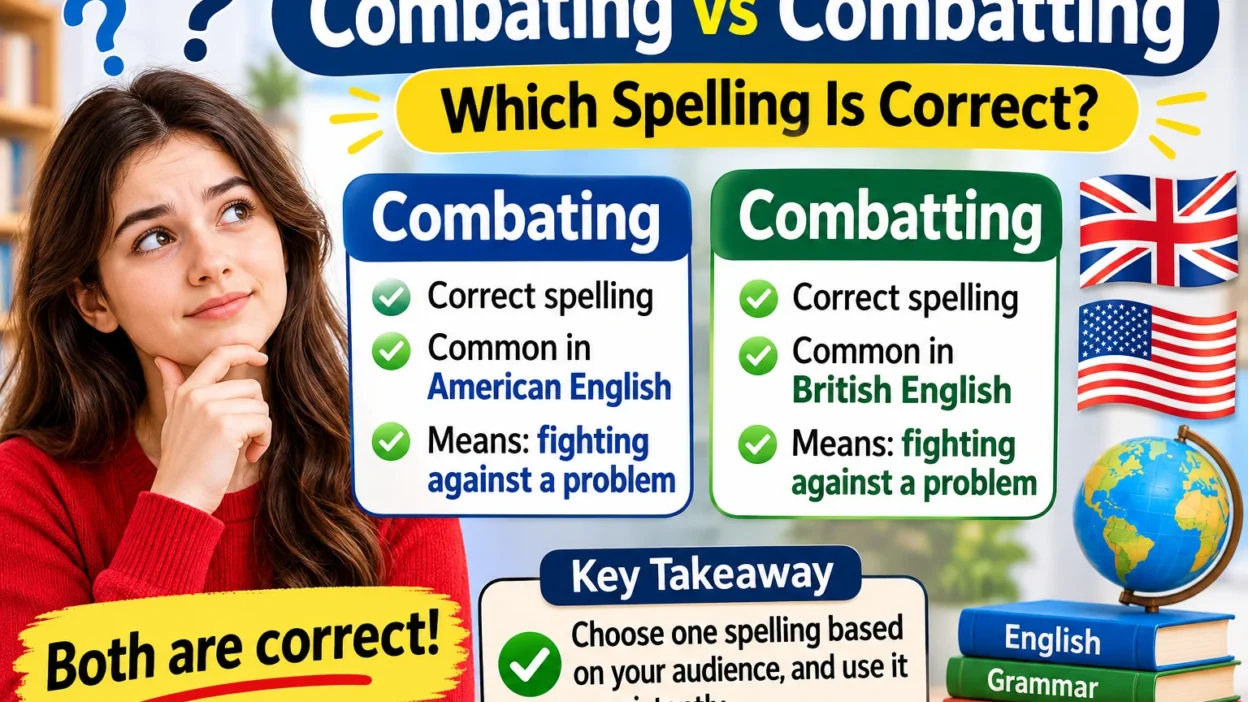
Have you ever wondered if combating or combatting is the correct spelling? Both forms are correct, but the difference depends on spelling conventions. The word combating is more common in American English, while combatting is widely accepted in British English and other varieties of English. Both words come from the verb combat, which means to fight against, oppose, or take action to stop something harmful.
Understanding the difference between these spellings can help you write more confidently in school assignments, professional documents, emails, and everyday conversations. Although the two forms have the same meaning and pronunciation, choosing the appropriate spelling for your audience can make your writing more consistent. In this guide, you will learn what each spelling means, when to use it, how American and British English differ, and how to avoid common mistakes. You will also find practical examples and answers to frequently asked questions.
Quick Answer
Combating and combatting are both correct spellings of the present participle of combat. Combating is generally preferred in American English, while combatting is common in British English. Both mean fighting against or taking action to stop something harmful. Choose one spelling based on your preferred English variety, and use it consistently throughout your writing.
Why Do People Confuse Combating and Combatting?
People often confuse these words because they differ by just one letter. Both spellings come from the verb combat, and both describe the same action.
The confusion arises from a common English spelling pattern. When a verb ends in a consonant followed by a stressed final syllable, that consonant is often doubled before adding -ing. However, the rules for doubling consonants vary according to the word and the spelling conventions being followed.
In the case of combat, both combating and combatting are accepted spellings. The single-t spelling is generally more common in American English, while the double-t spelling is frequently used in British English.
The important point is that neither spelling changes the meaning of the word.
First Word: Combating
Combating is the present participle of the verb combat. It means fighting against, resisting, or taking action to reduce or prevent something undesirable.
This spelling is especially common in American English and is widely understood internationally.
Meaning of Combating
The word combating can describe efforts to address many problems, including:
- Combating poverty
- Combating climate change
- Combating misinformation
- Combating corruption
- Combating disease
- Combating discrimination
Examples of Combating
- The government is combating corruption.
- Exercise can help with combating stress.
- Scientists are combating the spread of infectious diseases.
- Education plays an important role in combating poverty.
- The organization is combating misinformation online.
In each sentence, combating describes an ongoing effort to oppose or reduce a problem.
Second Word: Combatting
Combatting is also the present participle of the verb combat. It has exactly the same meaning as combating and is an accepted spelling, particularly in British English.
The extra t does not change the pronunciation, meaning, or grammatical function of the word.
Meaning of Combatting
Combatting means actively fighting against, resisting, or trying to overcome a problem or threat.
It can be used in the same contexts as combating, including health, education, government, business, and environmental protection.
Examples of Combatting
- The charity is combatting child poverty.
- Researchers are combatting antibiotic resistance.
- The school introduced a program for combatting bullying.
- Local communities are combatting environmental pollution.
- The government is combatting financial fraud.
These sentences are grammatically correct. You could replace combatting with combating without changing their meaning.
Combating vs Combatting: Comparison Table
| Feature | Combating | Combatting |
|---|---|---|
| Correct spelling | Yes | Yes |
| Base verb | Combat | Combat |
| Meaning | Fighting against or resisting | Fighting against or resisting |
| Pronunciation | Same | Same |
| Grammatical form | Present participle or gerund | Present participle or gerund |
| American English | Generally preferred | Accepted but less common |
| British English | Accepted | Commonly used |
| Meaning difference | None | None |
| Example | Combating poverty | Combatting poverty |
The main difference is spelling preference, not meaning. Both forms are correct, so your choice should depend on your audience and the spelling style you follow.
When Should You Use Combating or Combatting?
Choosing between these spellings is simple once you know your audience.
When to Use Combating
Use combating when writing in American English or when following a style guide that prefers the single-t spelling.
Examples:
- The city is combating air pollution.
- The company is combating online fraud.
- Doctors are combating the spread of infection.
- The organization is combating food insecurity.
If you are unsure which spelling to choose for an international audience, combating is a practical option because it is widely recognized and commonly used.
When to Use Combatting
Use combatting when following British English conventions or a publication’s preferred spelling style.
Examples:
- The government is combatting organised crime.
- The school is combatting bullying.
- Researchers are combatting climate-related risks.
- The charity is combatting homelessness.
Remember that British English does not make combating incorrect. Both forms are accepted.
How Can You Choose the Right Spelling?
Follow these simple guidelines:
- Know your audience: Consider if your readers expect American or British English.
- Check your style guide: Follow the spelling conventions required by your school, employer, or publication.
- Be consistent: Avoid switching between combating and combatting in the same document without a good reason.
- Focus on meaning: Both forms express the same idea.
12 Examples of Combating vs Combatting in Sentences
The following examples show how both spellings work in everyday and professional English.
| No. | With Combating | With Combatting |
|---|---|---|
| 1 | We are combating poverty. | We are combatting poverty. |
| 2 | The team is combating misinformation. | The team is combatting misinformation. |
| 3 | Scientists are combating climate change. | Scientists are combatting climate change. |
| 4 | The police are combating organised crime. | The police are combatting organised crime. |
| 5 | Education helps in combating illiteracy. | Education helps in combatting illiteracy. |
| 6 | The campaign focuses on combating bullying. | The campaign focuses on combatting bullying. |
| 7 | Doctors are combating infectious diseases. | Doctors are combatting infectious diseases. |
| 8 | The company is combating workplace discrimination. | The company is combatting workplace discrimination. |
| 9 | New measures are combating financial fraud. | New measures are combatting financial fraud. |
| 10 | Communities are combating food insecurity. | Communities are combatting food insecurity. |
| 11 | The organization is combating homelessness. | The organization is combatting homelessness. |
| 12 | Researchers are combating antibiotic resistance. | Researchers are combatting antibiotic resistance. |
Both columns are grammatically correct. The examples demonstrate that the spelling changes, but the meaning remains the same.
Common Mistakes to Avoid
Although combating and combatting are both correct, English learners sometimes make other mistakes when using these words.
Mistake 1: Thinking One Spelling Is Always Wrong
Incorrect assumption: Combatting is always incorrect.
Correct understanding: Both spellings are accepted. Their relative frequency varies by English variety and publication style.
Mistake 2: Changing the Meaning
Incorrect assumption: Combating means preventing a problem, while combatting means fighting an existing problem.
Correct understanding: Both forms can describe efforts to prevent, resist, reduce, or overcome a problem.
Mistake 3: Using the Wrong Base Verb
Incorrect: We are combatting the issue.
Correct: We are combating the issue.
Also correct: We are combatting the issue.
Both forms are possible, but combating is often the more familiar spelling in American English.
Mistake 4: Mixing Spelling Styles
Using combating in one paragraph and combatting in another can make a document appear inconsistent.
Better approach: Choose one spelling and use it throughout your work unless you are quoting text or following a specific source’s spelling.
Mistake 5: Confusing Combat With Combatting
Combat is the base verb, while combating and combatting are its present participle forms.
Examples:
- Present tense: They combat corruption.
- Present continuous: They are combating corruption.
- Present continuous: They are combatting corruption.
- Past tense: They combated corruption.
Memory Trick: How to Remember the Difference
Use this simple memory trick:
American English: Combat + ing = Combating
British English: Combat + t + ing = Combatting
Think of the extra t as a spelling variation associated with British usage. This is a helpful reminder, not an absolute rule, because both spellings are accepted in both varieties of English.
Another easy way to remember the difference is to focus on the word’s meaning rather than its spelling. Both words describe the same action: fighting against a problem.
American vs British English: Which Spelling Is Preferred?
American and British English sometimes use different spelling conventions. The distinction between combating and combatting is one example of this variation.
American English
In American English, combating is generally the more common spelling.
Examples:
- The government is combating inflation.
- The organization is combating discrimination.
- Researchers are combating disease.
British English
In British English, combatting is a common spelling, although combating is also accepted.
Examples:
- The government is combatting inflation.
- The organisation is combatting discrimination.
- Researchers are combatting disease.
Notice that other spelling differences may appear in these examples, such as organization versus organisation. Those differences are separate from the choice between combating and combatting.
Which Spelling Should International Writers Use?
If you write for readers around the world, either form can work.
For a simple and consistent approach, choose combating if you are following American English conventions or combatting if you are following a British English style guide.
The most important thing is to use your chosen spelling consistently.
Similar Words to Combating and Combatting
Several English words have meanings related to fighting, resisting, or addressing a problem. However, they are not always interchangeable.
| Word | Meaning | Example |
|---|---|---|
| Fighting | Taking action against someone or something | They are fighting corruption. |
| Opposing | Acting against an idea, action, or policy | She is opposing the proposal. |
| Resisting | Refusing to accept or give in to something | He is resisting pressure. |
| Tackling | Making an effort to deal with a problem | The city is tackling homelessness. |
| Countering | Acting to reduce or neutralize an opposing force | The team is countering misinformation. |
| Addressing | Giving attention to an issue | The school is addressing bullying. |
| Preventing | Stopping something from happening | The campaign is preventing fraud. |
| Overcoming | Successfully dealing with a difficulty | They are overcoming obstacles. |
These words are related in meaning, but each has its own usage. For example, preventing focuses on stopping something before it happens, while combating can describe efforts to prevent or fight an existing problem.
Final Verdict: Combating or Combatting?
The answer is straightforward: both combating and combatting are correct.
They are two accepted spellings of the same word, with no difference in meaning or pronunciation.
Choose combating when following American English conventions, where it is generally preferred. Choose combatting when following a British English style that uses the double-t form.
If your teacher, employer, or publication specifies a spelling preference, follow that guidance. Otherwise, choose the version you prefer and use it consistently.
Frequently Asked Questions
1. Is combating or combatting correct?
Both spellings are correct. Combating is generally more common in American English, while combatting is frequently used in British English. Both mean fighting against or trying to overcome a problem.
2. Is combatting a real word?
Yes. Combatting is an accepted spelling of the present participle of combat. It has the same meaning as combating and can be used in the same grammatical contexts.
3. Is combating American or British English?
Combating is particularly common in American English, but it is also accepted in British English. It is not an exclusively American spelling.
4. Is combatting British English?
Combatting is common in British English, but it is not exclusively British. It is also recognized in American English, although combating is generally more common there.
5. Do combating and combatting have different meanings?
No. Both words mean fighting against, resisting, or taking action to address a problem. The only difference is their spelling.
6. How do you pronounce combating and combatting?
Both words are pronounced the same way: kuhm-BAT-ing. The extra t in combatting does not create a different pronunciation.
7. What is the past tense of combat?
The past tense of combat is combated. For example, “The organization combated misinformation through public education.”
8. Which spelling should I use in an essay?
Follow the spelling conventions required by your school or teacher. If no preference is given, choose either combating or combatting and use it consistently throughout your essay.
Remember This
- Combating: Correct spelling, generally preferred in American English.
- Combatting: Correct spelling, common in British English.
- Meaning: Both mean fighting against or trying to overcome a problem.
- Pronunciation: Both are pronounced the same way.
- Best practice: Follow your preferred English variety and maintain consistency.
Conclusion
The difference between combating and combatting is simply a matter of spelling preference. Both are grammatically correct, share the same meaning, and describe efforts to fight against or overcome problems. Although combating is generally preferred in American English and combatting is common in British English, neither form is inherently wrong.
When writing an essay, email, report, or article, consider your audience and follow the appropriate spelling conventions. If there is no specific requirement, choose either spelling and use it consistently. Once you understand this small difference, you can use both words confidently and correctly.

Charles Kyle is a passionate writer and dream researcher at SleepCout, dedicated to exploring coded dreams, lucid dreaming, dream symbolism, and sleep science. He creates engaging, well-researched content that helps readers understand their dreams and discover the fascinating connection between technology, imagination, and the sleeping mind.