Simple sentences are the foundation of English grammar. They help students, beginners, and English language learners express their thoughts clearly and correctly. if you are writing a school assignment, speaking with friends, or learning English as a second language, understanding simple sentences can improve your communication skills.
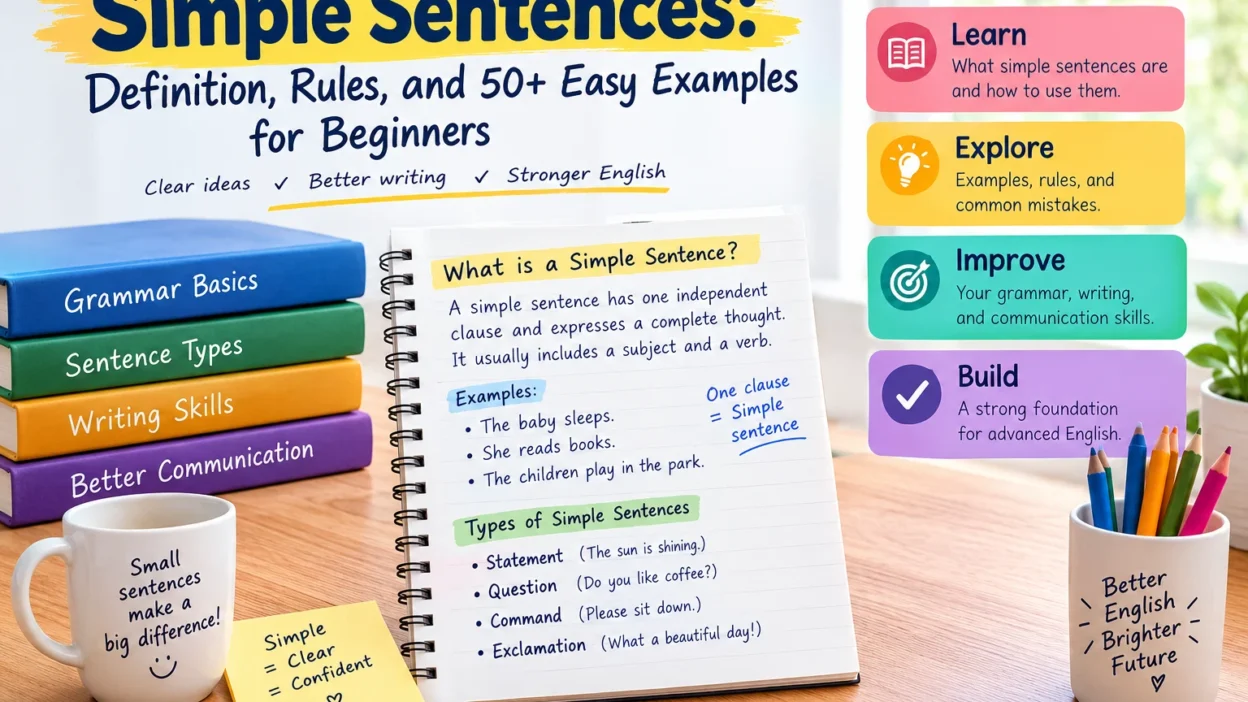
A simple sentence contains one independent clause, which means it expresses a complete thought and can stand alone. It usually includes a subject and a verb. For example, “The baby sleeps.” is a simple sentence because it has a subject (the baby), a verb (sleeps), and a complete meaning. Simple sentences can also contain longer subjects, additional details, and compound subjects or verbs while remaining grammatically simple.
In this guide, you will learn what simple sentences are, how to identify and write them, and how they differ from other sentence types. You will also find practical examples, common grammar mistakes, helpful memory tricks, and answers to frequently asked questions.
Quick Answer: What Is a Simple Sentence?
A simple sentence is a sentence that contains one independent clause and expresses a complete thought. It usually has a subject and a verb. For example, “Birds fly,” “She reads books,” and “The children play in the park” are simple sentences. A simple sentence can be short or long, but it contains only one independent clause.
Why Do People Confuse Simple Sentences?
Many learners believe that a simple sentence must contain only a few words. However, sentence simplicity depends on its grammatical structure, not its length.
For example:
- Short simple sentence: The dog barked.
- Long simple sentence: The little brown dog barked loudly at the stranger outside our house.
Both sentences are simple because each contains only one independent clause.
Another common source of confusion is the difference between a simple sentence and a compound sentence. A sentence may contain the word and without becoming a compound sentence.
Consider these examples:
- Simple: Sara and Ali play football.
- Simple: Sara plays football and watches television.
- Compound: Sara plays football, and Ali watches television.
In the first example, the sentence has a compound subject. In the second, it has a compound predicate. In the third, it contains two independent clauses joined by and.
What Is the First Word in a Simple Sentence?
The first word of a simple sentence is not fixed. It depends on what the writer wants to communicate.
A simple sentence can begin with a noun, pronoun, article, adjective, or introductory expression.
Examples:
- Ali plays cricket.
- She likes chocolate.
- The sun is shining.
- My brother is sleeping.
- Today, we are going shopping.
- After lunch, the students returned to class.
The important point is that the sentence must contain one independent clause and express a complete thought.
What Is the Second Word in a Simple Sentence?
The second word in a simple sentence also depends on its structure.
In a basic subject-verb sentence, the second word may be a verb or another part of the subject.
Examples:
- Birds fly. — The verb follows the subject.
- My brother sleeps. — The second word is part of the subject.
- She is happy. — The second word is a linking verb.
- The baby cries. — The second word is part of the subject.
- They work daily. — The second word is the verb.
There is no universal rule that the second word must be a verb. Focus on the subject, verb, and complete meaning instead.
Simple Sentences: Comparison Table
Understanding the difference between sentence structures makes English grammar easier to learn.
| Sentence Type | Definition | Example |
|---|---|---|
| Simple sentence | Contains one independent clause | The cat sleeps. |
| Compound sentence | Contains two or more independent clauses | The cat sleeps, and the dog plays. |
| Complex sentence | Contains one independent clause and at least one dependent clause | The cat sleeps while the dog plays. |
| Compound-complex sentence | Contains at least two independent clauses and at least one dependent clause | The cat sleeps while the dog plays, and the baby rests. |
Remember: A simple sentence can include several subjects, verbs, or descriptive phrases. What matters is the number of independent clauses.
When Should You Use Simple Sentences?
Simple sentences are useful in everyday conversations, schoolwork, stories, instructions, and many other forms of writing.
1. To Express Basic Information
Use simple sentences to communicate facts directly.
Examples:
- Water is essential.
- The Earth moves.
- My name is Ahmed.
2. To Describe People and Things
Simple sentences help you describe someone or something clearly.
Examples:
- My sister is kind.
- The flowers are beautiful.
- Our classroom is clean.
3. To Describe Actions
Use them to explain what someone or something does.
Examples:
- The boy runs.
- My mother cooks dinner.
- The birds build nests.
4. To Give Instructions
Simple sentences make directions easy to understand.
Examples:
- Open your book.
- Close the window.
- Turn off the light.
5. To Improve Writing Clarity
Short, direct sentences can make difficult information easier to understand.
Examples:
- The meeting starts at nine.
- Please bring your notebook.
- The train arrives tomorrow.
50+ Examples of Simple Sentences
Here are 55 simple sentence examples organized by category to help students and beginners understand their structure.
1. Simple Sentences About Daily Life
- I wake up early.
- She drinks milk.
- He brushes his teeth.
- We eat breakfast together.
- My father reads the newspaper.
- The children go to school.
- I clean my room.
- My mother prepares dinner.
- They watch television.
- We sleep at night.
2. Simple Sentences About People
- Ali is my friend.
- Sara sings beautifully.
- My brother plays cricket.
- The teacher explains the lesson.
- My grandmother tells stories.
- The baby smiles.
- My uncle drives a car.
- The students study English.
- She helps her mother.
- He works in an office.
3. Simple Sentences About Animals
- The dog barks loudly.
- Cats like warm places.
- Birds fly in the sky.
- The horse runs fast.
- Fish swim in water.
- The lion roars.
- Monkeys climb trees.
- The rabbit eats carrots.
- Bees make honey.
- The cow gives milk.
4. Simple Sentences About Nature
- The sun rises in the east.
- The moon shines at night.
- The wind blows gently.
- Flowers grow in spring.
- Rain falls from the clouds.
- The river flows through the valley.
- Trees provide shade.
- Snow covers the mountains.
- The sky looks blue.
- Leaves fall in autumn.
5. Simple Sentences for Students
- I study English every day.
- She writes neatly.
- He solves the problem.
- We learn new words.
- The class begins at eight.
- My friend borrows a pencil.
- The teacher checks our homework.
- I answer the question.
- They complete their assignments.
- Everyone listens carefully.
6. More Simple Sentence Examples
- The baby is sleeping peacefully.
- My parents love me.
- We visited the museum yesterday.
- The soup tastes delicious.
- Please sit down.
Each example expresses a complete thought through one independent clause. Some include additional information, but they remain simple sentences.
Common Mistakes When Writing Simple Sentences
English learners often make a few predictable mistakes when forming sentences. Understanding these errors can help you write more accurately.
Mistake 1: Writing an Incomplete Sentence
Incorrect: Because I was tired.
Correct: I went to bed early because I was tired.
The first example is a dependent clause, not a complete sentence in standard usage. The corrected version expresses a complete thought through one independent clause and a dependent clause, making it a complex sentence rather than a simple one.
Mistake 2: Forgetting the Verb
Incorrect: My brother very intelligent.
Correct: My brother is very intelligent.
A complete sentence generally needs a verb. Here, is connects the subject to its description.
Mistake 3: Using the Wrong Verb Form
Incorrect: She play tennis.
Correct: She plays tennis.
In the simple present tense, third-person singular subjects such as he, she, and it usually require a verb ending in -s or -es.
Mistake 4: Confusing Sentence Length With Sentence Type
Incorrect idea: A long sentence cannot be simple.
Correct understanding: A sentence can be long and still contain only one independent clause.
Example: The young girl with the red backpack walked slowly through the crowded school hallway.
This is a simple sentence because it contains one independent clause.
Mistake 5: Joining Two Complete Sentences Incorrectly
Incorrect: I was hungry, I ate a sandwich.
Correct: I was hungry, so I ate a sandwich.
The corrected example is a compound sentence. Two independent clauses should not normally be joined by a comma alone.
What Is an Easy Memory Trick for Simple Sentences?
Use the “One Complete Thought” rule.
Ask yourself these three questions:
- Does the sentence express a complete thought?
- Does it contain an independent clause?
- Does it contain only one independent clause?
If the answers are yes, yes, and yes, the sentence is simple.
For example:
The children are playing in the garden.
- Subject: The children
- Verb phrase: are playing
- Additional information: in the garden
- Independent clauses: One
Therefore, it is a simple sentence.
A useful reminder is: Simple does not mean short. Simple means one independent clause.
Are Simple Sentences Different in American and British English?
The basic grammatical structure of a simple sentence is the same in American and British English. Both varieties use one independent clause to express a complete thought.
However, spelling, vocabulary, and some everyday expressions differ.
| American English | British English | Example |
|---|---|---|
| Apartment | Flat | I live in an apartment. / I live in a flat. |
| Elevator | Lift | The elevator is broken. / The lift is broken. |
| Truck | Lorry | The truck is outside. / The lorry is outside. |
| Vacation | Holiday | We enjoyed our vacation. / We enjoyed our holiday. |
| Color | Colour | My favorite color is blue. / My favourite colour is blue. |
Both versions can contain grammatically correct simple sentences. The differences mainly involve spelling and vocabulary, not the definition of a simple sentence.
What Words and Concepts Are Similar to Simple Sentences?
Several grammar terms are closely related to simple sentences. Understanding them helps you recognize sentence structures more easily.
1. Independent Clause
An independent clause contains a subject and a predicate and expresses a complete thought.
Example: The baby laughed.
This is an independent clause and can also function as a simple sentence.
2. Subject
The subject tells us who or what the sentence is about.
Example: The little boy runs quickly.
The subject is the little boy.
3. Predicate
The predicate tells us something about the subject and contains the verb.
Example: The little boy runs quickly.
The predicate is runs quickly.
4. Compound Sentence
A compound sentence contains at least two independent clauses.
Example: I wanted tea, but my sister wanted coffee.
The sentence contains two independent clauses joined by but.
5. Complex Sentence
A complex sentence contains one independent clause and at least one dependent clause.
Example: I stayed inside because it was raining.
The main clause is I stayed inside. The dependent clause is because it was raining.
6. Simple Present Tense
The simple present is a verb tense commonly used for habits, routines, facts, and general truths.
Example: She walks to school.
Important: A simple sentence and the simple present tense are different concepts. A simple sentence can use the past, present, or future tense.
Final Verdict: What Makes a Sentence Simple?
A simple sentence contains exactly one independent clause and communicates a complete thought. It usually has a subject and a verb, but it can include additional details, descriptive phrases, compound subjects, or compound verbs.
For example, “The dog sleeps” and “The tired dog sleeps peacefully on the soft rug near the fireplace” are both simple sentences. Their lengths differ, but each contains one independent clause.
To identify a simple sentence, focus on its grammatical structure rather than its number of words. This approach will help you distinguish simple sentences from compound, complex, and compound-complex sentences.
Frequently Asked Questions About Simple Sentences
1. What is a simple sentence in English?
A simple sentence contains one independent clause and expresses a complete thought. For example, “The baby cries” is a simple sentence because it has a subject, a verb, and a complete meaning.
2. What are five examples of simple sentences?
Here are five examples:
- I like apples.
- She reads books.
- The sun is shining.
- Birds sing beautifully.
- We play football.
Each example contains one independent clause.
3. Can a simple sentence have more than one verb?
Yes. A simple sentence can contain a compound predicate with two or more verbs.
Example: Sara opened the door and entered the room.
The sentence has one subject and two coordinated actions within one independent clause.
4. Can a simple sentence be long?
Yes. A simple sentence can contain many words, descriptive phrases, and additional details while retaining one independent clause.
Example: The young teacher with the blue bag walked slowly through the busy school corridor.
This is a simple sentence because it contains one independent clause.
5. What is the difference between a simple and a compound sentence?
A simple sentence contains one independent clause. A compound sentence contains at least two independent clauses.
- Simple: I cooked dinner.
- Compound: I cooked dinner, and my brother washed the dishes.
6. How can students identify a simple sentence?
Students should identify the subject and verb, check if the sentence expresses a complete thought, and count its independent clauses. If it contains exactly one independent clause, it is a simple sentence.
7. Is a sentence with “and” always a compound sentence?
No. The word and can join words, phrases, or independent clauses.
- Simple: Ali and Ahmed are friends.
- Simple: Ali sings and dances.
- Compound: Ali sings, and Ahmed dances.
Only the last example contains two independent clauses.
8. What is the difference between a simple sentence and the simple present tense?
A simple sentence is a grammatical structure containing one independent clause. The simple present tense is a verb form used for habits, facts, and general truths.
Example of a simple sentence in the present: She walks to school.
Example of a simple sentence in the past: She walked to school.
Both sentences are simple, but they use different tenses.
Remember This
- A simple sentence contains one independent clause.
- It expresses a complete thought.
- It usually includes a subject and a verb.
- It can be short or long.
- It can contain compound subjects and compound predicates.
- The word and does not automatically make a sentence compound.
- Simple sentences can use past, present, or future tense.
Conclusion
Simple sentences are an essential part of learning English grammar. They help you communicate ideas clearly, write correct sentences, and build a strong foundation for more advanced sentence structures. By understanding subjects, verbs, independent clauses, and complete thoughts, you can recognize simple sentences with confidence.
Practice writing a few simple sentences every day about your family, school, hobbies, and daily routine. Start with short examples and gradually add descriptive details. Remember that a simple sentence does not have to be short; it only needs one independent clause. With regular practice, you will find it easier to write clearly and distinguish simple sentences from other types of sentences.

Charles Kyle is a passionate writer and dream researcher at SleepCout, dedicated to exploring coded dreams, lucid dreaming, dream symbolism, and sleep science. He creates engaging, well-researched content that helps readers understand their dreams and discover the fascinating connection between technology, imagination, and the sleeping mind.