
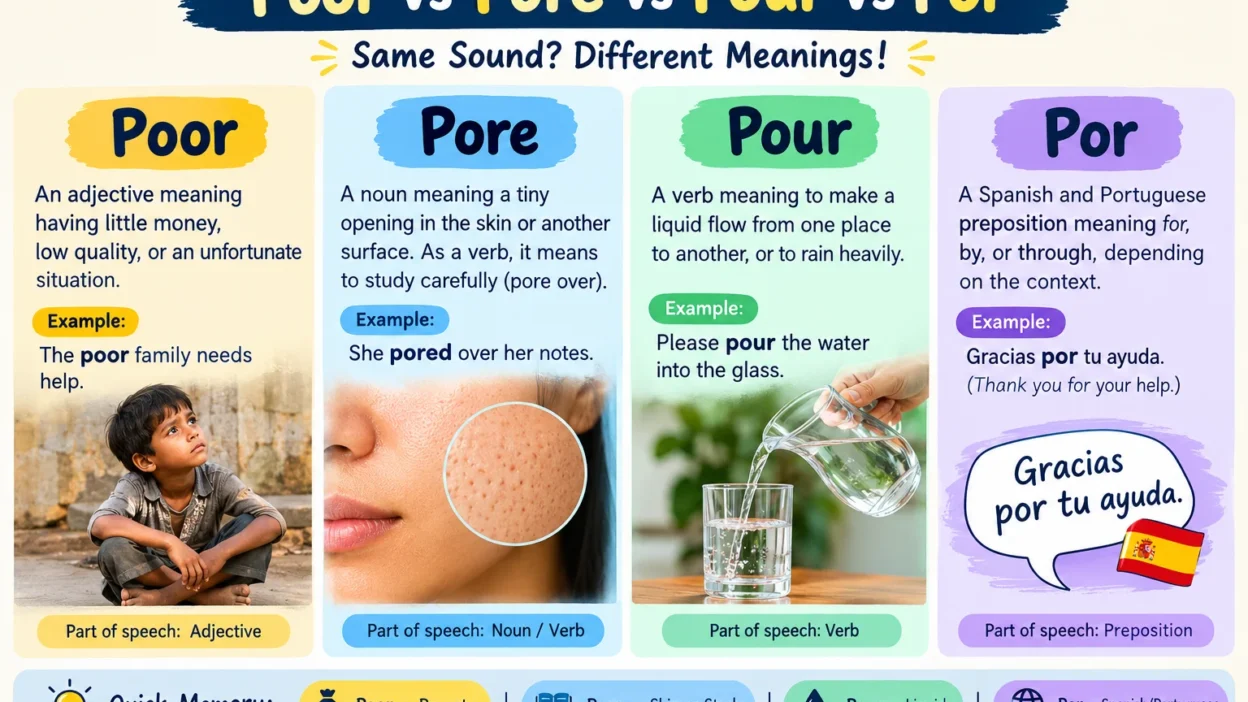
Have you ever confused poor vs pore vs pour vs por while writing or learning English? These four words can be tricky because poor, pore, and pour often sound alike in English, depending on the speaker’s accent. However, they have completely different meanings and uses. The word por also appears in Spanish and Portuguese, where it has grammatical meanings that English learners may encounter when studying other languages.
Understanding the difference between these words can help you improve your spelling, grammar, vocabulary, and everyday communication. if you are a student, an ESL learner, or someone who wants to write more accurately, learning their meanings with simple examples makes them much easier to remember.
In this guide, you will discover what each word means, when to use it, how to avoid common mistakes, and how to distinguish between similar-sounding English words. You will also find practical sentences, memory tricks, and answers to frequently asked questions.
Quick Answer: What Is the Difference Between Poor, Pore, Pour, and Por?
Poor means having little money or being of low quality. Pore refers to a tiny opening in the skin or another surface; in the phrase pore over, it means to study something carefully. Pour means to make a liquid flow from one place to another. Por is not a standard English word in these senses, but it is a common Spanish and Portuguese word meaning for, by, or through, depending on the context.
Why Do People Confuse Poor, Pore, Pour, and Por?
People often confuse these words because their spelling is similar, and three of them are pronounced alike by many English speakers.
The main differences involve meaning, spelling, and grammatical function.
- Poor: An adjective describing poverty, low quality, or an unfortunate situation.
- Pore: A noun meaning a tiny opening, or a verb used in the expression pore over.
- Pour: A verb describing the movement of liquids or other substances.
- Por: A Spanish or Portuguese preposition, not a standard English equivalent of the other three words.
For example, you might say, “The poor child has a pore on his skin,” or “Please pour some water into the glass.” Each word communicates a different idea.
Learning their meanings rather than relying only on pronunciation is the best way to use them correctly.
1. What Does Poor Mean?
Poor is an adjective that commonly describes someone who has little money or insufficient resources. It can also describe something that is unsatisfactory, weak, or below an expected standard.
Meaning of Poor
The word poor has several common meanings:
- Having little money: A person or family that lacks sufficient financial resources.
- Low quality: Something that does not meet expectations.
- Unsatisfactory performance: A weak result or lack of skill.
- Unfortunate or deserving sympathy: A way to express concern for someone.
Examples of Poor in Sentences
- Many poor families need access to affordable housing.
- The restaurant received a poor review.
- She gave a poor performance in the competition.
- He has poor eyesight and wears glasses.
- The poor dog was left outside in the rain.
Is Poor a Noun or an Adjective?
Poor is primarily an adjective.
For example:
- Correct: He comes from a poor family.
- Correct: The quality of the product is poor.
- Incorrect: Please poor the milk into the cup.
In the last example, pour is the correct word because the sentence describes moving a liquid.
2. What Does Pore Mean?
Pore has two main uses in English. As a noun, it means a tiny opening in the skin or another material. As a verb, it appears in the expression pore over, meaning to examine or study something carefully.
Meaning of Pore as a Noun
A pore is a small opening that allows substances to pass through a surface. In human skin, pores are associated with hair follicles and the openings of skin structures.
Examples:
- Sweat can reach the skin’s surface through openings associated with pores.
- Dust can settle into the pores of some materials.
- The skincare product is designed to help clean clogged pores.
Meaning of Pore as a Verb
The expression pore over means to study, read, or examine something with great attention.
Examples:
- She spent hours poring over her notes.
- The detective pored over the evidence.
- He pored over the map before starting the journey.
Notice the spelling: when someone studies something carefully, the correct expression is pore over, not pour over.
Pore vs Pour: What Is the Difference?
These words are easy to mix up because they sound alike in many accents.
- Pore over: To examine something carefully.
- Pour over: To spill or flow over a surface, or to move a liquid across or onto something.
Compare these sentences:
- She pored over the documents before the meeting.
- Water poured over the edge of the bucket.
The first sentence describes careful study. The second describes the movement of water.
3. What Does Pour Mean?
Pour is a verb meaning to make a liquid flow from one container or place to another. It can also describe a large quantity of something moving or falling continuously.
Meaning of Pour
Common uses of pour include:
- Transferring a liquid into another container.
- Serving a drink.
- Making a liquid flow onto a surface.
- Describing heavy rainfall.
- Describing a large number of people or things arriving continuously.
Examples of Pour in Sentences
- Please pour some tea into my cup.
- She poured milk over her cereal.
- It started to pour just as we left the house.
- The crowd poured into the stadium.
- He poured the soup into a bowl.
Pour as a Verb
Pour is a verb, so it commonly describes an action.
Its main forms are:
| Verb Form | Example |
|---|---|
| Base form | Pour the water. |
| Third-person singular | She pours the juice. |
| Past tense | He poured the milk. |
| Present participle | They are pouring the tea. |
| Past participle | The water has been poured. |
Remember that pour describes movement or flow. It does not mean poor in quality or a tiny opening in the skin.
Poor vs Pore vs Pour vs Por: Comparison Table
The following table summarizes the main differences between these four words.
| Word | Part of Speech | Meaning | Example |
|---|---|---|---|
| Poor | Adjective | Having little money or being low in quality | The family is poor. |
| Pore | Noun | A tiny opening in a surface | Sweat reaches the surface through skin structures associated with pores. |
| Pore | Verb | To study carefully, usually in pore over | She pored over the report. |
| Pour | Verb | To make a liquid flow | Pour the water into the glass. |
| Pour | Verb | To rain heavily | It is pouring outside. |
| Por | Preposition in Spanish and Portuguese | A word whose meaning depends on context | Spanish: Gracias por venir means “Thank you for coming.” |
Important: In standard English, poor, pore, and pour are established words with different meanings. Por is not normally used as an English substitute for any of them.
When Should You Use Poor, Pore, Pour, or Por?
Choosing the correct word becomes easier when you identify what you want to communicate.
Use Poor When Talking About Money or Quality
Choose poor when describing a lack of money, something unsatisfactory, or an unfortunate situation.
Examples:
- The family has a poor standard of living.
- His essay received a poor grade.
- She made a poor decision.
Quick rule: If you mean not wealthy or not good enough, use poor.
Use Pore When Talking About Skin or Careful Study
Choose pore when referring to tiny openings in a surface or when using the expression pore over.
Examples:
- The pores on his nose appear noticeable.
- She pored over her homework.
- The researcher pored over the historical records.
Quick rule: If you mean a tiny opening or study carefully, use pore.
Use Pour When Talking About Liquids or Flow
Choose pour when describing a liquid being transferred, rain falling heavily, or something moving in a continuous stream.
Examples:
- Pour the juice into the glass.
- Rain poured down all afternoon.
- Fans poured out of the stadium.
Quick rule: If you mean make something flow, use pour.
Use Por When Writing in Spanish or Portuguese
Use por when the grammar and meaning of a Spanish or Portuguese sentence require it.
Examples:
- Spanish: Gracias por tu ayuda. — Thank you for your help.
- Spanish: Caminamos por el parque. — We walked through the park.
- Portuguese: Obrigado por tudo. — Thank you for everything.
The exact translation of por depends on the sentence. It can express ideas such as cause, means, exchange, duration, or movement through a place.
12 Examples of Poor, Pore, Pour, and Por
These examples show how the words work in everyday communication.
Examples Using Poor
1. Many poor children need better access to education.
Here, poor describes children whose families have limited financial resources.
2. The company received a poor customer review.
Here, poor means unsatisfactory or low in quality.
3. He made a poor choice by ignoring the instructions.
Here, poor describes a decision that was not good.
Examples Using Pore
4. Everyone has pores in their skin.
Here, pores refers to tiny openings associated with skin structures.
5. She pored over the book before her final examination.
Here, pored over means studied carefully.
6. The scientist pored over the results of the experiment.
Here, the scientist examined the results closely.
Examples Using Pour
7. Please pour a glass of water for me.
Here, pour means to transfer water into a glass.
8. It began to pour during our picnic.
Here, pour means to rain heavily.
9. He poured the sauce over the pasta.
Here, poured describes the movement of a liquid onto food.
10. The audience poured into the hall.
Here, poured describes a large number of people entering a place.
Examples Using Por
11. Spanish: Gracias por ayudarme.
English meaning: Thank you for helping me.
12. Spanish: Pasamos por la ciudad.
English meaning: We passed through the city.
These final examples show that por belongs to Spanish grammar rather than standard English spelling.
Common Mistakes With Poor, Pore, Pour, and Por
Even experienced English learners can confuse these words. Understanding the mistakes below can help you avoid them.
Mistake 1: Writing Poor Instead of Pour
Incorrect: Please poor the water into the bottle.
Correct: Please pour the water into the bottle.
Why? The sentence describes moving water, so the verb pour is required.
Mistake 2: Writing Pour Instead of Pore
Incorrect: She spent an hour pouring over her notes.
Correct: She spent an hour poring over her notes.
Why? The sentence describes studying notes carefully, not spilling liquid over them.
Mistake 3: Writing Pore Instead of Poor
Incorrect: The pore family lives in a small house.
Correct: The poor family lives in a small house.
Why? The intended meaning concerns financial circumstances.
Mistake 4: Using Por as an English Word
Incorrect: I am por and need a job.
Correct: I am poor and need a job.
Why? Por is not the standard English spelling for someone who has little money.
Mistake 5: Assuming Similar Pronunciation Means Similar Meaning
The words poor, pore, and pour are pronounced alike by many English speakers, but pronunciation varies by accent. Similar sounds do not make the words interchangeable.
The best approach: Check the meaning and grammatical role of the word before choosing its spelling.
Memory Trick: How to Remember Poor vs Pore vs Pour vs Por
Use these simple associations to remember the differences.
- Poor = Poverty: Both begin with the letter P, and poor often describes someone with little money.
- Pore = Skin or Study: Think of skin pores or the phrase pore over a book.
- Pour = Liquid: Imagine pouring water from a bottle into a glass.
- Por = Spanish or Portuguese: Remember that por is a common preposition in these languages.
One Easy Sentence to Remember All Three English Words
“Poor students may pore over their books while someone pours them a glass of water.”
This sentence uses each English word in a different context:
- Poor describes financial circumstances.
- Pore describes careful study.
- Pour describes transferring a liquid.
The word por can be remembered separately as a Spanish or Portuguese preposition.
American vs British English: Are Poor, Pore, and Pour Different?
The spelling and basic meanings of poor, pore, and pour are generally the same in American and British English. However, pronunciation can differ.
Pronunciation of Poor
Some speakers pronounce poor similarly to pore and pour. Others distinguish it with a different vowel or vowel sequence.
Pronunciation of Pore and Pour
In many American and British accents, pore and pour are homophones, meaning they sound alike but have different meanings and spellings.
Does Por Change in American or British English?
No. Por does not become a standard English word in either variety. It remains a word commonly used in Spanish and Portuguese, although English speakers may encounter it in foreign-language sentences.
Remember: Pronunciation depends on accent, but the spelling and meaning of each word determine how it should be used in writing.
Similar Words You Should Know
Learning related words can help you improve your vocabulary and recognize spelling differences.
| Word | Meaning | Example |
|---|---|---|
| Poverty | The condition of having insufficient money or resources | The charity works to reduce poverty. |
| Poorly | In a weak, inadequate, or unhealthy way | The project was poorly planned. |
| Pore | A tiny opening in a surface | Dirt can collect in pores. |
| Pored | Examined or studied carefully | She pored over the letter. |
| Pouring | Making a liquid flow or raining heavily | It is pouring outside. |
| Poured | Past tense of pour | He poured the coffee. |
| Pore over | To study or examine carefully | They pore over the details. |
| Pour out | To empty a liquid or express something freely | She poured out her feelings. |
These related words reinforce the differences between financial conditions, small openings, careful study, and the movement of liquids.
Final Verdict: Poor vs Pore vs Pour vs Por
The main difference between these words is their meaning and grammatical use.
Poor describes poverty, low quality, or an unfortunate situation. Pore means a tiny opening or appears in the expression pore over, which means to study carefully. Pour means to make a liquid flow or describes something moving in a continuous stream. Por is a preposition commonly found in Spanish and Portuguese, not a standard English alternative to the other words.
If you are writing in English, focus on the meaning of your sentence rather than how the words sound. This simple habit will help you choose the correct spelling.
Frequently Asked Questions
1. What is the difference between poor, pore, and pour?
Poor describes someone with little money or something of low quality. Pore means a tiny opening or appears in pore over, meaning to study carefully. Pour means to make a liquid flow.
2. Are poor, pore, and pour homophones?
They are homophones for many English speakers because they share the same or a very similar pronunciation. However, pronunciation varies across accents, and some speakers distinguish poor from pore and pour.
3. Is por a real English word?
Por is not a standard English word with the meanings of poor, pore, or pour. It is a common preposition in Spanish and Portuguese, where its translation depends on context.
4. Is it pore over or pour over?
Use pore over when you mean to study or examine something carefully. Use pour over when describing a liquid flowing over something.
Example: “She pored over the report” means she studied the report carefully.
5. How do you spell poor as in having no money?
The correct spelling is poor.
Example: “The organization provides food and shelter for poor families.”
6. What does pore mean in the human body?
A pore is a tiny opening in the skin or another surface. In human skin, pores are associated with hair follicles and the openings of skin structures.
Example: “The skincare product helps remove dirt and oil from the pores.”
7. What is the past tense of pour?
The past tense of pour is poured.
Example: “She poured the milk into the glass.”
8. How can I remember the difference between poor, pore, and pour?
Remember these three associations: poor = poverty, pore = skin or study, and pour = liquid. If you encounter por, remember that it is commonly used in Spanish and Portuguese.
Remember This
- Poor: Having little money or being low in quality.
- Pore: A tiny opening or the verb in pore over.
- Pour: To make a liquid flow.
- Por: A Spanish or Portuguese preposition, not a standard English substitute for the other three.
When in doubt, ask yourself what the sentence means. Are you describing money, studying, a tiny opening, or a flowing liquid? The answer will usually point you toward the correct word.
Conclusion
Understanding the difference between poor vs pore vs pour vs por is easier when you learn the meaning of each word instead of memorizing its spelling alone. Although poor, pore, and pour sound alike for many English speakers, they serve different purposes. Poor describes financial circumstances or quality, pore refers to a tiny opening or careful study, and pour describes the movement of liquids or other things.
The word por belongs primarily to Spanish and Portuguese grammar, where it functions as a preposition with several possible translations. By reviewing the examples, avoiding common mistakes, and using the memory trick in this guide, you can choose the correct word more confidently. With regular practice, these commonly confused words will become easier to recognize and use in everyday English.

John Tyler is a dream researcher and content writer at SleepCout, sharing insightful articles about coded dreams, dream meanings, symbolism, sleep psychology, and practical guidance to help readers understand their dreams.