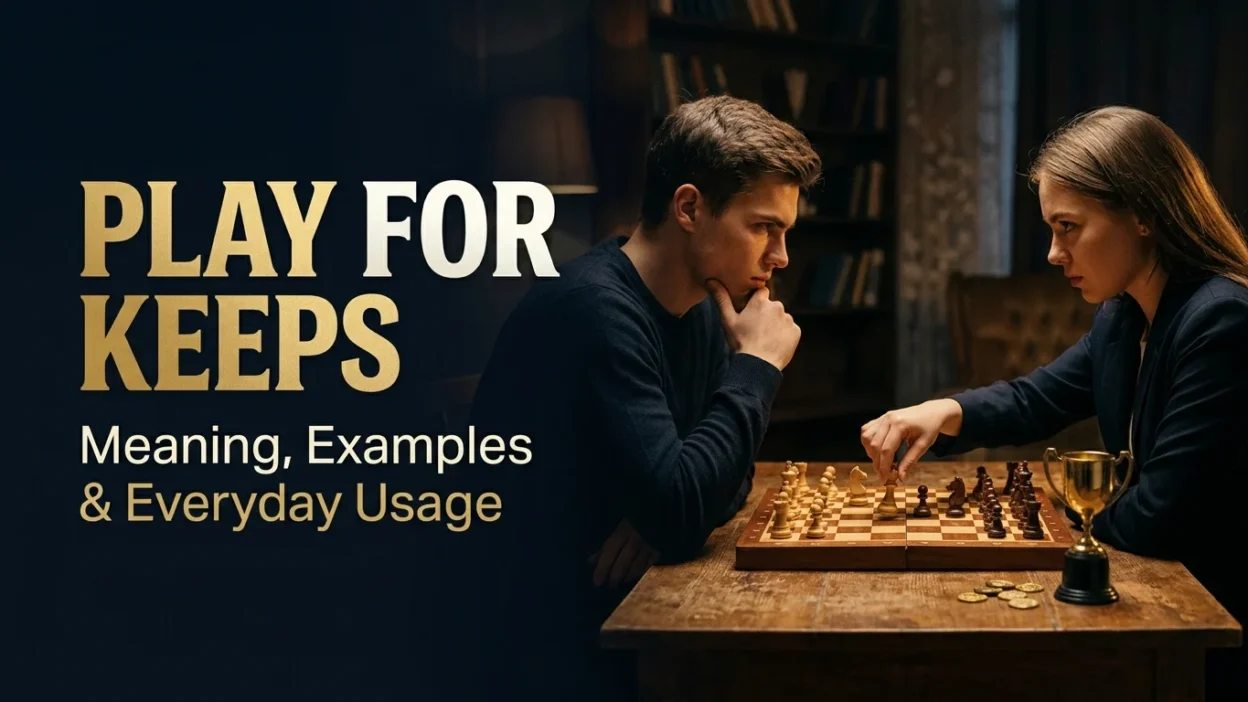
Have you ever heard someone say, “This time, I’m playing for keeps”? This common English expression can sound confusing if you take it literally. The phrase “play for keeps” means to take something seriously, compete to win, or try to achieve a result that truly matters. It can also describe a situation in which the winner keeps what they win rather than returning it to the other players.
People often use this expression when talking about sports, business, relationships, competitions, and important life decisions. For example, if someone says, “Our team is playing for keeps this season,” they mean the team is determined to win and is taking the competition seriously.
Understanding the meaning of “play for keeps” can help you recognize it in movies, books, conversations, and everyday English. In this guide, you will learn its definition, common uses, practical examples, similar expressions, and the difference between playing for fun and playing for keeps.
Quick Answer: What Does Play for Keeps Mean?
“Play for keeps” means to compete seriously, with the intention of winning something valuable or achieving a meaningful result. In its literal sense, it can mean that winners get to keep what they win. In everyday conversation, the phrase often suggests determination, high stakes, and a willingness to do what is necessary to succeed within the rules.
Why Do People Confuse “Play for Keeps”?
People sometimes misunderstand “play for keeps” because its meaning changes depending on the situation.
The word “play” usually refers to having fun, participating in a game, or enjoying an activity. The word “keeps,” however, suggests keeping something permanently or retaining possession of it.
When these words come together, they create an expression that goes beyond ordinary play. The phrase can describe a serious competition, a determined attitude, or a game in which the winner keeps the prize.
For example:
- Playing for fun: We are playing chess to enjoy ourselves.
- Playing for keeps: We are playing chess for a valuable prize, and the winner gets to keep it.
In everyday speech, the expression does not always involve a physical prize. It can simply mean that someone is serious about winning.
First Word: Play
The word “play” is a verb that can mean participating in a game, enjoying an activity, performing music, or taking part in a sport.
Its meaning depends on the context.
Examples:
- The children play in the park every afternoon.
- We play football after school.
- She can play the piano beautifully.
- They play chess during their lunch break.
In the expression “play for keeps,” the word “play” refers to participating in a competition or game. However, the complete expression suggests that the activity is being taken seriously.
Remember: “Play” describes the activity, while the full phrase “play for keeps” communicates a serious competitive attitude.
Second Word: Keeps
The word “keeps” can refer to retaining or holding on to something, although its meaning in the expression is not simply the usual meaning of the verb “keep.”
In the phrase “for keeps,” the word means permanently or for one’s own possession.
Examples:
- You can keep this book.
- She decided to keep the gift.
- The winner gets to keep the trophy.
- He bought a souvenir to keep as a reminder of the trip.
When someone plays for keeps, the idea is that something is genuinely at stake. The person is not merely participating for entertainment; winning or achieving the desired result matters.
Remember: “Keeps” adds the idea of retaining something or treating the outcome as important.
Play for Keeps vs. Play for Fun: Comparison Table
| Feature | Play for Keeps | Play for Fun |
|---|---|---|
| Meaning | Compete seriously or play to win something valuable | Participate mainly for enjoyment |
| Main goal | Winning or achieving an important result | Having fun and enjoying the activity |
| Attitude | Determined and competitive | Relaxed and recreational |
| Stakes | May involve a prize, money, reputation, or another meaningful outcome | Usually involves little or no pressure |
| Example | Our team is playing for keeps today. | We are playing football just for fun. |
| Common settings | Business, sports, competitions, and serious negotiations | Hobbies, casual games, and social activities |
The main difference is the intention behind the activity. Someone can enjoy playing for keeps, but the expression emphasizes the importance of the outcome rather than enjoyment alone.
When Should You Use “Play for Keeps”?
Use “play for keeps” when you want to describe a person or group that is serious about winning, achieving a goal, or competing for something important.
1. In Sports
The phrase is useful when a team or athlete is determined to win.
Example: “The championship starts tomorrow, and our team is playing for keeps.”
This means the team is treating the competition seriously.
2. In Business
People may use the expression to describe a competitive business environment.
Example: “The company is playing for keeps in the international market.”
This suggests that the company is serious about competing and wants to achieve a significant result.
3. In Personal Goals
You can use the phrase when someone decides to take a goal seriously.
Example: “She has stopped making excuses and is playing for keeps with her career.”
This means she is committed to making real progress.
4. In Games and Competitions
The expression can have a literal meaning when the winner gets to keep a prize.
Example: “We are playing for keeps, so the winner gets the signed football.”
In this situation, the phrase refers directly to keeping what is won.
5. In Relationships and Negotiations
The phrase can describe a serious approach to an important decision or negotiation.
Example: “Both companies know they are playing for keeps during these negotiations.”
This means the outcome matters considerably to both sides.
However, the expression can sound aggressive or overly competitive in sensitive situations, so consider your audience before using it.
12 Examples of “Play for Keeps” in Sentences
Here are 12 practical examples to help you understand how the phrase works in different contexts.
- Sports: Our team is playing for keeps in the final match.
- Business: The two companies are playing for keeps in the battle for market share.
- School: The students are playing for keeps in the national debate competition.
- Friendship: We usually play for fun, but today we are playing for keeps.
- Career: He is playing for keeps as he works toward his dream job.
- Politics: The candidates know they are playing for keeps in this election.
- Negotiations: The company is playing for keeps during the contract negotiations.
- Games: We agreed to play for keeps, so the winner gets to keep the prize.
- Sports training: The coach told the players to stop treating the tournament like practice and start playing for keeps.
- Entrepreneurship: She is playing for keeps as she builds her new business.
- Competition: When the final round began, everyone knew the contestants were playing for keeps.
- Everyday conversation: “If you want to succeed, you need to play for keeps,” my brother told me.
These examples show that the phrase can refer to literal games or figurative situations in which people are determined to succeed.
Common Mistakes When Using “Play for Keeps”
Although the expression is easy to understand once you know its meaning, some mistakes are common.
Mistake 1: Taking the Phrase Too Literally
Incorrect understanding: “Play for keeps” always means that someone physically keeps an object.
Correct understanding: The phrase can also describe serious competition or a determined approach to a goal.
Example: “The restaurant is playing for keeps in a crowded market.”
The restaurant is not playing a physical game. It is competing seriously for customers.
Mistake 2: Confusing It With “Play It Safe”
“Play for keeps” and “play it safe” have different meanings.
- Play for keeps: Compete seriously or aim for an important result.
- Play it safe: Avoid unnecessary risks or choose a cautious approach.
Example: “The team is playing for keeps, but the coach still wants them to play it safe when defending.”
Both expressions can appear in the same situation, but they communicate different ideas.
Mistake 3: Using It for Every Casual Activity
The phrase is not usually the best choice when describing an activity that is purely recreational.
Less natural: “We are playing for keeps while casually kicking a ball around.”
More natural: “We are playing for fun while casually kicking a ball around.”
Use “play for keeps” when the outcome matters or the competition is serious.
Mistake 4: Forgetting the Preposition “For”
The standard expression is “play for keeps,” not “play keeps.”
Correct: “They are playing for keeps this season.”
Incorrect: “They are playing keeps this season.”
The preposition “for” is an essential part of the idiom.
Mistake 5: Assuming It Always Means Cheating or Aggression
Playing for keeps does not automatically mean breaking rules or behaving unfairly.
It usually means taking the competition seriously. The phrase may sound forceful in certain contexts, but it does not necessarily suggest dishonest behavior.
Memory Trick: How to Remember “Play for Keeps”
A simple way to remember the expression is to imagine a game in which the winner gets to take home the prize.
Think about these two situations:
- Play for fun: You play a game, enjoy yourself, and do not worry much about winning.
- Play for keeps: You compete seriously because winning matters.
The word “keeps” can remind you of keeping the prize after winning.
Easy memory tip: If someone is playing for keeps, the result is important to them.
This simple association can help you remember the phrase when reading or speaking English.
Is “Play for Keeps” Different in American and British English?
“Play for keeps” is an established English idiom, particularly familiar in American English. It is also understandable in British English, although speakers may choose different expressions depending on the context.
In American English, you might hear:
- “They are playing for keeps now.”
- “If we want to win the championship, we have to play for keeps.”
In British English, speakers might also say:
- “They mean business now.”
- “They are taking the competition seriously.”
- “They are determined to win.”
These alternatives communicate similar ideas, but they are not always exact replacements. “Mean business” emphasizes seriousness and determination, while “play for keeps” specifically evokes competition or important stakes.
The expression is not exclusive to either variety of English, and its meaning remains broadly recognizable across both.
What Are Some Similar Expressions to “Play for Keeps”?
Several English expressions communicate a similar sense of determination, seriousness, or competition.
| Expression | Meaning | Example |
|---|---|---|
| Mean business | Be serious about achieving something | The new manager means business. |
| Give it your all | Make your greatest effort | Give it your all in the final round. |
| Go all out | Make the greatest possible effort | The team went all out to win. |
| Step up your game | Improve your performance | You need to step up your game. |
| Pull out all the stops | Use every available effort or resource | The organizers pulled out all the stops. |
| Raise the stakes | Make a situation more important or risky | The final round raised the stakes. |
| Be in it to win it | Participate with the intention of winning | We are in it to win it. |
| Take no prisoners | Compete or act with extreme determination, often aggressively | The team took no prisoners in the final. |
Although these expressions are related, each has its own nuance. For example, “give it your all” focuses on effort, while “raise the stakes” focuses on increasing the importance or risk of a situation.
Final Verdict: What Does “Play for Keeps” Really Mean?
“Play for keeps” means to take a competition seriously, aim to win, or participate when the outcome genuinely matters. In a literal game, it may mean that the winner gets to keep the prize.
In everyday English, the expression often describes people who are determined to succeed in sports, business, careers, negotiations, and other competitive situations. It does not automatically mean cheating, aggression, or unfair behavior.
If you remember one thing, remember this: playing for fun is mainly about enjoyment, while playing for keeps emphasizes winning or achieving an important result.
Frequently Asked Questions
1. What does “play for keeps” mean in simple English?
“Play for keeps” means to take a game or competition seriously because winning matters. It can also mean playing a game in which the winner keeps the prize. The phrase is often used figuratively to describe serious competition in business, sports, or everyday life.
2. Is “play for keeps” an idiom?
Yes, “play for keeps” is an English idiom. Its meaning goes beyond the literal act of playing a game. It often describes a serious competitive attitude or a situation in which the outcome has real importance.
3. What is an example of “play for keeps”?
An example is: “Our team is playing for keeps in the championship.” This means the team is determined to win and is treating the competition seriously. Another example is: “We are playing for keeps, so the winner gets to keep the prize.”
4. Does “play for keeps” mean to win at all costs?
Not necessarily. The phrase means to compete seriously or treat the outcome as important. Although it can suggest an intense, uncompromising attitude, it does not automatically mean someone is willing to break rules or behave dishonestly.
5. What is the opposite of “play for keeps”?
Depending on the context, possible opposites include “play for fun,” “play casually,” and “play without worrying about the result.” These expressions emphasize enjoyment rather than serious competition or the importance of winning.
6. Can you use “play for keeps” in everyday conversation?
Yes. You can use it in everyday conversations about sports, work, business, games, and personal ambitions.
For example: “I used to treat my studies casually, but now I am playing for keeps.”
This means the speaker is taking their studies seriously and wants to achieve a meaningful result.
7. Is “play for keeps” formal or informal?
“Play for keeps” is generally conversational and informal, although it can also appear in journalism, business discussions, and other contexts. In formal writing, alternatives such as “compete seriously,” “pursue the goal with determination,” or “treat the competition as a high-stakes contest” may be more appropriate.
8. What is the difference between “play for keeps” and “mean business”?
Both expressions suggest seriousness and determination, but their meanings are slightly different.
“Play for keeps” emphasizes serious competition or an important outcome. “Mean business” means someone is serious about what they intend to do and is not joking or making an empty threat.
For example, “The team is playing for keeps” emphasizes its competitive intentions, while “The new manager means business” emphasizes the manager’s serious attitude.
Remember This
- Meaning: To compete seriously or play to win something important.
- Literal use: The winner gets to keep the prize.
- Figurative use: Someone is serious about winning or achieving a goal.
- Opposite idea: Playing mainly for fun.
- Similar expressions: Mean business, go all out, and be in it to win it.
- Grammar: The standard expression is “play for keeps.”
Conclusion
The expression “play for keeps” is a useful part of everyday English. It describes a situation in which winning matters, the competition is serious, or someone is determined to achieve an important goal. You may hear it when people discuss sports, business, careers, games, and other competitive situations. Its meaning can be literal or figurative, depending on the context.
To use the phrase correctly, focus on the importance of the outcome. If someone is playing mainly to enjoy an activity, “play for fun” is usually more suitable. If someone is determined to win or achieve something meaningful, “play for keeps” is a natural choice. Learning this expression will help you understand conversations, recognize idiomatic English, and express determination more naturally.

Charles Kyle is a passionate writer and dream researcher at SleepCout, dedicated to exploring coded dreams, lucid dreaming, dream symbolism, and sleep science. He creates engaging, well-researched content that helps readers understand their dreams and discover the fascinating connection between technology, imagination, and the sleeping mind.