
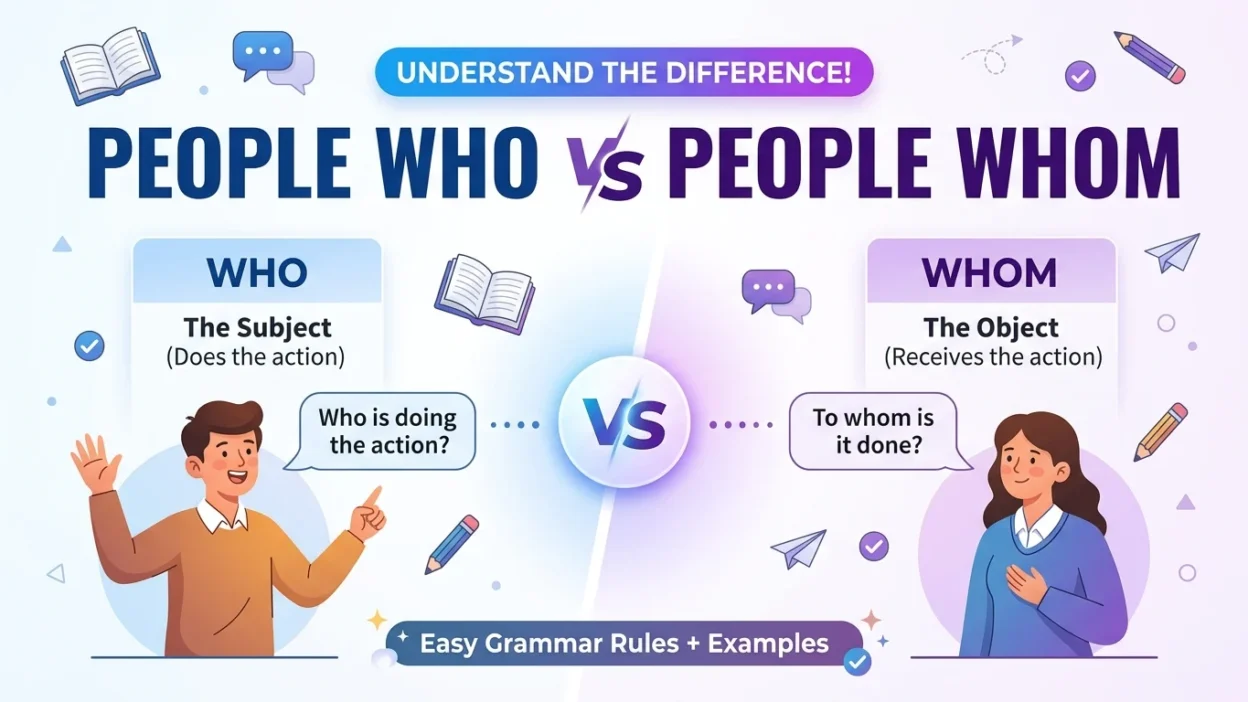
Have you ever wondered if to write “people who helped me” or “people whom I helped”? Both phrases are grammatically correct, but they serve different purposes in a sentence. Understanding the difference between who and whom can help you write more clearly, speak more confidently, and avoid common English grammar mistakes.
The main difference is simple: use “who” when referring to people who perform an action, and use “whom” when referring to people who receive an action or follow a preposition. For example, “People who work hard often succeed” uses who because the people perform the action. In contrast,
“People whom I admire inspire me” uses whom because the speaker admires those people. Although whom is less common in everyday conversation, it remains useful in formal writing and certain sentence structures. In this guide, you will learn when to use each word, how to remember the difference, and how to apply the rules through simple, real-life examples.
Quick Answer: People Who vs. People Whom
“People who” is used when people are the subject of a verb, meaning they perform an action. “People whom” is used when people are the object of a verb or preposition, meaning an action affects them or a preposition relates to them. For example, “People who teach” and “people whom I teach” are both correct.
Why Do People Confuse “People Who” and “People Whom”?
People often confuse who and whom because both words refer to people. Their meanings are closely related, but their grammatical roles are different.
The easiest way to understand the distinction is to look at the role the person plays in the sentence.
- Who: Refers to the person or people performing an action.
- Whom: Refers to the person or people receiving an action or following a preposition.
Consider these examples:
- People who help others make a difference.
- People whom others help may feel grateful.
In the first sentence, the people perform the action of helping. In the second sentence, the people receive help.
Another reason for the confusion is that English speakers often use who instead of whom in casual conversation. However, understanding the traditional distinction is helpful when writing formal letters, academic assignments, business documents, and professional communications.
First Word: What Does “Who” Mean?
Who is a relative pronoun or interrogative pronoun used to refer to people. In the expression “people who,” it usually introduces a clause describing what those people do.
Use who when the people are the subject of the verb in the clause.
Examples of “People Who”
- People who exercise regularly often improve their fitness.
- People who speak politely make a good impression.
- People who study consistently may perform better on exams.
- People who help their neighbors strengthen their communities.
- People who arrive early can choose their seats.
In each example, who refers to people performing an action: exercising, speaking, studying, helping, or arriving.
How to Identify “Who” in a Sentence
Try replacing who with he, she, or they. If the replacement makes sense, who is generally the correct choice.
For example:
“People who work hard deserve recognition.”
Replace the clause with “They work hard.”
The sentence makes sense, so who is correct.
This test is especially useful when you are unsure which word to use in a longer sentence.
Second Word: What Does “Whom” Mean?
Whom is a pronoun used as the object of a verb or preposition. In the expression “people whom,” it refers to people who receive an action or have a relationship expressed by a preposition.
Use whom when the people are the object rather than the subject of the clause.
Examples of “People Whom”
- People whom we respect deserve kindness.
- People whom I invited will attend the event.
- People whom the manager interviewed received an email.
- People whom you help may remember your kindness.
- People whom she trusts know her secrets.
In these examples, the people receive an action: we respect them, I invited them, the manager interviewed them, you help them, and she trusts them.
How to Identify “Whom” in a Sentence
Try replacing whom with him, her, or them. If the replacement makes sense, whom is generally the correct choice in formal English.
For example:
“People whom I admire inspire me.”
Replace the clause with “I admire them.”
The replacement works, so whom is correct in formal usage.
In everyday conversation, many speakers would say “people who I admire.” This construction is widely used in informal English, although whom preserves the traditional subject-object distinction.
People Who vs. People Whom: Comparison Table
| Feature | People Who | People Whom |
|---|---|---|
| Main use | Subject of a verb | Object of a verb or preposition |
| Grammatical role | Performs the action | Receives the action or follows a preposition |
| Simple replacement | They | Them |
| Example | People who teach inspire others. | People whom I teach learn from me. |
| Common in conversation | Very common | Less common |
| Formal writing | Correct | Correct when used as an object |
| Example with a preposition | People who work with us | People with whom we work |
| Main question | Who performs the action? | Whom does the action affect? |
Remember: The choice depends on the grammatical role of the pronoun, not on whether the sentence sounds formal or informal.
When Should You Use “People Who” or “People Whom”?
Choosing the correct expression becomes easier when you identify the subject and object in the clause.
When to Use “People Who”
Use “people who” when the people perform the action described by the verb.
Examples:
- People who volunteer make their communities stronger.
- People who listen carefully understand others better.
- People who practice regularly develop their skills.
- People who arrive late may miss important information.
- People who care about others often show kindness.
Simple rule: If the people do the action, use who.
When to Use “People Whom”
Use “people whom” when the people receive the action of a verb.
Examples:
- People whom we support appreciate our efforts.
- People whom she invited arrived early.
- People whom the teacher praised felt encouraged.
- People whom I called did not answer.
- People whom the company hired started work on Monday.
Simple rule: If someone does something to or for the people, whom is appropriate in formal English when those people are the object.
When to Use “Whom” After a Preposition
In formal English, whom is used after a preposition such as to, with, for, or from.
Examples:
- The people to whom I spoke were helpful.
- The people with whom she works are friendly.
- The people for whom we organized the event arrived early.
- The people from whom I received advice were experienced.
In everyday English, speakers often place the preposition at the end of the clause and use who instead.
For example:
- Formal: The people with whom I work are friendly.
- Conversational: The people who I work with are friendly.
Both forms are widely understood, but the first follows the traditional formal rule.
12 Examples of People Who vs. People Whom
These examples show how the correct word changes depending on the role of the people in the sentence.
| No. | Sentence | Correct Word | Reason |
|---|---|---|---|
| 1 | People ___ exercise regularly feel healthier. | Who | The people perform the action of exercising. |
| 2 | People ___ I admire inspire me. | Whom in formal English | The speaker admires those people. |
| 3 | People ___ help others show kindness. | Who | The people perform the action of helping. |
| 4 | People ___ we invited arrived early. | Whom in formal English | We invited those people. |
| 5 | People ___ work hard can achieve their goals. | Who | The people perform the action of working. |
| 6 | People ___ she trusts keep her secrets. | Whom in formal English | She trusts those people. |
| 7 | People ___ teach children shape their futures. | Who | The people perform the action of teaching. |
| 8 | People ___ the manager selected joined the team. | Whom in formal English | The manager selected those people. |
| 9 | People ___ listen carefully learn more. | Who | The people perform the action of listening. |
| 10 | People ___ I called did not answer. | Whom in formal English | I called those people. |
| 11 | People ___ live nearby often become friends. | Who | The people perform the action of living. |
| 12 | People ___ we depend on should be trustworthy. | Whom in formal English | We depend on those people. |
In everyday conversation, who is also common in several object clauses above, such as “people who I admire” and “people who we invited.” In formal writing, use whom when the pronoun functions as an object.
Common Mistakes With People Who and People Whom
Even experienced English learners sometimes choose the wrong pronoun. These are some mistakes to watch for.
Mistake 1: Using “Whom” for the Subject
Incorrect: People whom work hard often succeed.
Correct: People who work hard often succeed.
Why? The people perform the action of working, so who is the correct subject pronoun.
Mistake 2: Using “Who” in Formal Object Clauses
Traditional formal usage: People who I invited arrived early.
Preferred formal version: People whom I invited arrived early.
Why? The speaker invited the people, so they are the object of the verb invited. In casual speech, however, the first version is common and generally accepted.
Mistake 3: Choosing Based on How Important the People Are
Incorrect: People whom help the community deserve respect.
Correct: People who help the community deserve respect.
Why? The word choice depends on grammatical function, not on the importance of the people.
Mistake 4: Assuming “Whom” Is Always More Professional
Incorrect reasoning: “Whom” must sound better in every sentence.
Correct approach: Use who for subjects and whom for objects in formal English.
For example:
- Correct: People who lead with kindness earn trust.
- Correct: People whom we trust earn our respect.
Using whom where who belongs does not make a sentence more professional.
Mistake 5: Forgetting Prepositions
Formal: The people to whom I sent the invitations responded.
Conversational: The people who I sent the invitations to responded.
The formal construction uses whom after to. The conversational version is common, although the sentence can also be made clearer by writing, “The people I sent invitations to responded.”
Memory Trick: How to Remember Who vs. Whom
The easiest way to remember the difference is to use the he/him test.
- If you can replace the pronoun with he, she, or they, use who.
- If you can replace it with him, her, or them, use whom in formal English.
Example 1
“People who help us deserve thanks.”
Test: They help us.
Because they works, use who.
Example 2
“People whom we help deserve thanks.”
Test: We help them.
Because them works, use whom in formal English.
One-Line Memory Trick
Who = they; whom = them.
This simple trick works in many everyday sentences and is especially useful for students preparing for English grammar tests.
American vs. British English: Is There a Difference?
The basic grammatical distinction between who and whom is the same in American and British English.
In both varieties:
- Who is used as a subject.
- Whom is used as an object in traditional formal grammar.
- Whom commonly appears after a preposition in formal constructions.
For example:
- American English: People who work hard often succeed.
- British English: People who work hard often succeed.
The sentence is correct in both varieties.
Similarly, “the people to whom I spoke” is grammatically correct in both American and British English.
The main difference is not the grammar rule but the level of formality. In everyday conversation, speakers in both varieties frequently use who instead of whom in object clauses.
For instance:
- Formal: The people whom I met were friendly.
- Informal: The people who I met were friendly.
Both are commonly understood. For formal essays, academic work, and professional documents, following the traditional distinction is a reliable choice.
Similar Words: Who, Whom, Whose, and Which
Understanding related pronouns can make English grammar easier.
Who vs. Whom
- Who: Identifies the subject performing an action.
- Whom: Identifies the object receiving an action or following a preposition.
Example:
- People who inspire me are important.
- People whom I admire inspire me.
Who vs. Whose
Whose indicates possession or association.
Examples:
- People who work here are friendly.
- People whose work inspires others deserve recognition.
In the second sentence, whose tells us that the work belongs to or is associated with the people.
Who vs. Which
Who generally refers to people, while which commonly refers to things and animals.
Examples:
- People who enjoy reading often visit libraries.
- Books which explain grammar clearly can help students.
In many contexts, that can also introduce a clause describing people or things.
For example: “People that help others make a difference.”
This is common English usage, although who is often preferred when referring to people.
Final Verdict: People Who or People Whom?
Both expressions are correct, but they are used in different grammatical situations.
Use “people who” when the people perform an action:
- People who work hard succeed.
- People who care about others show kindness.
Use “people whom” when the people receive an action or follow a preposition in formal English:
- People whom I respect inspire me.
- People with whom I work are supportive.
If you are writing an academic essay, a formal letter, or a professional document, following the traditional subject-object distinction is a good approach. In everyday conversation, who is frequently used in place of whom when the pronoun is an object.
The most important rule is simple: who = they; whom = them.
Frequently Asked Questions
1. Is It “People Who” or “People Whom”?
Both are correct, depending on the sentence. Use people who when the people perform an action, as in “people who teach.” Use people whom when the people are the object of a verb, as in “people whom I teach,” in formal English.
2. Is “People Who I Know” Grammatically Correct?
Yes. “People who I know” is widely used and accepted in everyday English. In traditional formal grammar, “people whom I know” is preferred because I perform the action of knowing, while the people are the object.
3. Is “People Whom” Always Correct?
No. Whom is appropriate when the pronoun functions as an object, but it should not replace who when the pronoun is the subject of a verb.
For example, “people whom work hard” is incorrect in traditional grammar. The correct expression is “people who work hard.”
4. Can I Use “Who” Instead of “Whom” in Everyday English?
Yes. Many English speakers use who instead of whom in everyday speech and informal writing, even when the pronoun is an object.
For example, “the people who I invited” is common in conversation. “The people whom I invited” follows the traditional formal distinction.
5. How Do I Know Whether to Use Who or Whom?
Use the he/him test. If you can replace the pronoun with he, she, or they, use who. If you can replace it with him, her, or them, use whom in formal English.
For example, “They work hard” indicates who, while “I respect them” indicates whom.
6. Should I Use “Whom” in Academic Writing?
Use whom when it functions as an object in a formal sentence. For example, “The students whom the professor selected received awards.”
However, do not use whom simply to sound formal. When the pronoun is the subject, who is correct, even in academic writing.
7. Is “People to Whom” Correct?
Yes. “People to whom” is grammatically correct in formal English because whom follows the preposition to.
Example: “The people to whom I spoke were helpful.”
In informal English, you can say, “The people who I spoke to were helpful.”
8. What Is the Easiest Way to Remember the Difference?
Remember this simple rule: who = they, whom = them. Use who for people performing an action and whom for people receiving an action or following a preposition in formal English.
Remember This
- People who = people performing an action.
- People whom = people receiving an action or following a preposition in formal English.
- Who = they.
- Whom = them.
- Both words refer to people, but their grammatical roles differ.
- In everyday English, who often replaces whom in object clauses.
- In formal writing, use the traditional distinction when appropriate.
Conclusion
Understanding the difference between “people who” and “people whom” is easier when you focus on the role of the pronoun in a sentence. Use who when the people perform an action, such as “people who teach,” and use whom when the people receive an action, such as “people whom I teach.” The he/him test can help you make the right choice quickly.
Although whom remains useful in formal writing, who is common in everyday English, including many object clauses. Learn the traditional rule, practice with simple examples, and pay attention to how each sentence is structured. With regular practice, you will become more confident using both expressions correctly.

Adam Cody is a passionate writer at SleepCout, exploring coded dreams, dream meanings, sleep science, lucid dreaming, and symbolism through engaging, well-researched articles that inspire curiosity and self-discovery.