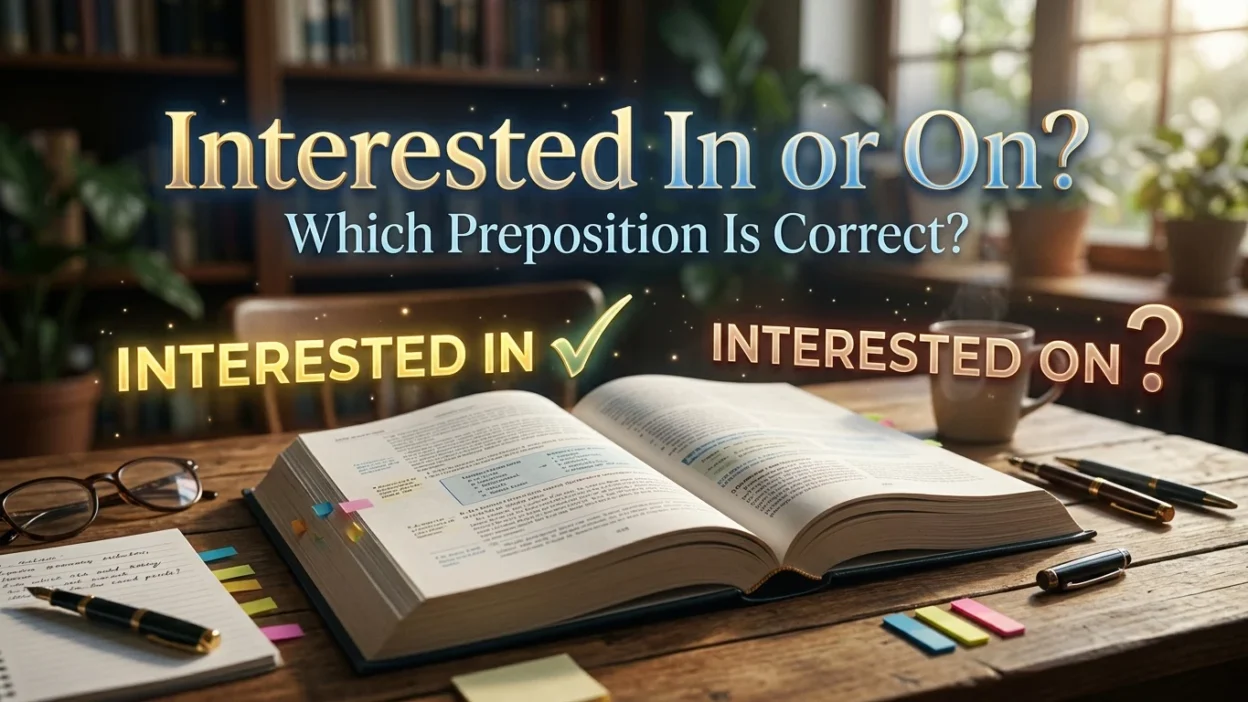
Choosing the right preposition can make a big difference in English. One common question is whether to say “interested in” or “interested on.” Although both words are common English prepositions, they are not interchangeable after the adjective interested.
The correct and standard expression is “interested in.” We use it when we want to say that someone has curiosity, enthusiasm, attention, or a desire to learn more about a person, subject, activity, or thing. For example, “She is interested in photography” is correct.
In contrast, “interested on” is generally incorrect when talking about someone’s interest in a subject or activity. English learners sometimes choose “on” because it can mean “about” or “concerning” in other expressions. However, after interested, the natural preposition is in. Understanding this simple rule can help you sound more natural and avoid a common grammar mistake.
Quick Answer
The correct phrase is “interested in,” not “interested on.” Use interested in to describe curiosity, enthusiasm, or attention toward a person, subject, activity, or thing. For example, “I am interested in history” and “They are interested in learning English.” Interested on is normally not correct in standard English.
Why Do People Confuse “Interested In” and “Interested On”?
People often confuse these expressions because in and on are both very common prepositions.
The preposition on is frequently used with subjects and topics:
- a book on grammar
- an article on climate change
- a lecture on science
- information on the subject
Because “on” can sometimes mean “about,” learners may think it should also follow interested.
However, English adjectives often have specific prepositions that naturally go with them. Interested is one of those adjectives.
The standard combination is:
interested + in
So we say:
- I am interested in music.
- He is interested in computers.
- We are interested in your proposal.
- She became interested in photography.
Not:
- I am interested on music.
- He is interested on computers.
First Word: “Interested In”
Interested in is the correct and natural expression in standard English.
It means that someone has curiosity, enthusiasm, concern, or attention toward something.
Examples
- I am interested in history.
- She is interested in painting.
- They are interested in buying a new car.
- He became interested in learning Spanish.
- Are you interested in sports?
The word or phrase after in can be a noun, pronoun, or gerund (-ing form).
Interested + noun
She is interested in psychology.
Interested + activity
He is interested in swimming.
Interested + gerund
I am interested in learning French.
Interested + person
She is interested in him.
The meaning can change depending on context. “Interested in him” could mean that she is curious about him, wants to know more about him, or has romantic interest in him.
Second Word: “Interested On”
Interested on is generally incorrect when you mean that someone has an interest in a subject, person, activity, or thing.
For example:
I am interested on history.
The correct sentence is:
I am interested in history.
Similarly:
She is interested on photography.
She is interested in photography.
There are situations where interested and on can appear near each other in a sentence, but that does not make interested on a standard fixed expression.
For example:
The students are interested in the information on the website.
Here, in belongs with “interested,” while on belongs with “information.”
This distinction is important.
Interested In vs Interested On: Comparison Table
| Expression | Correct? | Meaning/Use | Example |
|---|---|---|---|
| interested in | Yes | Having curiosity or enthusiasm about something | I am interested in art. |
| interested on | Normally no | Not the standard preposition after interested | I am interested on art. ❌ |
| information on | Yes | Information about a topic | I need information on art. |
| a book on | Yes | A book about a subject | She bought a book on art. |
| interested about | Usually unnatural | Not the normal collocation | I am interested about art. ❌ |
| interested by | Sometimes | Attracted or stimulated by something | I was interested by his story. |
When Should You Use “Interested In”?
Use interested in whenever you want to express someone’s interest, curiosity, enthusiasm, or attention.
1. Talking about hobbies
I am interested in photography.
2. Talking about school subjects
Maria is interested in biology.
3. Talking about careers
He is interested in becoming a doctor.
4. Talking about activities
Are you interested in playing tennis?
5. Talking about people
She is interested in meeting new people.
6. Talking about ideas
We are interested in your idea.
7. Talking about opportunities
I am interested in this job opportunity.
8. Talking about learning
They are interested in learning English.
9. Talking about news or events
He is interested in current events.
10. Talking about products or services
The customer is interested in buying the new model.
11. Talking about research
The professor is interested in artificial intelligence.
12. Talking about future plans
She is interested in studying abroad.
10+ Examples of “Interested In”
Here are more examples to make the rule easy to remember:
- I am interested in learning new languages.
- She is interested in fashion.
- My brother is interested in football.
- Are you interested in this position?
- They are interested in buying a house.
- He became interested in photography last year.
- We are interested in your proposal.
- Sarah is interested in studying medicine.
- The children are interested in science.
- I have always been interested in history.
- He is interested in traveling around Europe.
- She is not interested in watching television.
- Are they interested in joining the club?
- The company is interested in expanding overseas.
Notice that in remains the correct preposition even when the next word is an -ing verb.
Common Mistakes With “Interested In”
Mistake 1: Using “interested on”
I am interested on computers.
I am interested in computers.
Mistake 2: Using “interested about”
She is interested about history.
She is interested in history.
Mistake 3: Forgetting the preposition
He is interested learning English.
He is interested in learning English.
Mistake 4: Using the wrong verb form
After interested in, an activity is commonly expressed with an -ing form.
I am interested in learn English.
I am interested in learning English.
Mistake 5: Confusing “interested in” with “interesting”
Interested describes how a person feels.
I am interested in science.
Interesting describes something that creates interest.
Science is interesting.
Compare:
- The movie is interesting.
- I am interested in the movie.
Memory Trick: “Interested IN = Interest Goes IN”
A simple way to remember the rule is:
Your interest goes IN something.
Think of in as showing the subject that receives your attention.
- interested in music
- interested in sports
- interested in science
- interested in learning
- interested in travel
Whenever you want to say that someone has an interest in something, choose in.
Easy formula
Subject + be + interested in + noun/gerund
Examples:
I am interested in art.
She is interested in dancing.
They are interested in technology.
American vs British English
There is no major American-versus-British difference in this particular expression.
Both American English and British English normally use:
interested in
For example:
American English:
I am interested in learning French.
British English:
I am interested in learning French.
The preposition does not normally change from in to on depending on the variety of English.
Therefore, if you are writing for an American, British, Australian, Canadian, or international audience, interested in is the safe and standard choice.
Similar Words and Expressions
Several expressions are related to structures are different.
Fascinated by
Means extremely interested in or attracted by something.
She is fascinated by space.
Curious about
Means wanting to know or understand something.
He is curious about the new project.
Enthusiastic about
Means very excited or positive about something.
They are enthusiastic about the new plan.
Keen on
Commonly means liking or being enthusiastic about something, especially in British English.
She is keen on tennis.
Concerned about
Means worried or attentive because something may be a problem.
He is concerned about the situation.
Excited about
Means feeling happy and enthusiastic about something that is expected to happen.
We are excited about the trip.
These expressions do not all take the same preposition, which is why learning common word combinations is useful.
Final Verdict:
The correct choice is interested in.
Use interested in when you want to say that someone has curiosity, enthusiasm, attention, or an attraction toward a person, subject, activity, idea, or thing.
Interested on is not the normal or standard expression for this meaning.
Remember:
I am interested in music.
I am interested on music.
And:
She is interested in learning English.
She is interested on learning English.
If you are unsure, remember that naturally pairs with in.
Frequently Asked Questions
Is “interested in” grammatically correct?
Yes. Interested in is the standard grammatical expression used to describe curiosity, enthusiasm, attention, or attraction toward something.
Is “interested on” correct English?
Generally, no. Interested on is not the standard expression when talking about having an interest in a subject, person, activity, or thing. Use interested in instead.
Do you say “interested in learning” or “interested in learn”?
The correct form is interested in learning. After the preposition in, an activity is normally expressed using the gerund form.
Can I say “I am interested in this”?
Yes. I am interested in this is completely natural English. It means that you find the thing being discussed appealing, useful, important, or worth knowing more about.
Is “interested in” used in both American and British English?
Yes. Both American and British English use interested in. There is no standard regional change to interested on.
What is the difference between “interested in” and “interesting”?
Interested describes a person’s feeling, while interesting describes something that creates interest.
I am interested in history.
History is interesting.
Can “interested in” be followed by a verb?
Yes. When a verb follows interested in, use the -ing form.
She is interested in studying medicine.
They are interested in joining us.
Remember This
Interested in is the correct phrase.
Use:
- interested in sports
- interested in science
- interested in someone
- interested in learning
- interested in a job
- interested in an idea
Avoid interested on when you mean that someone has an interest in something.
The quickest rule is:
Interested + IN
Once you remember this common word combination, you will be able to use the expression naturally in everyday conversation, school writing, professional communication, and formal English.
Conclusion
The difference between interested in and interested on is simple: interested in is the correct standard expression when describing someone’s interest in a subject, activity, person, idea, or thing. Although on can mean “about” in expressions such as “a book on history” or “an article on science,” it does not normally replace in after the adjective interested.
Whenever you want to describe someone’s curiosity or enthusiasm, use interested in. For example, say “I am interested in learning English,” not “I am interested on learning English.” Keep the simple pattern interested + in in mind, and this common preposition mistake becomes easy to avoid.

Charles Kyle is a passionate writer and dream researcher at SleepCout, dedicated to exploring coded dreams, lucid dreaming, dream symbolism, and sleep science. He creates engaging, well-researched content that helps readers understand their dreams and discover the fascinating connection between technology, imagination, and the sleeping mind.