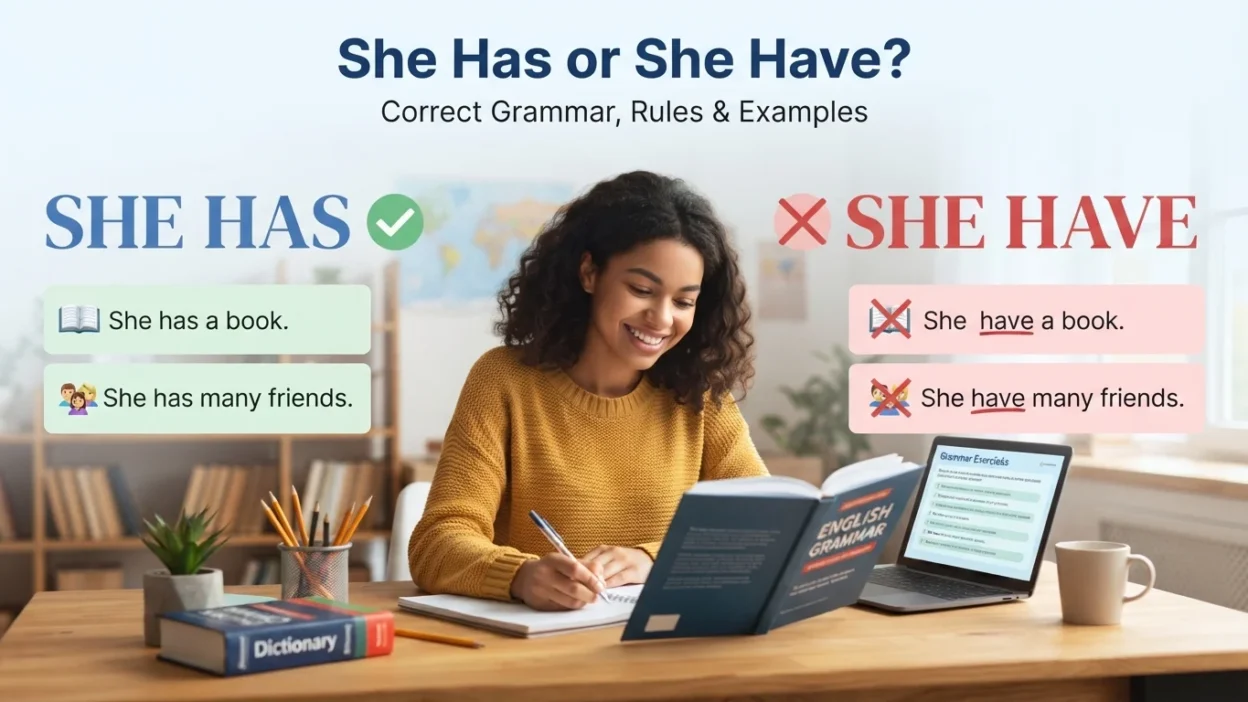
When you are talking about a woman, girl, or another singular person, choosing between “she has” and “she have” can be confusing. The good news is that the rule is simple: “She has” is grammatically correct in standard English, while “she have” is generally incorrect when “she” is the subject of a present-tense sentence.
This difference comes from subject-verb agreement. The pronoun “she” is third-person singular, so it takes “has”, not “have,” in the present simple. For example, we say, “She has a new phone,” not “She have a new phone.” However, “have” can appear with “she” in certain structures, such as after modal verbs: “She should have more time.” Understanding this small distinction will help you write and speak English more naturally.
Quick Answer
“She has” is correct when “she” is the subject in a normal present-tense sentence. “She have” is incorrect in standard English when used by itself. However, “she” can be followed by “have” after words such as does, can, will, should, and may: “She does have a car.”
Why Do People Confuse “She Has” and “She Have”?
The confusion usually happens because has and have are both forms of the same verb: to have.
The correct form depends on the subject.
- I have
- You have
- We have
- They have
- He has
- She has
- It has
The important point is that he, she, and it normally take has in the present simple.
For example:
- She has a dog.
- He has a new job.
- It has four wheels.
What Does “She Has” Mean?
“She has” means that a female person possesses, experiences, owns, or is connected with something.
It can express:
- Possession: She has a car.
- Relationships: She has two brothers.
- Experiences: She has a headache.
- Characteristics: She has beautiful eyes.
- Activities or events: She has a meeting today.
Examples of “She Has”
- She has a new laptop.
- She has three children.
- She has a beautiful voice.
- She has a lot of work.
- She has an important meeting.
- She has enough money.
What About “She Have”?
“She have” is normally incorrect when “have” is the main verb in a simple present-tense sentence.
Incorrect:
She have a new car.
Correct:
She has a new car.
Incorrect:
She have two sisters.
Correct:
She has two sisters.
However, “have” itself is not impossible after “she.” It is correct when another auxiliary or modal verb requires the base form.
For example:
- She does have a car.
- She can have some cake.
- She will have more time tomorrow.
- She should have a doctor’s appointment.
- She may have the answer.
She Has vs. She Have: Comparison Table
| Phrase | Correct? | Example | Explanation |
|---|---|---|---|
| She has | ✅ Yes | She has a car. | Correct present-tense form |
| She have | ❌ Usually no | She have a car. | Incorrect subject-verb agreement |
| She does have | ✅ Yes | She does have a car. | “Does” takes the base verb “have” |
| She can have | ✅ Yes | She can have some tea. | Modal verbs take the base form |
| She will have | ✅ Yes | She will have time later. | “Will” takes the base form |
| She should have | ✅ Yes | She should have more rest. | “Should” takes the base form |
When Should You Use “She Has”?
Use “she has” when has is the main verb in a present-tense statement.
1. To Show Possession
She has a new phone.
She has a large house.
2. To Talk About Family
She has two sisters.
She has a young son.
3. To Describe Something Someone Experiences
She has a headache.
She has a problem.
4. To Talk About Scheduled Events
She has a meeting at noon.
She has an appointment tomorrow.
5. To Describe Features
She has long hair.
She has blue eyes.
When Can You Use “She Have”?
You can use “have” after “she” when another verb or auxiliary requires the base form.
After “Does”
She does have a point.
After “Can”
She can have some coffee.
After “Will”
She will have dinner later.
After “Should”
She should have more patience.
After “May”
She may have the information you need.
The important rule is:
After a modal verb or “does,” use the base form “have,” not “has.”
10+ Examples of “She Has” and “She Have”
- She has a new job. ✅
- She has two cats. ✅
- She has a beautiful garden. ✅
- She has enough time. ✅
- She has an interesting idea. ✅
- She has a cold. ✅
- She has a meeting today. ✅
- She has three books. ✅
- She does have a valid reason. ✅
- She can have another piece of cake. ✅
- She will have dinner at eight. ✅
- She should have more confidence. ✅
Notice that examples 1–8 use has directly after “she,” while examples 9–12 use have because another auxiliary or modal verb comes before it.
Common Mistakes
Mistake 1: Using “have” directly after “she”
❌ She have a car.
✅ She has a car.
Mistake 2: Using “has” after “does”
❌ She does has a car.
✅ She does have a car.
After does, use the base form have.
Mistake 3: Using “has” after a modal verb
❌ She can has a break.
✅ She can have a break.
Modal verbs such as can, will, should, may, might, and must are followed by the base form of the verb.
Mistake 4: Forgetting that “she” is singular
“ She” is a singular third-person pronoun, so the present-simple form is:
She has.
Not:
She have.
A Simple Memory Trick
Remember:
He → has
She → has
It → has
But:
I → have
You → have
We → have
They → have
A useful shortcut is:
He, she, it = has. Everyone else = have.
Just remember that after does and modal verbs, the verb returns to its base form:
She has a car.
She does have a car.
She can have a car.
American vs. British English
The basic rule is the same in both American English and British English.
Both varieties use:
She has a car.
And both use the base form after auxiliaries and modal verbs:
She does have a car.
She can have a car.
There is no standard American-versus-British difference that makes “she have” correct as a simple present-tense statement.
Similar Words and Forms
Understanding the related forms of have can make this rule easier.
Have
Used with I, you, we, and they in the present simple.
They have a house.
Has
Used with he, she, and it in the present simple.
She has a house.
Had
The past-tense form used with all subjects.
She had a house.
They had a house.
Having
The -ing form.
She is having lunch.
Have
The base form used after auxiliaries and modal verbs.
She does have a car.
She will have lunch soon.
Final Verdict: She Has or She Have?
The correct choice is “she has” when have is the main verb in a normal present-tense sentence.
✅ She has a car.
❌ She have a car.
However, “she have” can be grammatically correct when another auxiliary or modal verb comes before it:
- She does have a car.
- She can have a car.
- She will have a car.
- She should have a car.
So, the simplest rule is: Use “has” directly after “she,” but use “have” after “does” and modal verbs.
Frequently Asked Questions
Is “she has” grammatically correct?
Yes. “She has” is grammatically correct when has is the main verb in a present-tense sentence.
She has a new computer.
Is “she have” correct?
Usually, no. “She have” is incorrect when “have” directly follows “she” as the main verb in the present simple.
❌ She have a car.
✅ She has a car.
Why do we say “she has” instead of “she have”?
Because she is a third-person singular subject. In the present simple, the verb have changes to has with he, she, and it.
Can I say “she does have”?
Yes. “She does have” is correct. After does, the main verb uses its base form:
She does have a good reason.
Can I say “she will have”?
Yes. “She will have” is correct. The modal verb will is followed by the base form have.
Which is correct: “She has” or “she have”?
“She has” is correct when the verb comes directly after she in a simple present-tense sentence.
Is “she have” ever grammatically correct?
Yes, but normally only when another word requires the base form have, such as:
She can have it.
She does have it.
She will have it.
Remember This
She has = correct when have is the main verb.
She have = incorrect when used directly as the main verb in the present simple.
She does have / can have / will have = correct because the auxiliary or modal takes the grammatical marking, leaving have in its base form.
Conclusion
The difference between “she has” and “she have” is mainly a matter of subject-verb agreement. Because she is a third-person singular pronoun, use has when have is the main verb in the present simple: “She has a car.” This is the standard form in both American and British English.
Remember that have can still appear after “she” when another auxiliary or modal verb comes first. For example, “She does have,” “she can have,” and “she will have” are all correct. Once you understand this pattern, choosing between has and have becomes much easier.

Charles Kyle is a passionate writer and dream researcher at SleepCout, dedicated to exploring coded dreams, lucid dreaming, dream symbolism, and sleep science. He creates engaging, well-researched content that helps readers understand their dreams and discover the fascinating connection between technology, imagination, and the sleeping mind.