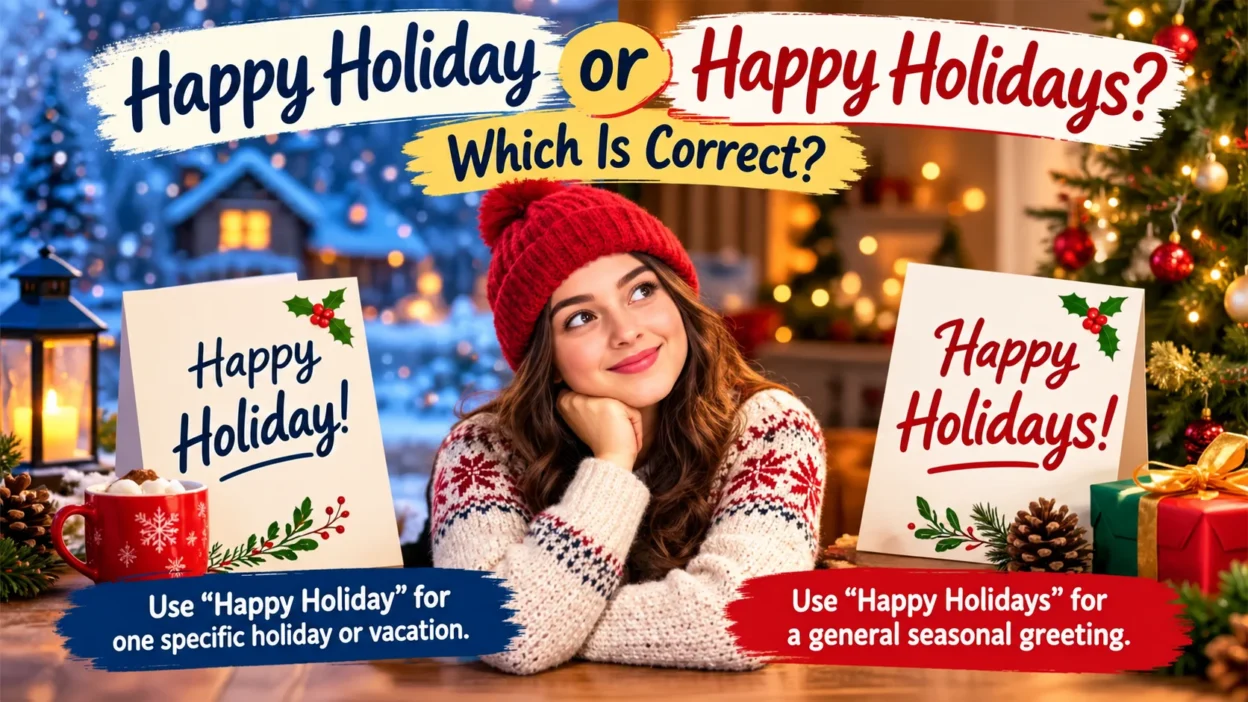
When deciding between “happy holiday” and “happy holidays,” the correct choice depends on what you want to say. “Happy holidays” is the more common greeting when wishing someone joy during a holiday season, such as Christmas and New Year. “Happy holiday” is also grammatically correct, but it usually refers to one specific holiday or a single vacation.
Both expressions can be understood in English, but they are not always interchangeable. Knowing when to use each phrase helps you write natural messages, greeting cards, emails, and social media posts. Whether you are wishing friends, family members, colleagues, or customers well, choosing the right expression makes your message sound more fluent and natural.
In this guide, you will learn the difference between happy holiday and happy holidays, discover practical examples, and understand how American and British English use these expressions. You will also find simple tips to help you remember which phrase to choose in everyday conversations.
Quick Answer: Happy Holiday or Happy Holidays?
“Happy holidays” is the standard, more common greeting for wishing someone well during a holiday season. It can refer to a period that includes several celebrations. “Happy holiday” is grammatically correct when referring to one particular holiday or occasion, although it is less common as a general seasonal greeting. For most greeting cards and messages, choose “Happy Holidays!”
Why Do People Confuse Happy Holiday and Happy Holidays?
People confuse these expressions because they differ by only one letter: the final -s. Both phrases use the adjective “happy,” which means feeling or expressing joy.
The difference is the noun:
- Holiday: One holiday, celebration, or vacation period.
- Holidays: Multiple holidays or, in common greetings, the broader holiday season.
English speakers also use “holiday” differently depending on the country. In American English, it often refers to a public or religious celebration. In British English, it can also mean a vacation away from home.
Because of these differences, the correct expression depends on the situation and the intended meaning.
What Does Happy Holiday Mean?
“Happy holiday” is a grammatically correct expression used to wish someone happiness during one specific holiday or holiday period.
However, English speakers do not commonly use it as a general greeting for the entire end-of-year holiday season. In many situations, “Happy Holidays” sounds more natural.
Examples of Happy Holiday
- “Have a happy holiday with your family.”
- “I hope you enjoy a happy holiday in the mountains.”
- “Wishing you a happy holiday filled with peace and joy.”
- “We hope you have a happy holiday this weekend.”
The first three examples refer to an enjoyable holiday experience or occasion. The fourth is also understandable, though “Have a great holiday weekend” may sound more natural in some contexts.
What Does Happy Holidays Mean?
“Happy holidays” is a widely used greeting that expresses good wishes during a holiday season. It is especially common around the end of the year, when people may celebrate Christmas, Hanukkah, New Year’s, or other holidays.
The plural form can also be used when wishing someone well during a period that includes multiple holidays.
Examples of Happy Holidays
- “Happy holidays to you and your family!”
- “Wishing everyone happy holidays and a wonderful New Year.”
- “Happy holidays! I hope you enjoy the festive season.”
- “Our team wishes you happy holidays and continued success.”
- “Happy holidays to all our valued customers.”
The expression is useful in personal messages, professional emails, greeting cards, advertisements, and social media captions.
Happy Holiday vs. Happy Holidays: Comparison Table
| Feature | Happy Holiday | Happy Holidays |
|---|---|---|
| Grammar | Correct | Correct |
| Noun form | Singular | Plural |
| General seasonal greeting | Less common | More common |
| Refers to several celebrations | Not usually | Yes |
| Refers to one holiday or vacation | Can fit | Can also fit a season |
| Greeting cards | Possible in specific contexts | Common choice |
| Business messages | Possible with context | Common and inclusive |
The key difference: Use “Happy Holidays” for a general seasonal greeting. Use “happy holiday” when the singular form fits the specific occasion or experience you are describing.
When Should You Use Happy Holiday or Happy Holidays?
1. Use Happy Holidays for the Holiday Season
Choose “Happy Holidays” when you want to send general seasonal wishes without naming a particular celebration.
Examples:
- “Happy holidays to everyone!”
- “Wishing you happy holidays and a prosperous New Year.”
- “Happy holidays from our family to yours.”
This expression works well when you do not know which holidays someone celebrates.
2. Use Happy Holiday for One Specific Occasion
The singular form can work when you are referring to one particular holiday or occasion.
Examples:
- “Have a happy holiday with your loved ones.”
- “I hope you have a happy holiday this year.”
- “May this be a happy holiday for your family.”
In everyday English, alternatives such as “Have a wonderful Christmas” or “Enjoy your holiday” may sound more natural when the occasion is specific.
3. Use Happy Holidays in Professional Messages
“Happy Holidays” is common in workplace emails, business greetings, and customer communications because it can acknowledge different celebrations.
Example:
“Thank you for your support throughout the year. We wish you happy holidays and a successful New Year.”
4. Use Holiday or Holidays When Talking About Vacations
In British English, “holiday” commonly means a vacation. The singular form refers to one trip or vacation period, while the plural can refer to multiple trips or a broader holiday period.
Examples:
- “Have a lovely holiday in Spain.”
- “We had wonderful holidays last summer.”
In American English, “vacation” is generally more common for a leisure trip.
12 Examples of Happy Holiday and Happy Holidays
Here are practical examples to help you understand the difference.
Examples Using Happy Holiday
- “I hope you have a happy holiday with your family.”
- “Wishing you a happy holiday filled with wonderful memories.”
- “Have a happy holiday and enjoy your time off.”
- “We hope your holiday is happy and relaxing.”
- “May you have a happy holiday surrounded by loved ones.”
- “She wished her friends a happy holiday before leaving.”
Examples Using Happy Holidays
- “Happy holidays to you and your family!”
- “We wish all our customers happy holidays.”
- “Happy holidays, and best wishes for the New Year.”
- “Our school wishes students and teachers happy holidays.”
- “Happy holidays! May your season be full of joy.”
- “Sending warm wishes for happy holidays and a bright New Year.”
These examples show that both expressions can be correct, but “Happy Holidays” is generally the better choice for a broad seasonal greeting.
Common Mistakes to Avoid
Even though both phrases are grammatically acceptable, some usage mistakes can make a message sound less natural.
Mistake 1: Using Happy Holiday as the Default Seasonal Greeting
Less natural for a general seasonal greeting:
“Happy holiday to everyone celebrating this season!”
More natural:
“Happy holidays to everyone celebrating this season!”
Mistake 2: Assuming Happy Holidays Refers Only to Christmas
“Happy Holidays” is not limited to Christmas. It can refer broadly to a season that includes multiple cultural, religious, and public celebrations.
Mistake 3: Thinking the Singular Form Is Grammatically Wrong
“Happy holiday” is not incorrect. Its suitability depends on the context. It can be used when discussing one holiday or wishing someone an enjoyable holiday experience.
Mistake 4: Confusing Holiday Greetings With Vacation Wishes
If someone is going on a trip, you can say:
- “Enjoy your holiday!”
- “Have a great vacation!”
- “Have a wonderful holiday in London!”
If you are greeting someone during the end-of-year festive season, “Happy Holidays!” is usually more appropriate.
Mistake 5: Writing Happy Holidays’ With an Apostrophe
The standard greeting is “Happy Holidays!” There is no apostrophe because the word is simply plural, not possessive.
What Is the Easiest Memory Trick?
Remember this simple rule:
- One holiday or vacation: Think singular — “holiday.”
- A season with several celebrations: Think plural — “holidays.”
- A general festive greeting: Choose “Happy Holidays!”
For example, if your friend is leaving for a beach vacation, you might say, “Have a wonderful holiday!”
If you are sending a greeting to your friends, family, or customers in December, you would usually write, “Happy Holidays!”
American English vs. British English
Both American and British English use “Happy Holidays,” but the word “holiday” has different everyday meanings in the two varieties.
| Expression | American English | British English |
|---|---|---|
| Happy Holidays | Common seasonal greeting | Understood and used as a seasonal greeting |
| Happy holiday | Correct, but less common as a general seasonal greeting | Correct when context supports the singular |
| Holiday | Often a public or religious celebration | Often a vacation or time away from work |
| Vacation | Common word for a leisure trip | Less common than “holiday” for this meaning |
| Bank holiday | Public holiday in certain contexts | Common term for an official public holiday |
For example, an American might say, “I’m going on vacation next week,” while a British speaker might say, “I’m going on holiday next week.”
Despite this difference, “Happy Holidays” is a natural greeting in both varieties of English, especially during a season with multiple celebrations.
Similar Words and Holiday Greetings
If you want to make your message more specific, these alternatives may be useful.
- Happy Christmas: A Christmas greeting used especially in British English.
- Merry Christmas: A traditional and widely used Christmas greeting.
- Happy New Year: A greeting for the beginning of a new year.
- Season’s Greetings: A polite, often professional greeting suitable for the festive season.
- Enjoy your holiday: A natural expression when someone is taking a vacation or time off.
- Have a wonderful vacation: A common American English expression for someone going on a trip.
- Warm holiday wishes: A friendly phrase for greeting cards and professional messages.
- Best wishes for the holidays: A polite expression for personal and business correspondence.
Choose the expression that best matches your audience and the occasion. For a broad seasonal greeting, “Happy Holidays” remains an excellent option.
Final Verdict: Which One Should You Use?
Both “happy holiday” and “happy holidays” are grammatically correct, but “Happy Holidays” is the more natural and widely used choice for a general festive-season greeting.
Use “happy holiday” when the singular form fits your intended meaning, such as wishing someone an enjoyable holiday experience. When sending seasonal wishes to friends, colleagues, customers, or a general audience, choose “Happy Holidays!”
Frequently Asked Questions
1. Is it Happy Holiday or Happy Holidays?
Both expressions are grammatically correct. “Happy Holidays” is more common as a general seasonal greeting, while “happy holiday” can refer to one particular holiday or an enjoyable holiday experience.
2. Why do people say Happy Holidays instead of Happy Holiday?
People say “Happy Holidays” because the greeting commonly covers a season that includes multiple celebrations. It is also a convenient way to wish people well without assuming that everyone celebrates the same holiday.
3. Is Happy Holiday grammatically incorrect?
No. “Happy holiday” is grammatically correct. However, it is less common than “Happy Holidays” as a general greeting during the end-of-year festive season.
4. Should I write Happy Holidays in a greeting card?
Yes. “Happy Holidays” is a natural choice for greeting cards, emails, social media posts, and business messages, particularly when you want to acknowledge a broad range of celebrations.
5. Is Happy Holidays appropriate for business emails?
Yes. “Happy Holidays” is a polite, professional greeting that works well for customers, clients, colleagues, and business partners during the festive season.
6. Do Americans and British people both say Happy Holidays?
Yes. Both use and understand “Happy Holidays.” However, British English more commonly uses “holiday” to mean a vacation, whereas American English typically uses “vacation” for that meaning.
7. Can I say Happy Holidays if I do not celebrate Christmas?
Yes. “Happy Holidays” is a broad seasonal greeting and does not require you to celebrate Christmas. It can be used by people with different cultural and religious backgrounds.
Remember This
- Happy Holidays: Best for general seasonal greetings.
- Happy Holiday: Correct when referring to one holiday or an enjoyable holiday experience.
- Merry Christmas: Best when specifically wishing someone well for Christmas.
- Enjoy your holiday: Natural when someone is taking time off or going on vacation.
When in doubt, use “Happy Holidays” for a general festive greeting. It is clear, friendly, and appropriate for many different audiences.
Conclusion
Choosing between “happy holiday” and “happy holidays” is simple once you understand the difference between the singular and plural forms. Both are correct English, but they serve slightly different purposes. “Happy Holidays” is the more common choice for seasonal greetings because it can cover several celebrations and is suitable for personal and professional messages.
Use “happy holiday” when the singular meaning fits your sentence, especially when talking about one holiday or an enjoyable holiday experience. For greeting cards, business emails, social media captions, and general festive wishes, “Happy Holidays” is usually the safest and most natural choice.

Charles Kyle is a passionate writer and dream researcher at SleepCout, dedicated to exploring coded dreams, lucid dreaming, dream symbolism, and sleep science. He creates engaging, well-researched content that helps readers understand their dreams and discover the fascinating connection between technology, imagination, and the sleeping mind.