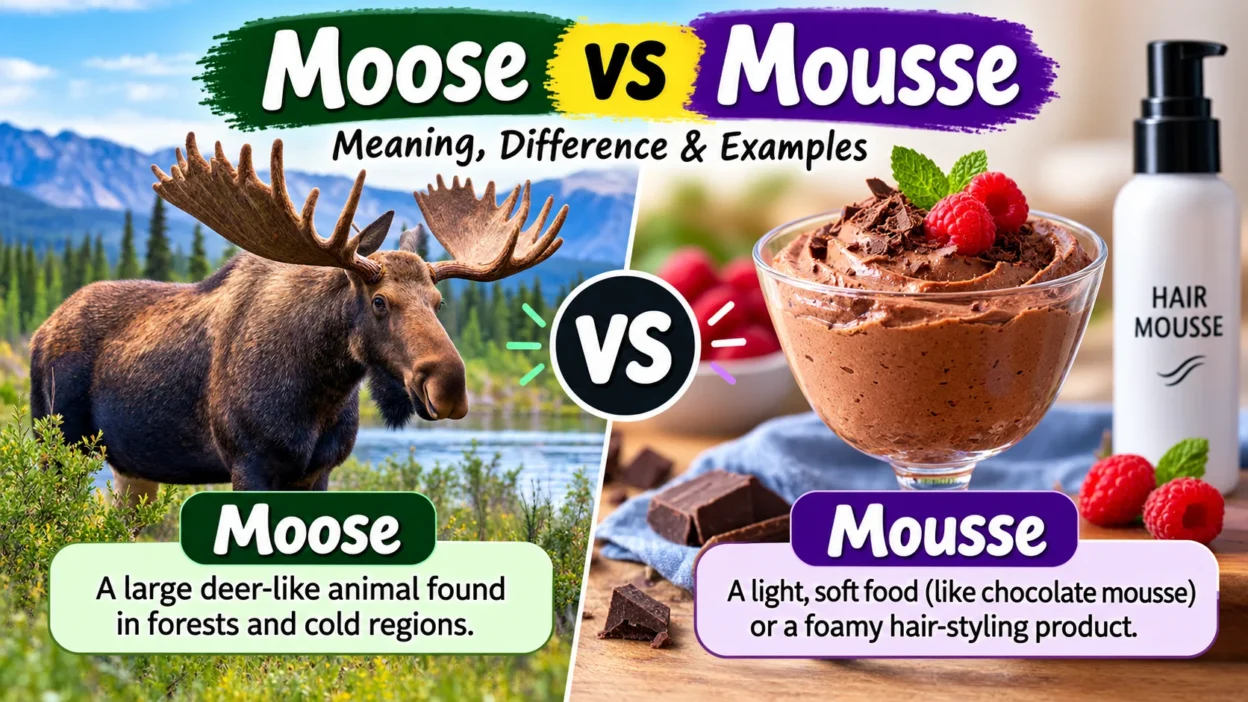
Have you ever wondered if to write moose or mousse? Although these two words look and sound similar, they have completely different meanings. One refers to a large wild animal, while the other describes a light, soft food or a hair-styling product.
Understanding the difference between moose vs mousse is easy once you learn what each word means and how to use it in a sentence. Both words are nouns, and both have the same pronunciation in standard English, which makes them easy to confuse in writing. However, their meanings, spellings, and uses are entirely different.
In this guide, you will learn the definitions of moose and mousse, see practical examples, compare their meanings in a table, and discover simple memory tricks to remember which spelling to use. Whether you are learning English, improving your vocabulary, or checking your spelling, this explanation will help you use both words correctly.
Quick Answer: Moose vs Mousse
Moose is a large deer-like animal with long legs and, in males, broad antlers. Mousse is a soft, light-textured food, such as chocolate mousse, or a product used to style hair. Both words are pronounced the same way, but their meanings and spellings are different.
Why Do People Confuse Moose and Mousse?
People often confuse moose and mousse because they sound identical when spoken. These words are examples of homophones, which are words that share the same pronunciation but have different meanings.
Their spelling is also similar, with both containing the letters m, o, u, and s. The main difference is the order of the final letters:
- Moose: M-O-O-S-E
- Mousse: M-O-U-S-S-E
The context usually makes the intended meaning clear. If someone is talking about wildlife, forests, or antlers, they probably mean moose. If the conversation involves chocolate, desserts, or hair products, they probably mean mousse.
What Does Moose Mean?

Moose is a large member of the deer family. It is known for its long legs, large body, distinctive nose, and broad, flattened antlers on males.
Moose live in northern regions of North America, Europe, and Asia. In North America, the animal is called a moose, while in much of Europe, it is known as an elk. However, the word elk can refer to a different species in North American English.
Examples of Moose in Sentences
- We saw a moose near the forest.
- The male moose had enormous antlers.
- A moose crossed the road in front of our car.
- The wildlife photographer captured a picture of a moose.
- Moose often live in areas with forests and wetlands.
Is Moose Singular or Plural?
Moose has the same form in both singular and plural uses.
- Singular: We saw one moose.
- Plural: We saw five moose.
The word mooses is generally not used as the standard plural in ordinary English.
What Does Mousse Mean?

Mousse is a light, soft preparation that contains tiny air bubbles, giving it a fluffy or creamy texture. It is commonly associated with desserts, especially chocolate mousse, fruit mousse, and other sweet dishes.
The word can also refer to a hair-styling product that adds volume, texture, or hold to the hair.
Examples of Mousse in Sentences
- I ordered chocolate mousse for dessert.
- The restaurant serves a delicious strawberry mousse.
- She prepared a lemon mousse for the party.
- He applied hair mousse before styling his hair.
- This mousse gives my hair extra volume.
What Are the Two Main Types of Mousse?
1. Food mousse: A light, airy dish that can be sweet or savory. Chocolate mousse is one popular example.
2. Hair mousse: A foamy styling product applied to the hair to help create volume, shape, or texture.
The meaning depends on the context in which the word appears.
Moose vs Mousse: Comparison Table
| Feature | Moose | Mousse |
|---|---|---|
| Meaning | A large deer-like animal | A light food or hair product |
| Part of speech | Noun | Noun |
| Pronunciation | /muːs/ | /muːs/ |
| Spelling | M-O-O-S-E | M-O-U-S-S-E |
| Common examples | Wildlife, forests, antlers | Chocolate mousse, hair mousse |
| Plural form | Moose | Mousses |
| Typical context | Nature and animals | Food, beauty, and hair care |
| Example | A moose crossed the road. | I ate chocolate mousse. |
The most important difference is meaning: a moose is an animal, while mousse is a food or styling product.
When Should You Use Moose or Mousse?
Choose the word that matches what you want to describe.
Use Moose When Talking About Animals
Use moose when referring to the large mammal found in northern forests and other suitable habitats.
Examples:
- The moose stood beside the lake.
- We learned about moose in science class.
- A herd of moose was spotted in the wilderness.
Use Mousse When Talking About Food or Hair Products
Use mousse when describing a fluffy dish or a foamy product used to style hair.
Examples:
- The chocolate mousse was delicious.
- She used mousse to style her curly hair.
- The chef prepared a savory mushroom mousse.
How Can Context Help You Choose?
Look at the words surrounding the disputed spelling.
- Animal clues: antlers, forest, wildlife, deer, habitat.
- Dessert clues: chocolate, cream, dessert, recipe, restaurant.
- Hair-care clues: styling, volume, curls, foam, hair.
These clues can help you identify the correct word even if you are unsure about its spelling.
12 Examples of Moose vs Mousse in Sentences
Here are 12 practical examples to help you understand the difference.
Examples Using Moose
1. The moose walked slowly through the snowy forest. The sentence describes an animal.
2. We spotted a moose while driving through the national park. The word refers to wildlife.
3. A male moose can have large, broad antlers. The sentence describes a physical feature of the animal.
4. The children saw a moose at the wildlife center. The word identifies a mammal.
5. A moose stood near the river, drinking water. The surrounding words indicate an animal.
6. Moose are adapted to survive in cold environments. Here, moose is plural.
Examples Using Mousse
7. She served chocolate mousse after dinner. The word refers to a dessert.
8. The strawberry mousse tasted sweet and refreshing. It describes a light food.
9. He bought a bottle of mousse for his curly hair. The word refers to a styling product.
10. The chef decorated the chocolate mousse with berries. The context is food preparation.
11. Apply the hair mousse evenly before blow-drying. The word describes a hair-care product.
12. We prepared two different mousses for the dinner party. The plural mousses refers to two types or servings of the preparation.
Common Mistakes With Moose and Mousse
Even though these words are easy to distinguish once you know their meanings, a few mistakes are common.
Mistake 1: Using Mousse for an Animal
Incorrect: We saw a mousse in the forest.
Correct: We saw a moose in the forest.
The sentence refers to a wild animal, so moose is the correct spelling.
Mistake 2: Using Moose for a Dessert
Incorrect: I ordered chocolate moose.
Correct: I ordered chocolate mousse.
Chocolate mousse is a dessert, so the spelling must be mousse.
Mistake 3: Assuming They Have Different Pronunciations
Both words are pronounced /muːs/ in standard English. The spelling difference does not normally change how they sound.
Mistake 4: Writing Mooses as the Usual Plural
Incorrect: We saw three mooses.
Correct: We saw three moose.
The standard plural of moose is moose, not mooses.
Mistake 5: Writing Mousse as Mous
Incorrect: She applied hair mous.
Correct: She applied hair mousse.
Remember that mousse has a double s before the final e.
Easy Memory Trick: Moose vs Mousse
Use these simple associations to remember the correct spelling.
- Moose = outdoors. Think of a large animal with antlers in a forest.
- Mousse = menu. Think of chocolate mousse on a restaurant menu.
- Mousse = makeup and hair care. Remember that hair mousse helps with styling.
Another useful trick is to remember the extra letters in mousse. The word has U-S-S-E, while moose has O-O-S-E.
Try this quick practice:
- I saw a ___ near the lake. (moose)
- We ate chocolate ___ after dinner. (mousse)
- She used hair ___ to add volume. (mousse)
Moose vs Mousse in American and British English
The meanings and spellings of moose and mousse are generally the same in American and British English.
| Word | American English | British English |
|---|---|---|
| Moose | Moose | Moose |
| Chocolate mousse | Chocolate mousse | Chocolate mousse |
| Hair mousse | Hair mousse | Hair mousse |
There is no standard American-versus-British spelling difference between these two words.
However, animal terminology can differ. In North America, moose refers to the animal called elk in much of Europe. In North American English, elk commonly refers to a different animal, also known as a wapiti.
Similar Words You Should Know
Learning a few related terms can help expand your vocabulary.
- Elk: A large deer; the exact animal meant depends on the region.
- Deer: A group of hoofed mammals that includes moose.
- Mousse cake: A cake containing a soft, airy mousse layer.
- Hair gel: A styling product that helps hold hair in place.
- Foam: A mass of small bubbles, similar to the texture of many mousses.
- Homophone: A word that sounds like another word but has a different meaning, such as moose and mousse.
Understanding these related words makes it easier to use moose and mousse correctly in conversation and writing.
Frequently Asked Questions
1. What Is the Main Difference Between Moose and Mousse?
A moose is a large deer-like mammal, while mousse is a light, airy food or a foamy hair-styling product. Their spellings and meanings differ, although they are pronounced the same way.
2. Are Moose and Mousse Pronounced the Same?
Yes. Both words are pronounced /muːs/, rhyming with loose. They are homophones in standard English.
3. Is Chocolate Moose or Chocolate Mousse Correct?
Chocolate mousse is correct. It refers to a light dessert, often made with chocolate and ingredients that create an airy texture. Chocolate moose would refer literally to an animal made of or associated with chocolate, perhaps as a joke or creative description.
4. What Is the Plural of Moose?
The standard plural is moose. For example, you can say, “We saw four moose near the lake.”
5. What Is the Plural of Mousse?
The plural is mousses. For example, “The chef prepared three different mousses for the guests.”
6. Is Mousse Only a Dessert?
No. Mousse can also refer to a foamy hair-styling product. In cooking, mousse can be sweet or savory, so it is not limited to chocolate desserts.
7. Are Moose and Mousse Homonyms or Homophones?
They are homophones because they have the same pronunciation but different meanings and spellings. The term homonym is sometimes used more broadly, but homophone is the most precise description here.
Remember This
- Moose = a large wild animal.
- Mousse = an airy food or hair-styling product.
- Both words sound the same.
- The plural of moose is moose.
- The plural of mousse is mousses.
- Use the context to determine which word belongs in your sentence.
Conclusion
The difference between moose and mousse becomes simple once you connect each word with its meaning. A moose is a large animal known for its long legs and impressive antlers, while mousse is a light, fluffy preparation used in cooking or a foamy product used for styling hair. Although the words sound identical, they are not interchangeable.
To avoid spelling mistakes, remember the forest animal when you see moose and the dessert or hair product when you see mousse. Pay attention to the context, practice using both words in sentences, and remember their different plural forms. With these simple tips, you can confidently choose the right word whenever you write or speak English.

John Tyler is a dream researcher and content writer at SleepCout, sharing insightful articles about coded dreams, dream meanings, symbolism, sleep psychology, and practical guidance to help readers understand their dreams.