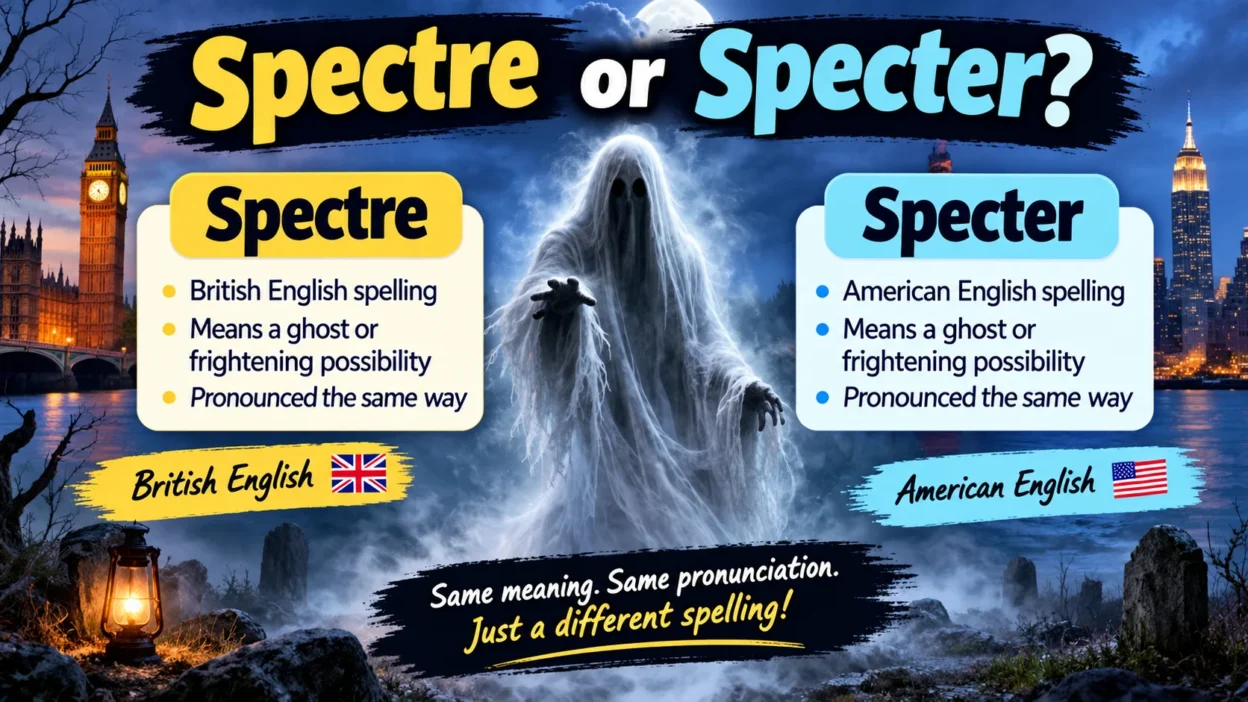
The words spectre and specter have the same meaning, but they differ in spelling. Both refer to a ghost, a frightening supernatural figure, or something that causes fear or worry. The main difference is regional: spectre is the preferred spelling in British English, while specter is the standard spelling in American English.
If you are writing for a British, Australian, or other audience that generally follows British spelling conventions, spectre is usually the better choice. If your readers are primarily American, use specter. Both forms are correct, and neither is inherently more formal or more accurate than the other.
Although these words are often associated with ghosts and horror stories, they also have a figurative meaning. For example, the phrase the spectre of war describes the frightening possibility of war, not an actual ghost. Understanding these different uses will help you choose the right spelling and use the word naturally in your writing.
Quick Answer: Spectre or Specter?
Spectre is the British English spelling, and specter is the American English spelling. Both words mean a ghost, an apparition, or a frightening possibility. They are pronounced the same way and can be used in both literal and figurative contexts. Choose the spelling that matches your audience and remain consistent throughout your writing.
Why Do People Confuse Spectre and Specter?
People confuse spectre and specter because the words sound identical and have the same definition. The only difference is the spelling of the final syllable.
English has many words with British and American spelling variations. For example, British English uses centre, while American English uses center. Similarly, British English generally prefers spectre, whereas American English prefers specter.
Both spellings are accepted English words, so the choice depends primarily on your intended audience.
What Does Spectre Mean?
Spectre is a noun that means a ghost, a spirit, or an imagined presence that causes fear. It can also describe a threatening possibility or an unpleasant situation that people worry about.
The spelling spectre is standard in British English and is commonly used in British publications and writing that follows British spelling conventions.
Examples of Spectre in a Sentence
- A mysterious spectre appeared in the abandoned house.
- The spectre frightened everyone who entered the old castle.
- The spectre of unemployment worried many workers.
- The country faced the spectre of another economic crisis.
- Stories about a wandering spectre fascinated the children.
In the first two examples, spectre refers to a ghost. In the next two, it describes a frightening possibility.
What Does Specter Mean?
Specter is the American English spelling of the same word. It refers to a ghost, an apparition, or something threatening that creates fear or anxiety.
American writers generally use specter in both everyday writing and formal publications.
Examples of Specter in a Sentence
- A pale specter appeared near the cemetery.
- The children imagined a specter hiding in the attic.
- The specter of inflation worried American families.
- The company faced the specter of bankruptcy.
- The novel describes a specter that haunts an ancient mansion.
The meaning remains the same whether you use spectre or specter. Only the regional spelling changes.
Spectre vs Specter: Comparison Table
| Feature | Spectre | Specter |
|---|---|---|
| Preferred variety | British English | American English |
| Part of speech | Noun | Noun |
| Meaning | Ghost or frightening possibility | Ghost or frightening possibility |
| Pronunciation | /ˈspek.tər/ | /ˈspek.tər/ |
| Literal use | A ghost in a story | A ghost in a story |
| Figurative use | A threat or feared possibility | A threat or feared possibility |
| Correct spelling? | Yes | Yes |
| Example | The spectre haunted the castle. | The specter haunted the castle. |
The key difference: Spectre is generally preferred in British English, while specter is generally preferred in American English.
When Should You Use Spectre or Specter?
Choose the spelling according to your audience, publication style, or regional spelling convention.
Use Spectre in British English
Use spectre when writing for British readers or following British English spelling conventions.
Examples:
- The spectre of war threatened the region.
- A ghostly spectre wandered through the ruins.
- The government feared the spectre of economic decline.
This spelling is also appropriate for publications that follow British spelling conventions in other countries.
Use Specter in American English
Use specter when writing for an American audience or following American English spelling conventions.
Examples:
- The specter appeared at midnight.
- The specter of recession worried investors.
- The story follows a mysterious specter in a haunted town.
What If You Are Writing for an International Audience?
Either spelling is understandable to most proficient English readers. However, choosing one spelling convention and using it consistently makes your writing more polished.
If you are unsure, consider your publication’s existing style guide or the spelling used by your intended readers.
12 Examples of Spectre and Specter in Sentences
The following examples show how both spellings work in everyday writing, storytelling, news, and formal contexts.
- British: A spectre appeared in the window of the abandoned house.
- American: A specter appeared in the window of the abandoned house.
- British: The spectre of war caused widespread concern.
- American: The specter of war caused widespread concern.
- British: The villagers believed a spectre haunted the forest.
- American: The villagers believed a specter haunted the forest.
- British: The spectre of poverty remained a serious concern.
- American: The specter of poverty remained a serious concern.
- British: The old legend tells of a spectre that guards the castle.
- American: The old legend tells of a specter that guards the castle.
- British: Investors worried about the spectre of financial collapse.
- American: Investors worried about the specter of financial collapse.
Notice that each British example can be rewritten with specter for American readers without changing its meaning.
Common Mistakes to Avoid
Even though spectre and specter are easy to understand, writers sometimes make avoidable mistakes.
1. Thinking One Spelling Is Incorrect
Both spellings are correct. The difference is regional, not grammatical.
Incorrect assumption: “Spectre is always wrong because it ends in -re.”
Correct understanding: Spectre is standard British spelling.
2. Using Both Spellings in the Same Article
Switching between spectre and specter without a reason can make your writing inconsistent.
Choose the spelling that matches your audience and use it throughout the article.
3. Assuming the Word Always Means a Ghost
The word can describe a supernatural figure, but it also commonly refers to an unpleasant possibility.
For example, “the specter of failure” means the possibility of failure, not a ghost.
4. Confusing Spelling With Pronunciation
Both words are pronounced the same way. The spelling difference does not create a difference in meaning or pronunciation.
5. Using the Word When a Simpler Word Is Better
In ordinary conversation, ghost, fear, threat, or possibility may communicate your meaning more directly.
For example, “The possibility of war worried them” is simpler than “The spectre of war worried them.”
Memory Trick: How to Remember Spectre vs Specter
Use this simple trick to remember which spelling belongs to each variety of English.
- Spectre = British English: Remember the -re ending, as in centre and theatre.
- Specter = American English: Remember the -er ending, as in center and theater.
You can also remember this sentence:
“The British see a spectre; Americans see a specter.”
Both spellings describe the same thing, so focus on the regional spelling pattern rather than the meaning.
Spectre vs Specter in American and British English
The difference between spectre and specter follows a familiar pattern in English spelling.
| British English | American English |
|---|---|
| Spectre | Specter |
| Centre | Center |
| Theatre | Theater |
| Metre | Meter |
| Fibre | Fiber |
These examples demonstrate a common spelling pattern, although English has exceptions and not every word ending in -re follows the same rule.
British English generally favors spectre, while American English generally favors specter. Other English varieties may follow British conventions or have their own preferred usage, depending on the publication and context.
The important point is that neither spelling changes the definition or pronunciation.
Similar Words to Spectre and Specter
Several English words are related to spectre and specter, but they are not always interchangeable.
Ghost
A ghost is the spirit or appearance of a dead person. It is the simplest and most common alternative when describing a supernatural figure.
Example: A ghost appeared in the old house.
Apparition
An apparition is a figure or image that appears unexpectedly, especially something supernatural.
Example: The witness reported seeing an apparition in the hallway.
Phantom
A phantom is something that appears real but may be imaginary, ghostly, or elusive.
Example: The travelers followed what they believed was a phantom.
Wraith
A wraith is a ghostly figure, often associated with death or frightening supernatural stories.
Example: A wraith wandered across the battlefield in the legend.
Menace
A menace is a person, thing, or situation that threatens harm. Unlike spectre, it does not ordinarily mean a ghost.
Example: The threat of violence became a growing menace.
Threat
A threat is a sign or possibility of danger or harm.
Example: The threat of economic collapse worried the community.
When discussing a supernatural being, ghost, apparition, phantom, and wraith may be suitable alternatives. When discussing a frightening possibility, threat, danger, or risk may be clearer.
Final Verdict: Spectre or Specter?
The correct choice depends on which variety of English you are using.
- Choose spectre for British English.
- Choose specter for American English.
- Use either spelling when the regional convention does not matter, but remain consistent.
- Remember that both words mean a ghost or a frightening possibility and have the same pronunciation.
If you are writing an article, school assignment, story, or professional document, follow the spelling convention expected by your readers. Neither word is more correct than the other in all contexts.
Frequently Asked Questions
1. Is spectre or specter the correct spelling?
Both are correct. Spectre is the standard British English spelling, while specter is the standard American English spelling. They have the same meaning and pronunciation.
2. Is spectre British or American English?
Spectre is generally the preferred British English spelling. It is used to describe a ghost, an apparition, or a frightening possibility.
3. Is specter American or British English?
Specter is the preferred American English spelling. It has the same meaning as spectre and is used in both literal and figurative contexts.
4. Do spectre and specter mean the same thing?
Yes. Both words refer to a ghost or an imagined presence. They can also describe a threatening possibility, as in “the specter of war” or “the spectre of poverty.”
5. How do you pronounce spectre and specter?
Both are pronounced approximately SPEK-ter. Their spelling differs, but their pronunciation is essentially identical in standard English.
6. Can I use spectre in American writing?
Yes. American readers will generally understand spectre, but specter is the conventional American spelling. Use specter when following standard American English conventions.
7. What is the plural of spectre or specter?
The plural of spectre is spectres, while the plural of specter is specters. Follow the same British or American spelling convention when forming the plural.
8. What does “the specter of war” mean?
“The specter of war” refers to the frightening possibility or threat of war. It is a figurative expression, so it does not mean that an actual ghost is present.
Remember This
- Spectre: British English spelling.
- Specter: American English spelling.
- Meaning: A ghost, apparition, or frightening possibility.
- Pronunciation: The same for both words.
- Best practice: Choose one spelling convention and use it consistently.
Conclusion
The difference between spectre and specter is simple: both words are correct, but they belong to different spelling conventions. British English generally uses spectre, while American English prefers specter. Neither spelling changes the word’s meaning or pronunciation, so your choice should depend on your intended audience.
Remember that these words can describe both supernatural figures and frightening possibilities. Whether you write about a ghost in a haunted castle or the spectre of an economic crisis, you can use either spelling as long as it fits your regional style. Once you learn this distinction, choosing between spectre and specter becomes easy.

John Tyler is a dream researcher and content writer at SleepCout, sharing insightful articles about coded dreams, dream meanings, symbolism, sleep psychology, and practical guidance to help readers understand their dreams.