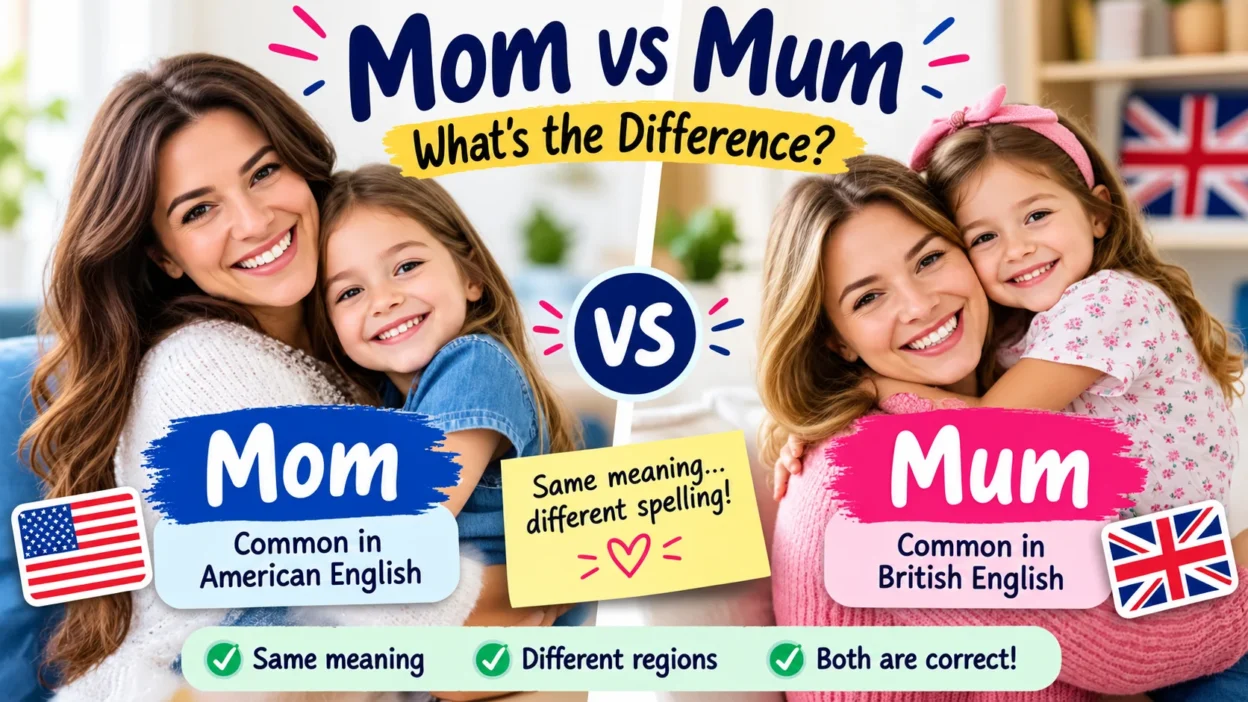
The words “mom” and “mum” mean the same thing: a female parent or mother. The main difference is regional spelling. “Mom” is the standard spelling in American English, while “mum” is commonly used in British English. Both words are correct, natural, and widely understood in English-speaking countries.
Choosing between mom and mum usually depends on your audience, location, and preferred variety of English. If you are writing for an American audience, “mom” is generally the best choice. If you are writing for readers in the United Kingdom, “mum” is usually more appropriate. In countries such as Canada, Australia, and New Zealand, usage can vary, although “mum” is common in Australia and New Zealand.
Understanding this small spelling difference can help you write more naturally, avoid confusion, and maintain consistency in your writing. Whether you are sending a birthday message, writing a school assignment, or talking about your family, both words express the same familiar relationship.
Quick Answer: Mom or Mum?
Mom is the usual American English spelling, while mum is the usual British English spelling. Both words mean “mother” and are used affectionately when talking to or about a person’s mother. Choose “mom” for American audiences and “mum” for British audiences. Neither spelling is universally better; the preferred form depends on regional usage.
Why Do People Confuse Mom and Mum?
People confuse these words because they have the same meaning and are pronounced similarly in many English accents. The difference is mainly a matter of regional spelling rather than grammar or definition.
Both words are informal and affectionate alternatives to “mother.” They are common in everyday conversations, family messages, stories, and personal writing.
For example:
- American English: “My mom makes the best cookies.”
- British English: “My mum makes the best biscuits.”
The spelling changes, but the meaning remains the same.
What Does Mom Mean?
Mom is an informal word for “mother,” used primarily in American English.
It is common in conversations, text messages, school writing, social media posts, and other everyday situations. The word can express affection, familiarity, and closeness.
Examples of Mom in Sentences
- My mom is my biggest supporter.
- I called my mom after school.
- Mom is making dinner tonight.
- My friend’s mom works at a hospital.
- I bought a birthday gift for my mom.
In American English, “mom” is the standard everyday spelling. The capitalized form “Mom” is often used when addressing your mother directly or using the word like a name.
Example: “Can you help me, Mom?”
What Does Mum Mean?
Mum is an informal word for “mother,” used primarily in British English and also common in Australian and New Zealand English.
Like “mom,” it is affectionate and natural in everyday speech. It appears in conversations, letters, text messages, and personal writing.
Examples of Mum in Sentences
- My mum is a wonderful cook.
- I visited my mum last weekend.
- Mum is waiting for me at home.
- My friend’s mum teaches English.
- I bought flowers for my mum.
In British English, “mum” is the usual spelling. When addressing your mother directly, you can capitalize it.
Example: “Thank you, Mum!”
Mom vs Mum: Comparison Table
| Feature | Mom | Mum |
|---|---|---|
| Meaning | Mother | Mother |
| Main variety | American English | British English |
| Common in | United States | United Kingdom |
| Also used in | Some other English-speaking communities | Australia and New Zealand |
| Formality | Informal and affectionate | Informal and affectionate |
| Pronunciation | Usually /mɑːm/ in American English | Often /mʌm/ in British English |
| Example | My mom is kind. | My mum is kind. |
Both words are correct. The main distinction is the regional variety of English in which each spelling is preferred.
When Should You Use Mom or Mum?
Use the spelling that matches your intended audience and the variety of English you are writing.
Use Mom in American English
Choose “mom” when writing for an American audience or following American English spelling conventions.
Examples:
- My mom loves gardening.
- Happy Mother’s Day, Mom!
- I am going shopping with my mom.
- My mom taught me how to cook.
Use Mum in British English
Choose “mum” when writing for a British audience or following British English spelling conventions.
Examples:
- My mum loves gardening.
- Happy Mother’s Day, Mum!
- I am going shopping with my mum.
- My mum taught me how to cook.
What About Australia and New Zealand?
In Australia and New Zealand, “mum” is the common everyday spelling. If you are writing for readers in these countries, “mum” is generally the natural choice.
What If You Are Writing for an International Audience?
Either word will usually be understood. However, choose one spelling based on your target audience and use it consistently throughout your article, story, or message.
12 Examples of Mom vs Mum in Sentences
These examples show how the same sentence changes depending on the variety of English.
1. American: My mom is at work. British: My mum is at work.
2. American: I love my mom very much. British: I love my mum very much.
3. American: Mom bought me a new jacket. British: Mum bought me a new jacket.
4. American: I am calling my mom tonight. British: I am calling my mum tonight.
5. American: My mom makes delicious cakes. British: My mum makes delicious cakes.
6. American: I went shopping with my mom. British: I went shopping with my mum.
7. American: My mom reads to me every night. British: My mum reads to me every night.
8. American: I gave my mom a birthday card. British: I gave my mum a birthday card.
9. American: My mom is visiting us tomorrow. British: My mum is visiting us tomorrow.
10. American: I told my mom about my new job. British: I told my mum about my new job.
11. American: Thanks for everything, Mom! British: Thanks for everything, Mum!
12. American: My friend’s mom is very friendly. British: My friend’s mum is very friendly.
In every pair, the meaning stays the same. Only the preferred regional spelling changes.
Common Mistakes When Using Mom and Mum
Although these words are easy to understand, a few common mistakes are worth avoiding.
1. Thinking One Spelling Is Wrong
“Mom” is not incorrect in American English, and “mum” is not incorrect in British English. Both are established spellings.
2. Mixing Regional Spellings Without a Reason
Using “mom” in one paragraph and “mum” in another can make your writing look inconsistent if you are addressing a particular regional audience.
Tip: Follow one variety of English throughout your work.
3. Confusing Mum With a Different Meaning
In British English, “mum” usually means mother. However, “mum” can also mean silent or keeping something secret, as in “keep mum about the surprise.”
The meaning depends on the context.
4. Forgetting Capitalization
Capitalize “Mom” or “Mum” when using it as a direct form of address.
- Correct: “Good morning, Mom!”
- Correct: “Good morning, Mum!”
- Correct: “My mom is sleeping.”
- Correct: “My mum is sleeping.”
When referring to your mother in a general way, lowercase is usually appropriate unless the word begins a sentence.
What Is an Easy Memory Trick for Mom vs Mum?
Use this simple trick:
- Mom = USA
- Mum = UK, Australia, and New Zealand
Remember that “mom” is the common American form, while “mum” is common in British English and several other varieties.
You can also associate the letter O in “mom” with the United States and the letter U in “mum” with the United Kingdom. This is only a memory aid, but it can help you remember the usual spelling.
Mom vs Mum in American and British English
Regional English varieties often use different spellings for the same word. “Mom” and “mum” are a clear example of this difference.
American English
In the United States, “mom” is the standard informal term for mother. It is used in everyday conversation, books, advertisements, and family communication.
Other common American terms include “mommy” and “mama,” although their use depends on family preference and context.
British English
In the United Kingdom, “mum” is the standard informal term. “Mummy” is also common, particularly among young children and in some family settings.
“Mam” is used in certain British and Irish regional varieties, so not everyone uses “mum.”
Canadian English
Both “mom” and “mum” can be encountered in Canada, but “mom” is generally the more common spelling. Canadian usage can vary by individual and community.
Australian and New Zealand English
“Mum” is the usual everyday spelling in both Australia and New Zealand. “Mummy” is also used in affectionate or child-directed contexts.
What Are Some Similar Words to Mom and Mum?
Several English words refer to a mother, but they differ in tone, formality, or regional use.
| Word | Meaning or usage | Common context |
|---|---|---|
| Mother | Standard, more formal term | Formal writing and general conversation |
| Mommy | Affectionate term | American English, especially among children |
| Mummy | Affectionate term | British, Australian, and other varieties |
| Mama | Familiar, affectionate term | Many English-speaking communities |
| Momma | Informal variant | Some American regional and family usage |
| Mam | Regional term for mother | Parts of the UK and Ireland |
| Mumsy | Informal, sometimes teasing or old-fashioned | Particular contexts |
These words are related, but they are not always interchangeable. For example, “mother” may sound more formal than “mom,” while “mummy” may sound more childlike or affectionate.
Frequently Asked Questions
1. Is Mom or Mum Correct?
Both are correct. “Mom” is the standard spelling in American English, while “mum” is the usual spelling in British English. The best choice depends on your audience and the variety of English you follow.
2. Is Mum British or American?
“Mum” is primarily associated with British English. It is also common in Australian and New Zealand English. In the United States, “mom” is the usual spelling.
3. Do Americans Say Mum or Mom?
Americans generally say and write “mom.” Some individuals may use “mum” because of family background, personal preference, or exposure to other English varieties, but it is not the standard American form.
4. Do British People Say Mom or Mum?
British people generally say and write “mum.” Some regional and personal variations exist, but “mum” is the standard everyday spelling in British English.
5. Is Mum More Correct Than Mom?
No. Neither word is more correct universally. “Mum” is preferred in British English, while “mom” is preferred in American English. Both express the same meaning.
6. Is It Happy Mother’s Day, Mom or Mum?
Both are correct, depending on the audience. Americans commonly write “Happy Mother’s Day, Mom!” British, Australian, and New Zealand English users commonly write “Happy Mother’s Day, Mum!”
7. Is Mum Short for Mummy?
Yes, “mum” is a familiar short form of “mummy” in British English and other varieties that use the word. Similarly, “mom” is related to the American form “mommy.”
8. Why Do Americans Spell It Mom Instead of Mum?
“Mom” reflects the established spelling and pronunciation conventions of American English. “Mum” developed as the standard form in British English. Both forms evolved through familiar words for mother, and neither is a misspelling of the other.
Remember This
- Mom is standard American English.
- Mum is standard British English.
- Both words mean “mother.”
- Both are informal and affectionate.
- “Mum” is also common in Australia and New Zealand.
- Use the spelling that suits your audience, and stay consistent.
Conclusion
The difference between “mom” and “mum” is simple: both words mean mother, but they belong to different regional varieties of English. Americans usually write “mom,” while people in the UK, Australia, and New Zealand generally use “mum.” Neither spelling is wrong, and both are widely understood.
When choosing between mom and mum, consider who will read your writing and which variety of English you want to follow. Use “mom” for American readers and “mum” for British, Australian, and New Zealand readers. Once you remember this regional difference, you can use both words confidently in conversations, schoolwork, articles, and personal messages.

John Tyler is a dream researcher and content writer at SleepCout, sharing insightful articles about coded dreams, dream meanings, symbolism, sleep psychology, and practical guidance to help readers understand their dreams.