Have you ever wondered if to say “I’m mad” or “I’m angry”? Both expressions describe a feeling of displeasure, irritation, or frustration, but they can carry slightly different meanings depending on the situation. Understanding the difference between mad vs angry can help you communicate more naturally in everyday conversations, writing, and professional settings.
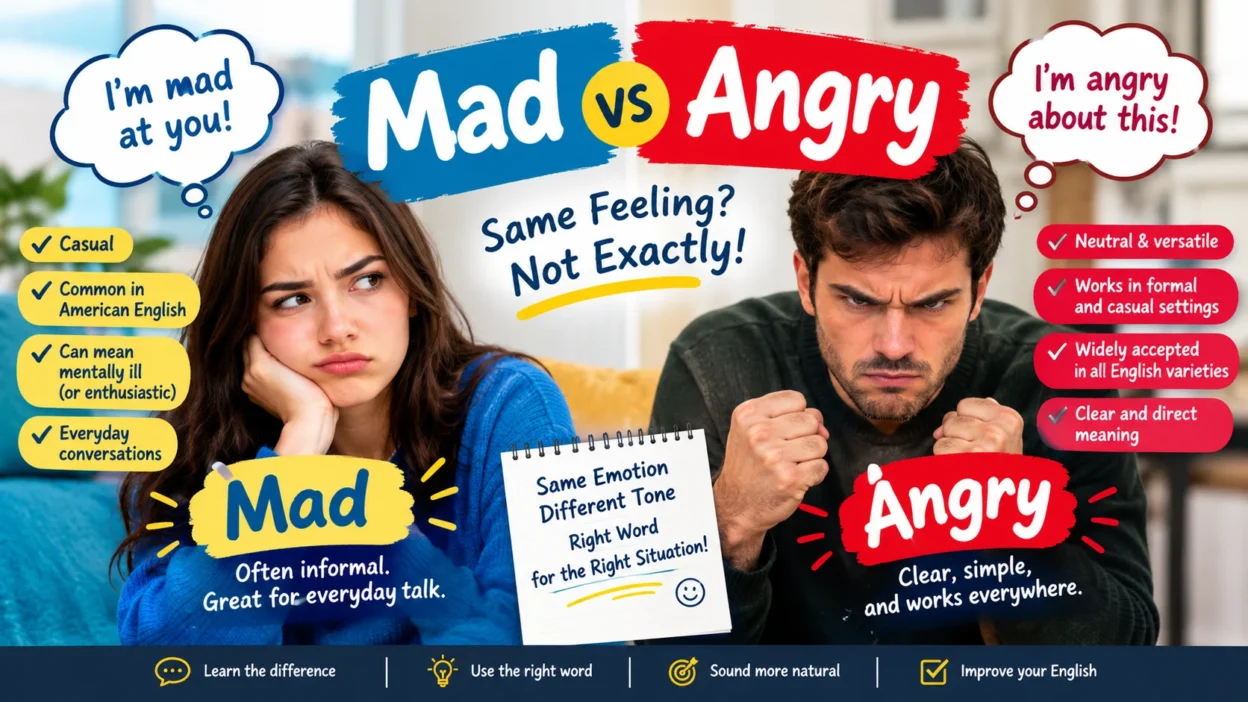
The main difference is that mad is often more informal and conversational, especially in American English, while angry is a widely accepted word that works in both casual and formal situations. For example, you might tell a friend, “I’m mad at you,” or explain more formally, “I’m angry about the decision.” Both sentences are correct, but their tone is slightly different. In American English, mad can also mean mentally ill or irrational in certain contexts, although this usage can sound outdated or offensive when referring to a person’s mental health. Learning when to use each word will help you express your feelings clearly and choose the right tone.
Quick Answer: Mad vs Angry
Mad and angry both mean feeling strong displeasure, irritation, or frustration. In American English, mad is especially common in everyday conversation, while angry works in both casual and formal contexts. In British English, angry is generally more common for expressing anger. The best choice depends on your audience, context, and intended tone.
Why Do People Confuse Mad and Angry?
People often confuse these words because they describe nearly the same emotion. In many situations, you can replace one with the other without changing the main meaning.
For example:
- “She is mad at her brother.”
- “She is angry at her brother.”
Both sentences mean that she feels upset with her brother.
However, the words are not always interchangeable. Mad has additional meanings, including being mentally ill or behaving irrationally in some contexts. It can also mean extremely enthusiastic about something, as in “He is mad about football” in British English.
The differences become clearer when you consider regional usage, tone, and context.
What Does Mad Mean?
Mad is an adjective that commonly describes someone who feels angry, annoyed, or upset. It is particularly common in informal American English.
Examples of Mad in a Sentence
- I am mad at my brother for breaking my phone.
- She was mad because nobody listened to her.
- My parents will be mad if I come home late.
- He got mad when he heard the news.
- Why are you so mad at me?
In these examples, mad describes an emotional reaction to a situation or someone’s behavior.
Other Meanings of Mad
The word mad has several meanings depending on the context.
1. Angry or upset:
“She is mad at her friend for lying.”
2. Mentally ill or irrational:
In some expressions, mad has historically meant mentally ill or irrational. This meaning can sound old-fashioned or insensitive when used to describe someone’s mental health.
3. Extremely enthusiastic:
In British English, “She is mad about music” means she loves music very much.
4. Very enthusiastic or intense:
In informal expressions such as “a mad rush,” the word can suggest frantic or uncontrolled activity.
Always consider the surrounding words to understand which meaning is intended.
What Does Angry Mean?
Angry is an adjective that describes the feeling of displeasure or hostility caused by something perceived as wrong, unfair, frustrating, or upsetting.
It is widely used in American, British, and other varieties of English. Unlike mad, it generally has a more direct and unambiguous connection to the emotion of anger.
Examples of Angry in a Sentence
- I am angry about the unfair decision.
- She was angry with her colleague.
- He became angry when he discovered the mistake.
- The customer sounded angry during the phone call.
- They were angry because the meeting was canceled.
In each sentence, angry communicates an emotional response to a situation.
Is Angry More Formal Than Mad?
Generally, yes, especially when comparing angry with the informal American use of mad. However, angry is not exclusively formal. It is perfectly natural in everyday conversations.
For example:
- Casual: “I’m mad at you!”
- Neutral: “I’m angry with you.”
- More formal: “I am concerned and angry about how this matter was handled.”
The level of formality depends on the entire sentence, not just the adjective.
Mad vs Angry: Comparison Table
| Feature | Mad | Angry |
|---|---|---|
| Main meaning | Feeling angry or upset | Feeling displeasure or hostility |
| Tone | Often informal | Neutral; suitable for formal contexts |
| American English | Very common | Very common |
| British English | Can mean enthusiastic or mentally ill, depending on context | A common word for the emotion |
| Professional writing | Can sound conversational | Often a suitable choice |
| Common expressions | Mad at someone, get mad | Angry with someone, angry about something |
| Other meanings | Enthusiastic, irrational, or mentally ill in certain uses | Primarily describes the emotion |
| Best use | Casual conversation, especially in the US | Everyday speech, formal writing, and professional communication |
The key point is that both words can describe the same feeling. The difference usually involves tone, regional preference, and context rather than the intensity of the emotion.
When Should You Use Mad or Angry?
Choose the word that best fits your audience and situation.
Use Mad in Casual American English
Mad is a natural choice when speaking with friends, family members, or people you know well.
Examples:
- “Mom will be mad if I forget my homework.”
- “Are you mad at me?”
- “I got mad when he interrupted me.”
These sentences sound natural in everyday American conversation.
Use Angry in Formal or Professional Situations
Angry is often a good choice when discussing workplace problems, disagreements, complaints, or serious issues.
Examples:
- “The employees were angry about the sudden policy change.”
- “The customer was angry about the incorrect charge.”
- “Residents are angry about the lack of public services.”
You can also use mad in professional settings, particularly in American English, but angry is often more neutral and precise.
Use Angry When You Want to Be Clear
If you want to communicate the emotion without risking confusion, angry is a straightforward choice.
For example:
- “I am angry about what happened.”
- “She looked angry after the conversation.”
These sentences clearly describe an emotional state.
Use Mad Carefully When the Meaning Could Be Unclear
Because mad has several meanings, context matters.
Compare:
- “He is mad at his boss.” — He is angry with his boss.
- “He is mad about football.” — In British English, he loves football.
- “That is a mad idea!” — Depending on the variety of English, this may mean an unusual, wild, or unreasonable idea.
If you mean anger specifically, angry can sometimes prevent misunderstandings.
12 Examples of Mad vs Angry in Everyday English
These examples show how both words work in natural sentences.
| Mad | Angry |
|---|---|
| I am mad at my brother. | I am angry with my brother. |
| She got mad about the delay. | She got angry about the delay. |
| Are you mad at me? | Are you angry with me? |
| My dad was mad when I broke the vase. | My dad was angry when I broke the vase. |
| He looks mad right now. | He looks angry right now. |
| They were mad about the decision. | They were angry about the decision. |
| I get mad when people lie. | I get angry when people lie. |
| The teacher was mad because we were late. | The teacher was angry because we were late. |
| She sounded mad on the phone. | She sounded angry on the phone. |
| Why did he get so mad? | Why did he get so angry? |
| I was mad at myself for forgetting. | I was angry with myself for forgetting. |
| The fans were mad about the result. | The fans were angry about the result. |
Both columns are grammatically correct. The mad examples may sound more conversational in American English, while angry is suitable across a wider range of contexts.
Common Mistakes When Using Mad and Angry
Understanding the meanings is only part of learning these words. You should also know how to use them naturally.
Mistake 1: Thinking Mad Always Means Mentally Ill
Incorrect assumption: “Mad” only means mentally ill.
Correct understanding: In modern American English, mad very commonly means angry.
Example: “I am mad at my friend.”
Mistake 2: Believing Angry Is Always Formal
Angry is not limited to formal writing. It is common in everyday speech.
Example: “I’m angry because you didn’t call me.”
Mistake 3: Assuming Mad Is Always Stronger
Neither word automatically expresses a stronger emotion. The intensity depends on the situation and the words around it.
Compare:
- “I’m a little mad.”
- “I’m extremely angry.”
The second sentence expresses greater intensity because of extremely, not simply because of angry.
Mistake 4: Confusing Mad About With Mad At
The preposition can change the meaning.
- “I’m mad at John.” — I am angry with John.
- “I’m mad about John.” — Depending on context, I may be extremely enthusiastic about John or romantically interested in him.
When you want to express anger toward a person, mad at is a common American English construction.
Mistake 5: Avoiding Angry in Casual Conversations
There is no need to avoid angry when talking with friends. It is natural in informal situations.
Example: “I was angry when you canceled our plans.”
Memory Trick: How to Remember Mad vs Angry
Use this simple rule:
Mad = casual American expression. Angry = clear, versatile expression.
- “I’m mad at my friend.” — Casual and conversational.
- “I’m angry about the unfair treatment.” — Clear and suitable for a wide range of situations.
This is a helpful guideline, not an absolute rule. Both words can be used in casual conversation, and both can describe the same emotion.
Mad vs Angry in American and British English
Regional differences are important when choosing between these words.
American English
In the United States, mad is very common as a synonym for angry.
Examples:
- “Are you mad at me?”
- “She got mad when I forgot.”
- “My parents will be mad.”
Americans also use angry regularly, especially when describing serious disagreements or expressing themselves in a more neutral tone.
British English
In British English, angry is generally a more common and straightforward choice when describing the emotion.
Examples:
- “He was angry about the decision.”
- “She looked angry after the argument.”
British English also uses mad in expressions such as:
- “He is mad about cricket.” — He loves cricket.
- “That was a mad idea.” — That was a wild or unreasonable idea.
However, British speakers can also use mad to mean angry, particularly in informal speech, so the distinction is not absolute.
Similar Words: Mad, Angry, Annoyed, Furious, and Upset
English has many words for negative emotions. Choosing the right one helps you express the intensity of your feelings more precisely.
| Word | Meaning | Example |
|---|---|---|
| Mad | Angry or upset, especially in American English | I’m mad at him. |
| Angry | Feeling displeasure or hostility | She is angry about the delay. |
| Annoyed | Slightly angry or irritated | I’m annoyed by the noise. |
| Furious | Extremely angry | He was furious about the damage. |
| Upset | Emotionally troubled, sad, or angry | She was upset about the argument. |
| Irritated | Annoyed by something bothersome | I felt irritated by the constant interruptions. |
| Frustrated | Annoyed because something is difficult or unsuccessful | I’m frustrated with this problem. |
| Enraged | Extremely angry, often intensely | The unfair treatment enraged the crowd. |
Which Word Is Stronger: Mad or Angry?
Neither word is always stronger than the other. Both can describe mild irritation or intense anger, depending on the context.
For example, “I’m really mad” and “I’m really angry” both express strong feelings.
If you want to communicate a particularly intense emotion, words such as furious or enraged may be more precise.
Final Verdict: Mad vs Angry
Mad and angry are usually interchangeable when they describe the emotion of anger. The main difference is how they are commonly used.
Choose mad for relaxed, conversational American English, such as “I’m mad at you.” Choose angry when you want a clear, widely understood word that works in casual conversations, formal writing, and professional communication.
Remember that mad can have other meanings, especially in British English, where “mad about something” can mean very enthusiastic about it. When clarity matters, angry is often the safest choice.
Frequently Asked Questions
1. Are mad and angry the same thing?
Yes, when they describe an emotion, mad and angry usually mean the same thing. Both describe feelings of displeasure, irritation, or hostility. The main difference is regional usage and tone.
2. Is mad or angry more correct?
Both words are correct. Use mad when it fits the conversational style, especially in American English. Use angry when you want a neutral word that works across different English-speaking regions and levels of formality.
3. Is mad more informal than angry?
Generally, yes. In American English, mad often sounds more conversational, while angry can sound more neutral or serious. However, both words are common in everyday speech.
4. Is mad stronger than angry?
No, not necessarily. The intensity depends on context and modifiers. “Very mad” and “very angry” can both express strong emotions. Neither word automatically indicates a higher level of anger.
5. Do British people use mad to mean angry?
Yes, although angry is generally the more straightforward and common choice for that meaning in British English. The word mad also appears in British expressions such as “mad about football,” meaning very enthusiastic about football.
6. Should I write mad or angry in a formal email?
Angry is usually the safer choice because it is clear and suitable for professional communication.
For example: “I am angry about the way this issue was handled.”
For a more diplomatic tone, you could write: “I am concerned about how this issue was handled.”
7. What is the difference between mad at and angry with?
Both expressions can mean that you feel anger toward someone.
- “I’m mad at my brother.”
- “I’m angry with my brother.”
The first is especially common in American English. Both are correct, and angry at is also widely used.
8. What is a stronger word than mad or angry?
Furious, enraged, and livid can describe very intense anger. For example, “She was furious about the unfair decision.” These words are stronger in many contexts, though the exact intensity depends on how they are used.
Remember This
- Mad: Often informal and especially common in American English.
- Angry: A clear, versatile word suitable for casual and formal situations.
- Annoyed: Usually suggests a milder feeling.
- Furious: Usually suggests very strong anger.
- Mad about: Can mean angry about something or very enthusiastic about something, depending on context.
The easiest way to choose is to consider your audience and what you want to communicate.
Conclusion
The difference between mad and angry is mainly a matter of tone, regional usage, and context. Both words can describe the same emotion, and neither is inherently more correct than the other. In American English, mad is a familiar choice for everyday conversations, while angry is a versatile word that works naturally in both casual and formal settings.
As you continue learning English, pay attention to how these words appear in conversations, books, films, and everyday writing. Practice using both in your own sentences, and remember that words such as annoyed, frustrated, and furious can help you express different levels of emotion. With practice, you will find it easier to choose the right word for every situation.

Charles Kyle is a passionate writer and dream researcher at SleepCout, dedicated to exploring coded dreams, lucid dreaming, dream symbolism, and sleep science. He creates engaging, well-researched content that helps readers understand their dreams and discover the fascinating connection between technology, imagination, and the sleeping mind.