
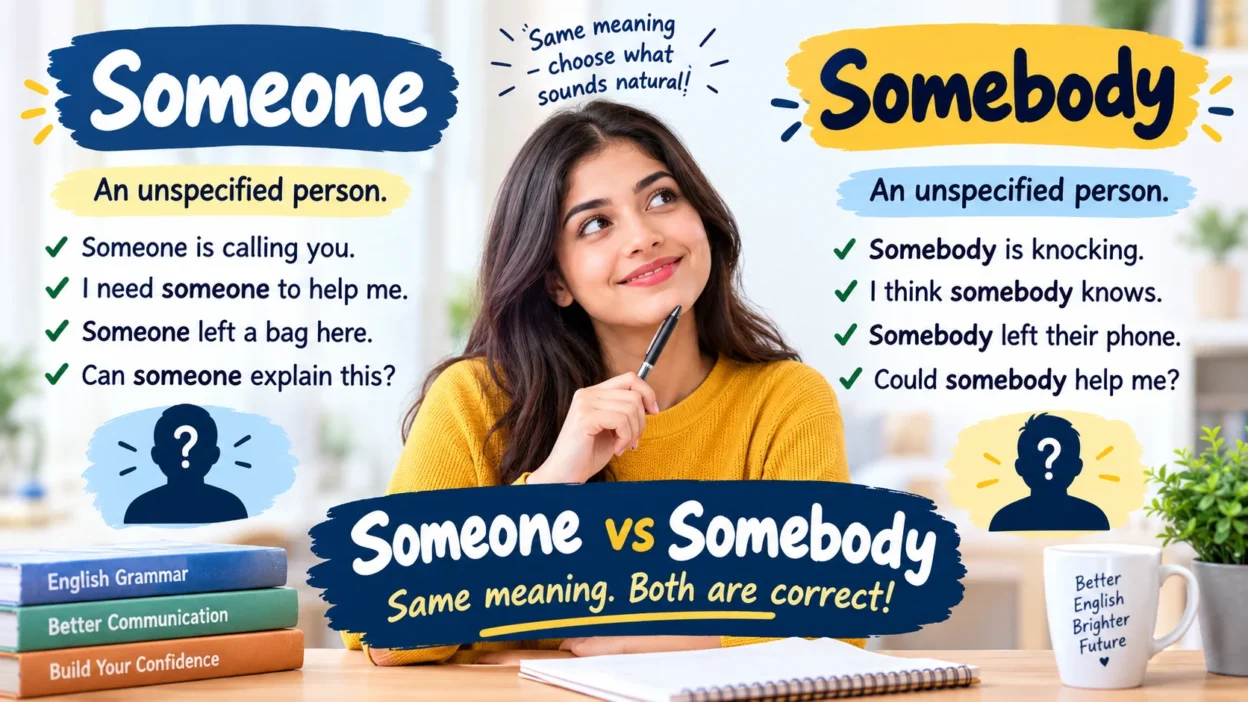
Have you ever wondered whether to use someone vs somebody in a sentence? Both words are common in everyday English, but learners sometimes wonder if they have different meanings or if one is more grammatically correct than the other. The good news is that these two words are almost identical in meaning and usage.
Someone and somebody both refer to an unknown, unspecified, or unidentified person. You can use either word when talking about a person whose identity is unknown or does not need to be mentioned. For example, “Someone is calling you” and “Somebody is calling you” are both correct and mean the same thing.
Although the words are interchangeable in most situations, a writer may prefer one because of personal style, rhythm, or the tone of a sentence. Understanding how these words work will help you speak more naturally, write clearer sentences, and avoid common English mistakes.
Quick Answer: Someone vs Somebody
Someone and somebody have the same basic meaning: an unspecified person. Both are indefinite pronouns and can be used in positive sentences, questions, and other contexts. For example, “Someone left a bag here” and “Somebody left a bag here” are equally correct. Neither word is universally more formal or more grammatically correct than the other.
Why Do People Confuse Someone and Somebody?
People often confuse these words because they have nearly identical meanings and follow the same grammatical rules. Both refer to a person whose identity is unknown, unimportant, or deliberately left unspecified.
Consider these examples:
- Someone wants to speak to you.
- Somebody wants to speak to you.
Both sentences communicate exactly the same idea. The speaker knows that a person wants to speak to the listener but does not identify that person.
The confusion also comes from the endings -one and -body. These endings may seem to suggest different types of people, but they do not create a meaningful difference in the words’ everyday use.
The main distinction is usually personal preference rather than grammar or meaning.
What Does Someone Mean?
Someone is an indefinite pronoun that refers to an unknown or unspecified person.
It is especially common in everyday conversation, professional communication, academic writing, and general written English.
Examples of Someone in Sentences
- Someone is waiting outside.
- I need someone to help me with this task.
- Someone has taken my notebook.
- Can someone explain this question?
- Someone called while you were sleeping.
In each example, the word someone refers to a person whose identity is not specified.
Is Someone Singular or Plural?
Someone is grammatically singular. It usually takes a singular verb.
Examples:
- Someone is at the door.
- Someone has sent you a message.
- Someone wants to meet you.
However, when you refer back to someone using a pronoun and their gender is unknown or irrelevant, singular they is widely accepted in modern English.
For example: “Someone left their umbrella here.”
What Does Somebody Mean?
Somebody is also an indefinite pronoun that refers to an unknown or unspecified person. Its meaning is essentially the same as someone.
It is common in spoken English and informal writing, but it is also perfectly acceptable in standard written English.
Examples of Somebody in Sentences
- Somebody is knocking at the door.
- I think somebody knows the answer.
- Somebody left their phone in the classroom.
- Somebody needs to clean this room.
- Could somebody help me, please?
Each sentence could use someone instead of somebody without changing its basic meaning.
Is Somebody Singular or Plural?
Somebody is grammatically singular, just like someone. It normally takes a singular verb.
Examples:
- Somebody is calling you.
- Somebody has opened the window.
- Somebody wants to see you.
In everyday English, you can also use singular they to refer back to somebody.
Example: “Somebody forgot their keys.”
Someone vs Somebody: Comparison Table
| Feature | Someone | Somebody |
|---|---|---|
| Meaning | An unspecified person | An unspecified person |
| Part of speech | Indefinite pronoun | Indefinite pronoun |
| Grammatical number | Singular | Singular |
| Verb agreement | Singular verb | Singular verb |
| Formality | Suitable for formal and informal contexts | Suitable for formal and informal contexts |
| Everyday conversation | Very common | Very common |
| Professional writing | Correct | Correct |
| Basic meaning | No significant difference | No significant difference |
| Can replace the other? | Usually yes | Usually yes |
The most important point is that neither word is inherently more correct or more formal in every situation. Both are standard English.
When Should You Use Someone or Somebody?
In most cases, you can choose either word. However, understanding the context can help you make your writing sound natural.
1. Use Someone in Professional or Neutral Writing
Someone works well in emails, reports, instructions, and other neutral or professional contexts.
Examples:
- Someone from the support team will contact you.
- We need someone with experience in customer service.
- Someone has requested additional information.
You can also use somebody in all these sentences. Choosing someone is simply a reasonable stylistic preference.
2. Use Somebody in Everyday Conversation
Somebody is natural in casual conversations and friendly interactions.
Examples:
- Somebody told me about this restaurant.
- I think somebody is at the window.
- Somebody should call her back.
Remember that someone would also be correct in these examples.
3. Use Either Word When the Person Is Unknown
When you do not know who performed an action, both words work naturally.
Examples:
- Someone broke the glass.
- Somebody broke the glass.
Both sentences tell us that an unidentified person broke the glass.
4. Use Either Word in Questions
Both words can appear in questions, especially when asking whether a person is available or willing to help.
Examples:
- Is someone available to help?
- Is somebody available to help?
- Did someone call me?
- Did somebody call me?
The choice depends on the speaker’s preference and the flow of the sentence.
5. Use Either Word in Negative Sentences Carefully
When using someone or somebody in a negative sentence, pay attention to the intended meaning.
For example:
- I didn’t see anyone.
- I didn’t see anybody.
These are natural ways to say that you saw no person.
In standard English, anyone and anybody are often preferred in negative constructions. However, someone and somebody can still occur in negative sentences when the context calls for them.
Example: “I don’t think somebody would do that deliberately.”
12 Examples of Someone vs Somebody
Here are practical examples showing how both words work in everyday English.
| Using Someone | Using Somebody |
|---|---|
| Someone is waiting for you. | Somebody is waiting for you. |
| Someone called this morning. | Somebody called this morning. |
| Someone left a book here. | Somebody left a book here. |
| I need someone to help me. | I need somebody to help me. |
| Someone knows the answer. | Somebody knows the answer. |
| Someone is knocking on the door. | Somebody is knocking on the door. |
| Someone wants to meet you. | Somebody wants to meet you. |
| Someone has taken my pen. | Somebody has taken my pen. |
| Someone sent me an email. | Somebody sent me an email. |
| Can someone explain this? | Can somebody explain this? |
| Someone is looking for you. | Somebody is looking for you. |
| Someone needs to make a decision. | Somebody needs to make a decision. |
All these pairs are grammatically correct. The meaning remains essentially unchanged.
Common Mistakes With Someone and Somebody
Although the words are easy to use, learners sometimes make mistakes with their grammar or meaning.
Mistake 1: Treating Them as Plural
Incorrect: Someone are waiting outside.
Correct: Someone is waiting outside.
Because someone is grammatically singular, it normally takes a singular verb.
The same rule applies to somebody.
Incorrect: Somebody have called you.
Correct: Somebody has called you.
Mistake 2: Thinking Someone Is Always More Formal
It is not accurate to say that someone is always formal and somebody is always informal. Both words are acceptable in professional and casual communication.
You may prefer someone in a particular sentence, but that is a stylistic choice rather than a strict grammatical rule.
Mistake 3: Assuming the Words Have Different Meanings
Incorrect assumption: Someone refers to an unknown person, while somebody refers to an important person.
Correct understanding: Both words can refer to an unknown or unspecified person. Neither word automatically means a more important person.
Mistake 4: Confusing Them With Anyone and Anybody
Someone and somebody commonly refer to an unspecified person in affirmative statements.
Examples:
- Someone is waiting outside.
- Somebody wants to speak to you.
Anyone and anybody are especially common in questions and negative statements, although they can also appear in affirmative sentences.
Examples:
- Is anyone here?
- I don’t know anybody in this town.
The appropriate choice depends on the sentence’s meaning and grammatical context.
Mistake 5: Using an Incorrect Verb
Incorrect: Somebody know the truth.
Correct: Somebody knows the truth.
Remember that both someone and somebody normally take singular verbs.
Memory Trick: How to Remember Someone vs Somebody
Here is a simple way to remember the difference:
Someone = Somebody = One unspecified person.
Both words refer to a person whose identity is not given.
Think of these two sentences:
- Someone is at the door.
- Somebody is at the door.
Both tell you that a person is at the door, but neither tells you who that person is.
If you are unsure which word to use, choose the one that sounds more natural to you. You will generally be grammatically correct either way.
Someone vs Somebody in American and British English
Both someone and somebody are standard in American and British English. Neither word belongs exclusively to one variety of English.
| Context | American English | British English |
|---|---|---|
| Everyday speech | Someone or somebody | Someone or somebody |
| Formal writing | Someone or somebody | Someone or somebody |
| Questions | Both are correct | Both are correct |
| Negative sentences | Both are possible, depending on context | Both are possible, depending on context |
| Verb agreement | Singular | Singular |
There may be individual differences in how frequently people use each word, but there is no universal American-versus-British rule that requires one over the other.
For learners, the best approach is to become comfortable using both forms.
Similar Words: Someone, Somebody, Anyone, Anybody, Everyone, and Everybody
These indefinite pronouns are related, but their meanings are not identical.
| Word | Meaning | Example |
|---|---|---|
| Someone | An unspecified person | Someone called you. |
| Somebody | An unspecified person | Somebody called you. |
| Anyone | Any person, depending on context | Can anyone help? |
| Anybody | Any person, depending on context | Does anybody know? |
| Everyone | Every person in a group | Everyone is ready. |
| Everybody | Every person in a group | Everybody is ready. |
| No one | Not a single person | No one answered. |
| Nobody | Not a single person | Nobody answered. |
Notice that someone and somebody have essentially the same meaning. The same is true of anyone and anybody, everyone and everybody, and no one and nobody.
However, these groups differ from one another in meaning. For example, someone refers to an unspecified person, while everyone refers to all the people in a relevant group.
Final Verdict: Someone or Somebody?
Someone and somebody are interchangeable in most everyday English sentences. Both refer to an unspecified person, both are grammatically singular, and both take singular verbs.
Choose someone if you prefer its sound or it fits the style of your sentence. Choose somebody if that sounds more natural to you. Neither is universally better or more correct than the other.
For English learners, the most important thing is to use the correct verb and understand the context. You do not need to memorize a strict rule separating these two words because their basic meanings and grammatical functions are the same.
Frequently Asked Questions
1. Is someone or somebody grammatically correct?
Both are grammatically correct. Someone and somebody are standard indefinite pronouns that refer to an unspecified person. You can generally use either one without changing the meaning of your sentence.
2. What is the main difference between someone and somebody?
There is no significant difference in their basic meaning. Both refer to an unknown or unspecified person. Any difference usually comes from personal preference, sentence rhythm, or writing style rather than grammar.
3. Is someone more formal than somebody?
Not necessarily. Someone is often chosen in neutral or professional writing, but somebody is also acceptable in formal contexts. Neither word is automatically more formal in every situation.
4. Should I say someone is or someone are?
Say someone is because someone is grammatically singular.
Correct: Someone is waiting outside.
Incorrect: Someone are waiting outside.
The same rule applies to somebody: “Somebody is waiting outside.”
5. Can I use somebody in academic writing?
Yes. Somebody is a standard English word and can be used in academic writing when it fits the context. However, depending on the subject, a more specific term such as a participant, an individual, or a person may communicate the intended meaning more precisely.
6. Is somebody one word or two words?
Somebody is written as one word. Someone is also written as one word. By contrast, some one is a different construction used in specific contexts and is not normally a substitute for the indefinite pronoun someone.
7. Can someone and somebody be used in questions?
Yes. Both words are common in questions.
Examples:
- Can someone help me?
- Can somebody help me?
Both questions are correct and ask whether an unspecified person can provide help.
8. Are someone and somebody singular or plural?
Both are grammatically singular and normally take singular verbs, such as is, has, and wants. You can use singular they to refer back to either word when the person’s gender is unknown or irrelevant.
Remember This
- Someone = Somebody: Both mean an unspecified person.
- Someone is: Use a singular verb.
- Somebody has: Follow the same singular-verb rule.
- Both are correct: Neither word is universally more formal or more accurate.
- Choose naturally: Use whichever word fits your sentence and personal style.
Conclusion
Understanding someone vs somebody is simple once you know that the two words have essentially the same meaning. Both refer to an unspecified person, and both work in everyday conversations, questions, professional communication, and general writing. In most sentences, you can replace one with the other without changing the message.
As you continue learning English, focus on sentence structure, verb agreement, and the context in which you use indefinite pronouns. Remember that someone and somebody are both correct, so you can confidently use either word when referring to a person whose identity is unknown or does not need to be mentioned.

John Tyler is a dream researcher and content writer at SleepCout, sharing insightful articles about coded dreams, dream meanings, symbolism, sleep psychology, and practical guidance to help readers understand their dreams.