
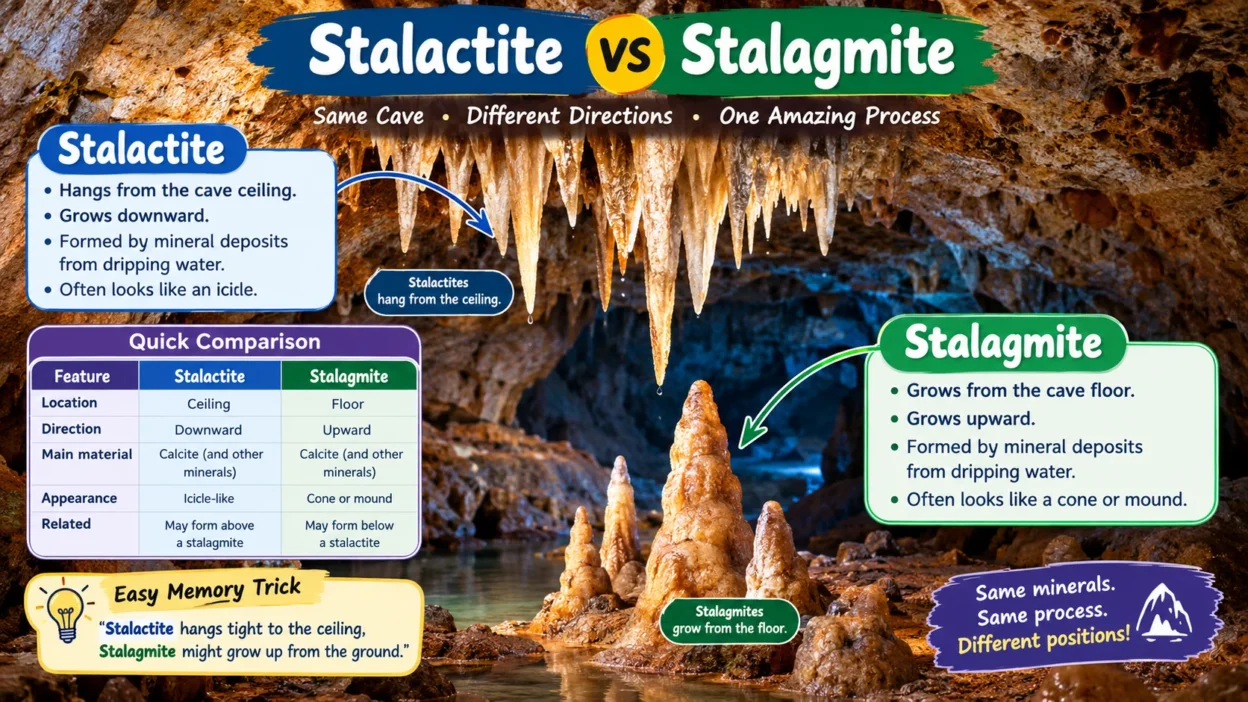
Stalactite vs stalagmite is a common comparison for people learning about caves, geology, and natural landforms. Both words describe beautiful rock formations found in caves, and both develop over thousands of years as mineral-rich water deposits minerals such as calcite. However, the main difference is where each formation grows. A stalactite hangs from the ceiling of a cave, while a stalagmite grows upward from the cave floor. Although their names look and sound similar, remembering their positions makes them easy to distinguish.
These formations develop when water containing dissolved minerals drips through limestone and enters a cave. As the water loses carbon dioxide or evaporates, it leaves behind small mineral deposits. Over time, these deposits gradually build into recognizable shapes. Stalactites often resemble icicles hanging from above, whereas stalagmites look like mounds, cones, or pillars rising from the ground. Understanding the difference between stalactites and stalagmites helps you describe cave formations accurately and recognize them in photographs, nature documentaries, science lessons, and cave explorations.
Quick Answer: Stalactite vs Stalagmite
A stalactite is a mineral formation that hangs from a cave ceiling, while a stalagmite grows upward from the cave floor. Both commonly form from calcite deposited by dripping mineral-rich water. Remember: stalactites hang tight to the ceiling, and stalagmites might grow up from the ground.
Why Do People Confuse Stalactites and Stalagmites?
People often confuse these words because they have similar spellings, similar pronunciations, and related meanings. Both describe mineral formations created by similar geological processes inside caves.
The main difference is their direction of growth:
- Stalactite: Grows downward from the ceiling.
- Stalagmite: Grows upward from the floor.
Another reason for confusion is that both formations can appear pointed, rounded, or cone-shaped. Their appearance alone may not always be enough to identify them. Their position in the cave is the easiest clue.
What Is a Stalactite?
A stalactite is a mineral deposit that hangs from the ceiling of a cave. It usually forms when water carrying dissolved minerals drips from the cave roof and leaves behind small amounts of calcite or other minerals.
Over time, these deposits accumulate and gradually extend downward. Some stalactites are thin and pointed, resembling icicles, while others are thick, curved, or irregular.
How Does a Stalactite Form?
The formation process typically follows these steps:
- Rainwater absorbs carbon dioxide as it moves through soil.
- The slightly acidic water dissolves some limestone as it travels through cracks.
- Mineral-rich water reaches the cave ceiling and begins to drip.
- Changes in carbon dioxide levels and evaporation encourage calcium carbonate to precipitate.
- Mineral deposits accumulate, gradually forming a stalactite.
Stalactites can take thousands of years or longer to grow substantially, depending on water flow, mineral concentration, temperature, and other environmental conditions.
Example: A pointed mineral formation hanging from the ceiling of a limestone cave is a stalactite.
What Is a Stalagmite?
A stalagmite is a mineral formation that grows upward from the floor of a cave. It commonly develops beneath a stalactite when mineral-rich water drips onto the ground and deposits minerals.
As each drop releases minerals, the deposits accumulate on the cave floor. Over time, the formation may become a cone, mound, rounded column, or irregular pillar.
How Does a Stalagmite Form?
The formation process generally works like this:
- Mineral-rich water drips from the cave ceiling.
- The drops land on the cave floor.
- Calcium carbonate precipitates from the water.
- Mineral deposits accumulate at the point where the drops land.
- Repeated deposits gradually build the formation upward.
Stalagmites do not always form directly beneath stalactites. Their positions depend on where water drips and where mineral deposits accumulate.
Example: A cone-shaped mineral mound rising from the floor beneath a dripping cave roof is a stalagmite.
Stalactite vs Stalagmite: Comparison Table
| Feature | Stalactite | Stalagmite |
|---|---|---|
| Location | Cave ceiling | Cave floor |
| Direction | Grows downward | Grows upward |
| Formation | Mineral deposits accumulate on the roof | Mineral deposits accumulate on the ground |
| Common appearance | Icicle-like or hanging point | Cone-shaped mound or pillar |
| Water source | Water deposits minerals on the ceiling | Dripping water deposits minerals on the floor |
| Typical material | Calcite and other minerals | Calcite and other minerals |
| Relationship | May form above a stalagmite | May form below a stalactite |
| Possible result | Can join with a stalagmite | Can join with a stalactite |
When Should You Use Stalactite or Stalagmite?
Use stalactite when describing a mineral formation hanging from a cave ceiling.
Examples:
- The stalactite hung like an icicle above the narrow passage.
- We photographed a large stalactite during our cave tour.
- Water dripped slowly from the tip of the stalactite.
Use stalagmite when describing a mineral formation growing upward from the cave floor.
Examples:
- A tall stalagmite stood in the center of the cave.
- The stalagmite had a broad base and a pointed top.
- The guide showed us a stalagmite that had developed over many years.
If you see formations both above and below, identify each one by its location rather than its shape alone.
12 Examples of Stalactite and Stalagmite in Sentences
These examples show how to use both terms correctly.
- Stalactite: A long stalactite hung from the limestone ceiling.
- Stalagmite: A small stalagmite rose from the damp cave floor.
- Stalactite: The explorer carefully walked beneath a low stalactite.
- Stalagmite: The children learned how a stalagmite forms from dripping water.
- Stalactite: Mineral-rich water slowly added new layers to the stalactite.
- Stalagmite: A cone-shaped stalagmite stood near the cave entrance.
- Both: The cave contained stalactites on the ceiling and stalagmites on the floor.
- Both: Some stalactites and stalagmites develop from calcium carbonate deposits.
- Stalactite: The photographer captured a delicate stalactite hanging above a pool.
- Stalagmite: The stalagmite had grown taller as minerals accumulated over time.
- Both: The guide explained how the two formations could eventually join.
- Both: Visitors were asked not to touch the fragile stalactites or stalagmites.
Common Mistakes When Comparing Stalactites and Stalagmites
1. Thinking both formations hang from the ceiling
This is incorrect. Stalactites hang from the ceiling, but stalagmites grow from the floor.
2. Thinking stalagmites grow downward
Stalagmites grow upward as mineral deposits accumulate on the ground.
3. Assuming they are always made of exactly the same mineral
Both commonly contain calcite, but cave formations can contain other minerals depending on local geological conditions.
4. Believing every stalactite has a stalagmite beneath it
A stalactite may have no stalagmite beneath it. Water may drip elsewhere, or the conditions may not support stalagmite growth.
5. Assuming the two formations always meet
Some stalactites and stalagmites eventually join to form a column, but many never meet.
6. Confusing them with ordinary ice
Stalactites and stalagmites are generally mineral formations, not frozen water. Ice formations can also develop in caves, but they are different.
The Easiest Memory Trick: Stalactite vs Stalagmite
The simplest way to remember the difference is to connect stalactite with tight and stalagmite with might.
- Stalactite = hangs tight to the ceiling.
- Stalagmite = might grow up from the ground.
Another helpful trick is to remember the final letters:
- Stalactite hangs from the top.
- Stalagmite grows from the ground.
The first trick is a popular memory aid, while the second is an additional association to help you recall the positions. Neither connection describes the scientific origin of the words; they are simply ways to remember their meanings.
Stalactite vs Stalagmite in American and British English
There is no meaningful difference between American and British English in the definitions or standard spelling of stalactite and stalagmite.
Both varieties of English use the same words for the same cave formations. Pronunciation may vary slightly by speaker or accent, but the spelling, meaning, and geological distinction remain the same.
For example:
- American English: The stalactite hangs from the cave ceiling.
- British English: The stalagmite rises from the cave floor.
Both sentences are correct in either variety of English.
Similar Words Related to Stalactites and Stalagmites
Several geological terms are related to cave formations. Learning them can make the distinction easier to understand.
Speleothem
A speleothem is a mineral deposit formed in a cave. Stalactites and stalagmites are two types of speleothems.
Column
A column is a cave formation created when a stalactite and a stalagmite grow together and join.
Flowstone
Flowstone forms when mineral-rich water flows over cave walls or floors, leaving behind layers of mineral deposits.
Soda straw
A soda straw is a thin, hollow, tube-shaped stalactite. It can develop into a thicker stalactite as mineral deposits accumulate around its outside.
Helictite
A helictite is a cave formation that grows in unusual, twisting directions, sometimes appearing to defy gravity.
These terms describe different formations or categories, but they are not interchangeable with stalactite and stalagmite.
Final Verdict: Which Is Which?
The difference between stalactite and stalagmite comes down to where each formation grows.
- A stalactite hangs from a cave ceiling.
- A stalagmite rises from a cave floor.
Both commonly develop when mineral-rich water deposits calcium carbonate inside caves. Although they form through related processes, their locations distinguish them clearly. If you remember that stalactites hang above and stalagmites grow below, you can identify and describe them with confidence.
Frequently Asked Questions
1. What is the main difference between a stalactite and a stalagmite?
A stalactite hangs from the ceiling of a cave, while a stalagmite grows upward from the cave floor. Both commonly form through mineral deposits left by dripping water.
2. Which grows from the ceiling: a stalactite or a stalagmite?
A stalactite grows from the ceiling. It develops as mineral-rich water deposits minerals along the cave roof and around dripping points.
3. Which grows from the ground: a stalactite or a stalagmite?
A stalagmite grows from the ground. It forms as dripping water leaves mineral deposits on the cave floor, gradually building the formation upward.
4. Can a stalactite and a stalagmite meet?
Yes. If a stalactite grows downward and a stalagmite grows upward in the right conditions, they can eventually join to form a column. This process may take a very long time.
5. Are stalactites and stalagmites made of the same material?
They commonly contain calcite, a crystalline form of calcium carbonate. However, their exact mineral composition can vary according to the water and geological conditions in the cave.
6. Do stalactites and stalagmites grow quickly?
Generally, no. Many grow very slowly, sometimes over thousands of years. Their growth rates vary depending on water supply, mineral concentration, temperature, and other environmental conditions.
7. What is an easy way to remember stalactite vs stalagmite?
Remember that a stalactite hangs tight to the ceiling, while a stalagmite might grow up from the ground. Their positions are the most reliable clues.
Remember This
- Stalactite = ceiling = hangs down.
- Stalagmite = ground = grows up.
- Both are mineral formations commonly found in caves.
- Dripping mineral-rich water helps form both.
- They may eventually join to create a column.
Conclusion
Understanding stalactite vs stalagmite is easy once you focus on location and direction. A stalactite hangs from the ceiling, while a stalagmite grows upward from the cave floor. Both are fascinating geological formations created by mineral deposits, often involving calcium carbonate carried by dripping water. Their shapes can vary, but their positions provide the clearest way to tell them apart.
Whether you are studying geology, preparing for a school exam, visiting a limestone cave, or simply expanding your vocabulary, this distinction is useful to remember. Think of a stalactite hanging above you and a stalagmite rising beneath it. With this simple visual association, you can identify both formations correctly and explain the difference in everyday conversation.

Charles Kyle is a passionate writer and dream researcher at SleepCout, dedicated to exploring coded dreams, lucid dreaming, dream symbolism, and sleep science. He creates engaging, well-researched content that helps readers understand their dreams and discover the fascinating connection between technology, imagination, and the sleeping mind.