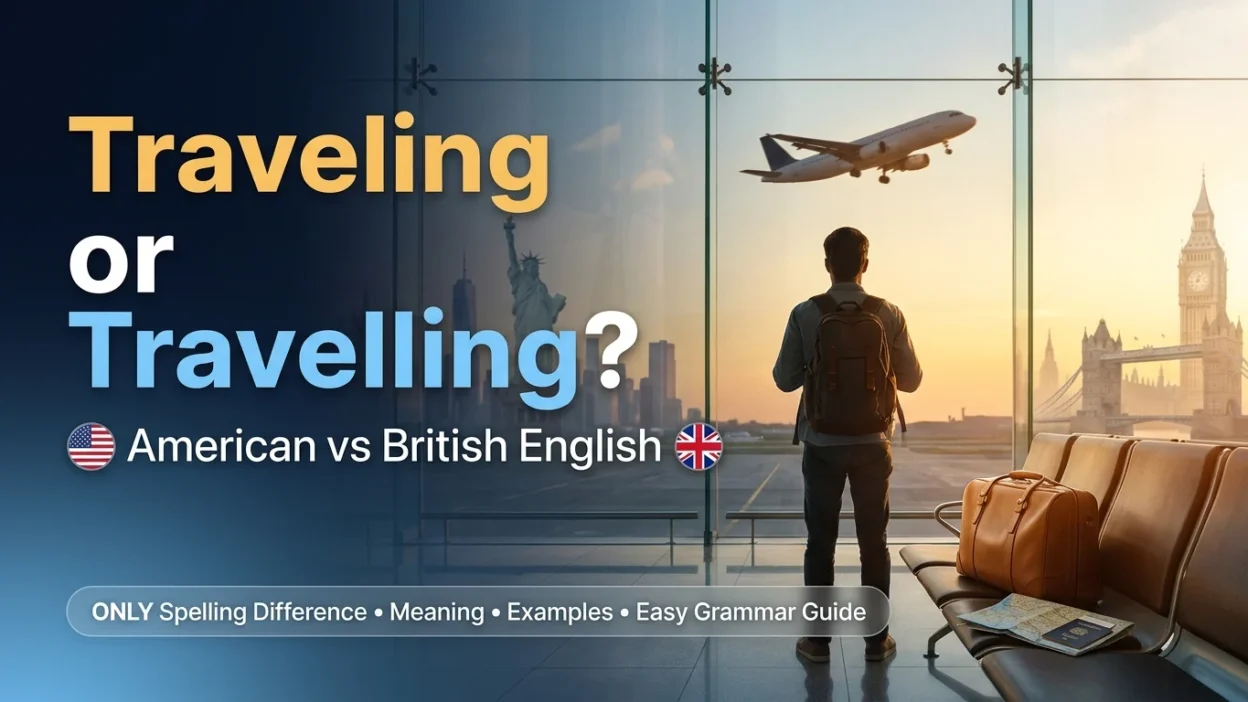
The correct spelling depends on which variety of English you use. “Traveling” is the standard American English spelling, while “travelling” is the standard British English spelling. Both words have the same meaning: going from one place to another, usually for work, vacation, education, or personal reasons. Neither spelling is wrong.
If you are writing for an American audience, use traveling. If you are writing for a British, Australian, or many other Commonwealth English audiences, travelling is generally preferred. The difference comes from spelling conventions, not pronunciation or meaning. Once you understand this simple rule, you can confidently choose the right spelling for essays, emails, travel blogs, school assignments, and professional documents.
Quick Answer: Traveling vs. Travelling
Traveling is the American English spelling, and travelling is the British English spelling. Both are correct and mean the same thing. American English usually uses one L when adding -ing to travel, while British English usually doubles the L. Choose one spelling style and use it consistently.
Why Do People Confuse Traveling and Travelling?
People often confuse these spellings because English has different spelling conventions in different countries. Both forms look correct, sound identical, and express the same action.
The confusion mainly comes from how American and British English handle the final consonant when adding a suffix such as -ing.
For example:
- American English: travel → traveling
- British English: travel → travelling
The same difference appears in other words, such as canceled and cancelled or labeled and labelled.
What Does Traveling Mean?
Traveling is the American English spelling of the present participle of travel. It can describe the act of going somewhere, a journey in progress, or movement from one place to another.
Examples:
- I am traveling to New York next week.
- Traveling helps people experience different cultures.
- She enjoys traveling with her family.
- He is traveling for business this month.
In American English, traveling is the preferred spelling in schoolwork, business communication, newspapers, and most other forms of writing.
What Does Travelling Mean?
Travelling is the British English spelling of the same word. It has exactly the same meaning as traveling and is used in the same grammatical situations.
Examples:
- I am travelling to London next week.
- Travelling helps people learn about different cultures.
- She enjoys travelling with her family.
- He is travelling for business this month.
British English generally prefers travelling in formal and informal writing. This spelling is also commonly used in Australian and New Zealand English.
Traveling vs. Travelling: Comparison Table
| Feature | Traveling | Travelling |
|---|---|---|
| English variety | American English | British English |
| Number of Ls before -ing | One | Two |
| Meaning | Going from one place to another | Going from one place to another |
| Pronunciation | Same | Same |
| Grammar | Present participle or gerund | Present participle or gerund |
| Example | I am traveling abroad. | I am travelling abroad. |
| Correct in American English? | Yes | Generally not the preferred spelling |
| Correct in British English? | Generally not the preferred spelling | Yes |
When Should You Use Traveling or Travelling?
The best spelling depends on your audience and the spelling style you are following.
Use Traveling in American English
Choose traveling when writing for American readers or following American English conventions.
Examples:
- I am traveling to California this summer.
- Traveling by train is convenient.
- My brother is traveling for work.
- The traveling team arrived yesterday.
Use Travelling in British English
Choose travelling when writing for British readers or following British English conventions.
Examples:
- We are travelling to Scotland tomorrow.
- Travelling by train is convenient.
- My brother is travelling for work.
- The travelling team arrived yesterday.
What If You Are Writing for an International Audience?
Either spelling is acceptable for an international audience. However, choose one variety of English and use it consistently throughout your article, website, assignment, or document.
For example, if you use travelling, you may also prefer British spellings such as organise and colour. If you use traveling, you may prefer organize and color.
12 Examples of Traveling and Travelling in Sentences
The following examples show how both spellings work in everyday English.
- American: I am traveling to Canada next month.
- British: I am travelling to Canada next month.
- American: Traveling alone can be an exciting experience.
- British: Travelling alone can be an exciting experience.
- American: She is traveling with her best friend.
- British: She is travelling with her best friend.
- American: We spent the weekend traveling around Texas.
- British: We spent the weekend travelling around Wales.
- American: He loves traveling by train.
- British: He loves travelling by train.
- American: They are traveling abroad for their honeymoon.
- British: They are travelling abroad for their honeymoon.
Notice that the meaning and grammatical structure remain the same. Only the spelling changes.
Common Mistakes to Avoid
Even though both spellings are correct, writers sometimes make mistakes when choosing between them.
1. Thinking One Spelling Is Always Wrong
Incorrect assumption: “Travelling” is always misspelled.
Correction: Travelling is correct in British English, while traveling is standard in American English.
2. Mixing American and British Spellings
Using traveling in one paragraph and travelling in another can make your writing inconsistent.
Tip: Pick one spelling style and follow it throughout your document.
3. Changing the Meaning
The two words do not have different meanings. You do not use one for vacations and the other for business trips.
Both can describe any kind of travel.
4. Doubling the L in Every Word
British English often doubles the final l in words such as travelling, but this is not a universal rule for every English word.
For example, traveling is standard in American English, while travelling is standard in British English.
5. Confusing the Verb Forms
Both spellings follow the same grammatical rules:
- Base form: travel
- Present participle: traveling or travelling
- Past tense: traveled or travelled
- Noun: travel
What Is an Easy Memory Trick?
Use this simple trick to remember the difference:
- American = one L: traveling.
- British = two Ls: travelling.
Think of the shorter spelling as the American version and the doubled l as the British version.
You can also remember the related forms:
| American English | British English |
|---|---|
| Traveling | Travelling |
| Traveled | Travelled |
| Traveler | Traveller |
| Traveling bag | Travelling bag |
The same general spelling pattern applies to these related forms, although the best choice depends on the variety of English you are using.
Traveling vs. Travelling in American and British English
American and British English have several spelling differences, and traveling versus travelling is one of the most familiar examples.
American English
American English usually does not double the final l in travel when adding -ing or -ed.
Examples:
- traveling
- traveled
- traveler
These forms are common in American books, newspapers, websites, and educational materials.
British English
British English generally doubles the final l in these forms.
Examples:
- travelling
- travelled
- traveller
These spellings are common in British publications and educational materials. Australian and New Zealand English generally follow the doubled-l convention as well.
Which Spelling Should ESL Learners Use?
If you are learning English as a second language, both spellings are worth recognizing. However, use the version taught in your course or required by your school, employer, or publication.
For international exams and professional writing, follow the relevant style guide or institution’s requirements.
Similar Words With American and British Spelling Differences
The traveling/travelling difference is part of a broader pattern in English spelling.
| American English | British English |
|---|---|
| Traveling | Travelling |
| Canceled | Cancelled |
| Labeled | Labelled |
| Modeling | Modelling |
| Fueled | Fuelled |
| Jewelry | Jewellery |
| Color | Colour |
| Organize | Organise |
Some of these differences follow different rules, so it is best to learn them individually rather than assuming that every word follows the same pattern.
Frequently Asked Questions
1. Is traveling or travelling correct?
Both are correct. Traveling is the standard American English spelling, while travelling is the standard British English spelling.
2. Is traveling American or British English?
Traveling is the preferred spelling in American English. It uses one l before the -ing ending.
3. Is travelling British or American English?
Travelling is the preferred spelling in British English. It uses two ls before the -ing ending.
4. Do traveling and travelling mean the same thing?
Yes. Both words mean going from one place to another. They have the same pronunciation and grammatical function.
5. Is travelling with two Ls wrong?
No. Travelling is correct in British English and is also common in Australian and New Zealand English.
6. Is traveling one L or two?
In American English, traveling has one l before -ing. In British English, travelling has two.
7. Should I write traveled or travelled?
Use traveled in American English and travelled in British English. Both are accepted spellings in their respective varieties.
8. Which spelling should I use in an essay?
Follow your teacher’s instructions or your institution’s preferred English variety. If there is no specific requirement, choose either American or British English and use it consistently.
Remember This
- Traveling = American English.
- Travelling = British English.
- Both spellings have the same meaning and pronunciation.
- Neither spelling is universally wrong.
- Consistency matters more than choosing one variety over the other.
Conclusion
The difference between traveling and travelling is simple: American English usually uses one l, while British English generally uses two. Both words describe the same action and can be used in the same grammatical contexts. The correct choice depends on the English spelling convention you follow.
When writing an essay, email, blog post, or professional document, consider your audience and remain consistent. Remembering the one l American spelling and the two-l British spelling will help you avoid confusion and write more confidently.

John Tyler is a dream researcher and content writer at SleepCout, sharing insightful articles about coded dreams, dream meanings, symbolism, sleep psychology, and practical guidance to help readers understand their dreams.