
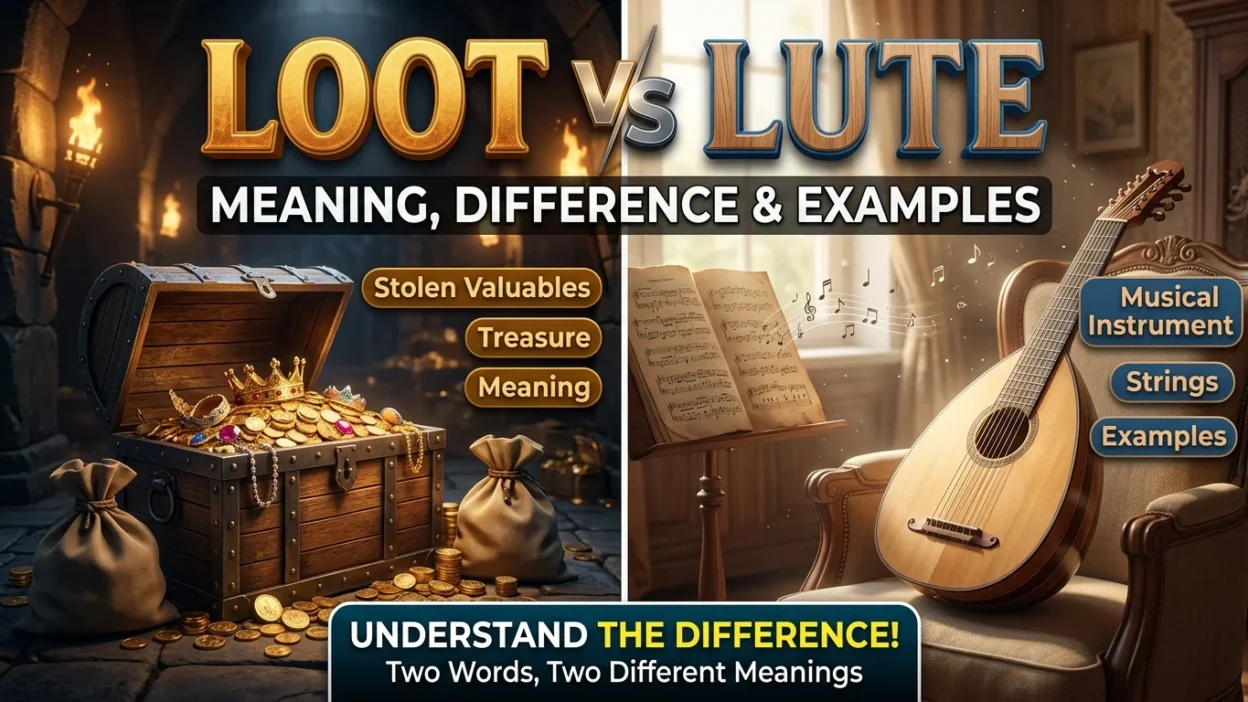
The words loot and lute may look and sound similar, but they have completely different meanings. Loot refers to money, valuables, or other items stolen or taken by force, while lute is a musical instrument with strings that is played by plucking them. Understanding the difference between loot and lute will help you use both words correctly in writing and conversation.
These words can be confusing for English learners because they differ by only one letter. They are also pronounced differently in English, even though their spellings are almost identical. One word is associated with stealing, treasure, and valuable possessions, while the other is connected to music, classical instruments, and traditional performances. In this guide, you will learn the definitions of loot and lute, their pronunciation, the grammatical roles they can play, and practical examples that show how to use them naturally. By the end, you will know exactly when to use each word and how to avoid common spelling mistakes.
Quick Answer: Loot vs Lute
Loot means money, valuables, or goods stolen or taken, especially during a robbery, war, or raid. It can also be a verb meaning to steal or take valuable items. Lute is a stringed musical instrument with a rounded body and a fretted neck. Remember: loot is about stolen valuables, while lute is about music.
Why Do People Confuse Loot and Lute?
People often confuse loot and lute because their spellings differ by only one vowel. Both are short words with four letters, making typing mistakes easy.
However, their meanings, pronunciations, and uses are distinct.
- Loot: Connected to theft, robbery, valuables, and stolen goods.
- Lute: Connected to music, instruments, and musical performances.
Their pronunciation also differs:
- Loot: /luːt/ — rhymes with boot and root.
- Lute: /luːt/ — commonly pronounced the same way as loot in English.
Although their meanings are different, loot and lute are generally homophones because they share the same pronunciation in standard English.
1. What Does Loot Mean?
Loot is a noun or verb referring to valuable things stolen or taken, especially during a robbery, war, riot, or similar event.
As a noun, it describes the stolen property or valuables themselves. As a verb, it means to steal goods or take valuable items, often by force or during a period of disorder.
Loot as a Noun
When used as a noun, loot refers to stolen money, jewelry, goods, or other valuables.
Examples:
- The thieves escaped with their loot.
- The soldiers discovered a chest filled with loot.
- The police recovered the stolen loot.
- The robbers divided the loot among themselves.
Loot as a Verb
When used as a verb, loot describes the act of stealing or taking valuable goods.
Examples:
- The thieves tried to loot the jewelry store.
- Rioters began to loot several shops.
- The invaders looted the abandoned palace.
- The authorities arrested people who looted the warehouse.
Synonyms of Loot
Depending on the context, synonyms for loot include:
- Plunder
- Booty
- Spoils
- Stolen goods
- Treasure
These words are not always interchangeable. For example, treasure can refer to valuable possessions that were acquired legally, whereas loot often suggests theft or unlawful taking.
2. What Does Lute Mean?
A lute is a stringed musical instrument with a rounded body, a fretted neck, and strings that are usually plucked with the fingers or a plectrum.
Lutes have a long history in several musical traditions and are particularly associated with European Renaissance and medieval music. Related instruments have also been important in other musical cultures.
Lute as a Noun
The word lute is primarily used as a noun. It names the musical instrument itself.
Examples:
- The musician played a beautiful melody on the lute.
- The museum displayed an antique lute.
- She learned to play the lute at music school.
- The sound of the lute filled the historic hall.
What Does a Lute Sound Like?
A traditional lute generally produces a warm, gentle, resonant sound. Its musical character depends on the instrument, its strings, and the way it is played.
Lutes are often heard in historical music, classical performances, and traditional musical arrangements.
Synonyms and Related Musical Instruments
There is no exact synonym for lute, because it names a specific instrument. However, related stringed instruments include:
- Guitar
- Oud
- Mandolin
- Theorbo
- Archlute
These instruments differ in construction, tuning, playing technique, and musical tradition. The oud, for example, is closely related to the lute family but typically does not have the same fretted neck as a European Renaissance lute.
Loot vs Lute: Comparison Table
| Feature | Loot | Lute |
|---|---|---|
| Meaning | Stolen valuables or the act of stealing | A stringed musical instrument |
| Part of speech | Noun and verb | Noun |
| Pronunciation | /luːt/ | /luːt/ |
| Main association | Theft, robbery, and valuables | Music and musical instruments |
| Example | The robbers divided the loot. | He played the lute. |
| Related words | Plunder, booty, spoils | Oud, theorbo, mandolin |
| Common context | Crime, history, gaming | Music, history, performances |
Key difference: Loot refers to stolen valuables or stealing, while lute refers to a musical instrument.
When Should You Use Loot or Lute?
Choosing the correct word depends on what you want to describe.
Use Loot When Talking About Stolen Valuables
Use loot when discussing stolen property, valuables taken during a raid, or the act of stealing goods.
Examples:
- The thieves hid their loot in a basement.
- The soldiers were accused of looting the village.
- The game rewards players with extra loot.
In video games, loot commonly refers to items, weapons, coins, or rewards collected by players. In this context, the items do not necessarily have to be stolen.
Use Lute When Talking About Music
Use lute when referring to the traditional stringed instrument.
Examples:
- The musician performed a song on the lute.
- He bought a lute for his historical music collection.
- The composer wrote a piece for lute and voice.
A useful rule is to check the subject of your sentence. If you are talking about stealing or collected items, loot is usually correct. If you are talking about an instrument or musical performance, use lute.
12 Examples of Loot and Lute in Sentences
The following examples show how both words work in everyday English and more specialized contexts.
Examples Using Loot
- The thieves escaped with the loot before the police arrived.
- The police found the stolen loot inside an abandoned car.
- The pirates searched the ship for loot.
- The robbers argued over how to divide the loot.
- Several shops were looted during the unrest.
- Players can collect valuable loot after defeating an enemy.
Examples Using Lute
- The musician played the lute during the concert.
- The museum has a beautiful Renaissance lute on display.
- She practices the lute every afternoon.
- The old painting shows a man holding a lute.
- The composer wrote a melody for the lute.
- Visitors enjoyed listening to a lute performance at the festival.
These examples demonstrate that loot and lute can appear in different situations, even though they sound alike.
Common Mistakes When Using Loot and Lute
English learners may occasionally choose the wrong word because the two spellings are so similar. Here are common mistakes to avoid.
Mistake 1: Using Lute Instead of Loot
Incorrect: The thieves stole the lute from the bank.
Correct: The thieves stole the loot from the bank.
The corrected sentence refers to stolen valuables. However, if the thieves specifically stole a musical instrument, lute would be correct.
Mistake 2: Using Loot Instead of Lute
Incorrect: The musician played the loot beautifully.
Correct: The musician played the lute beautifully.
The sentence describes a musical performance, so lute is the correct choice.
Mistake 3: Assuming Both Words Have the Same Meaning
Although loot and lute are pronounced alike, they have unrelated meanings. They are homophones, not synonyms.
Mistake 4: Forgetting That Loot Can Be a Verb
Incorrect: The thieves took part in the lute of the shop.
Correct: The thieves looted the shop.
Loot can describe an action, while lute names an instrument.
Mistake 5: Assuming Loot Always Means Stolen Property
In gaming, loot can refer to rewards or items collected from enemies, treasure chests, or completed challenges. The word does not always imply real-world theft.
Memory Trick: How to Remember Loot vs Lute
Use these simple associations to remember the difference.
- Loot = Looting: Both words relate to taking valuables.
- Lute = Listening: A lute is an instrument you can listen to.
- Loot = Valuables: Think of money, jewelry, and treasure.
- Lute = Music: Think of strings, melodies, and musicians.
You can also remember this sentence:
“The thieves took the loot, but the musician played the lute.”
This sentence uses both words correctly and makes their different meanings easy to recall.
Loot vs Lute in American and British English
There is no major difference in the meaning of loot and lute between American and British English.
Both varieties use loot to refer to stolen valuables or the act of stealing goods. Both also use lute for the traditional stringed musical instrument.
Their standard pronunciations are generally the same in American and British English: both rhyme with boot.
The spelling does not change between the two varieties.
| Word | American English | British English |
|---|---|---|
| Loot | Stolen valuables; to steal goods | Stolen valuables; to steal goods |
| Lute | A stringed musical instrument | A stringed musical instrument |
Therefore, you can use the same spellings and meanings in both American and British English.
Similar Words to Loot and Lute
Learning related words can help you understand the difference more clearly.
Words Related to Loot
- Plunder: To steal or take goods by force; also refers to the goods taken.
- Booty: Valuables captured or stolen, especially in historical or pirate contexts.
- Spoils: Goods or benefits gained through victory or success.
- Ransack: To search a place thoroughly, often causing disorder.
- Steal: To take something belonging to someone else without permission.
Words Related to Lute
- Oud: A traditional plucked string instrument widely used in Middle Eastern and neighboring musical traditions.
- Theorbo: A large, long-necked plucked string instrument associated with early European music.
- Mandolin: A small plucked string instrument commonly used in folk and classical music.
- Guitar: A fretted stringed instrument commonly played by strumming or plucking.
- Harp: A stringed instrument whose strings are plucked, typically with the fingers.
Although some of these instruments are related to the lute, they are not interchangeable names for the same instrument.
Final Verdict: Loot or Lute?
The correct word depends on your intended meaning.
Use loot when referring to stolen valuables, goods taken by force, or the act of stealing. It can function as both a noun and a verb.
Use lute when referring to a traditional stringed musical instrument played by plucking its strings. It is a noun.
Remember that these words are pronounced alike but have different meanings. If your sentence is about valuables or stealing, choose loot. If it is about music or an instrument, choose lute.
Frequently Asked Questions
1. What is the main difference between loot and lute?
Loot means stolen valuables or the act of taking goods unlawfully. Lute is a traditional stringed musical instrument. The words are pronounced alike but have different meanings.
2. Are loot and lute homophones?
Yes. In standard English, loot and lute are homophones because they share the same pronunciation, /luːt/, but have different spellings and meanings.
3. Is loot a noun or a verb?
Loot can be both a noun and a verb. As a noun, it means stolen valuables. As a verb, it means to steal or take goods, often by force.
4. Is lute a musical instrument?
Yes. A lute is a plucked stringed instrument with a rounded body and a fretted neck. It is especially associated with medieval and Renaissance European music.
5. Can loot be used in video games?
Yes. In video games, loot often means items, weapons, coins, equipment, or rewards collected during gameplay. These items are not necessarily stolen in the ordinary sense.
6. Do American and British English spell loot and lute differently?
No. Both American and British English use the spellings loot and lute. Their meanings and standard pronunciations are also essentially the same.
7. What is an easy way to remember loot and lute?
Remember that loot relates to looting and valuables, while lute relates to listening to music. The sentence “The thieves took the loot, but the musician played the lute” is a helpful memory trick.
Remember This
- Loot: Stolen valuables or the act of stealing goods.
- Lute: A traditional plucked stringed musical instrument.
- Pronunciation: Both words are pronounced /luːt/ in standard English.
- Grammar: Loot is a noun and a verb; lute is a noun.
- Spelling: Loot contains two os, while lute contains u and e.
Conclusion
Understanding loot vs lute is easy once you connect each word to its meaning. Loot is associated with valuables, theft, and collected rewards, while lute refers to a musical instrument with a long history. Although they sound the same, they cannot be used interchangeably.
When writing or speaking, think about the context before choosing a word. If you are describing stolen goods, use loot. If you are describing a musician playing a traditional stringed instrument, use lute. Remembering this simple distinction will help you avoid spelling mistakes and communicate more clearly in English.

Alice Allison is the Administrator at SleepCout, ensuring smooth operations while supporting a platform dedicated to coded dreams, dream interpretation, and insightful content that inspires curiosity, creativity, and imagination.