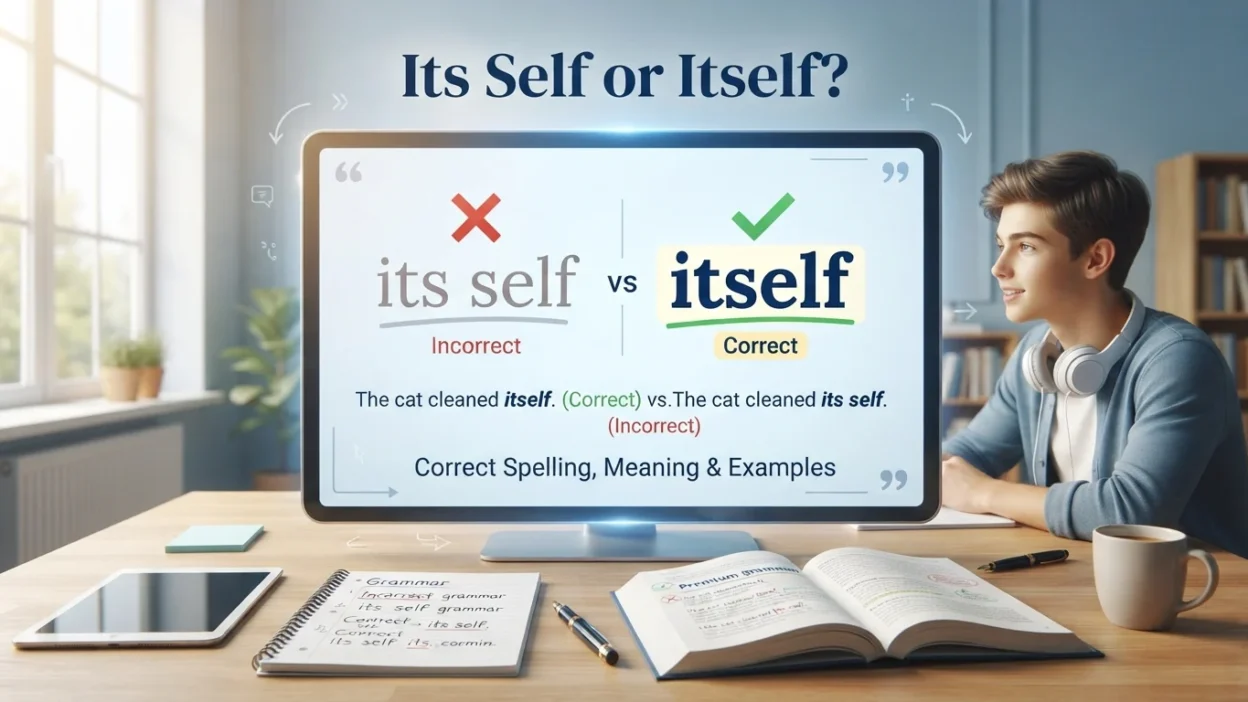
When you want to describe something acting independently or referring back to the same thing, should you write “it’s self” or “itself”? This is a common English spelling and grammar question, especially for English learners. The correct form in standard English is “itself” when you need the reflexive pronoun. “It’s self” is generally incorrect when used as a pronoun.
The confusion happens because “it’s” is a contraction of “it is” or “it has, while “self” is a separate noun. In contrast, “itself” is one word and functions as a reflexive or emphatic pronoun. Understanding this small difference can help you avoid a frequent writing mistake and use the word naturally in sentences.
Quick Answer
“Itself” is the correct word when you mean the reflexive pronoun referring to a thing, animal, or situation. “It’s self” is normally incorrect. Remember that “it’s” means “it is” or “it has,” while “itself” means the thing itself.
Why Do People Confuse “It’s Self” and “Itself”?
The confusion usually comes from the apostrophe in it’s.
Many learners see:
- it + self → it’s self
However, English reflexive pronouns are normally written as single words:
- myself
- yourself
- himself
- herself
- itself
- ourselves
- yourselves
- themselves
The apostrophe in it’s does not indicate possession. Instead, it represents missing letters in it is or it has.
For example:
It’s raining.
= It is raining.
But:
The machine repaired itself.
Here, itself is a reflexive pronoun.
“Itself”: Meaning and Use
Itself is a reflexive pronoun used when a thing, animal, or situation refers back to the same subject.
Examples
- The cat cleaned itself.
- The computer restarted itself.
- The door opened itself.
- The company itself announced the decision.
- The problem will resolve itself.
Itself can also add emphasis:
The building itself is beautiful.
Here, itself emphasizes the building.
What Does “Itself” Mean?
Depending on the sentence, itself can mean:
- the same thing
- the thing in question
- without outside help
- emphasizing the subject
For example:
The machine fixed itself.
This suggests that the machine fixed its own problem.
“It’s Self”: Why It Is Usually Incorrect
“It’s self” is not normally used as the reflexive pronoun.
The word it’s is a contraction:
- it’s = it is
- it’s = it has
So if you write:
The dog cleaned it’s self.
you have used it’s incorrectly.
The correct sentence is:
The dog cleaned itself.
There can be rare contexts where it’s and self happen to appear next to each other as separate words, but this is not the normal way to form the reflexive pronoun.
Comparison Table
| Form | Correct? | Meaning | Example |
|---|---|---|---|
| itself | ✅ Yes | Reflexive/emphatic pronoun | The phone turned itself off. |
| it’s | ✅ Yes | It is / it has | It’s very cold. |
| it’s self | ❌ Usually incorrect | Not the standard reflexive form | The cat washed itself. |
| its | ✅ Yes | Possessive determiner | The dog wagged its tail. |
When Should You Use “Itself”?
Use itself when the subject and the object refer to the same thing.
1. For reflexive actions
The cat washed itself.
The cat is both performing and receiving the action.
2. For emphasis
The president of the company itself issued the statement.
Here, itself emphasizes the company.
3. To refer to something independently
The program can update itself.
The program performs the action without someone directly doing it.
4. With situations or ideas
The situation will eventually resolve itself.
The word refers back to the situation.
10+ Examples of “Itself”
- The door opened itself.
- The computer restarted itself.
- The dog scratched itself.
- The machine can clean itself.
- The problem solved itself unexpectedly.
- The plant can protect itself from certain pests.
- The phone turned itself off.
- The website refreshed itself.
- The company itself admitted the mistake.
- The book itself is quite interesting.
- The idea itself is simple.
- The system will automatically correct itself.
Notice that itself is always written as one word in these examples.
Common Mistakes
Mistake 1: Writing “it’s self”
❌ The machine repaired it’s self.
✅ The machine repaired itself.
Mistake 2: Confusing “its” with “itself”
Its shows possession.
The company changed its policy.
Itself is reflexive or emphatic.
The company defended itself.
Mistake 3: Confusing “it’s” with “its”
❌ The dog hurt it’s leg.
✅ The dog hurt its leg.
Here, its shows possession.
Mistake 4: Using “it’s” when you mean “itself”
❌ The machine can fix it’s own problems.
Depending on the intended meaning, you might write:
✅ The machine can fix its own problems.
or:
✅ The machine can fix itself.
Memory Trick
A simple way to remember the difference is:
It’s = it is / it has
Its = belongs to it
Itself = the thing itself
Try replacing it’s with it is:
It’s working.
→ It is working. ✅
But:
The machine repaired itself.
You cannot replace itself with “it is.”
Another useful pattern is:
myself → yourself → himself → herself → itself
They are all written as single words.
American vs British English
There is no meaningful spelling difference between American and British English for itself.
Both varieties use:
itself
The same is true for it’s and its. The distinction is based on grammar and meaning rather than regional spelling.
For example, both American and British writers would use:
The animal protected itself.
Similar Words
Understanding related forms can make the difference easier to remember:
- myself — referring back to “I”
- yourself — referring back to “you”
- himself — referring back to “he”
- herself — referring back to “she”
- itself — referring back to “it”
- ourselves — referring back to “we”
- yourselves — referring back to “you”
- themselves — referring back to “they”
Compare:
I taught myself English.
She introduced herself.
The machine restarted itself.
They prepared themselves.
Final Verdict
“Itself” is the correct form when you need the reflexive or emphatic pronoun.
Use:
- itself → the thing itself / referring back to “it”
- its → belonging to it
- it’s → it is or it has
Avoid writing “it’s self” when you mean the reflexive pronoun.
Quick comparison
The cat washed itself. ✅
The cat washed it’s self. ❌
The cat hurt its paw. ✅
It’s hurt. ✅ = It is hurt.
Frequently Asked Questions
Is “itself” one word or two?
Itself is one word. It is the standard reflexive pronoun corresponding to “it.”
Is “it’s self” grammatically correct?
Usually, no. When you mean the reflexive pronoun, the correct form is itself.
What is the difference between “its” and “itself”?
Its is possessive, while itself is reflexive or emphatic.
The dog wagged its tail.
The dog cleaned itself.
What does “it’s” mean?
It’s is a contraction of “it is” or “it has.”
It’s raining. = It is raining.
It’s been a long day. = It has been a long day.
Can “itself” refer to a person?
Generally, itself refers to a thing, animal, organization, or non-human entity rather than a person. For people, English normally uses himself or herself, depending on the referent.
Is “itself” used in American English?
Yes. Itself is standard in both American and British English.
What is the easiest way to remember “itself”?
Remember that reflexive pronouns such as myself, yourself, himself, herself, itself, ourselves, and themselves are written as single words.
Remember This
Itself = the thing itself
Its = belonging to it
It’s = it is / it has
If you mean that something is referring back to itself, use itself.
Conclusion
The correct spelling is itself, not it’s self, when you need a reflexive or emphatic pronoun. For example, “The computer restarted itself” is correct because the computer refers back to itself. Writing “it’s self” in this situation is a common spelling and grammar mistake.
The easiest way to avoid confusion is to remember the three forms separately: itself is a reflexive pronoun, its shows possession, and it’s means “it is” or “it has.” Once you understand these functions, choosing the correct form becomes much easier.

John Tyler is a dream researcher and content writer at SleepCout, sharing insightful articles about coded dreams, dream meanings, symbolism, sleep psychology, and practical guidance to help readers understand their dreams.