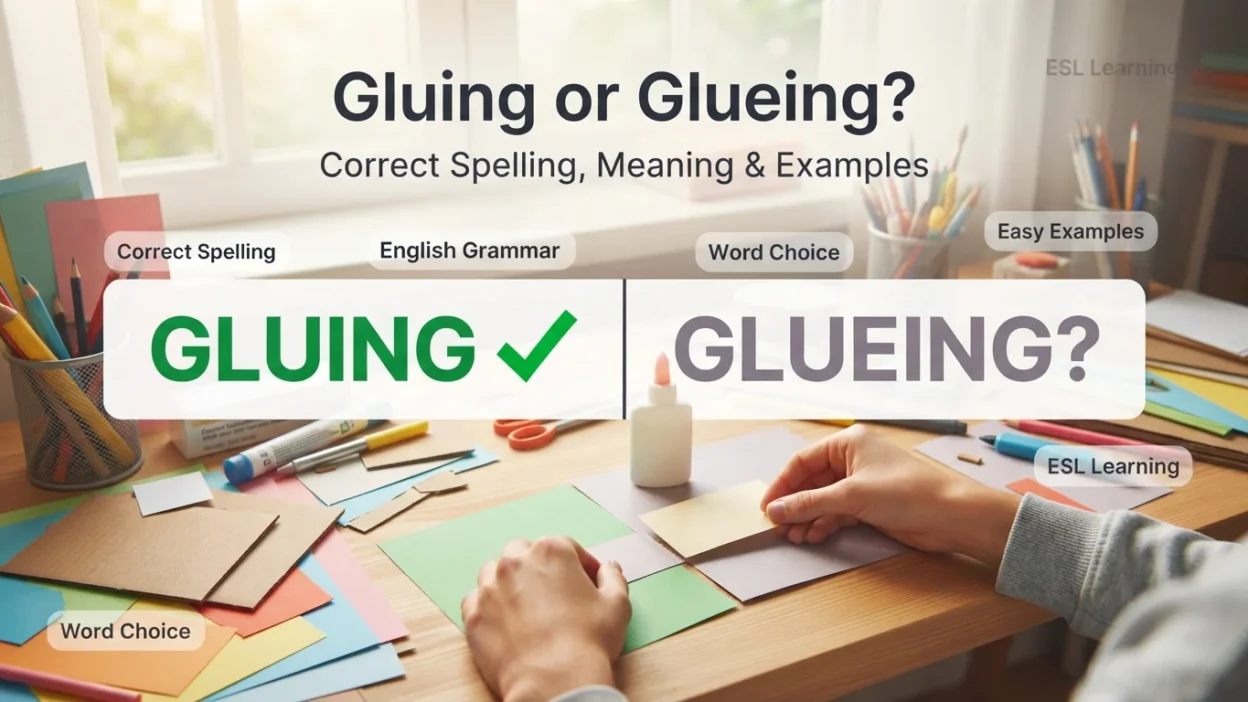
If you are unsure if “gluing” or “glueing” is correct, the standard spelling is gluing. The word glue becomes gluing when the suffix -ing is added. Although glueing can sometimes be found, especially in older or less common usage, gluing is the normal modern spelling in both American and British English.
This spelling can be confusing because many English verbs ending in -e drop the final e before adding -ing. For example, make becomes making and write becomes writing. With glue, however, writers sometimes expect the spelling to behave differently because the final e is part of the familiar word ending. Understanding the standard form makes it easier to write correctly in schoolwork, emails, instructions, and everyday communication.
Quick Answer: Gluing or Glueing?
Gluing is the standard and preferred spelling. It is the present participle and gerund form of glue, meaning to join something with glue. Glueing is sometimes seen, but it is generally considered a less common variant. For modern English writing, use gluing.
Why Do People Confuse “Gluing” and “Glueing”?
The confusion comes from the unusual spelling pattern of glue + -ing.
Normally, when a verb ends in a silent e, the e is removed before -ing:
- make → making
- bake → baking
- write → writing
- use → using
Following that pattern, glue becomes gluing.
However, because the pronunciation and spelling of glue feel different from words such as make or write, some writers naturally form glueing.
The First Word: Gluing
Gluing is the standard spelling.
It is formed by adding -ing to the verb glue:
glue + ing = gluing
Glue means to attach or join things using an adhesive substance.
Examples:
- I am gluing the pieces together.
- She spent the afternoon gluing pictures into her notebook.
- We are gluing the broken pieces back together.
- He is gluing the cardboard to the paper.
Gluing can function as both a present participle and a gerund.
As a present participle
Tom is gluing the model together.
Here, gluing is part of the verb phrase is gluing.
As a gerund
Gluing small pieces requires patience.
Here, gluing functions as a noun.
The Second Word: Glueing
Glueing is a spelling that does occur, but it is much less common than gluing in modern standard English.
For most readers and writers, gluing is the form to choose.
If you are writing an essay, school assignment, professional document, instruction manual, or website content, use gluing.
Gluing vs Glueing: Comparison Table
| Feature | Gluing | Glueing |
|---|---|---|
| Base word | Glue | Glue |
| Meaning | Joining with glue | Joining with glue |
| Standard modern spelling | Yes | Less common variant |
| Common in modern writing | Very common | Much less common |
| Recommended for general writing | Yes | Usually avoid |
| Example | She is gluing the paper. | She is glueing the paper. |
When Should You Use “Gluing”?
Use gluing whenever you mean the act of joining something with glue.
In everyday sentences
I am gluing these two pieces together.
In instructions
Begin by gluing the paper to the cardboard.
In schoolwork
The children were gluing shapes onto the poster.
In crafts
She enjoys gluing decorations onto handmade cards.
In technical or practical writing
Make sure the surface is clean before gluing the parts together.
10+ Examples of “Gluing” in Sentences
- I am gluing the broken pieces together.
- Sarah is gluing pictures into her scrapbook.
- The students were gluing colored paper onto the poster.
- He is gluing the model airplane together.
- We spent an hour gluing the decorations onto the box.
- She enjoys gluing craft materials together.
- The teacher showed us how to start gluing the pieces.
- Be careful when gluing the cardboard.
- They are gluing the photographs onto the board.
- I finished gluing the labels onto the containers.
- Gluing the pieces in the correct order is important.
- The children practiced gluing shapes onto paper.
Common Mistakes
Mistake 1: Using “glueing” automatically
Some people assume that the word should retain the final e:
I am glueing the paper.
For standard modern usage, write:
I am gluing the paper.
Mistake 2: Thinking every -ing form follows the same spelling rule
English spelling has many exceptions and irregular patterns. It is better to learn the standard spelling of gluing rather than trying to create it from pronunciation.
Mistake 3: Confusing “gluing” with “glue”
Remember that glue is the base verb, while gluing describes the action happening now or the activity itself.
- Glue the pieces together.
- She is gluing the pieces together.
Memory Trick: Glue Loses the “E”
A simple way to remember the spelling is:
GLUE → GLUING
Think:
Glue loses E before -ing.
Just as:
- make → making
- write → writing
- bake → baking
you can remember:
- glue → gluing
American vs British English
Gluing is the normal spelling in both American English and British English.
Unlike some words that have different spellings across the two varieties, such as color/colour or center/centre, gluing does not normally require an American-versus-British spelling change.
So whether you are writing for readers in the United States, United Kingdom, Canada, Australia, or elsewhere, gluing is the safest standard form.
Similar Words
Here are some related forms that are useful to know:
| Word | Meaning | Example |
|---|---|---|
| Glue | An adhesive or the act of joining with adhesive | Use glue to attach the pieces. |
| Gluing | Joining something with glue | She is gluing the pieces together. |
| Glued | Joined with glue | The pieces are glued together. |
| Glues | Third-person singular form of glue | He glues the parts together. |
| Glued-on | Attached using glue | The glued-on label came loose. |
Final Verdict: Gluing or Glueing?
Gluing is the standard spelling you should use in modern English.
Glueing is a less common spelling that you may encounter, but it is not the usual choice for contemporary standard writing.
The easiest rule to remember is:
Glue + -ing = gluing
So write:
“She is gluing the paper to the cardboard.”
rather than:
“She is glueing the paper to the cardboard.”
Frequently Asked Questions
Is “gluing” or “glueing” correct?
Gluing is the standard and preferred spelling in modern English. Glueing is sometimes found as a variant, but gluing is the form most writers should use.
Is “glueing” a real word?
Yes, glueing can be found in English texts, but it is much less common than gluing. For standard modern writing, gluing is the better choice.
Why is it “gluing” instead of “glueing”?
The usual spelling is formed by dropping the final e from glue before adding -ing:
glue + ing → gluing
Is “gluing” correct in British English?
Yes. Gluing is used in British English as well as American English.
Is “gluing” a verb?
Yes. Gluing is the -ing form of the verb glue. Depending on the sentence, it can work as a present participle or a gerund.
What is the past tense of “glue”?
The past tense is glued.
She glued the pieces together yesterday.
What is the noun form of “gluing”?
Gluing itself can function as a noun when it refers to the activity or process.
Gluing requires patience and precision.
Can I use “glueing” in formal writing?
It is better to use gluing in formal writing because it is the standard modern spelling and is much more widely used.
Remember This
Glue → Gluing
- Gluing = standard spelling
- Glueing = less common variant
- Gluing = American English
- Gluing = British English
- Glued = past tense and past participle
When in doubt, choose gluing.
Conclusion
The correct spelling for most modern English writing is gluing. It is the -ing form of glue and means joining something with glue. Although glueing appears occasionally, it is much less common and is generally not the form you should choose for everyday or formal writing.
Remember the simple pattern glue → gluing. Whether you are describing a school craft, repairing an object, making a model, or giving instructions, gluing is the clear standard choice. Using this spelling will help keep your writing natural and consistent.

Charles Kyle is a passionate writer and dream researcher at SleepCout, dedicated to exploring coded dreams, lucid dreaming, dream symbolism, and sleep science. He creates engaging, well-researched content that helps readers understand their dreams and discover the fascinating connection between technology, imagination, and the sleeping mind.