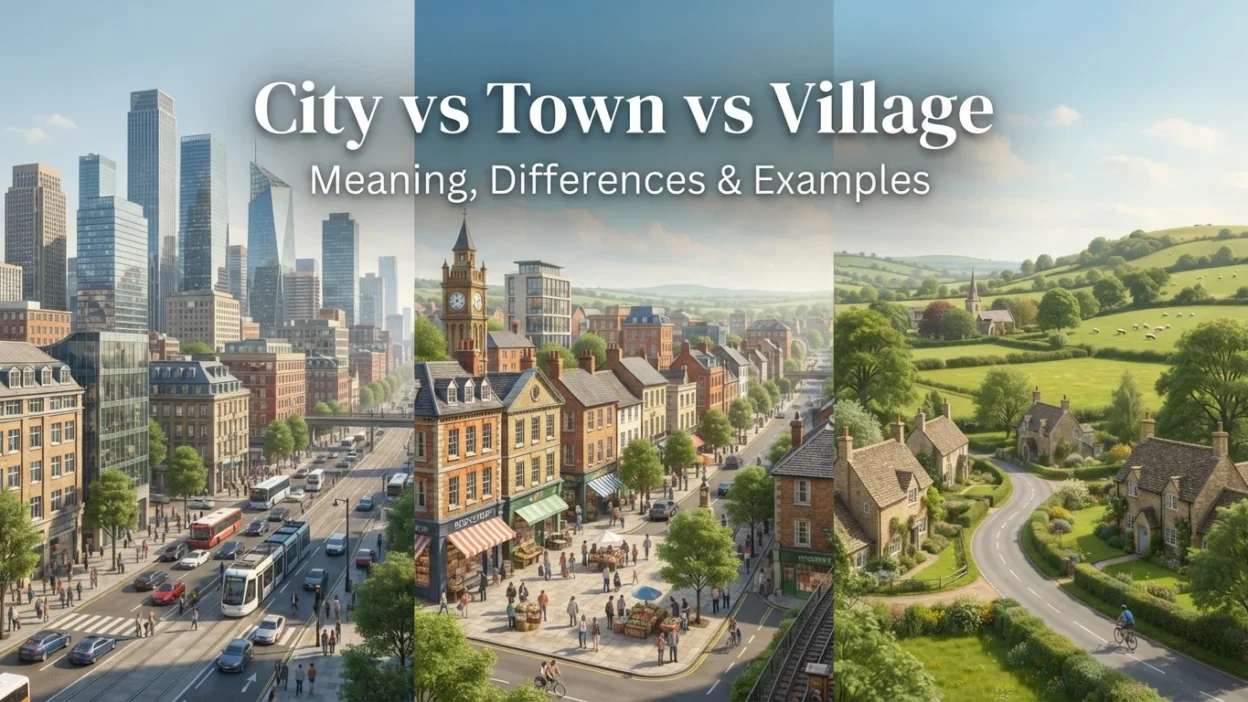
When talking about places where people live, city, town, and village may seem easy to understand. However, the difference between them is not always based on one exact population number. A city is generally a large, densely populated settlement with extensive services and infrastructure. A town is usually smaller than a city but larger and more developed than a village. A village is generally a small settlement with fewer people and services.
The meaning can also vary from one country to another. Some governments use official population limits or legal definitions, while others classify settlements according to their administrative status. That is why a place called a “town” in one country might be similar in size to a “city” somewhere else.
Quick Answer
A city is generally a large and highly developed urban settlement, a town is usually smaller with fewer people and services, and a village is typically a small community with fewer facilities. However, there is no universal population rule separating all three terms.
Why Do People Confuse City, Town, and Village?
People often confuse these words because their boundaries are not universal.
The terms can describe size, population, services, development, administrative status, or local tradition. A settlement may officially be a town even if another place with a similar population is legally classified as a city.
For English learners, the easiest general pattern is:
City → Town → Village
This suggests a general decrease in population and urban development, although exceptions exist.
What Does “City” Mean?
A city is a large urban settlement where many people live and work. Cities usually have extensive infrastructure, transportation, businesses, schools, hospitals, government offices, and other public services.
Examples of “City”
- New York City is a major city in the United States.
- London is a large city in England.
- Karachi is a major city in Pakistan.
- Tokyo is a highly populated city in Japan.
Example Sentences
- I live in a large city.
- The city has several universities.
- She moved to the city for work.
- We spent three days exploring the city.
What Does “Town” Mean?
A town is generally a settlement that is smaller than a city but larger or more developed than a village.
Towns often have shops, schools, restaurants, offices, healthcare facilities, markets, and local government services. However, the exact meaning of “town” differs between countries.
Examples of “Town”
- We live in a small town near the coast.
- The town has a busy market.
- She grew up in a quiet town.
- They drove into town to buy groceries.
What Does “Village” Mean?
A village is generally a small settlement or community. Villages often have fewer residents and fewer public or commercial facilities than towns and cities.
A village may be located in a rural area, although the word primarily describes the size and character of the settlement rather than simply whether it is surrounded by farmland.
Examples of “Village”
- My grandparents live in a small village.
- The village is surrounded by green fields.
- We visited a traditional mountain village.
- Everyone in the village knows each other.
City vs Town vs Village: Comparison Table
| Feature | City | Town | Village |
|---|---|---|---|
| General size | Large | Medium | Small |
| Population | Usually higher | Usually moderate | Usually lower |
| Services | Extensive | Moderate | Fewer |
| Infrastructure | Highly developed | Developed | More limited |
| Businesses | Many and diverse | Several | Usually fewer |
| Transportation | Often extensive | Moderate | Usually limited |
| Typical setting | Urban | Urban or semi-urban | Often rural |
| Example phrase | “a major city” | “a small town” | “a rural village” |
Important: This table describes common usage, not a universal legal classification. Different countries and regions define settlements differently.
When Should You Use City, Town, and Village?
Use “City” When:
Use city when referring to a large urban settlement.
Example:
She works in the city but lives in the suburbs.
Use “Town” When:
Use town for a settlement that is generally smaller than a city.
Example:
He owns a small business in the town.
Use “Village” When:
Use village for a small community or settlement.
Example:
They built a house in a peaceful village.
10+ Examples of City, Town, and Village
- London is a large city.
- She moved to the city for university.
- The city has a modern public transportation system.
- He grew up in a small town.
- The town has a popular weekly market.
- We stopped in a town on our journey.
- My uncle lives in a quiet village.
- The village has only a few shops.
- They visited a beautiful mountain village.
- The city is much busier than the town.
- The town is larger than the nearby village.
- Many people from the village travel to the town for shopping.
Common Mistakes
Mistake 1: Thinking Every City Must Have a Specific Population
There is no single worldwide population number that automatically turns a settlement into a city.
Better understanding: Population can be one factor, but legal and administrative definitions also matter.
Mistake 2: Assuming Every Village Is Rural
Many villages are rural, but “village” does not always mean exactly the same thing everywhere.
Mistake 3: Treating “Town” as an Exact Size
A town does not have one universal population range.
Mistake 4: Using “City” for Every Large Place
A large settlement may still officially be classified as a town depending on the country or local government.
Memory Trick
Remember this simple sequence:
CITY = BIG
TOWN = MEDIUM
VILLAGE = SMALL
Think of it as:
City → Town → Village
You can also remember:
Big city, smaller town, small village.
This is useful for everyday English, but remember that official classifications can differ.
American vs British English
The words city, town, and village are used in both American and British English, but their administrative meanings can differ.
In British English, “city” can have a specific legal or historical status rather than simply meaning a settlement with a large population. Some relatively small places officially have city status.
In American English, city and town can have different legal meanings depending on the state. A “town” is not necessarily simply a smaller version of a “city” in every legal context.
Therefore, when discussing an actual settlement, it is useful to consider the country’s or region’s official classification.
Similar Words
Here are some related words you may encounter:
- City — a large urban settlement.
- Town — generally a settlement smaller than a city.
- Village — generally a small settlement or community.
- Hamlet — a very small settlement, often smaller than a village.
- Suburb — a residential area near or within the urban area of a larger city.
- Metropolitan area — a major urban area together with surrounding communities.
- Urban area — a developed area with a relatively high concentration of people and buildings.
- Rural area — an area outside major urban settlements, often with lower population density.
- Municipality — a local government area or administrative unit.
- Community — a group of people living in the same area or sharing a social connection.
Final Verdict
In everyday English, the simplest distinction is:
City = generally large and highly developed
Town = generally smaller than a city
Village = generally smaller than a town
However, these terms do not have one universal definition. Population, infrastructure, historical usage, and official government classification can all affect what a settlement is called.
Frequently Asked Questions
Is a town bigger than a village?
Generally, yes. In ordinary English usage, a town is usually larger and has more services and facilities than a village. However, exact population boundaries vary by country.
Is a city bigger than a town?
Generally, yes. A city usually has a larger population and more extensive infrastructure and services than a town, although official classifications can create exceptions.
What is the difference between a city and a village?
A city is generally a large urban settlement with extensive infrastructure and services, while a village is usually a much smaller community with fewer facilities.
What is smaller, a town or a village?
A village is generally smaller than a town in everyday English.
Can a village become a town?
Yes. A settlement can grow and develop over time, and its official administrative classification may also change according to local laws.
Is every large town a city?
No. A settlement may remain officially classified as a town even when it is relatively large. Legal definitions vary by jurisdiction.
Is a suburb a town or a city?
A suburb is not necessarily a separate type of settlement. It is generally an area associated with a larger urban area and may be located within or outside the main city.
Remember This
City, town, and village all describe settlements, but they are not separated by one worldwide rule.
For simple everyday English:
- City → generally large
- Town → generally medium-sized
- Village → generally small
Always consider local usage when talking about the official status of a particular place.
Conclusion
The main difference between city vs town vs village is usually their relative size, population, development, and range of services. A city is generally the largest, a town is smaller, and a village is generally the smallest. These distinctions make the words easy to understand in everyday conversation.
However, English does not provide one universal population limit for these terms. Countries and local authorities may use different legal, historical, or administrative definitions. For ordinary communication, remembering city → town → village is a useful starting point, while official classifications should be checked when precision matters.

John Tyler is a dream researcher and content writer at SleepCout, sharing insightful articles about coded dreams, dream meanings, symbolism, sleep psychology, and practical guidance to help readers understand their dreams.