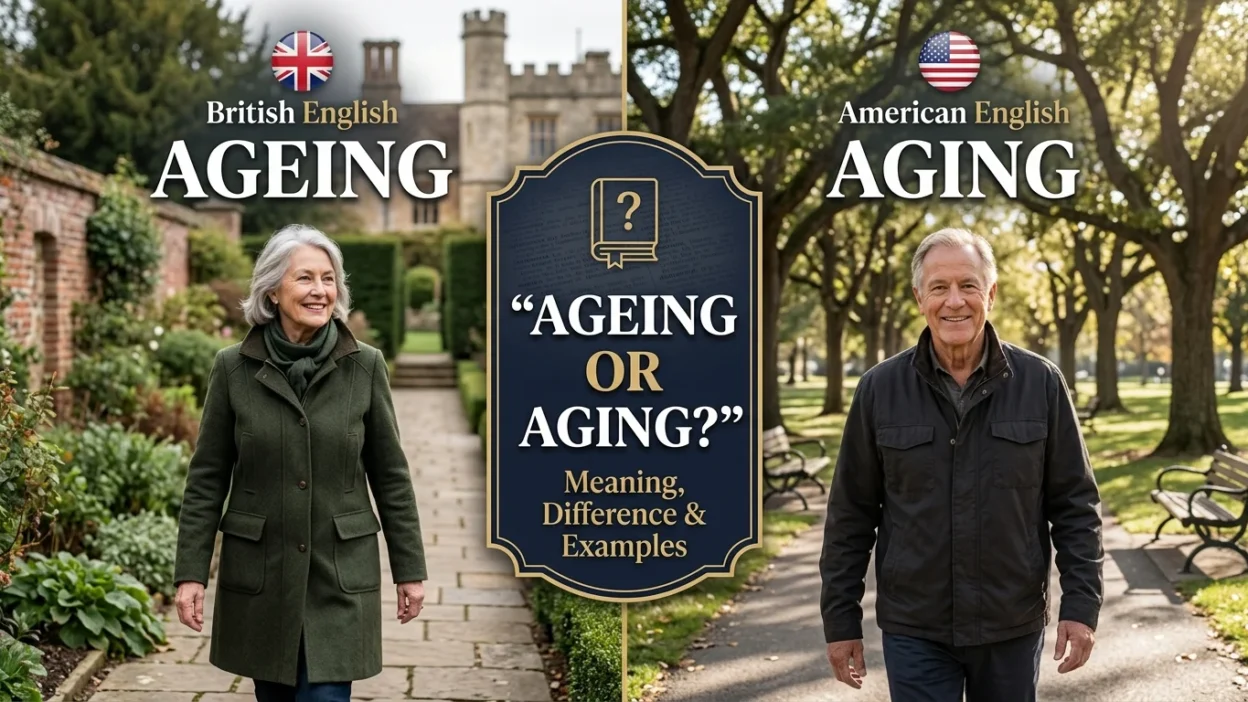
The words ageing and aging have the same meaning, but the correct spelling depends on which variety of English you use. Ageing is the standard spelling in British English, while aging is the standard spelling in American English. Both refer to the process of getting older or becoming older over time.
For example, a British writer might say, “The population is ageing,” while an American writer would typically write, “The population is aging.” Neither spelling is wrong, and both can be used to describe people, animals, plants, materials, and other things that change over time.
Understanding the difference between ageing and aging helps you choose the right spelling for school assignments, professional documents, blog posts, and everyday communication. The most important thing is to follow the spelling convention of your intended audience and remain consistent throughout your writing.
Quick Answer: Ageing or Aging?
Ageing is the preferred British English spelling, while aging is the preferred American English spelling. Both words mean the same thing: growing older or undergoing changes associated with age. For British audiences, use ageing. For American audiences, use aging. Both spellings are correct.
Why Do People Confuse Ageing and Aging?
People often confuse these words because they differ by only one letter, and their meanings, pronunciation, and grammatical functions are identical.
The confusion comes mainly from differences between British and American spelling conventions. English has many words that follow similar patterns, including colour and color, organise and organize, and travelling and traveling.
The difference is not about meaning or grammar. It is about regional spelling preferences.
What Does Ageing Mean?
Ageing is the British English spelling of the word that describes growing older or the gradual changes that happen as something becomes older.
It can refer to living things, such as humans and animals, as well as nonliving things, such as buildings, wine, and materials.
Examples of Ageing in Sentences
- The ageing population needs better healthcare services.
- Scientists are studying the effects of ageing on memory.
- The ageing building requires extensive repairs.
- Ageing wine can develop a more complex flavour.
- Regular exercise may support healthy ageing.
In British English, ageing is the preferred spelling in formal writing, academic work, and everyday communication.
What Does Aging Mean?
Aging is the American English spelling of the same word. It describes the process of getting older or the changes that occur over time.
Like ageing, it can refer to people, animals, objects, materials, and natural processes.
Examples of Aging in Sentences
- The aging population needs access to quality healthcare.
- Researchers are investigating how aging affects the brain.
- The aging bridge needs regular maintenance.
- Aging cheese can develop a stronger flavour.
- Healthy habits may improve the quality of life during aging.
In American English, aging is the usual spelling in newspapers, books, academic publications, and professional documents.
Ageing vs Aging: Comparison Table
| Feature | Ageing | Aging |
|---|---|---|
| Meaning | Growing older | Growing older |
| Preferred variety | British English | American English |
| Pronunciation | The same | The same |
| Part of speech | Noun or adjective | Noun or adjective |
| Example | Ageing gracefully | Aging gracefully |
| Correct spelling? | Yes | Yes |
| Best use | British-oriented writing | American-oriented writing |
When Should You Use Ageing or Aging?
Choose the spelling according to your audience, location, or publication’s style guide.
Use Ageing When
- You are writing in British English.
- Your audience is primarily in the United Kingdom.
- You are following a British school’s spelling conventions.
- You are writing for a publication that prefers British spelling.
Example: The government introduced new policies to support an ageing population.
Use Aging When
- You are writing in American English.
- Your audience is primarily in the United States.
- You are following an American school’s spelling conventions.
- You are writing for a publication that prefers American spelling.
Example: The government introduced new policies to support an aging population.
What If You Are Writing for an International Audience?
Either spelling is acceptable. Choose one spelling system and use it consistently. If your employer, teacher, or publisher has a preferred style guide, follow that guidance.
12 Examples of Ageing and Aging in Sentences
The following examples show how both spellings work in natural English.
- British: Ageing is a natural part of life.
- American: Aging is a natural part of life.
- British: The ageing population is increasing in many countries.
- American: The aging population is increasing in many countries.
- British: Researchers study the effects of ageing on the human body.
- American: Researchers study the effects of aging on the human body.
- British: She is interested in healthy ageing.
- American: She is interested in healthy aging.
- British: The ageing computer needs to be replaced.
- American: The aging computer needs to be replaced.
- British: The effects of ageing vary from person to person.
- American: The effects of aging vary from person to person.
Notice that the meaning stays the same in every pair. Only the spelling changes.
Common Mistakes to Avoid
Although both spellings are correct, writers sometimes make mistakes when choosing between them.
1. Thinking One Spelling Is Always Wrong
Incorrect assumption: “Ageing is always incorrect.”
Correction: Ageing is standard in British English, while aging is standard in American English.
2. Mixing British and American Spellings
Using ageing in one paragraph and aging in another may look inconsistent if you are following one spelling convention.
Better approach: Choose your preferred variety and stick with it throughout the document.
3. Confusing Spelling With Meaning
Neither spelling describes a different stage of life or a different type of ageing process. The two words have the same meaning.
4. Forgetting Related Word Forms
The same regional spelling difference appears in related forms:
- Ageing / aging: The process of growing older.
- Ageing population / aging population: A population with an increasing proportion of older people.
- Healthy ageing / healthy aging: Maintaining health and well-being as people grow older.
Memory Trick: How to Remember Ageing vs Aging
Use this simple memory trick:
- Ageing = British English
- Aging = American English
Think of other familiar spelling differences:
- British: ageing, colour, travelling
- American: aging, color, traveling
Remember that ageing and aging are both correct. The choice depends on your spelling convention, not the meaning of the sentence.
American vs British English: Which Spelling Is Preferred?
The main difference between ageing and aging is regional.
In British English, the spelling ageing is generally preferred. In American English, aging is the standard form.
This difference follows a broader pattern in English spelling. British English often retains the -e in words such as ageing and dyeing, while American English commonly uses simplified forms such as aging.
However, spelling conventions can vary by publication and style guide. When writing for a particular institution or audience, its preferred spelling should take priority.
Similar Words: Ageing, Aged, and Age-Related
These words are connected to age, but they do not always serve the same grammatical purpose.
| Word or phrase | Meaning | Example |
|---|---|---|
| Ageing / Aging | The process of becoming older | Ageing affects everyone differently. |
| Aged | Having reached a particular age or being old | The aged building needs repairs. |
| Age-related | Associated with getting older | She has an age-related condition. |
| Age gracefully | To grow older in a positive or dignified way | He hopes to age gracefully. |
| Ageing process | The changes that occur over time | Scientists study the ageing process. |
| Ageing population | A population with a growing proportion of older people | An ageing population can affect healthcare demand. |
Remember that ageing and aging are interchangeable spellings, but aged and age-related have different grammatical uses.
Final Verdict: Ageing or Aging?
Both ageing and aging are correct English spellings with the same meaning.
Use ageing when writing in British English and aging when writing in American English. If you are unsure which form to choose, consider your readers and follow the spelling conventions of your publication or institution.
The easiest rule is simple: ageing for British English, aging for American English.
Frequently Asked Questions
1. Is ageing or aging correct?
Both are correct. Ageing is the preferred British English spelling, while aging is the preferred American English spelling. They have the same meaning.
2. Is ageing British or American English?
Ageing is primarily the British English spelling. It is commonly used in the UK and in other English-speaking contexts that follow British spelling conventions.
3. Is aging British or American English?
Aging is the standard American English spelling. It is commonly used in the United States in everyday, academic, and professional writing.
4. Do ageing and aging mean the same thing?
Yes. Both words refer to the process of growing older or the changes that occur as something gets older. The difference is spelling, not meaning.
5. How do you spell ageing in a formal essay?
Use ageing if your essay follows British English conventions and aging if it follows American English conventions. If your school or university provides a style guide, follow it.
6. Is it healthy ageing or healthy aging?
Both expressions are correct. Use healthy ageing in British English and healthy aging in American English. Both refer to maintaining health and well-being as people grow older.
7. Why does American English drop the “e” in aging?
American English commonly uses aging as its standard spelling, while British English generally retains the e in ageing. This is a regional spelling difference rather than a change in pronunciation or meaning.
Remember This
- Ageing: Preferred British English spelling.
- Aging: Preferred American English spelling.
- Meaning: Identical in both forms.
- Pronunciation: The same.
- Best writing practice: Follow your audience’s spelling conventions and remain consistent.
Conclusion
The difference between ageing and aging is straightforward once you understand British and American spelling conventions. Both words describe the process of growing older, and neither is inherently more correct than the other. Your choice should depend on the type of English you are using and the expectations of your readers.
For everyday writing, academic assignments, and professional communication, remember this simple guideline: use ageing for British English and aging for American English. By choosing one spelling convention and applying it consistently, you can write more clearly and confidently.

John Tyler is a dream researcher and content writer at SleepCout, sharing insightful articles about coded dreams, dream meanings, symbolism, sleep psychology, and practical guidance to help readers understand their dreams.