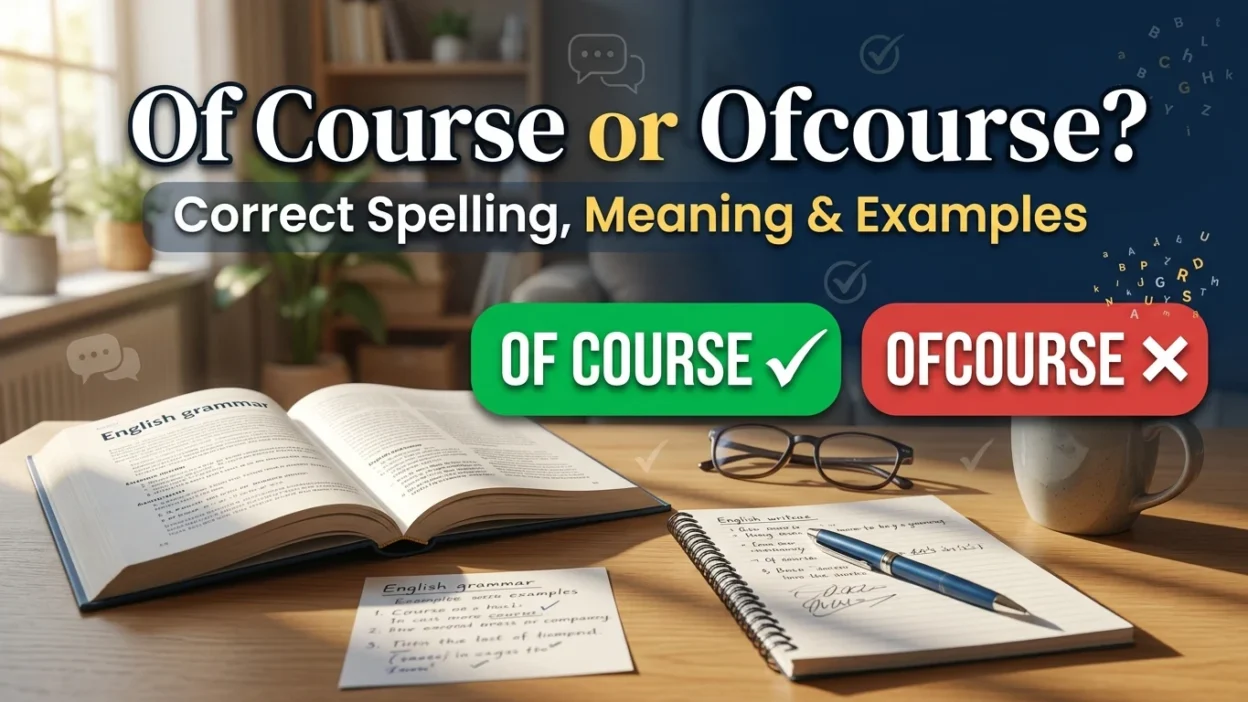
If you have ever wondered if to write “of course” or “ofcourse,” the correct spelling is of course—two separate words. “Ofcourse” is a common spelling mistake and is not accepted as the standard form in English. Use “of course” when you want to say “certainly,” “naturally,” or “without a doubt.”
For example, you can write, “Of course, I will help you with your homework.” This sentence shows that you are willing to help. Whether you are writing an email, sending a text message, completing a school assignment, or speaking English in everyday life, learning the correct spelling will help you communicate clearly. Although “ofcourse” may appear in informal messages or online posts, it is best to avoid it in all standard English writing.
Quick Answer
“Of course” is correct, and “ofcourse” is incorrect. The expression always consists of two words in standard English. It means “certainly,” “naturally,” or “without question.” For example, “Of course, you can join us.” Remember to include a space between “of” and “course.”
Why Do People Confuse “Of Course” and “Ofcourse”?
People often confuse these spellings because “of course” is pronounced as a connected phrase in everyday speech. When speaking quickly, the two words may sound like one, leading some writers to combine them accidentally.
Another reason is that English contains many compound words, such as “sometimes,” “everywhere,” and “anyone.” Writers may assume that “of course” follows the same pattern, but it does not.
The important distinction is simple: “Of course” is the correct two-word expression, while “ofcourse” is a misspelling.
What Does “Of Course” Mean?
“Of course” is a common English expression used to show agreement, certainty, willingness, or that something is expected or obvious.
1. To Show Agreement
Use “of course” when you want to agree with a request or suggestion.
- “Can you help me?” — “Of course!”
- “May I borrow your pen?” — “Of course.”
2. To Express Certainty
Use it when something is certain or expected.
- “Of course, the sun rises in the east.”
- “She will, of course, attend the meeting.”
3. To Show Willingness
It can also communicate that you are happy to do something for someone.
- “Could you explain this lesson?” — “Of course!”
- “Can I call you later?” — “Of course you can.”
4. To Introduce an Obvious or Expected Point
Sometimes, “of course” introduces information that the speaker considers natural or already understood.
- “Of course, practice takes time.”
- “Of course, we need to check the details first.”
What Is “Ofcourse”?
“Ofcourse” is an incorrect spelling of the standard expression “of course.” It may occur in online comments, text messages, or other informal writing, but it should not be used in formal or standard English.
Incorrect: “Ofcourse, I remember you.”
Correct: “Of course, I remember you.”
The meaning remains understandable when someone writes “ofcourse,” but the spelling is still incorrect. Always separate the two words.
Of Course vs Ofcourse: Comparison Table
| Feature | Of course | Ofcourse |
|---|---|---|
| Spelling | Correct | Incorrect |
| Number of words | Two | One |
| Standard English | Yes | No |
| Meaning | Certainly, naturally | Intended meaning of “of course” |
| Formal writing | Appropriate | Avoid |
| Example | Of course, I agree. | Ofcourse, I agree. |
When Should You Use “Of Course”?
Use “of course” whenever you want to express certainty, agreement, willingness, or an expected fact.
Common situations include:
- Answering a request: “Of course, I can help you.”
- Giving permission: “Of course, you may come in.”
- Agreeing with someone: “Of course, that sounds like a good idea.”
- Expressing an obvious fact: “Of course, water is essential for life.”
- Writing professional emails: “Of course, I will send you the updated report.”
- Reassuring someone: “Of course, everything will be fine.”
You can use the expression in casual conversations, academic writing, professional emails, and everyday communication. However, be mindful of tone: depending on context and punctuation, “of course” can sometimes sound impatient or sarcastic.
12 Examples of “Of Course” in Sentences
Here are twelve examples showing how to use the correct spelling naturally.
- Of course, I will help you with your assignment.
- “Can I sit here?” “Of course!”
- Of course, she knows the answer.
- You can call me anytime, of course.
- Of course, we should respect our teachers.
- “Would you like some tea?” “Of course, thank you.”
- Of course, learning a new language takes practice.
- He will, of course, attend his brother’s wedding.
- Of course, you are welcome to join us.
- I understand your concern, of course.
- Of course, we need more information before deciding.
- “Can you explain the difference?” “Of course I can.”
Notice that “of course” can appear at the beginning, middle, or end of a sentence. Its spelling remains the same in every position.
Common Mistakes to Avoid
Even though “of course” is easy to learn, several common mistakes are worth avoiding.
Mistake 1: Writing “Ofcourse”
Incorrect: Ofcourse, I will come.
Correct: Of course, I will come.
Why? The expression consists of two separate words.
Mistake 2: Writing “Off Course” When You Mean “Of Course”
Incorrect: Off course, I agree with you.
Correct: Of course, I agree with you.
“Off course” is a different expression. It means moving away from the intended route or direction.
Example: “The ship went off course during the storm.”
Mistake 3: Using “Of Course” in an Unclear Tone
Example: “Of course you forgot!”
Although the spelling is correct, this sentence may sound sarcastic or critical.
A more neutral alternative is: “I understand that you forgot.”
Mistake 4: Forgetting Punctuation
When “of course” begins a sentence as an introductory phrase, a comma is often appropriate.
Example: “Of course, I would be happy to help.”
However, punctuation depends on how the phrase is used within the sentence.
What Is an Easy Memory Trick?
Remember this simple rule:
Of + course = of course.
Think of “course” as a separate word, just as you would use it in “English course” or “training course.” The expression “of course” also keeps the words separate.
Another helpful trick is to remember this sentence:
“Of course, I completed my course.”
The first “course” belongs to the expression “of course,” while the second refers to a class or program. Both are written as separate words in their respective phrases.
Is “Of Course” Different in American and British English?
No. “Of course” is spelled the same way in American English and British English.
| Variety of English | Correct spelling | Example |
|---|---|---|
| American English | Of course | Of course, I can help. |
| British English | Of course | Of course, I can help. |
| Australian English | Of course | Of course, you’re welcome. |
| Canadian English | Of course | Of course, that’s fine. |
Unlike certain words that have different regional spellings, such as “color” and “colour,” this expression does not change across these varieties of English.
Similar Words and Expressions
If you want to express agreement, certainty, or willingness, several alternatives may work depending on the context.
| Expression | Meaning | Example |
|---|---|---|
| Certainly | Definitely; without doubt | Certainly, I can help. |
| Definitely | Without question | I will definitely attend. |
| Absolutely | Strong agreement or certainty | Absolutely, I agree. |
| Naturally | As expected | Naturally, she was pleased. |
| Surely | With confidence or expectation | Surely, you understand. |
| Without a doubt | With complete certainty | Without a doubt, she is talented. |
| No problem | Willingness to help | No problem, I’ll do it. |
| You’re welcome | A response to thanks | “Thank you!” “You’re welcome.” |
These expressions are not always interchangeable. For example, “no problem” is especially common when responding to a request, while “without a doubt” emphasizes certainty.
Frequently Asked Questions
1. Is “of course” one word or two?
“Of course” is two words. This is the standard spelling in English. Writing “ofcourse” as one word is incorrect.
2. Is “ofcourse” ever correct?
No. “Ofcourse” is not the standard spelling of the expression. Use “of course” in formal writing, schoolwork, emails, and everyday messages.
3. Why do people write “ofcourse” instead of “of course”?
People often write it as one word because the expression sounds connected in natural speech. They may also confuse it with genuine compound words that are written without spaces.
4. Is “of course” formal or informal?
“Of course” works in both formal and informal contexts. It is suitable for conversations, emails, reports, and academic writing. However, its tone can sound dismissive in certain situations.
5. What is the difference between “of course” and “off course”?
“Of course” means certainly or naturally. “Off course” means away from the intended route or direction.
Example: “Of course, I will attend the meeting.”
Example: “The plane drifted off course.”
6. Should I put a comma after “of course”?
A comma is often used when “of course” introduces a sentence or interrupts it as an aside.
Example: “Of course, I can help.”
Example: “I can, of course, help you.”
A comma is not always necessary when the expression flows naturally within a short sentence, such as “Of course I agree.”
7. Can I use “of course” in a professional email?
Yes. “Of course” is appropriate in professional emails when expressing agreement, willingness, or certainty.
Example: “Of course, I will share the revised document by tomorrow.”
For a more formal tone, you can also use “Certainly” or “I would be happy to.”
Remember This
- Of course: Correct spelling; always written as two words.
- Ofcourse: Incorrect spelling; avoid it.
- Off course: A different expression meaning away from the intended route.
- Quick rule: Whenever you mean “certainly” or “naturally,” write “of course.”
Conclusion
The correct choice between “of course” and “ofcourse” is simple: always use “of course” as two separate words. This common expression helps you communicate agreement, certainty, willingness, and expected information. Although the incorrect spelling may appear in informal online writing, it should not be used in standard English.
To remember the rule, think of “of” and “course” as two independent words that work together to express a single idea. Use “of course” in your conversations, messages, school assignments, and professional emails. With this simple spelling rule in mind, you can write more accurately and avoid a common English mistake.

John Tyler is a dream researcher and content writer at SleepCout, sharing insightful articles about coded dreams, dream meanings, symbolism, sleep psychology, and practical guidance to help readers understand their dreams.