
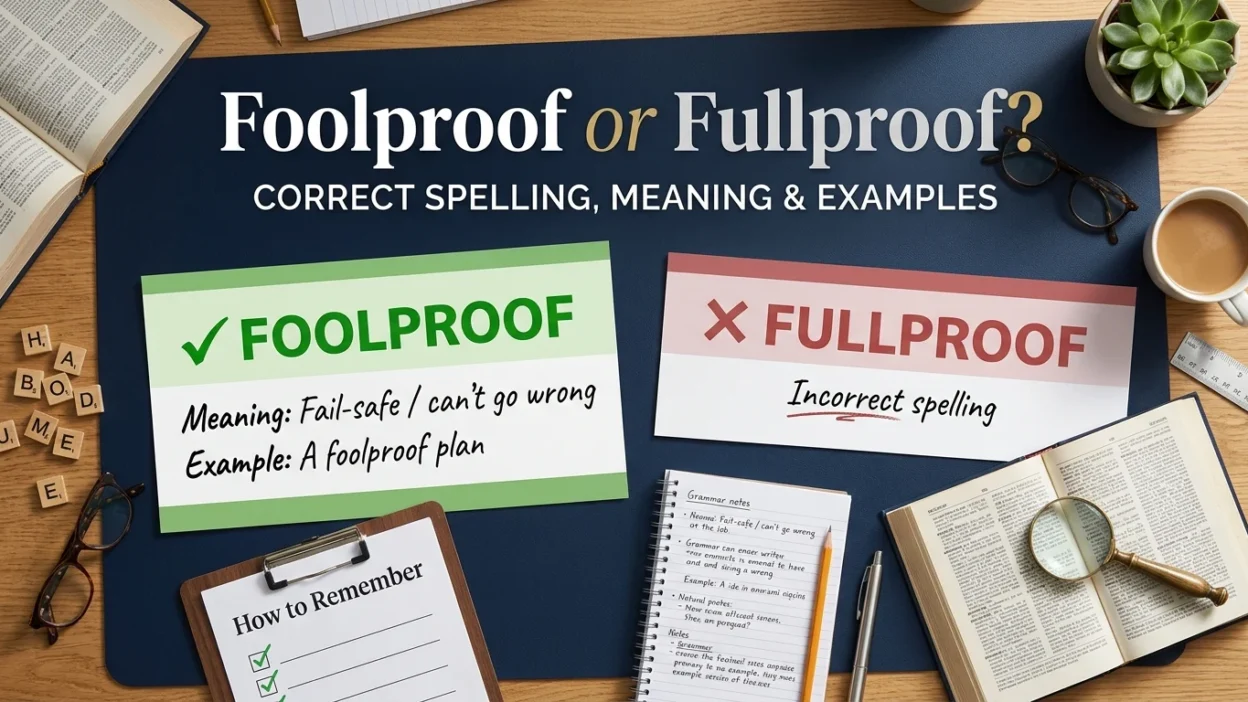
Have you ever wondered if the correct spelling is foolproof or fullproof? These words look and sound similar, so it is easy to mix them up. However, only one is the standard spelling when you want to describe something that is easy to use, understand, or operate successfully.
The correct word is foolproof, not fullproof. Foolproof means something is designed to work successfully with minimal risk of mistakes or failure. You might use it to describe a simple recipe, a reliable method, clear instructions, or a plan that is difficult to get wrong. Although people sometimes write “fullproof” by mistake, it is not the standard spelling for this meaning. Learning the difference will help you improve your spelling, write more clearly, and avoid common mistakes in emails, school assignments, and everyday conversations.
Quick Answer: Foolproof or Fullproof?
Foolproof is the correct spelling when describing something that is easy to use or unlikely to fail because of mistakes. Fullproof is a common misspelling of this word. For example, “She created a foolproof plan for organizing the event.” Remember to write foolproof with “fool” at the beginning.
Why Do People Confuse Foolproof and Fullproof?
People confuse foolproof and fullproof mainly because they sound similar when spoken aloud. The word foolproof contains the word “fool,” which some people mistakenly replace with “full.”
Another reason is that “full proof” may seem logical. Someone might assume that a plan with complete proof or complete protection should be called “fullproof.” However, that is not how the standard English word is spelled.
The important point is that foolproof is an established English word, while fullproof is generally a spelling error when used with the intended meaning.
What Does Foolproof Mean?
Foolproof is an adjective that describes something designed to be easy to understand, use, or carry out correctly, even by someone with little experience.
It can also describe a method or plan that is considered highly reliable or unlikely to fail.
Examples of Foolproof in Sentences
- This recipe is foolproof, even for beginners.
- The teacher gave us a foolproof way to solve the problem.
- We need a foolproof system for checking our work.
- Her instructions made the process simple and easy to follow.
In everyday English, foolproof is often used informally to express confidence in a method or solution. However, it does not literally guarantee that failure is impossible.
What Does Fullproof Mean?
Fullproof is not the standard English spelling of the adjective foolproof. People commonly use it accidentally when they mean something is reliable, dependable, or unlikely to fail.
For example:
- Incorrect: This is a fullproof method for learning English.
- Correct: This is a foolproof method for learning English.
The phrase full proof can appear as two separate words in a context where “full” modifies the noun “proof,” but it does not replace the established adjective foolproof.
If you want to describe a dependable plan, an easy process, or a reliable solution, choose foolproof.
Foolproof vs. Fullproof: Comparison Table
| Feature | Foolproof | Fullproof |
|---|---|---|
| Standard spelling | Correct | Incorrect for the intended meaning |
| Part of speech | Adjective | Not a standard adjective with this meaning |
| Meaning | Easy to use or unlikely to fail | Common misspelling of foolproof |
| Common use | Instructions, plans, methods, systems | Usually appears as a spelling error |
| Example | A foolproof recipe | A fullproof recipe (incorrect) |
When Should You Use Foolproof or Fullproof?
Use foolproof whenever you want to describe a process, plan, or system that is simple to follow and unlikely to go wrong.
Use these examples as a guide:
- For instructions: “The manual provides foolproof instructions.”
- For cooking: “This is a foolproof recipe for beginners.”
- For studying: “I found a foolproof way to remember new vocabulary.”
- For planning: “They developed a foolproof strategy for the presentation.”
- For technology: “The app has a simple, foolproof setup process.”
Avoid using fullproof as a substitute in these situations.
12 Examples of Foolproof in Sentences
Here are 12 practical examples to help you understand the correct usage.
- Cooking: This foolproof recipe produces soft cookies every time.
- Education: The teacher shared a foolproof method for remembering grammar rules.
- Technology: The software includes a foolproof installation guide.
- Business: We need a foolproof process for managing customer orders.
- Travel: She created a foolproof checklist for packing her suitcase.
- Planning: They developed a foolproof plan for the school event.
- Writing: This foolproof outline helps beginners organize their essays.
- Daily life: He found a foolproof way to keep his keys in one place.
- Problem-solving: The instructions offer a foolproof solution to the basic problem.
- Learning English: There is no foolproof shortcut to mastering a language, but regular practice helps.
- Work: Our team designed a foolproof checklist to reduce mistakes.
- Spelling: Remembering the word “fool” helps you spell foolproof correctly.
Notice that foolproof describes something intended to make a task easier, safer, or more reliable.
Common Mistakes When Using Foolproof and Fullproof
Avoid these frequent spelling and usage errors.
1. Writing Fullproof Instead of Foolproof
Incorrect: “This is a fullproof plan.”
Correct: “This is a foolproof plan.”
2. Assuming Foolproof Means Impossible to Fail
Although the word suggests reliability, no ordinary plan or method is guaranteed to work in every situation.
For example: “The foolproof plan failed because of unexpected weather.”
This sentence is grammatically correct because foolproof describes the plan’s intended reliability, not an absolute guarantee.
3. Using Foolproof When You Mean Evidence
If you mean strong evidence that supports a claim, words such as conclusive, convincing, or conclusive proof may be more appropriate.
For example:
- “The investigators found conclusive proof.”
- “The instructions provide a foolproof method.”
These expressions have different meanings and should not be confused.
What Is an Easy Memory Trick for Foolproof?
Use this simple trick: Foolproof = fool + proof.
Imagine instructions so simple that even an inexperienced person could follow them without making a mistake. That image can help you remember the correct spelling.
You can also remember this sentence:
“A foolproof plan helps prevent foolish mistakes.”
Both fool and foolproof begin with the same four letters, making the spelling easier to recall.
Is Foolproof Different in American and British English?
No. Foolproof is the standard spelling in both American and British English.
| English variety | Correct spelling | Example |
|---|---|---|
| American English | Foolproof | This is a foolproof solution. |
| British English | Foolproof | This is a foolproof solution. |
There is no regional spelling difference between the two varieties for this word. Fullproof remains a nonstandard spelling when the intended meaning is “easy to use or unlikely to fail.”
What Words Are Similar to Foolproof?
Several English words have meanings similar to foolproof, but they are not always interchangeable.
- Reliable: Something you can depend on.
- Dependable: Someone or something that can be trusted to perform well.
- Fail-safe: Designed to reduce danger or prevent serious failure.
- Simple: Easy to understand or use.
- Error-proof: Designed to prevent mistakes.
- Straightforward: Easy to understand or carry out.
- Infallible: Incapable of making mistakes or being wrong, often used in a stronger or more absolute sense.
For example, a simple recipe may be easy to follow, while a reliable method consistently produces good results. A foolproof method emphasizes being designed to minimize errors.
Final Verdict: Foolproof or Fullproof?
Foolproof is correct; fullproof is generally a misspelling.
Use foolproof when describing a plan, method, recipe, system, or set of instructions that is easy to follow and unlikely to fail because of mistakes.
Remember that the word does not guarantee perfect results. It simply suggests that something has been designed to work reliably and minimize errors.
Frequently Asked Questions
1. Is it foolproof or fullproof?
Foolproof is the correct spelling when describing something easy to use or unlikely to fail. Fullproof is a common misspelling in this context.
2. What does foolproof mean in simple English?
Foolproof means easy to understand or use, even for someone without much experience. It describes something designed to prevent mistakes or reduce the chance of failure.
3. Is fullproof a real English word?
Fullproof is not the standard English adjective for something reliable or difficult to get wrong. It is generally a misspelling of foolproof when used with that meaning.
4. How do you use foolproof in a sentence?
You can write, “My teacher gave me a foolproof method for remembering difficult words.” Here, foolproof describes a method designed to be easy to follow and effective.
5. Does foolproof mean 100% guaranteed?
No. Foolproof suggests that something is designed to minimize mistakes or failure, but it does not guarantee success in every possible situation.
6. Is foolproof one word or two?
Foolproof is written as one word. It should not be written as fool proof when used as the standard adjective.
7. Is foolproof the same in American and British English?
Yes. Both American and British English use foolproof. There is no difference in the standard spelling between these varieties.
Remember This
- Foolproof = correct spelling.
- Fullproof = usually a spelling mistake when you mean foolproof.
- Foolproof describes something designed to be easy to follow or unlikely to fail.
- The word is spelled the same way in American and British English.
- Foolproof does not mean that success is absolutely guaranteed.
Conclusion
Choosing between foolproof and fullproof is simple once you understand the correct spelling. Foolproof is the established English word used to describe a method, plan, recipe, or system that is easy to follow and designed to minimize mistakes. Fullproof is generally incorrect when used with this meaning.
To remember the difference, connect foolproof with the idea of preventing foolish mistakes. Use the correct spelling in your schoolwork, professional writing, emails, and everyday conversations. With this small spelling rule in mind, you can write more confidently and communicate your ideas clearly.

John Tyler is a dream researcher and content writer at SleepCout, sharing insightful articles about coded dreams, dream meanings, symbolism, sleep psychology, and practical guidance to help readers understand their dreams.