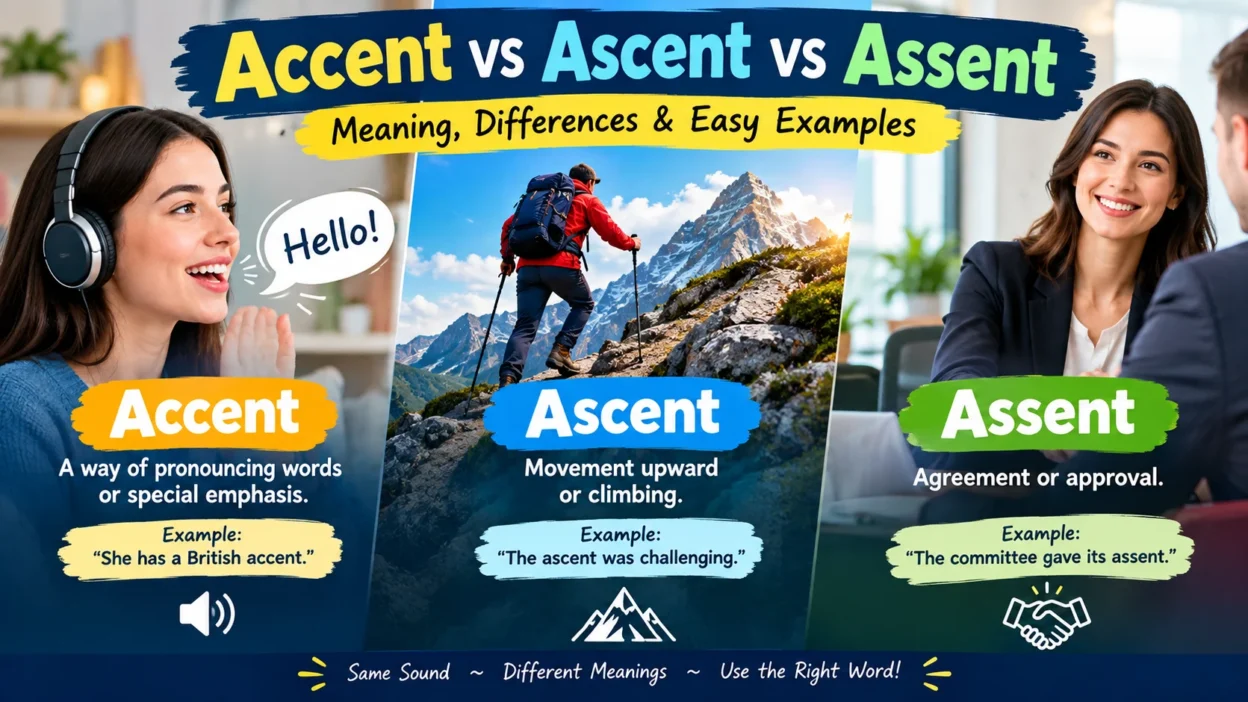
English has many words that sound alike but have completely different meanings. Accent, ascent, and assent are three such words. They are especially confusing because their pronunciations are similar, while their meanings and uses are quite different.
Accent usually relates to pronunciation or emphasis. Ascent means moving upward or climbing, while assent means agreement or approval. Knowing which word to use depends on whether you are talking about speech, upward movement, or agreement.
Quick Answer
Accent means a way of pronouncing words or special emphasis. Ascent means the act of going upward or climbing. Assent means agreement or approval. Although all three words sound similar, they have different meanings, spellings, and grammatical uses.
Why Do People Confuse Accent, Ascent, and Assent?
These three words are commonly confused because their pronunciations are very similar, especially in many varieties of English.
They also share similar spellings:
- Accent → related to speech or emphasis
- Ascent → related to going upward
- Assent → related to agreement
The easiest way to distinguish them is to focus on their meanings rather than their sounds.
What Does Accent Mean?
Accent is a noun that usually refers to the particular way someone pronounces a language.
For example:
She has a strong British accent.
The word can also mean special emphasis placed on a word, syllable, or idea.
The speaker put an accent on the importance of education.
Accent as a Verb
Accent can also be used as a verb meaning to emphasize something.
The blue curtains accent the white walls.
So, accent can relate to pronunciation, emphasis, or highlighting a feature.
What Does Ascent Mean?
Ascent is a noun meaning the act of moving upward or climbing to a higher position.
It is often used when talking about mountains, stairs, aircraft, or other upward movement.
The hikers began their ascent up the mountain.
It can also describe an increase in position, status, or importance.
Her rapid ascent in the company surprised everyone.
The opposite of ascent is descent, which means moving downward.
Easy Association
Think:
Ascent = go up
The plane began its ascent.
What Does Assent Mean?
Assent means agreement, approval, or acceptance of a proposal or idea.
As a noun:
The committee gave its assent to the proposal.
As a verb:
She assented to the new rules.
When someone assents, they agree with something or approve it.
Easy Association
Think:
Assent = agree
He assented to the plan.
Accent vs Ascent vs Assent: Comparison Table
| Word | Meaning | Part of Speech | Example |
|---|---|---|---|
| Accent | A way of pronouncing words; emphasis | Noun/Verb | She has a French accent. |
| Ascent | Movement upward or climbing | Noun | The ascent was difficult. |
| Assent | Agreement or approval | Noun/Verb | They gave their assent. |
When Should You Use Each Word?
Use “Accent” for Speech or Emphasis
Use accent when discussing someone’s pronunciation or emphasizing something.
He speaks English with a noticeable accent.
The designer used gold accents in the room.
Use “Ascent” for Going Up
Use ascent when something moves upward.
The airplane’s ascent was smooth.
Their ascent to the summit took several hours.
Use “Assent” for Agreement
Use assent when someone agrees with or approves something.
The board gave its assent to the proposal.
She assented to the terms.
12 Examples of Accent, Ascent, and Assent
Examples with “Accent”
- She has a slight American accent.
- His Scottish accent was easy to recognize.
- The teacher placed an accent on the first syllable.
- The colorful pillows accent the sofa.
Examples with “Ascent”
- The climbers began their ascent before sunrise.
- The plane’s ascent was surprisingly fast.
- The steep ascent made the hike difficult.
- We stopped several times during our ascent.
Examples with “Assent”
- The manager gave her assent to the project.
- The committee finally assented to the proposal.
- He nodded his assent.
- The plan cannot proceed without their assent.
Common Mistakes
Mistake 1: Using “Ascent” for Agreement
Incorrect:
The committee gave its ascent to the proposal.
Correct:
The committee gave its assent to the proposal.
Assent means agreement.
Mistake 2: Using “Assent” for Climbing
Incorrect:
The mountain’s assent was difficult.
Correct:
The mountain’s ascent was difficult.
Ascent refers to upward movement.
Mistake 3: Using “Accent” for Climbing
Incorrect:
Their accent up the mountain took five hours.
Correct:
Their ascent up the mountain took five hours.
Accent does not mean climbing.
Mistake 4: Confusing “Accent” with “Assent”
Incorrect:
She gave her accent to the proposal.
Correct:
She gave her assent to the proposal.
The first sentence uses a word associated with pronunciation or emphasis, while the second expresses agreement.
Memory Trick: How Can You Remember the Difference?
Use these three simple associations:
- Accent = A for Accent in speech
- Ascent = S for Sky / going up
- Assent = S for Say yes / agree
Another useful pair is:
Ascent ↔ Descent
Both describe movement:
- Ascent = going up
- Descent = going down
And:
Assent ↔ Agreement
Both relate to saying yes or approving something.
American vs British English
The meanings and spellings of accent, ascent, and assent are essentially the same in American and British English.
The main potential difficulty is pronunciation. Depending on the speaker’s accent, accent, ascent, and assent can sound very similar.
For learners, the safest approach is to identify the meaning from context rather than relying only on pronunciation.
Similar Words
Understanding related words can make these three terms easier to remember.
Words Related to Accent
- pronunciation
- dialect
- emphasis
- stress
- intonation
- tone
Words Related to Ascent
- climb
- rise
- elevation
- upward movement
- increase
- climb upward
Words Related to Assent
- agreement
- approval
- acceptance
- consent
- permission
- approval
Remember that these synonyms are not always interchangeable in every sentence.
Final Verdict
Accent, ascent, and assent sound similar but have completely different meanings.
- Accent = pronunciation or emphasis
- Ascent = movement upward
- Assent = agreement or approval
If you are talking about how someone speaks, choose accent. If something is moving upward, choose ascent. If someone agrees with or approves something, choose assent.
Frequently Asked Questions
Is it “accent” or “ascent”?
It depends on the meaning. Accent refers to pronunciation or emphasis, while ascent means upward movement or climbing.
Is “assent” the same as “agreement”?
Yes. Assent means agreement, approval, or acceptance of an idea, proposal, or decision.
Are accent, ascent, and assent pronounced the same?
They can sound very similar, and in some varieties of English they may be difficult to distinguish by sound alone. Their meanings and spellings are different.
What is the opposite of ascent?
The opposite of ascent is descent, meaning movement downward.
What is an example of assent?
The board gave its assent to the new policy.
Here, assent means approval or agreement.
What is an example of ascent?
The climbers began their ascent before dawn.
Here, ascent means the act of moving upward.
What is an example of accent?
She speaks English with a British accent.
Here, accent refers to a person’s way of pronouncing words.
How can I easily remember the difference?
Remember: accent = speech, ascent = up, assent = agreement. These three short associations will help you choose the correct word quickly.
Remember This
Accent = speech or emphasis
Ascent = going up
Assent = agreement
A simple sentence can help:
Her accent was noticeable during the ascent, and she gave her assent to the plan.
Each word has a completely different job.
Understanding the difference between accent, ascent, and assent becomes much easier when you connect each word with its core meaning. Do not rely only on pronunciation because these words can sound remarkably similar.
When writing, pause and ask yourself what you mean: speech, upward movement, or agreement? Once you identify the meaning, the correct spelling becomes much easier to choose.

John Tyler is a dream researcher and content writer at SleepCout, sharing insightful articles about coded dreams, dream meanings, symbolism, sleep psychology, and practical guidance to help readers understand their dreams.