
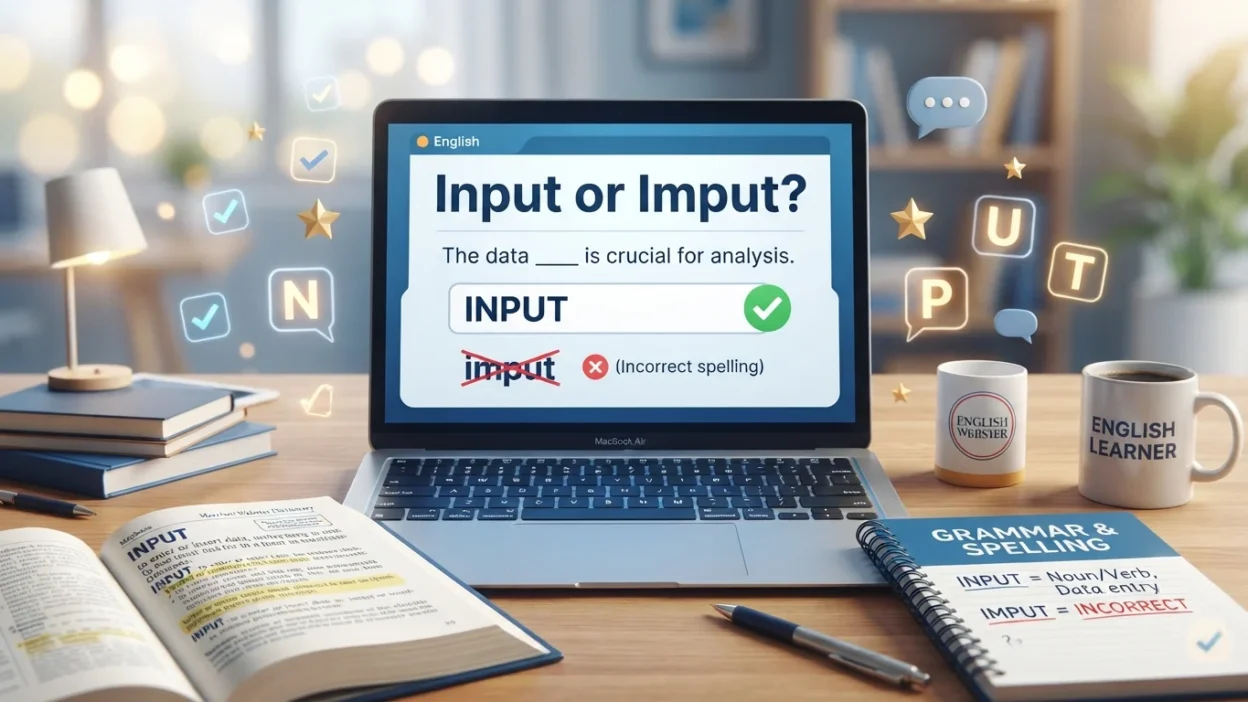
When you are unsure if to write “input” or “imput,” the correct spelling is input. Imput is a common spelling mistake and is not the standard English word. Input can be used as both a noun and a verb, depending on the sentence. As a noun, it means information, ideas, or data that someone provides. As a verb, it means to enter or provide information, especially into a computer or system.
This confusion often happens because the pronunciation of input can make the word sound slightly different from how it is spelled. Learners may also mistakenly apply spelling patterns from words such as “impossible” or “important.” Learning the meaning, pronunciation, and common examples of input makes the correct spelling much easier to remember.
Quick Answer
Input is the correct spelling. Imput is a misspelling and should generally be avoided in standard English. Input can be a noun meaning information or advice provided to someone, or a verb meaning to enter information into a computer, form, or system.
Why Do People Confuse “Input” and “Imput”?
People often confuse these two forms because input is not always pronounced exactly as beginners expect.
The word is made from in + put, which makes its spelling logical once you recognize the two parts.
For example:
- Please input your password.
- We need your input on this proposal.
- The employee input the information into the system.
Because put is pronounced with a short /ʊ/ sound, some people may incorrectly spell the whole word as imput.
However, changing n to m does not make “imput” correct.
What Does “Input” Mean?
Input has several closely related meanings.
As a noun, it can mean information, advice, ideas, or data provided for consideration or use.
We appreciate your input on this project.
Here, “input” means your ideas or advice.
As a verb, input means to enter information into a computer, device, form, or system.
Please input your account number.
Here, “input” means enter the information.
Input as a Noun
Examples include:
- customer input
- employee input
- expert input
- user input
- data input
- valuable input
Input as a Verb
As a verb, it is commonly used when talking about computers, databases, forms, and other systems.
She input the data into the database.
In everyday modern English, you may also encounter inputted, particularly when speakers want to make the past tense especially explicit. However, input is traditionally and very commonly used as the past form as well:
She input the data yesterday.
What Does “Imput” Mean?
Imput is generally a misspelling of “input.”
It does not normally function as a standard English word with a separate meaning.
For example:
Please imput your email address.
Correct:
Please input your email address.
If you see “imput” in informal writing, it is usually intended to mean input.
Input or Imput: Comparison Table
| Word | Correct? | Meaning | Example |
|---|---|---|---|
| Input | ✅ Yes | Information, advice, data, or the act of entering information | Please input your details. |
| Imput | ❌ No | Usually a misspelling of “input” | ❌ Please imput your details. |
The simple rule is:
Use “input.” Do not use “imput” when you mean the standard English word.
When Should You Use “Input”?
Use input when you are talking about information, advice, ideas, data, or entering information into a system.
1. For advice or opinions
I would like your input before we make a decision.
2. For information
The report contains important input from several departments.
3. For computer data
Please input your username and password.
4. For completing a form
You need to input your address in the required field.
5. For someone’s contribution
Her input helped improve the project.
6. For customer feedback
We value customer input.
7. For entering numbers
Input the correct amount into the calculator.
8. For entering data
The assistant input the new records into the database.
9. For suggestions
The manager asked for everyone’s input.
10. For technical systems
The system requires users to input a security code.
11. For opinions in a meeting
We need your input before moving forward.
12. For information supplied to a process
The program uses the user’s input to generate a result.
Common Mistakes With “Input”
Mistake 1: Writing “Imput”
I need to imput the information.
I need to input the information.
Mistake 2: Thinking “Imput” is an alternative spelling
It is not normally an accepted alternative spelling of input.
Please send your imput.
Please send your input.
Mistake 3: Confusing “input” with “inputted”
The past-tense usage can sometimes cause uncertainty.
For example:
She input the data yesterday.
This traditional form is widely used.
You may also encounter:
She inputted the data yesterday.
The important point for the spelling question is that neither form should be written as imput.
Mistake 4: Using “input” only for computers
Input is not limited to technology.
It can also mean ideas, advice, opinions, or contributions.
I appreciate your input on this issue.
Memory Trick: “In” + “Put”
A simple way to remember the spelling is:
IN + PUT = INPUT
Think of the word as two familiar parts:
in + put → input
So remember:
Put the information IN → INPUT.
There is an n, not an m.
American vs. British English
There is no important spelling difference between American and British English for this word.
Both varieties use:
- input ✅
- imput ❌
For example:
American English:
Please input your information.
British English:
Please input your information.
The word can also be used as a noun in both varieties:
We need your input.
So you do not need a different spelling depending on whether you are writing for an American or British audience.
Similar Words to “Input”
Several words are related to input, although they do not always mean exactly the same thing.
- Information — facts or details provided to someone.
- Advice — suggestions about what someone should do.
- Feedback — comments or reactions about something.
- Opinion — what someone thinks about a subject.
- Contribution — something someone adds to a project or discussion.
- Data — facts or information, especially in a form suitable for processing.
- Suggestion — an idea offered for consideration.
- Response — an answer or reaction.
- Entry — information entered into a form or system.
- Submission — information or material formally provided for consideration.
For example, input can sometimes overlap with “feedback” or “advice,” but the exact meaning depends on context.
Final Verdict: Input or Imput?
The correct standard spelling is input.
Imput is generally a spelling error and should be corrected to input.
Remember:
Input = correct
Imput = incorrect
Whether you are talking about computer data, information, advice, opinions, or contributions, input is the word you should use.
Frequently Asked Questions
Is “imput” a correct word?
No. Imput is generally a misspelling of input. In standard English, use input when referring to information, advice, data, or entering information into a system.
Is it “input” or “imput” information?
The correct expression is input information. For example: “Please input your information into the form.”
What is the meaning of input?
Input can mean information, ideas, advice, or data provided to someone or something. As a verb, it means to enter information into a computer, form, database, or other system.
Can “input” be a verb?
Yes. Input is both a noun and a verb. For example, “Your input was helpful” uses it as a noun, while “Please input your details” uses it as a verb.
Is “inputted” correct English?
Yes, inputted is used as a past-tense and past-participle form, especially when speakers want to make the verb form explicit. Input is also widely used as the past form.
How do you pronounce “input”?
Input is commonly pronounced approximately IN-put, with the stress on the first syllable.
Why do people spell input as “imput”?
The mistake likely comes from pronunciation and from confusion about the spelling pattern. Since input combines in and put, remembering “in + put” helps prevent the error.
Remember This
- Input is the correct spelling.
- Imput is generally incorrect.
- Input can be a noun or a verb.
- It can refer to information, advice, ideas, data, or entering information.
- Remember: IN + PUT = INPUT.
Conclusion
If you are wondering whether “input” or “imput” is correct, always choose input in standard English. The word is useful in everyday communication, education, business, and technology because it can describe both information provided and the act of entering information.
The easiest way to remember it is to break the word into in + put. Once you remember that spelling pattern, it becomes much easier to avoid the common “imput” mistake. if you are writing an email, completing an online form, or discussing someone’s ideas, input is the correct choice.

Charles Kyle is a passionate writer and dream researcher at SleepCout, dedicated to exploring coded dreams, lucid dreaming, dream symbolism, and sleep science. He creates engaging, well-researched content that helps readers understand their dreams and discover the fascinating connection between technology, imagination, and the sleeping mind.