English questions can become confusing when a sentence contains words such as when, can, I, and a verb. A common example is the confusion between “when I can” and “when can I.” Both expressions are correct, but they are used in different sentence structures and communicate different ideas.
The key difference is word order and sentence function. “When can I?” is normally used to ask a direct question about the time or opportunity to do something. For example, “When can I call you?” asks about the appropriate time to call. “When I can”, on the other hand, usually appears inside a larger sentence, such as “I will call you when I can.” Here, it means “when it is possible for me to do so.”
Quick Answer
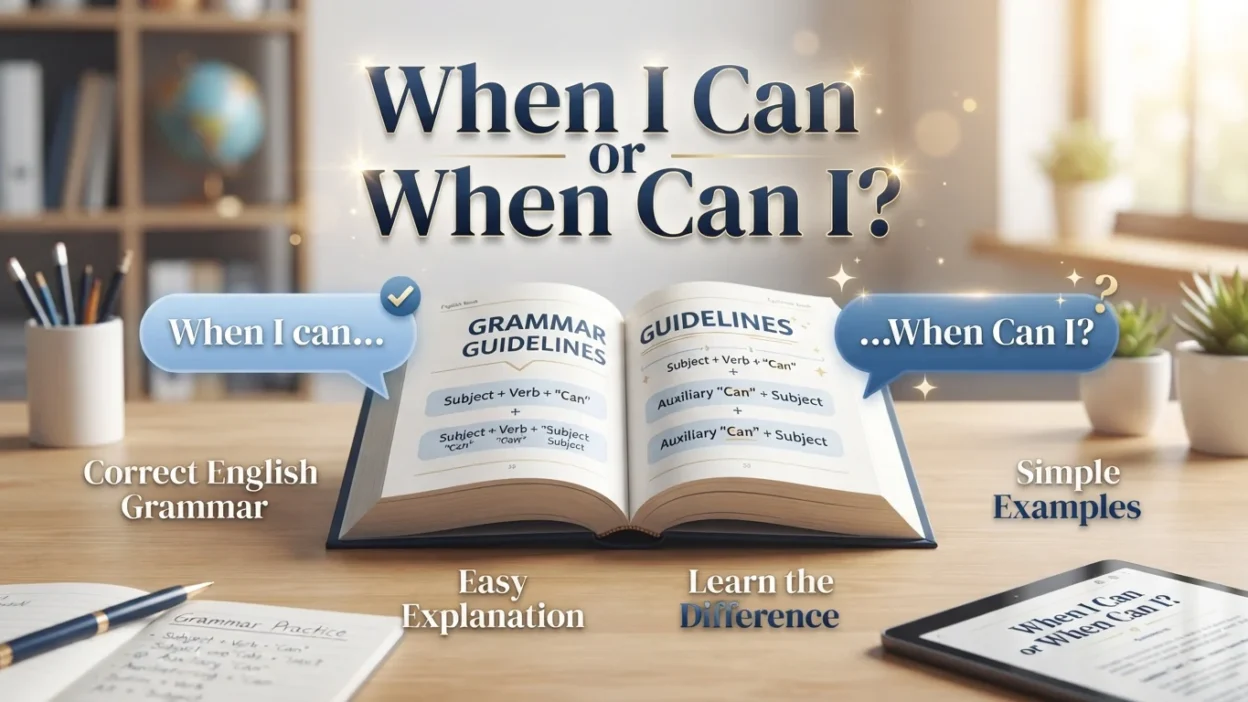
“When can I” is correct when asking a direct question: “When can I leave?” “When I can” is correct inside a statement or dependent clause: “I’ll leave when I can.” The correct choice depends on whether you are asking a question or making a statement.
Why Do People Confuse “When I Can” and “When Can I”?
The confusion happens because the same words appear in both expressions, but their word order changes according to sentence structure.
In a direct question, English commonly uses question word + auxiliary/modal verb + subject:
When + can + I + leave?
In a statement or dependent clause, normal subject-verb order is used:
when + I + can
This difference is especially important for English learners because many languages use different word-order patterns for questions.
What Does “When I Can” Mean?
“When I can” means “when it is possible for me to do something” or “at a time when I am able to do something.”
It is usually part of a longer sentence.
Examples
- I will help you when I can.
- She visits us when she can.
- I study English when I can.
- Please call me when you can.
- I’ll finish the work when I can.
Notice that “when I can” does not normally stand alone as a direct question.
What Does “When Can I” Mean?
“When can I” is used to ask a direct question about when something is possible, permitted, or appropriate.
Examples
- When can I call you?
- When can I visit?
- When can I start?
- When can I apply?
- When can I leave?
The structure is:
When + can + subject + base verb?
For example:
When + can + I + start?
“When I Can” vs. “When Can I”: Comparison Table
| Expression | Function | Meaning | Example |
|---|---|---|---|
| When I can | Statement/dependent clause | When it is possible for me | I’ll come when I can. |
| When can I | Direct question | Asking when something is possible | When can I come? |
| When I can help | Clause | At a time when I am able to help | I’ll help when I can. |
| When can I help? | Question | Asking for an opportunity to help | When can I help? |
When Should You Use “When I Can”?
Use “when I can” when you are making a statement rather than asking a direct question.
1. Talking about availability
I’ll call you when I can.
2. Talking about ability
I help my parents when I can.
3. Talking about an uncertain future time
I’ll visit you when I can.
4. Saying that you will do something as soon as possible
I’ll reply when I can.
Here, “when I can” often means that you do not know exactly when you will be able to do something.
When Should You Use “When Can I”?
Use “when can I” when you want to ask a direct question.
1. Asking about permission
When can I leave the office?
2. Asking about availability
When can I meet you?
3. Asking about an opportunity
When can I apply for the program?
4. Asking about the right time
When can I call you?
The basic pattern is:
When + can + I + verb?
10+ Examples of “When I Can” and “When Can I”
- When can I speak to the manager?
This is a direct question. - I’ll speak to the manager when I can.
This is a statement. - When can I submit the form?
You are asking about the submission time. - I’ll submit the form when I can.
You are saying you will do it when possible. - When can I visit your office?
This asks about a suitable time. - I’ll visit your office when I can.
This means you will visit when possible. - When can I start the course?
This asks for information. - I’ll start the course when I can.
This describes your intention. - When can I call you?
A direct question about calling. - Call me when you can.
A request telling someone to call when they are available. - When can I get my results?
You are asking when results will be available. - I’ll check the results when I can.
You will check them when you have the opportunity.
Common Mistakes
Mistake 1: Using “When I can?” as a direct question
When I can go?
For a direct question, use:
When can I go?
Mistake 2: Using question word order inside a dependent clause
I’ll call you when can I.
I’ll call you when I can.
The clause is not a direct question, so normal word order is required.
Mistake 3: Confusing “when can I” with “when I can”
Compare:
When can I leave?
I am asking about the time I can leave.
I’ll leave when I can.
I am saying I will leave when it becomes possible.
Mistake 4: Forgetting the main verb
In many direct questions, “When can I?” needs context or an understood verb.
For example:
“When can I?”
can be acceptable when the activity is already understood.
But in many situations, it is clearer to say:
“When can I leave?”
“When can I call?”
“When can I apply?”
A Simple Memory Trick
Remember:
Question → “When can I?”
Statement → “When I can.”
Think of the question as having can before I:
When can I…?
Think of the statement as having I before can:
when I can…
A quick formula can help:
Direct question:
When + can + I + verb?
Statement:
when + I + can + verb
For example:
When can I start?
but:
I’ll start when I can.
American vs. British English
There is no major American-versus-British difference in the basic distinction between “when I can” and “when can I.”
Both American and British English use:
When can I leave?
for a direct question.
Both also use:
I’ll leave when I can.
for a statement.
The difference is primarily about grammar and sentence structure, not nationality or dialect.
Similar Words and Expressions
Several related expressions can also cause confusion.
“When can I?”
Used to ask about a possible or appropriate time.
When can I meet you?
“When I can”
Used in a statement or dependent clause.
I’ll meet you when I can.
“If I can”
Means if it is possible for me.
I’ll help if I can.
“As soon as I can”
Means as soon as I am able to.
I’ll call you as soon as I can.
“Whenever I can”
Means every time or at any time that it is possible.
I exercise whenever I can.
Final Verdict
Both “when I can” and “when can I” are grammatically correct, but they do different jobs.
Use “when can I” for a direct question:
When can I start?
Use “when I can” in a statement or dependent clause:
I’ll start when I can.
The easiest way to remember the difference is to look at the word order: questions use “can I,” while statements use “I can.”
Frequently Asked Questions
Is “when I can” grammatically correct?
Yes. “When I can” is grammatically correct when it functions as part of a statement or dependent clause.
I’ll help you when I can.
Is “when can I” grammatically correct?
Yes. “When can I” is normally used to begin a direct question.
When can I start?
Should I say “when I can” or “when can I”?
It depends on your sentence. Use “when can I” when asking a direct question. Use “when I can” when making a statement or using a dependent clause.
Is “When I can?” correct as a question?
Usually, “When can I?” is the correct direct-question form. However, “When I can” can appear in a longer statement.
I’ll do it when I can.
Is “when can I” formal English?
Yes. “When can I…?” is standard English and can be used in both casual and formal situations.
What is the difference between “when can I go” and “when I can go”?
“When can I go?” is a direct question asking about the time you may or are able to go.
“when I can go” is a clause that normally appears inside a larger sentence:
Tell me when I can go.
Is “when I can” the same as “when I am able to”?
Often, yes. In many contexts, “when I can” means “when I am able to” or “when it is possible for me to do so.”
Remember This
- When can I…? → direct question
- when I can… → statement or dependent clause
- Can I…? → asks about possibility or permission
- When can I…? → asks about the time
- when I can → means when I am able to or when it is possible
Conclusion
The difference between “when I can” and “when can I” is mainly about word order and sentence function. “When can I” is used to ask a direct question, while “when I can” normally appears within a statement or dependent clause.
Once you remember the simple pattern question: “can I”; statement: “I can” this common English confusion becomes much easier. Pay attention to if you are asking a question or describing when something is possible, and choosing the correct expression will feel natural.

John Tyler is a dream researcher and content writer at SleepCout, sharing insightful articles about coded dreams, dream meanings, symbolism, sleep psychology, and practical guidance to help readers understand their dreams.