
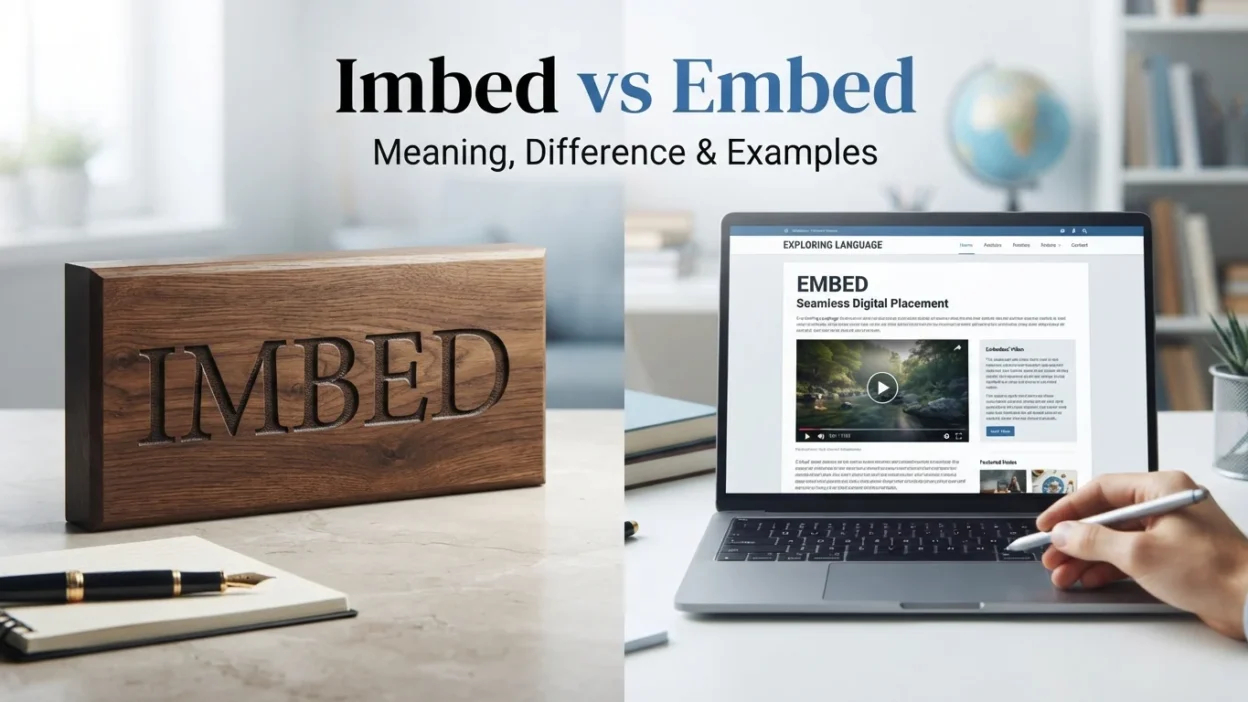
If you are wondering if “imbed” or “embed” is the correct word, the answer is: both are legitimate English words, but “embed” is the standard and much more common choice today. Both words can mean to place something firmly or deeply inside something else. However, modern English strongly favors embed, especially in formal writing, technology, education, and everyday usage.
“Imbed” is not simply a spelling mistake. It is a recognized variant of embed, and dictionaries record it with essentially the same core meaning. Still, if you want the safest and most widely accepted form, use “embed.” This is particularly important when writing about videos, images, links, code, or digital content, where “embed” is the established term.
Quick Answer
Embed is the preferred and more common spelling in modern English. Imbed is a legitimate variant with the same basic meaning: to fix, place, or insert something firmly into something else. For most writing, especially formal, academic, professional, and technical contexts, choose embed.
Why Do People Confuse “Imbed” and “Embed”?
The confusion comes from the fact that imbed is a real English word, not merely a typographical error.
Both forms have been used with the meaning of putting something deeply or firmly into another thing. Because the meanings overlap almost completely, writers may wonder whether one spelling is incorrect.
The word embed has become much more common in contemporary English. It is especially familiar because of technology.
For example:
- Embed a YouTube video.
- Embed an image in a webpage.
- Embed a link in the article.
- Embed code into a website.
The form imbed can still be found, particularly in older or specialized writing, but it is much less common.
What Does “Embed” Mean?
Embed means to place something firmly, deeply, or securely inside another thing.
It can describe a physical object:
The stone was embedded in the wall.
It can also describe an idea, feeling, or influence:
The experience was deeply embedded in her memory.
In modern technology, embed commonly means to insert digital content into another webpage, document, or application so that it appears or functions there.
The developer embedded a video on the website.
“Embed” as a Verb
The most common use is as a verb:
- embed a video
- embed an image
- embed a link
- embed a file
- embed information
- embed an object
Its common forms are:
- Present: embed
- Third-person singular: embeds
- Past: embedded
- Present participle: embedding
Examples:
We need to embed the video on the page.
She embedded the image in the document.
The teacher is embedding examples into the lesson.
What Does “Imbed” Mean?
Imbed is a recognized variant of embed.
It means essentially the same thing: to place or fix something deeply or firmly inside something else.
For example:
The nail was imbedded in the wooden board.
The spelling is legitimate, but it is considerably less common in modern usage.
You may encounter imbed in older texts, dictionaries, technical writing, or writing influenced by historical usage. Nevertheless, most contemporary readers are more accustomed to embed.
Is “Imbed” Wrong?
No. Imbed is not inherently wrong.
It is a valid spelling, but embed is the usual modern choice.
If you are writing an essay, website article, business document, instruction manual, or technical explanation, embed is generally the better choice because it is more familiar to readers.
Imbed vs Embed: Comparison Table
| Feature | Embed | Imbed |
|---|---|---|
| Meaning | Place something firmly inside something else | Place something firmly inside something else |
| Correct? | Yes | Yes |
| Modern usage | Very common | Less common |
| Technical usage | Standard | Rare |
| Digital content | Standard | Unusual |
| Formal writing | Preferred | Acceptable but uncommon |
| Past tense | Embedded | Imbedded |
| Best general choice | Yes | Usually no |
When Should You Use “Embed”?
Use embed when you want the standard modern form.
1. For Websites
We embedded the video on our homepage.
2. For Images
The article allows users to embed images.
3. For Links
You can embed the link directly into the text.
4. For Code
Copy this code and embed it into your webpage.
5. For Physical Objects
The jewel was embedded in the crown.
6. For Ideas or Beliefs
These values are deeply embedded in the culture.
In all these situations, embed sounds natural to modern English speakers.
When Can You Use “Imbed”?
You can use imbed when you deliberately choose the less common variant.
For example:
The fragments were imbedded in the surface.
The sentence is grammatically understandable and the spelling is recognized.
However, there is usually little practical reason to choose imbed when embed is available and widely understood.
For modern readers, especially in international English, embed is normally the clearer choice.
10+ Examples of “Embed” and “Imbed”
Examples with “Embed”
- Please embed the video in the article.
- The designer embedded an image into the webpage.
- The teacher embedded real-life examples into the lesson.
- The software allows users to embed charts in reports.
- The journalist embedded a social media post in the story.
- The memory became deeply embedded in his mind.
- The roots were embedded in the soil.
- You can embed the map on your website.
- The company embedded the payment system into its app.
- The photographer embedded metadata in the image file.
Examples with “Imbed”
- The small piece of glass was imbedded in the wood.
- The stone became imbedded in the ground.
- The scientist examined particles imbedded in the material.
These examples show that imbed can be grammatically correct, but embed is much more natural for most modern contexts.
Common Mistakes
Mistake 1: Thinking “Imbed” Is Always Incorrect
It is not.
Imbed is a legitimate variant of embed.
Mistake 2: Assuming the Two Words Have Different Meanings
In ordinary usage, they have essentially the same core meaning.
The main difference is frequency and modern preference, not meaning.
Mistake 3: Using “Imbed” for Digital Content
You may technically understand a sentence such as:
Imbed the video into the webpage.
But modern technical English overwhelmingly favors:
Embed the video into the webpage.
Mistake 4: Forgetting the Double “d” in the Past Tense
The past form is:
embedded
Not:
embeded
Likewise, the less common form is:
imbedded
Not:
imbeded
Mistake 5: Confusing “Embed” With “Insert”
The words are related but not always interchangeable.
Insert generally means to put something into something else.
Embed often suggests that something becomes firmly or deeply incorporated into its surroundings.
Compare:
Insert the USB drive into the computer.
Embed the video into the webpage.
Memory Trick
A simple way to remember the preferred spelling is:
E = Embed Everywhere
Think of embed as the modern default, especially for websites and digital content.
If you are unsure whether to write imbed or embed, choose:
EMBED
This will almost always be the more familiar choice for contemporary readers.
American vs British English
Both American English and British English recognize embed.
The spelling imbed can also occur, but it is much less common than embed.
There is therefore no major American-versus-British distinction that requires you to choose one spelling over the other.
For international communication, embed is the safest and most recognizable form.
Similar Words
Several words are related to embed, but their meanings are not exactly identical.
Insert
To put something into something else.
Insert the card into the machine.
Incorporate
To include something as part of a larger whole.
The designer incorporated several new features.
Implant
To place something inside a body or another structure, often deliberately and firmly.
The surgeon implanted the device.
Integrate
To combine something with another system or group so that they work together.
The company integrated the new software.
Inlay
To place a material into a surface as decoration.
The table has an inlaid wooden pattern.
Imbed
A less common variant spelling of embed.
Final Verdict
Embed is the preferred spelling in modern English.
Imbed is also a valid word, but it is much less common. The two forms generally have the same meaning, so the choice is primarily about modern usage and familiarity rather than a difference in definition.
For websites, technology, academic writing, professional communication, and everyday modern English, embed is the form you should normally use.
Frequently Asked Questions
Is “imbed” a correct word?
Yes. Imbed is a recognized variant of embed. It is grammatically valid, although it is much less common in modern English.
Is “embed” or “imbed” more common?
Embed is much more common. It is the standard choice in contemporary general and technical English.
Does “imbed” mean the same as “embed”?
Yes. In ordinary usage, both words mean to place or fix something firmly or deeply inside another thing.
Should I use “embed” in formal writing?
Yes. Embed is generally the better choice for formal, academic, professional, and technical writing because it is more widely recognized.
Is “embedded” the correct past tense?
Yes. The past tense and past participle of embed are embedded.
The video was embedded in the webpage.
Is “imbedded” also correct?
Yes. Imbedded is the corresponding past form of imbed, although this spelling is much less common than embedded.
Is “embed” used for websites?
Yes. Embed is the standard term for placing videos, images, maps, posts, code, or other digital content directly into a webpage or application.
Remember This
- Embed = the standard, modern, and widely used form.
- Imbed = a legitimate but uncommon variant.
- Both generally mean to place something firmly or deeply inside something else.
- Use embed for websites, videos, images, code, and most modern writing.
- The past form is embedded.
- If you are unsure, choose embed.
Conclusion
The choice between imbed vs embed is mostly a matter of modern usage rather than meaning. Both words can describe placing something firmly or deeply within another thing, and imbed is not simply a spelling error. However, embed is far more common and is the established form in contemporary English.
For everyday, academic, professional, and especially technical writing, embed is the safest choice. Whether you are talking about a video on a webpage, an object inside a material, or an idea deeply rooted in a culture, embed will usually be the natural word for modern readers.

John Tyler is a dream researcher and content writer at SleepCout, sharing insightful articles about coded dreams, dream meanings, symbolism, sleep psychology, and practical guidance to help readers understand their dreams.