Introduction
A possessive noun is a noun that shows ownership, possession, or a relationship between people, animals, places, and things. For example, in the phrase “Sarah’s book,” the word Sarah’s tells us that the book belongs to Sarah. Possessive nouns help us express ideas clearly without using longer sentences. Instead of saying “the book that belongs to Sarah,” we can simply say “Sarah’s book.”
Learning possessive nouns is an important part of English grammar for students, ESL learners, writers, and anyone who wants to improve their writing. However, possessive nouns can sometimes be confusing because their forms change depending on if the noun is singular, plural, or irregular. Apostrophes also play an important role in showing possession. Understanding the basic rules will help you use possessive nouns correctly in everyday conversations, school assignments, emails, and professional writing.
Quick Answer: What Is a Possessive Noun?
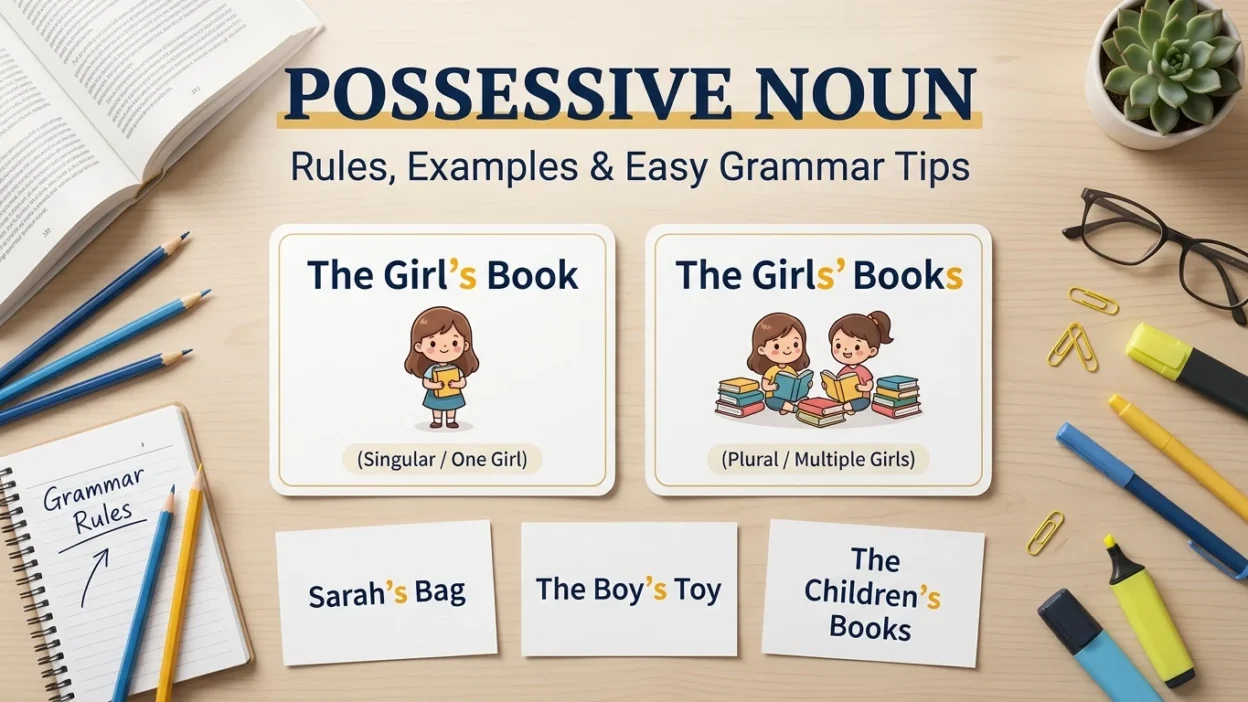
A possessive noun is a noun that shows ownership, possession, or a relationship. It is usually formed by adding an apostrophe and s to a singular noun, as in “the girl’s bag.” For plural nouns ending in s, add only an apostrophe, as in “the girls’ bags.”
Why Do People Confuse Possessive Nouns?
People often confuse possessive nouns because English uses apostrophes in different ways. The rules depend on if a noun is singular, plural, or irregular.
For example:
- The boy’s shoes: The shoes belong to one boy.
- The boys’ shoes: The shoes belong to multiple boys.
- The boys are playing: The word boys is plural, but it does not show possession.
Another common source of confusion is the difference between possessive nouns and possessive pronouns. For instance, “Maria’s pencil” contains a possessive noun, while “her pencil” uses a possessive determiner.
Understanding these differences makes it easier to recognize and form possessive nouns correctly.
What Is a Possessive Noun?
A possessive noun is a noun that indicates that something belongs to someone or something, or that a particular relationship exists.
Possession does not always mean physical ownership. It can also describe relationships, characteristics, time, or associations.
Examples:
- The teacher’s desk — The desk is associated with the teacher.
- The dog’s tail — The tail belongs to the dog.
- The company’s policy — The policy belongs to or is established by the company.
- A day’s work — Work completed or expected during a day.
- My brother’s friend — A friend associated with my brother.
In each example, the possessive noun gives additional information about another noun.
How Do You Form a Possessive Noun?
The most common way to form a possessive noun is to add an apostrophe and s to a singular noun.
Examples:
- Girl → girl’s
- Teacher → teacher’s
- Cat → cat’s
- James → James’s (a common style)
- Child → child’s
For regular plural nouns that already end in s, add an apostrophe after the s.
Examples:
- Girls → girls’
- Teachers → teachers’
- Cats → cats’
Irregular plural nouns that do not end in s generally take ’s.
Examples:
- Children → children’s
- Men → men’s
- Women → women’s
What Is the Second Type: Plural Possessive Nouns?
Plural possessive nouns show ownership or relationships involving more than one person, animal, place, or thing.
The formation depends on how the plural noun ends.
Plural nouns ending in s
Add an apostrophe after the final s.
Examples:
- The students’ classroom
- The players’ uniforms
- The teachers’ meeting
- The birds’ nests
- The parents’ decision
Irregular plural nouns
Add an apostrophe and s because these plural nouns do not end in s.
Examples:
- The children’s toys
- The men’s jackets
- The women’s team
- The people’s choice
- The mice’s hiding places
Remember that the apostrophe indicates possession, not simply plurality.
Possessive Noun Comparison Table
| Noun type | Formation | Example |
|---|---|---|
| Singular noun | Add ’s | The girl’s dress |
| Singular noun ending in s | Usually add ’s | James’s bicycle |
| Regular plural noun ending in s | Add ’ | The girls’ room |
| Irregular plural noun | Add ’s | The children’s books |
| Joint possession | Usually add ’s to the final name | Jack and Emma’s house |
| Separate possession | Add ’s to each name | Jack’s and Emma’s bicycles |
When Should You Use Possessive Nouns?
Use possessive nouns whenever you want to show ownership, association, or a relationship clearly.
1. To show ownership
Use possessive nouns when something belongs to a person or animal.
- This is Daniel’s phone.
- The cat’s bowl is empty.
- I borrowed my sister’s jacket.
2. To describe relationships
Possessive nouns can show relationships between people.
- Ali’s mother is a doctor.
- Sarah’s cousin lives nearby.
- The children’s teacher is helpful.
3. To show an association with a place or organization
Use possessive nouns to describe things connected with businesses, schools, and other organizations.
- The school’s library is open.
- The company’s website looks professional.
- The city’s transportation system needs improvement.
4. To express time or duration
Possessive forms can be used with time expressions.
- We took a week’s vacation.
- I need two days’ rest.
- She completed a year’s training.
15 Possessive Noun Examples in Sentences
Here are practical examples that show how possessive nouns work in everyday English.
- The boy’s bicycle is outside the house.
- I found my mother’s keys on the table.
- The teacher’s explanation helped the students.
- The dog’s collar is red.
- We visited Sarah’s house yesterday.
- The students’ projects were impressive.
- The players’ uniforms are ready.
- The children’s playground is near the school.
- My brother’s room is always clean.
- The company’s manager announced the news.
- The women’s team won the competition.
- The birds’ feathers looked beautiful.
- I read James’s letter this morning.
- We enjoyed a day’s trip to the countryside.
- The baby’s blanket is soft and warm.
Notice that the apostrophe placement changes according to the noun’s form.
Common Possessive Noun Mistakes
Even experienced English learners sometimes make mistakes with possessive nouns. Here are the most common ones to avoid.
Mistake 1: Using an apostrophe to form an ordinary plural
Incorrect: The apple’s are fresh.
Correct: The apples are fresh.
Why? The word apples is simply plural. It does not show ownership.
Mistake 2: Forgetting the apostrophe
Incorrect: The girls bags are here.
Correct: The girls’ bags are here.
Why? The apostrophe shows that the bags belong to the girls.
Mistake 3: Confusing singular and plural possession
- The student’s books: Books belonging to one student.
- The students’ books: Books belonging to multiple students.
The placement of the apostrophe changes the meaning.
Mistake 4: Confusing possessive nouns with possessive pronouns
Incorrect: This is her’s bag.
Correct: This is her bag.
Correct: This bag is hers.
Why? The word her is used before a noun, while hers stands alone. Neither requires an apostrophe.
Mistake 5: Writing its as it’s
- The dog wagged its tail. Here, its shows possession.
- It’s raining outside. Here, it’s means it is.
The apostrophe in it’s represents a contraction, not possession.
What Is an Easy Memory Trick for Possessive Nouns?
Use this simple rule to remember apostrophe placement:
One owner = usually ’s. Multiple owners ending in s = usually s’.
Examples:
- One teacher: the teacher’s book.
- Two teachers: the teachers’ books.
- Several children: the children’s books.
Remember that the noun’s form matters more than the number of objects owned. One teacher can own several books, and several teachers can share one classroom.
A helpful question to ask yourself is: Who owns or is associated with the thing? Once you identify the owner, choose the correct possessive form.
American vs. British English: Are Possessive Nouns Different?
Possessive noun rules are largely the same in American and British English. Both varieties use apostrophes to show possession.
Examples accepted in both varieties include:
- The student’s notebook
- The students’ notebooks
- The children’s books
- My friend’s house
One difference you may encounter involves names ending in s. Some style guides prefer James’s, while others allow or prefer James’. Both forms are used, but preferences vary by publication and style guide.
For schoolwork and formal writing, follow the spelling and punctuation rules recommended by your teacher, editor, or chosen style guide.
Possessive Nouns vs. Similar Grammar Terms
Possessive nouns are closely related to several other grammar concepts, but they do not all serve the same purpose.
| Term | Meaning | Example |
|---|---|---|
| Possessive noun | A noun showing possession or association | Maria’s bag |
| Possessive pronoun | A pronoun indicating possession that stands alone | The bag is hers |
| Possessive determiner | A word placed before a noun to indicate possession | Her bag |
| Plural noun | A noun referring to more than one | Girls |
| Contraction | A shortened form of two words | It’s = it is |
| Common noun | A general name for a person, place, or thing | Teacher |
Possessive Noun vs. Possessive Pronoun
A possessive noun names the owner, while a possessive pronoun replaces a noun phrase or indicates possession independently.
- Possessive noun: David’s laptop is new.
- Possessive pronoun: The laptop is his.
Possessive Noun vs. Plural Noun
A plural noun indicates more than one person, place, or thing. A possessive noun indicates possession or association.
- Plural: The dogs are barking.
- Possessive: The dog’s bed is comfortable.
- Plural possessive: The dogs’ beds are comfortable.
Possessive Noun vs. Possessive Determiner
A possessive noun can name an owner, whereas a possessive determiner such as my, your, his, her, its, our, or their appears before a noun.
- Possessive noun: Emma’s notebook
- Possessive determiner: Her notebook
Both forms can communicate ownership, but their grammatical structures differ.
Frequently Asked Questions About Possessive Nouns
1. What is a possessive noun in simple words?
A possessive noun is a noun that shows who owns something or what something is associated with. For example, in “Tom’s bicycle,” the word Tom’s indicates that the bicycle belongs to Tom.
2. What are five examples of possessive nouns?
Five examples are:
- The girl’s dress
- The dog’s food
- My father’s car
- The students’ classroom
- The children’s toys
Each example shows possession or a relationship.
3. How do you make a noun possessive?
For most singular nouns, add ’s. For regular plural nouns ending in s, add an apostrophe after the final s. For irregular plurals such as children and women, add ’s.
4. What is the difference between a singular and plural possessive noun?
A singular possessive noun indicates possession by one owner, as in “the boy’s hat.” A plural possessive noun indicates possession by multiple owners, as in “the boys’ hats.”
5. Is children’s a possessive noun?
Yes. Children’s is the possessive form of the irregular plural noun children. For example, “The children’s books are on the shelf” shows that the books belong to or are associated with the children.
6. Do possessive nouns always show ownership?
No. They can also show relationships, associations, characteristics, or measurements of time. For example, “my sister’s friend” describes a relationship, while “a day’s work” refers to work associated with a day.
7. What is the difference between its and it’s?
Its is a possessive determiner that shows possession, as in “The bird spread its wings.” It’s is a contraction of it is or it has, as in “It’s cold today.”
8. Can a proper noun be possessive?
Yes. Proper nouns can become possessive by adding an apostrophe and usually s. For example, “Sarah’s notebook” and “London’s museums” both use possessive proper nouns.
Remember This
- A possessive noun shows ownership, association, or a relationship.
- Most singular nouns take ’s.
- Regular plural nouns ending in s take an apostrophe after the final s.
- Irregular plural nouns usually take ’s.
- Possessive nouns are different from ordinary plurals and possessive pronouns.
- Its shows possession, while it’s means it is or it has.
Conclusion
Possessive nouns are an essential part of English grammar because they help us explain ownership, relationships, and associations clearly. By learning how to use apostrophes with singular nouns, regular plural nouns, and irregular plural nouns, you can make your sentences more accurate and easier to understand. Examples such as “the girl’s bag,” “the girls’ bags,” and “the children’s toys” demonstrate how small punctuation changes can affect meaning.
The best way to master possessive nouns is to practice identifying the owner and choosing the correct form. Pay attention to apostrophe placement, distinguish possession from ordinary plural forms, and remember the difference between possessive nouns and possessive pronouns. With regular practice, you will find it easier to use possessive nouns confidently in conversations, school assignments, and professional writing.

Adam Cody is a passionate writer at SleepCout, exploring coded dreams, dream meanings, sleep science, lucid dreaming, and symbolism through engaging, well-researched articles that inspire curiosity and self-discovery.