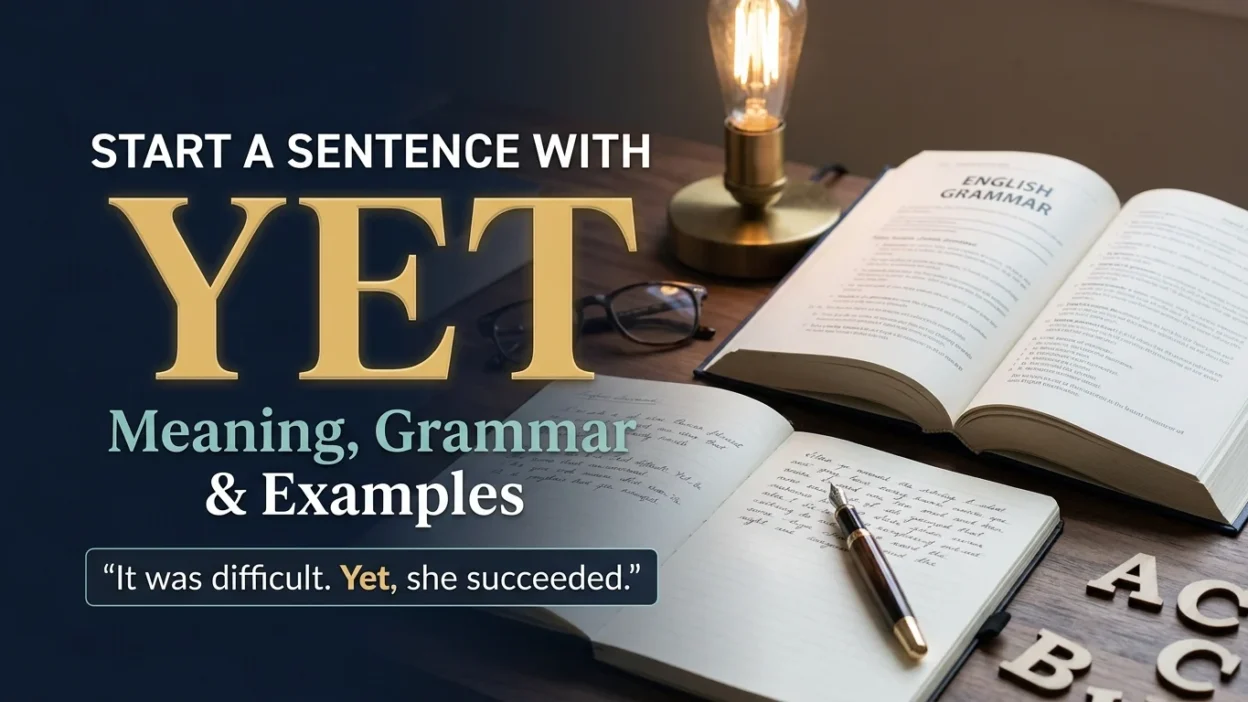
Starting a sentence with “yet” is grammatically correct and often makes your writing clearer, stronger, and more natural. The word yet can introduce a contrast, show an unexpected result, or emphasize that something is true despite what came before. For example: “The task was difficult. Yet, she completed it on time.” Here, yet connects two contrasting ideas.
Many students and English learners wonder if they can begin a sentence with yet or if it should only appear in the middle of a sentence. The good news is that you can use it at the beginning, especially when you want to highlight a difference between two ideas. The key is understanding its meaning and using the correct punctuation. In this guide, you will learn how to start a sentence with yet, explore practical examples, avoid common mistakes, and understand how it differs from similar words such as but, however, and although.
Quick Answer: Can You Start a Sentence With Yet?
Yes, you can start a sentence with yet. When used as a conjunctive adverb or a contrasting conjunction, it introduces an idea that contrasts with the previous statement. For example: “He was tired. Yet, he continued working.” Starting a sentence with yet is common in both formal and informal English.
Why Do People Confuse Starting a Sentence With Yet?
People sometimes believe that a sentence cannot begin with yet because they learn that it means the same as but. Others confuse its contrasting meaning with its use to describe something that has not happened up to the present time.
In reality, yet has several meanings depending on the context:
- Contrast: Yet, she refused to give up.
- Time: The bus has not arrived yet.
- Emphasis: It was a small yet powerful change.
When yet begins a sentence, it most often introduces a contrasting idea. Understanding this function helps you use it naturally and correctly.
What Does “Yet” Mean at the Beginning of a Sentence?
At the beginning of a sentence, yet usually means nevertheless, even so, or despite that. It tells readers that the next statement contrasts with something previously mentioned.
For example:
- The weather was cold. Yet, the children played outside.
- She had little experience. Yet, she performed exceptionally well.
- The road was dangerous. Yet, they continued their journey.
In each example, the second sentence presents an outcome that might seem surprising given the first statement.
Is “Yet” a Conjunction or a Conjunctive Adverb?
Yet can function as a coordinating conjunction or as an adverb, depending on how it is used.
As a coordinating conjunction, it connects contrasting ideas within a sentence:
– He was tired, yet he continued working.
At the beginning of a separate sentence, it commonly works as a transitional adverb expressing contrast:
– He was tired. Yet, he continued working.
Both constructions are acceptable. The punctuation depends on the sentence structure.
What Is the Difference Between “Yet” and “But”?
Yet and but can both express contrast, but yet sometimes places greater emphasis on an unexpected result.
- But: She was nervous, but she gave the presentation.
- Yet: She was nervous. Yet, she gave an excellent presentation.
The first example simply connects two contrasting ideas. The second gives the contrast a stronger sense of surprise.
Neither word is automatically more formal in every situation. The best choice depends on your intended meaning and writing style.
Comparison Table: Starting a Sentence With Yet vs. Similar Words
| Word | Main meaning | Example |
|---|---|---|
| Yet | Contrast or unexpected result | Yet, he remained hopeful. |
| But | Direct contrast | But, we had no other choice. |
| However | Contrast or qualification | However, the results were different. |
| Nevertheless | Despite the previous situation | Nevertheless, she continued. |
| Still | Despite something | Still, he refused to quit. |
| Although | Introduces a dependent clause | Although it was raining, we went out. |
Writing tip: Yet is useful when you want a concise transition that highlights an unexpected result. However and nevertheless can work well when you want a more formal tone.
When Should You Start a Sentence With Yet?
Use yet at the beginning of a sentence when the next idea contrasts with the previous one.
1. To Show an Unexpected Result
Use yet when something happens despite the circumstances.
Example: The team had very little time to prepare. Yet, they won the competition.
2. To Express Contrast
Use it when two statements seem different or contradictory.
Example: He is young. Yet, he has considerable professional experience.
3. To Emphasize Determination
Use yet to show that a person continues despite difficulties.
Example: She faced many challenges. Yet, she never abandoned her dream.
4. To Improve Essays and Formal Writing
Use yet to connect related ideas without repeating but in every paragraph.
Example: The proposal offers several advantages. Yet, its long-term costs remain uncertain.
5. To Create a Stronger Literary Effect
Writers sometimes use yet to create a pause before revealing an unexpected idea.
Example: The room was silent. Yet, something about it felt alive.
15 Examples of Sentences Starting With Yet
Here are 15 practical examples showing how to begin a sentence with yet.
- The exam was difficult. Yet, Maria answered every question.
- He had very little money. Yet, he remained generous.
- The weather looked terrible. Yet, we decided to go hiking.
- She was afraid of failure. Yet, she took the risk.
- The instructions were confusing. Yet, the students completed the task.
- The company faced serious problems. Yet, it continued to grow.
- He trained for months. Yet, he did not win the race.
- The book was short. Yet, it contained valuable lessons.
- They disagreed about many things. Yet, they remained good friends.
- The restaurant was small. Yet, it attracted many customers.
- The project seemed impossible. Yet, the team finished it ahead of schedule.
- She had every reason to complain. Yet, she stayed positive.
- The village was remote. Yet, it welcomed visitors from around the world.
- The evidence appeared convincing. Yet, further investigation revealed problems.
- He knew the journey would be difficult. Yet, he chose to continue.
These examples show that yet can introduce sentences in everyday conversation, academic writing, storytelling, and professional communication.
Common Mistakes When Starting a Sentence With Yet
Although beginning a sentence with yet is correct, writers sometimes misuse it.
Mistake 1: Thinking “Yet” Cannot Start a Sentence
Incorrect rule: Never start a sentence with yet.
Correction: Starting a sentence with yet is grammatically acceptable when it introduces a contrasting idea.
Example: The plan was risky. Yet, it was worth trying.
Mistake 2: Using “Yet” Without a Clear Contrast
Weak example: The sun was shining. Yet, the birds were singing.
This is not necessarily ungrammatical, but the contrast is unclear because sunshine and birds singing are compatible.
Better example: The sun was shining. Yet, the temperature remained below freezing.
Mistake 3: Confusing “Yet” With “Not Yet”
Yet can also mean that something has not happened up to the present.
Example: She has not finished her homework yet.
This is different from the contrasting use:
Example: She was exhausted. Yet, she finished her homework.
Mistake 4: Using Incorrect Punctuation
When yet connects two independent clauses as a coordinating conjunction, a comma generally comes before it.
Correct: He was tired, yet he continued working.
When it begins a new sentence as a transition, the following comma is often appropriate, especially when the contrast is emphasized.
Correct: He was tired. Yet, he continued working.
The comma after introductory yet is not always mandatory. In a short, smoothly flowing sentence, writers may omit it:
Example: Yet he continued working.
Mistake 5: Repeating “Yet” Too Often
Using yet at the start of every sentence can make your writing repetitive.
Instead, vary your transitions with words such as however, still, nevertheless, or even so when they fit the meaning.
Memory Trick: How to Remember the Use of Yet
Remember this simple rule:
Yet = something unexpected despite what came before.
For example:
- He was tired. Yet, he kept running.
- She was inexperienced. Yet, she succeeded.
- The task was difficult. Yet, they completed it.
Think of yet as a signal that says, “Despite that, here is what happened.”
This trick helps you recognize when yet is an appropriate opening word.
American vs. British English: Is Starting With Yet Different?
There is no major grammatical difference between American and British English when starting a sentence with yet. Both varieties allow this construction.
| Feature | American English | British English |
|---|---|---|
| Starting with yet | Correct | Correct |
| Showing contrast | Common | Common |
| Using yet within a sentence | Correct | Correct |
| Using yet to mean “up to now” | Common | Common |
| Punctuation | Depends on sentence structure and style | Depends on sentence structure and style |
Examples:
- American English: The store was crowded. Yet, we found everything we needed.
- British English: The shop was crowded. Yet, we found everything we needed.
The main difference here is store versus shop, not the use of yet.
Similar Words and Expressions
Several words and expressions can replace yet when introducing a contrasting idea, although their meanings and grammatical patterns are not always identical.
Yet vs. However
Both express contrast.
- Yet, she continued despite the obstacles.
- However, she continued despite the obstacles.
However often sounds more formal, while yet can create a sharper contrast.
Yet vs. Nevertheless
Both can mean despite that.
- The evidence was weak. Yet, the jury considered it.
- The evidence was weak. Nevertheless, the jury considered it.
Nevertheless often emphasizes that an outcome occurred despite a significant obstacle.
Yet vs. Still
Both can introduce an unexpected or continuing situation.
- He knew the risks. Yet, he accepted the challenge.
- He knew the risks. Still, he accepted the challenge.
The best choice depends on tone and context.
Yet vs. Although
These words express contrast but follow different grammatical patterns.
- Yet, he continued working.
- Although he was tired, he continued working.
Although introduces a dependent clause, so it usually needs a main clause to complete the sentence.
Yet vs. Even So
Both can show that something happens despite a previous fact.
- The journey was expensive. Yet, they decided to go.
- The journey was expensive. Even so, they decided to go.
Even so is a natural alternative in both conversation and writing.
Frequently Asked Questions
1. Is it grammatically correct to start a sentence with yet?
Yes. You can start a sentence with yet when it introduces a contrasting idea. For example: “The road was long. Yet, they continued walking.”
2. Should you put a comma after yet at the beginning of a sentence?
A comma is often used after introductory yet when it functions as a transitional adverb. However, it is not always necessary, especially in short, smoothly flowing sentences. For example, “Yet he continued” is also correct.
3. Can I start an academic essay sentence with yet?
Yes. Starting a sentence with yet is acceptable in academic writing when it clearly connects contrasting ideas. Use it thoughtfully and avoid repeating it too often.
4. What is another word for yet at the beginning of a sentence?
Depending on the context, you can use however, nevertheless, still, or even so. Choose the alternative that best matches your intended meaning.
5. What is the difference between yet and but at the beginning of a sentence?
Both can introduce contrast. Yet often emphasizes an unexpected result, while but is a more direct way to connect contrasting ideas. Both can be appropriate depending on the context.
6. Can you start a paragraph with yet?
Yes. You can begin a paragraph with yet when the paragraph contrasts with or qualifies the preceding discussion. The connection should be clear to the reader.
7. Does yet mean the same as however?
Not always. When expressing contrast, yet and however can have similar meanings. However, yet can also mean “up to now,” as in “I have not finished yet.”
8. Is starting a sentence with yet formal or informal?
It is acceptable in both formal and informal writing. In formal writing, use it when the contrast is meaningful and the transition helps readers follow your argument.
Remember This
- Starting a sentence with yet is grammatically correct.
- It commonly introduces contrast or an unexpected result.
- A comma after introductory yet is optional in many contexts.
- Use yet to connect ideas logically, not simply to decorate a sentence.
- Do not confuse contrasting yet with temporal yet, as in “not yet.”
- Alternatives include however, nevertheless, still, and even so.
Conclusion
Starting a sentence with yet is a simple and effective way to express contrast in English. It helps readers understand when an outcome differs from what they might expect. if you are writing an essay, telling a story, or communicating professionally, yet can make your sentences more engaging and your ideas easier to follow. The most important thing is to use it where a genuine contrast exists.
As you improve your English, practise using yet alongside similar transition words such as but, however, and nevertheless. Pay attention to sentence structure and punctuation, and choose the word that best expresses your intended meaning. With practice, you will learn to start sentences with yet naturally and confidently in both everyday communication and formal writing.

Adam Cody is a passionate writer at SleepCout, exploring coded dreams, dream meanings, sleep science, lucid dreaming, and symbolism through engaging, well-researched articles that inspire curiosity and self-discovery.