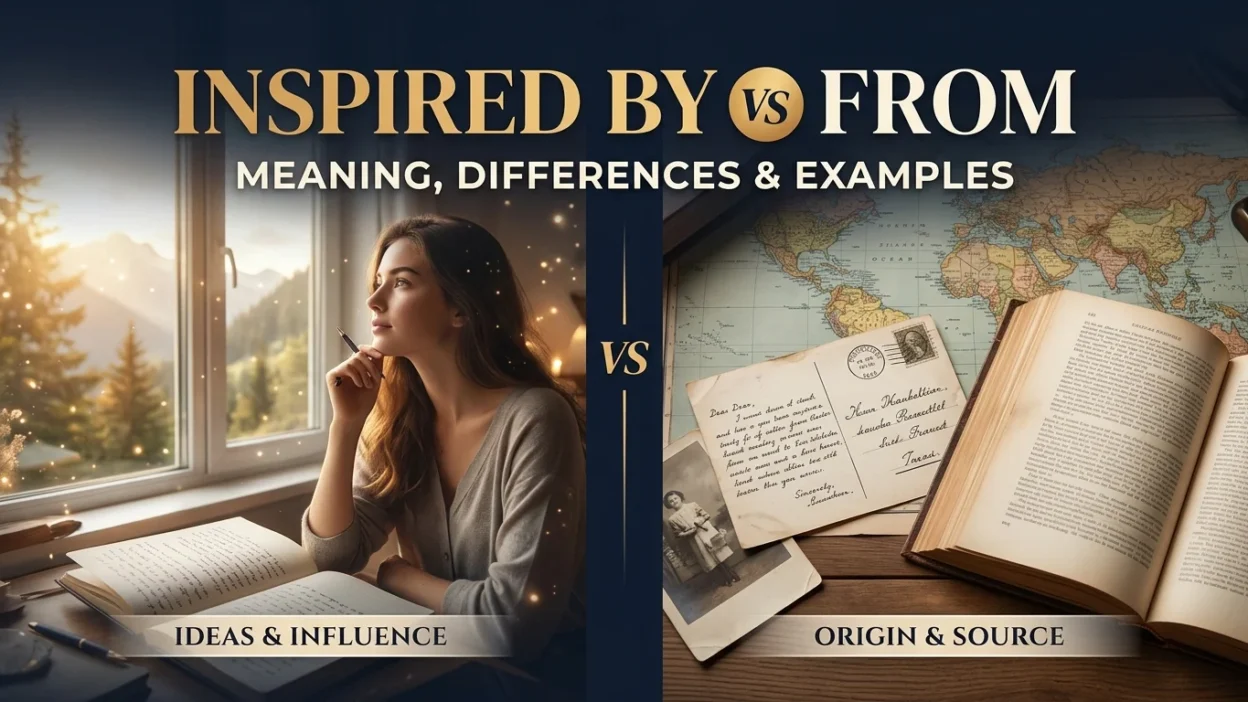
The phrases “inspired by” and “from” are both used to explain where an idea, creation, feeling, or thing originates. However, they do not mean exactly the same thing. Understanding the difference helps you write more clearly, choose the right expression, and avoid common English mistakes.
“Inspired by” usually describes something that influenced a person’s creativity, ideas, or actions. For example, “The artist was inspired by nature” means nature gave the artist ideas or motivation. In contrast, “from” is a broader word that identifies an origin, source, starting point, or cause. For example, “The painting is from Italy” identifies where the painting came from.
Although these expressions sometimes overlap, they serve different purposes in everyday English. Learning when to use “inspired by” and when to use “from” will help you describe creative influences, explain the origins of things, and express your ideas naturally.
Quick Answer: Inspired By vs. From
“Inspired by” means influenced by an idea, person, place, experience, or event. “From” identifies a source, origin, or starting point. For example, “The song was inspired by her childhood” describes creative influence, while “The song is from her first album” identifies its source or place in a collection.
Why Do People Confuse “Inspired By” and “From”?
People confuse these expressions because both can connect something to its source.
For example:
- The story was inspired by a real event.
- The story is from a real event.
The first sentence is natural because a real event influenced the story. The second sentence sounds unnatural in this context because “from” does not clearly express creative influence.
However, “from” works perfectly when identifying an actual source:
- The information is from a reliable website.
- The idea was inspired by a reliable website.
The first sentence identifies where the information came from. The second suggests that the website influenced the idea.
The main difference is influence versus origin.
What Does “Inspired By” Mean?
“Inspired by” is a phrase used when something influences a person’s thoughts, creativity, decisions, or actions.
It often appears when discussing art, music, writing, design, personal motivation, and life experiences.
Examples of “Inspired By”
- The movie was inspired by a true story.
- She was inspired by her teacher to become a writer.
- This design was inspired by traditional architecture.
- His new book was inspired by his travels.
In each example, the person, event, or experience provides an influence rather than necessarily being the direct source of the finished product.
When Should You Use “Inspired By”?
Use “inspired by” when you want to explain what influenced something.
Common contexts include:
- Books and stories: The novel was inspired by historical events.
- Art and design: The painting was inspired by the ocean.
- Music: The song was inspired by a personal experience.
- Motivation: I was inspired by her determination.
- Ideas: The project was inspired by an innovative solution.
Remember that something can be inspired by a source without copying it directly.
What Does “From” Mean?
“From” is a preposition that identifies where something originates, where someone begins a journey, or what source provides something. Depending on the context, it can also express separation, cause, or a starting point in time.
Examples of “From”
- This letter is from my friend.
- She comes from Canada.
- I received an email from my manager.
- The train travels from London to Manchester.
- He learned the technique from an experienced artist.
The meaning depends on the surrounding words and the situation.
When Should You Use “From”?
Use “from” when identifying a source, origin, or starting point.
Common contexts include:
- People: A message from my sister.
- Places: She is from Australia.
- Information: I got the news from a newspaper.
- Materials: The table is made from recycled wood.
- Learning: I learned this skill from my grandfather.
- Travel: We traveled from Lahore to Islamabad.
“From” is a general-purpose preposition, so it can express many relationships that “inspired by” cannot.
Inspired By vs. From: Comparison Table
| Feature | Inspired by | From |
|---|---|---|
| Main meaning | Influenced by | Originating from or supplied by |
| Main purpose | Explains inspiration | Identifies a source or origin |
| Common use | Art, ideas, motivation | People, places, information, movement |
| Creative work | The poem was inspired by nature. | The poem is from her latest book. |
| Personal example | I was inspired by my mother. | I received a gift from my mother. |
| Direct source required? | No; influence is enough | Often identifies a source or starting point |
| Can they be interchangeable? | Sometimes, depending on meaning | Sometimes, depending on meaning |
When to Use “Inspired By” vs. “From”
Choosing the correct phrase becomes easier when you consider what you want to communicate.
Use “Inspired By” for Creative Influence
Choose this expression when something gives you an idea or motivates you.
Examples:
- The artist was inspired by mountain landscapes.
- The designer created a collection inspired by flowers.
- Her speech was inspired by her personal struggles.
Use “From” for the Actual Source
Choose this expression when you want to identify where something came from.
Examples:
- This painting is from the nineteenth century.
- The quotation is from a famous novel.
- I received the photograph from my cousin.
Can Both Expressions Be Correct?
Yes. Both expressions can describe the same general connection while communicating different meanings.
Compare these sentences:
- The film was inspired by a historical figure. — The person influenced the film.
- The film is from a historical archive. — The archive is the source of the film.
The correct choice depends on whether you mean influence or origin.
12 Examples of “Inspired By” and “From”
Here are practical examples to help you understand the difference.
Examples in Everyday English
1. Books
- Inspired by: The novel was inspired by the author’s childhood.
- From: The quotation is from the author’s first novel.
2. Music
- Inspired by: The song was inspired by a difficult relationship.
- From: This song is from her newest album.
3. Art
- Inspired by: The painting was inspired by the beauty of nature.
- From: This painting is from a private collection.
4. Fashion
- Inspired by: Her dress was inspired by traditional clothing.
- From: Her dress is from a local designer.
5. Education
- Inspired by: I was inspired by my English teacher.
- From: I received this lesson from my English teacher.
6. Movies
- Inspired by: The movie was inspired by real-life events.
- From: This scene is from an old movie.
More Examples in Different Contexts
7. Business
- Inspired by: The company created a product inspired by customer feedback.
- From: The company received feedback from its customers.
8. Travel
- Inspired by: He wrote a travel guide inspired by his adventures.
- From: He returned from his adventures abroad.
9. Technology
- Inspired by: The new application was inspired by user suggestions.
- From: The data came from a user survey.
10. Personal Growth
- Inspired by: She was inspired by her friend’s courage.
- From: She learned an important lesson from her friend.
11. Home Design
- Inspired by: The room was inspired by Scandinavian interiors.
- From: The furniture came from Sweden.
12. Writing
- Inspired by: My poem was inspired by a beautiful sunset.
- From: This paragraph is from my diary.
These examples show that “inspired by” highlights influence, while “from” generally identifies origin, source, or starting point.
Common Mistakes to Avoid
English learners sometimes use these phrases incorrectly because they assume both simply mean “coming from.”
Mistake 1: Using “From” to Express Inspiration
Incorrect or unnatural: The painting was from the beauty of nature.
Better: The painting was inspired by the beauty of nature.
Use “inspired by” when nature or an experience provides a creative influence.
Mistake 2: Using “Inspired By” for a Direct Source
Unnatural in the intended context: I received a letter inspired by my friend.
Better: I received a letter from my friend.
Use “from” when identifying who sent something.
Mistake 3: Assuming “Inspired By” Means Copied From
Incorrect assumption: If a design is inspired by another design, it must be an exact copy.
Correct understanding: Inspiration can involve adapting an idea, style, mood, or concept without reproducing the original.
Mistake 4: Ignoring Context
The same noun can appear with both expressions, but the meaning changes.
- A film inspired by a novel describes creative influence.
- A film from a studio identifies its production source.
Always consider the relationship you want to describe.
Memory Trick: How to Remember the Difference
Use this simple trick:
- Inspired by = Influence
- From = Source
Ask yourself two questions:
- Did something give someone an idea or motivation? Use “inspired by.”
- Are you identifying where something came from or who provided it? Use “from.”
For example, if a beautiful garden gives you an idea for a painting, your painting is inspired by the garden. If your friend sends you a painting, the painting is from your friend.
This simple distinction works in most everyday situations.
Inspired By vs. From in American and British English
There is no major difference between American and British English in the basic meanings of these expressions.
Both varieties use “inspired by” to describe influence and “from” to identify a source or origin.
Examples in both varieties:
- The book was inspired by a true story.
- The book is from my favorite author.
- She was inspired by her schoolteacher.
- The letter came from her schoolteacher.
Spelling differences between American and British English do not change the meaning of these phrases. Your choice should depend on the intended meaning, not the variety of English you speak.
Similar Words and Expressions
Several other expressions can help you communicate influence or origin more precisely.
| Expression | Meaning | Example |
|---|---|---|
| Based on | Built on an idea, fact, or existing work | The film is based on a novel. |
| Influenced by | Affected by something or someone | Her style was influenced by jazz. |
| Derived from | Developed or obtained from a source | The word is derived from Latin. |
| Adapted from | Changed for a different purpose or format | The play was adapted from a book. |
| Originating from | Having a particular starting point | The tradition originated from an older custom. |
| Taken from | Obtained or copied from a source | The quotation was taken from a speech. |
| Motivated by | Driven to act by a reason or feeling | He was motivated by a desire to help. |
These expressions are related, but they are not always interchangeable.
For example, a movie based on a book usually follows its content more directly than a movie merely inspired by a book. Likewise, something derived from a source has a specific relationship to that source, which may involve development or transformation.
Final Verdict: Inspired By or From?
Use “inspired by” when you want to describe an influence, and use “from” when you want to identify an origin, source, or starting point.
For example, “The artwork was inspired by nature” explains what influenced the artist. “The artwork is from Italy” identifies its origin.
Both expressions are correct English, but they communicate different relationships. Understanding that difference will help you write more naturally and choose the right words in academic writing, everyday conversation, and creative work.
Frequently Asked Questions
1. What is the main difference between “inspired by” and “from”?
“Inspired by” describes something that influences an idea, creation, or action. “From” identifies a source, origin, or starting point. For example, a song can be inspired by a memory but come from a particular album.
2. Is “inspired by” grammatically correct?
Yes. “Inspired by” is a standard English expression. It commonly appears in sentences such as “The book was inspired by real events” and “She was inspired by her teacher.”
3. Can I use “from” instead of “inspired by”?
Sometimes, but not when you need to express creative influence specifically. “The song is from her childhood” and “The song was inspired by her childhood” express different relationships. The second clearly describes the influence of that experience.
4. Does “inspired by” mean the same as “based on”?
No. “Inspired by” usually describes a broad influence, while “based on” suggests that something uses a particular work, fact, or event as its foundation. A story may be inspired by a historical event without closely following it.
5. Is “inspired from” correct English?
“Inspired by” is the standard expression when naming the influence behind a creation. For example, write “The design was inspired by nature,” not “The design was inspired from nature.” You can use “from” in a different construction, such as “She drew inspiration from nature.”
6. Which phrase should I use in an essay?
Use “inspired by” when discussing the influence behind a person’s ideas, research, or creative work. Use “from” when identifying a source, such as a book, website, interview, or document. Choose the expression that accurately describes the relationship.
7. Can a movie be inspired by a true story?
Yes. “Inspired by a true story” means that real events or people influenced the movie. It does not necessarily mean that every scene or detail is historically accurate.
8. What is an easy way to remember the difference?
Remember influence versus source. “Inspired by” tells you what gave someone an idea, while “from” tells you where something originated or who supplied it.
Remember This
- Inspired by: Something influences an idea, creation, or action.
- From: Something identifies an origin, source, or starting point.
- Based on: Something uses an idea, work, or event as its foundation.
- Influenced by: Something has an effect on a person, idea, or creation.
When in doubt, ask yourself whether you are describing an influence or identifying a source.
Conclusion
Understanding “inspired by” versus “from” is easier when you focus on meaning rather than memorizing rules. “Inspired by” is the natural choice for describing creative influence, motivation, and ideas, while “from” is useful for explaining origins, sources, and starting points. Both expressions are common in everyday English, but they are not interchangeable in every situation.
To improve your English, practice using both phrases in sentences about books, music, people, experiences, and places. For example, say “My story was inspired by my travels” when describing your creative influence, and “My photographs are from my travels” when identifying their source. With practice, you will recognize the difference and use each expression confidently.

John Tyler is a dream researcher and content writer at SleepCout, sharing insightful articles about coded dreams, dream meanings, symbolism, sleep psychology, and practical guidance to help readers understand their dreams.