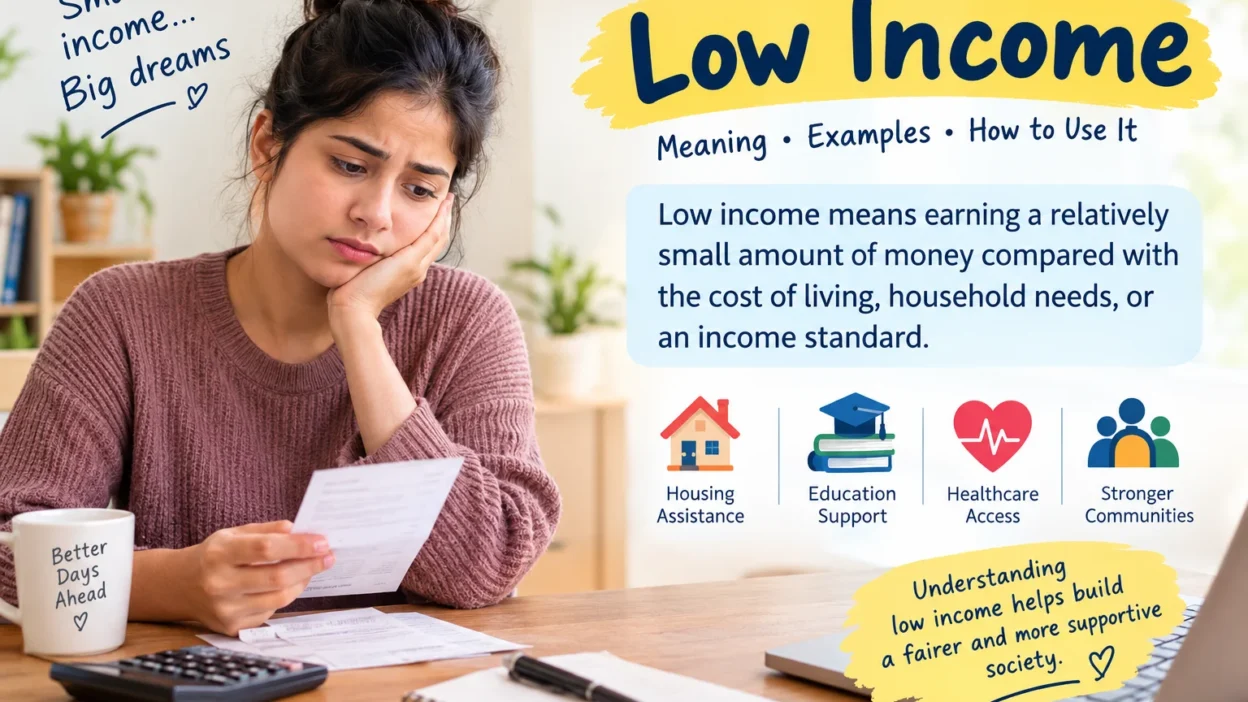
The term low income refers to earning a relatively small amount of money compared with the cost of living, household needs, or the income levels of a particular community. It is commonly used when discussing salaries, families, housing, education, healthcare, and financial difficulties. Understanding this term helps students, English learners, and everyday readers communicate clearly about money and living conditions.
Although “low income” sounds simple, its meaning can vary depending on the situation. A person may earn enough to cover basic expenses in one area but struggle to afford food, rent, transportation, and medical care in another. Government agencies and organizations may also use specific income limits to determine eligibility for financial assistance, housing programs, or other support. In everyday English, however, the phrase usually describes someone who earns relatively little money. Learning its definition, common uses, related words, and example sentences can help you understand it and use it naturally in conversations, academic writing, and professional communication.
Quick Answer: What Does Low Income Mean?
Low income means earning a relatively small amount of money compared with the needs of an individual or household, local living costs, or a relevant income standard. It is commonly associated with limited financial resources and difficulty affording essential expenses. The exact income level considered low depends on the location, household size, and purpose of the comparison.
Why Do People Confuse the Meaning of Low Income?
People sometimes confuse “low income” with poverty, unemployment, or being poor. Although these expressions are related, they do not always mean the same thing.
For example, someone can have a low-paying job and still earn enough to cover their basic needs if they live in an affordable area. Another person may earn a higher salary but struggle financially because of expensive housing, medical bills, or family responsibilities.
The main difference is that low income describes an income level, while poverty generally refers to a condition in which people lack sufficient resources to meet basic needs or fall below a defined poverty threshold.
The meaning of low income can also depend on official guidelines. A government housing program may define low income using household earnings and family size, while everyday conversation may use the phrase more generally.
Understanding the context helps you interpret the term correctly.
What Does the First Word Mean? Low
The word low means small in amount, level, height, or degree.
When talking about money, “low” describes an amount that is relatively small compared with a reference point.
Examples of Low
- Low salary: A salary that is relatively small compared with typical earnings or living expenses.
- Low price: A price that is relatively inexpensive.
- Low temperature: A temperature that is not high.
- Low cost: An amount of money that is relatively small.
- Low income: An income that is relatively small compared with a relevant standard or financial need.
Example sentence: She receives a low salary and has difficulty paying her monthly bills.
In this sentence, “low” describes the amount of salary she earns.
What Does the Second Word Mean? Income
The word income means money received by a person, household, or organization from sources such as employment, business activities, investments, or certain benefits.
Income can come from different sources, including:
- Wages or salaries from a job
- Earnings from self-employment
- Profits from a business
- Rental income from property
- Interest or dividends from investments
- Certain pensions and government benefits
Example sentence: His monthly income comes from his full-time job.
Income is not always the same as take-home pay. Gross income generally refers to earnings before certain deductions, while net income refers to the amount remaining after applicable deductions or expenses, depending on the context.
When discussing low income, it is important to understand which type of income is being measured.
Low Income vs. Related Financial Terms
The following table explains how low income differs from other commonly used financial expressions.
| Term | Meaning | Example |
|---|---|---|
| Low income | Earning a relatively small amount of money | She works in a low-income household. |
| High income | Earning a relatively large amount of money | He belongs to a high-income household. |
| Poverty | A condition involving insufficient resources to meet basic needs or falling below a defined poverty threshold | The family struggles to afford adequate food and housing. |
| Unemployment | Not having a job while meeting the relevant definition of unemployment | He is looking for work after losing his job. |
| Low salary | Receiving relatively little money from employment | She receives a low salary at her current job. |
| Financial hardship | Experiencing difficulty meeting financial obligations or essential needs | Unexpected medical bills caused financial hardship. |
| Middle income | Earning an amount generally associated with the middle of an income distribution or a defined middle-income range | The household falls within the local middle-income category. |
| Limited resources | Having relatively little money or access to essential resources | The school serves students from families with limited resources. |
These terms are related, but they are not interchangeable. For example, an unemployed person may have savings or other sources of income, while someone with a low income may work full-time.
When Should You Use Low Income?
Use “low income” when discussing earnings, household finances, economic circumstances, or access to services.
1. When Talking About Salary
Use the term to describe earnings that are relatively small.
Example: Many workers with low incomes find it difficult to save money each month.
2. When Describing a Household
Use “low-income household” when referring to a family or group of people whose combined income falls within a relatively low range under the relevant standard.
Example: The program provides assistance to eligible low-income households.
3. When Discussing Education
The phrase can describe students or families who have limited financial resources.
Example: The school offers additional learning resources to students from low-income families.
4. When Discussing Housing
It is often used in conversations about affordable housing and rental assistance.
Example: The city plans to build more affordable homes for low-income residents.
5. When Talking About Healthcare
The term may describe people whose financial circumstances limit their ability to afford medical services.
Example: The clinic provides reduced-cost services to eligible patients with low incomes.
6. When Discussing Financial Assistance
Government agencies and nonprofit organizations may use income limits to determine who qualifies for assistance.
Example: Applicants must meet the program’s household income requirements.
Remember that eligibility rules vary by program and location.
12 Example Sentences Using Low Income
Here are 12 practical examples showing how to use “low income” naturally in everyday English.
- She comes from a low-income family.
Meaning: Her family earns relatively little money. - Many low-income workers struggle to afford housing.
Meaning: Workers with limited earnings may find housing expensive. - The organization supports low-income households.
Meaning: The organization helps households with relatively little income. - He grew up in a low-income neighborhood.
Meaning: He grew up in an area where many residents have relatively low incomes. - The government introduced a program for low-income families.
Meaning: The program is designed to assist families that meet the relevant income criteria. - People with low incomes may qualify for financial assistance.
Meaning: Some people earning relatively little money may be eligible for support. - Her low income makes it difficult to save for emergencies.
Meaning: She has limited earnings available for savings. - The school provides free meals to eligible students from low-income households.
Meaning: Students who meet the relevant eligibility requirements receive meals without paying. - Rising food prices can place additional pressure on low-income families.
Meaning: Higher food costs can make household budgets more difficult to manage. - He works full-time but still has a low income.
Meaning: Even though he works full-time, his earnings remain relatively small. - The research examines the challenges faced by low-income communities.
Meaning: The research studies problems experienced by communities with limited financial resources. - A low income does not necessarily mean someone is unemployed.
Meaning: People can have jobs and still earn relatively little money.
These examples show that the phrase can describe individuals, families, workers, neighborhoods, and communities.
Common Mistakes When Using Low Income
English learners sometimes make mistakes when using “low income.” Here are the most important ones to avoid.
Mistake 1: Writing Lowincome as One Word
Incorrect: She belongs to a lowincome family.
Correct: She belongs to a low-income family.
Use a hyphen when “low-income” comes before a noun as a compound modifier.
Mistake 2: Confusing Low Income With No Income
Incorrect: Everyone with a low income earns no money.
Correct: People with low incomes earn money, but their earnings are relatively small.
Low income does not mean zero income.
Mistake 3: Assuming Everyone With a Low Income Lives in Poverty
Incorrect: All low-income people live below the poverty line.
Correct: Some people with low incomes may live in poverty, but the two terms have different meanings.
The distinction depends on income levels, household needs, living costs, and the applicable poverty definition.
Mistake 4: Using Low Salary and Low Income Interchangeably in Every Situation
Incorrect: Her low salary includes all her household income.
Correct: Her salary is low, and her household may receive additional income from other sources.
A salary is earnings from employment, while income can come from several sources.
Mistake 5: Ignoring Context
Incorrect: This family has a low income because it earns less than another family.
Correct: This family has a low income relative to its local cost of living and the relevant income standard.
Comparisons are more meaningful when the location, household size, and income measure are clear.
What Is an Easy Memory Trick for Low Income?
A simple way to remember the phrase is:
Low = small. Income = money received.
Put the two words together:
Low income = a relatively small amount of money received.
For example, if a person earns less than many comparable workers in the same area, you might describe that person’s earnings as low income.
However, remember that the phrase is relative. What counts as low income in one location may not be considered low in another.
Low Income in American vs. British English
The phrase “low income” is widely understood in both American and British English. Its basic meaning is the same, although related terminology and official classifications can differ.
| Feature | American English | British English |
|---|---|---|
| Common expression | Low-income family | Low-income family |
| General meaning | A family with relatively limited income | A family with relatively limited income |
| Related term | Federal poverty level | Low-income household or household on a low income |
| Common context | Benefits, housing assistance, taxes, and public programs | Benefits, housing, living costs, and public services |
| Spelling | Income | Income |
Examples in American English
- The program assists eligible low-income families.
- The household may qualify for housing assistance.
Examples in British English
- Many low-income households face rising living costs.
- The charity supports families on low incomes.
Both varieties use the expression naturally. The main differences arise from local terminology, government policies, and the systems used to assess household finances.
What Are Some Similar Words and Phrases?
Several English words and expressions are related to low income. Choosing the right one depends on what you want to communicate.
1. Limited Income
This means having a restricted amount of money available.
Example: Retired people on limited incomes may need to budget carefully.
2. Modest Income
This describes an income that is not particularly large. It can sound more neutral or polite than some alternatives.
Example: They live comfortably on a modest income.
3. Low-Paying
This describes a job or activity that provides relatively little money.
Example: She is looking for a better-paying job after years in low-paying work.
4. Financially Disadvantaged
This describes people who face financial disadvantages or have fewer economic resources or opportunities.
Example: The scholarship supports financially disadvantaged students.
5. Economically Disadvantaged
This broader expression describes people or groups facing economic disadvantages.
Example: The initiative provides educational opportunities for economically disadvantaged communities.
6. Poor
This is a common word for lacking enough money or resources to meet basic needs. Depending on the context, it can sound blunt or insensitive when describing a person.
Example: The charity works to reduce poverty and improve living conditions.
7. Underpaid
This describes someone who receives less pay than is considered appropriate for their work, skills, responsibilities, or circumstances.
Example: Many employees feel underpaid for the work they do.
Important distinction: Low income describes a financial situation, while underpaid suggests that someone’s pay is insufficient relative to an expected or appropriate level.
Final Verdict: What Does Low Income Really Mean?
Low income means earning a relatively small amount of money compared with a relevant income standard, household needs, or living costs.
It is commonly used when discussing wages, families, housing, education, public assistance, and financial challenges.
The phrase does not automatically mean that someone is unemployed, has no money, or lives below the poverty line. A person can work full-time and still have a low income, while another person with limited earnings may receive additional financial support.
The most important point is to consider the context. Location, household size, expenses, income sources, and official guidelines can all affect how the term is interpreted.
Frequently Asked Questions About Low Income
1. What is the simple meaning of low income?
Low income means earning relatively little money compared with a relevant standard or the cost of meeting basic needs. It can describe an individual, a family, or a household.
2. Is low income the same as poverty?
No. Low income describes the amount of money earned or received, while poverty refers to a condition of insufficient resources or falling below a defined poverty threshold. The two concepts overlap, but they are not identical.
3. What is considered a low income?
The amount considered low depends on the country, region, household size, cost of living, and purpose of the assessment. Government agencies may establish specific income limits for assistance programs.
4. Can someone work full-time and still have a low income?
Yes. A person can work full-time and still earn relatively little money. Their financial situation may also depend on housing costs, household responsibilities, healthcare expenses, and other necessary spending.
5. What is the opposite of low income?
The most direct opposite is high income. Depending on the context, you may also encounter expressions such as substantial earnings or a high salary.
6. What is the difference between low income and low salary?
Low salary refers specifically to relatively small earnings from employment. Low income is broader and can include wages, business earnings, investments, pensions, and other income sources.
7. Should low income have a hyphen?
Use a hyphen when “low-income” appears before a noun as a compound modifier, as in “a low-income family.” When the phrase follows the verb, it is generally written without a hyphen: “The family has a low income.”
8. How can I use low income in a sentence?
You can write, “The organization provides support to eligible low-income families.” This sentence uses “low-income” to describe families whose earnings fall within a relatively low range under the relevant criteria.
Remember This
- Low means relatively small in amount or level.
- Income means money received from different sources.
- Low income describes relatively limited earnings or financial resources.
- Low-income family uses a hyphen because the phrase modifies a noun.
- Poverty and low income are related but different concepts.
- The meaning of low income depends on context, location, household size, and relevant income standards.
Conclusion
Low income is a common English expression used to describe people or households that earn relatively little money. It appears in everyday conversations, educational materials, financial discussions, housing policies, and public assistance programs. Understanding its meaning helps you read financial information, follow discussions about living costs, and communicate more clearly in English.
Remember that low income does not automatically mean unemployment or poverty. The phrase describes earnings in relation to a relevant standard or financial need. By learning its definition, related expressions, grammatical usage, and practical examples, you can use “low income” confidently in speaking, writing, and everyday communication.

John Tyler is a dream researcher and content writer at SleepCout, sharing insightful articles about coded dreams, dream meanings, symbolism, sleep psychology, and practical guidance to help readers understand their dreams.