
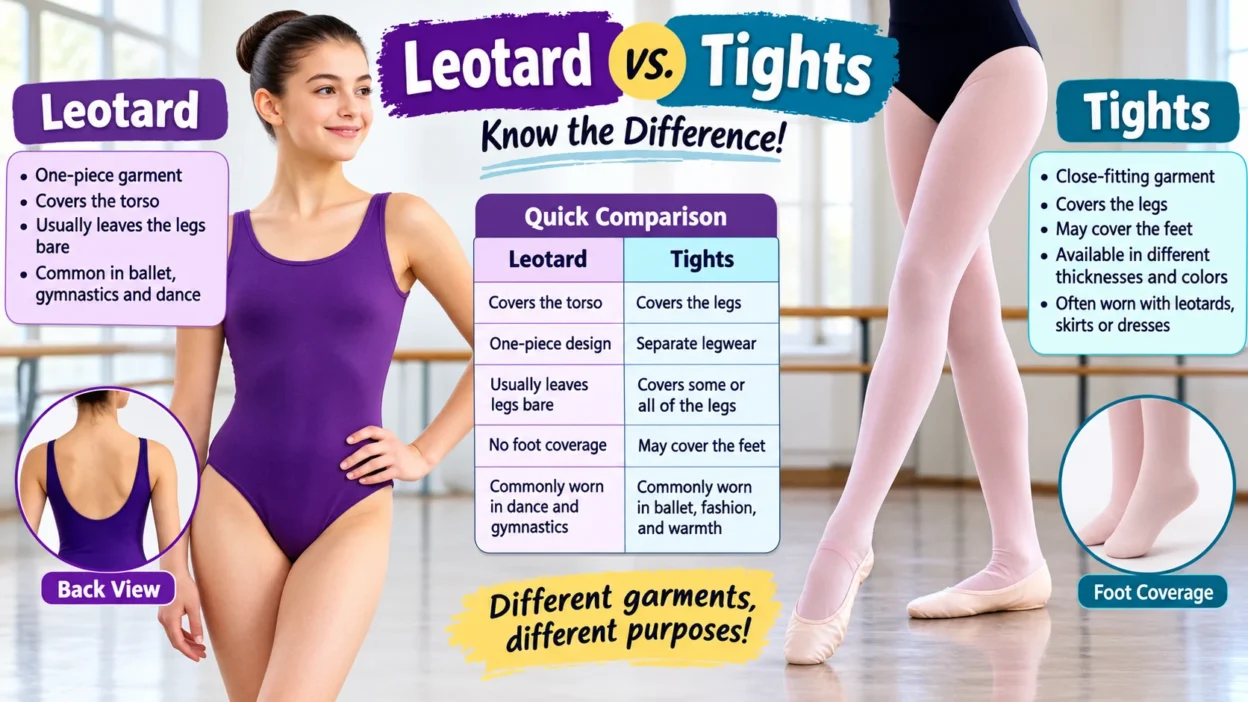
When comparing leotard vs. tights, the main difference is which parts of the body each garment covers. A leotard is a close-fitting, one-piece garment that covers the torso, usually leaving the legs bare. Tights are close-fitting garments that cover the legs and may extend over the feet, depending on the style. Both are commonly worn by dancers, gymnasts, and performers, but they serve different purposes.
Understanding the difference between a leotard and tights can help you choose the right clothing for ballet, gymnastics, dance practice, or everyday outfits. Although these garments are often worn together, they are not interchangeable. A dancer might wear a leotard as a top and tights underneath or alongside it to cover the legs. Their materials, coverage, and intended uses also vary. In this guide, you will learn what each word means, how to use it correctly, and how to recognize the difference through practical examples.
Quick Answer
A leotard is a one-piece, form-fitting garment that covers the torso and typically extends over the hips, while tights cover the legs and sometimes the feet. Leotards are common in ballet, gymnastics, and dance, whereas tights provide leg coverage and are often worn with leotards, skirts, or dresses.
Why Do People Confuse Leotards and Tights?
People often confuse leotards and tights because both are made from stretchy materials and fit closely to the body. They are also frequently worn together in ballet classes, dance performances, and gymnastics.
However, the two garments cover different areas:
- A leotard covers the upper body and crotch, generally leaving the legs exposed.
- Tights cover the legs and may cover the feet.
- Both may be made from materials such as nylon, spandex, or elastane.
- Both can be part of a dancer’s practice clothes or performance costume.
The easiest way to distinguish them is to look at their shape and coverage.
What Is a Leotard?
A leotard is a close-fitting, one-piece garment that covers the torso and usually fastens or fits around the crotch. It can have short sleeves, long sleeves, thin shoulder straps, or no sleeves.
Leotards are designed to allow freedom of movement while keeping the body covered without loose fabric getting in the way.
Common Uses of Leotards
Leotards are commonly worn for:
- Ballet and other forms of dance
- Gymnastics
- Figure skating
- Acrobatics
- Dance rehearsals and performances
- Some types of fitness training
Examples of Leotard Use
- The ballet student wore a black leotard to class.
- She chose a long-sleeved leotard for her gymnastics routine.
- The dance instructor recommended a comfortable leotard for practice.
- Her performance costume included a blue leotard with silver details.
A leotard is similar to a swimsuit in shape, although the materials and intended uses may differ.
What Are Tights?
Tights are close-fitting garments designed to cover the legs. Depending on the style, they may cover the feet completely, leave the toes exposed, or stop at the ankles.
Tights come in different thicknesses, colors, and materials. Some are sheer and delicate, while others are opaque and designed for warmth or athletic activities.
Common Uses of Tights
Tights are often worn for:
- Ballet and dance classes
- Gymnastics and stage performances
- Everyday fashion with skirts and dresses
- Cold-weather layering
- Figure skating and other performance activities
Examples of Tights Use
- She wore pink tights to her ballet lesson.
- The dancer chose footless tights for extra flexibility.
- Black tights completed her outfit.
- The gymnast wore performance tights under her costume.
In dance, tights can help create a consistent appearance and provide coverage while allowing the legs to move freely.
Leotard vs. Tights: Comparison Table
| Feature | Leotard | Tights |
|---|---|---|
| Main purpose | Covers the torso | Covers the legs |
| Design | One-piece upper-body garment | Close-fitting leg garment |
| Leg coverage | Usually leaves legs bare | Covers some or all of the legs |
| Foot coverage | No | Sometimes |
| Common materials | Nylon, spandex, cotton blends | Nylon, spandex, elastane blends |
| Common activities | Ballet, gymnastics, dance | Ballet, dance, fashion, layering |
| Typical outfit role | Worn as a top or base garment | Worn on the legs |
| Can they be worn together? | Yes | Yes |
When Should You Use Each?
Choose leotard when you are talking about a one-piece garment that covers the torso and is commonly worn for dance or gymnastics.
Choose tights when you mean a garment that covers the legs, whether it is worn for ballet, fashion, warmth, or performance.
Use “Leotard” in These Situations
- When describing a gymnast’s one-piece outfit.
- When discussing ballet dress codes that require a fitted top.
- When shopping for a dance garment that covers the torso.
- When describing a sleeveless or long-sleeved dance costume.
Example: The instructor asked every student to wear a plain leotard.
Use “Tights” in These Situations
- When describing legwear for ballet class.
- When shopping for sheer or opaque leg coverings.
- When talking about footless or convertible dance tights.
- When describing legwear worn with a skirt or dress.
Example: She packed two pairs of pink tights for the performance.
12 Examples of Leotard vs. Tights in Sentences
These examples show how the two words work in everyday English.
- Leotard: The dancer wore a black leotard during rehearsal.
- Tights: She wore pink tights with her ballet shoes.
- Leotard: My sister bought a new leotard for gymnastics.
- Tights: The ballet teacher recommended comfortable dance tights.
- Leotard: Her red leotard matched the performance theme.
- Tights: I prefer footless tights for certain dance exercises.
- Leotard: The student chose a sleeveless leotard for class.
- Tights: She put on warm tights before leaving home.
- Leotard: The gymnast’s leotard allowed her to move freely.
- Tights: The dancers wore matching tights on stage.
- Leotard: A leotard is often worn with ballet tights.
- Tights: Tights cover the legs, while a leotard covers the torso.
Notice that both garments can appear in the same sentence because they serve different purposes.
Common Mistakes to Avoid
1. Treating a Leotard and Tights as the Same Garment
They are different items. A leotard covers the torso, while tights cover the legs.
2. Assuming All Tights Cover the Feet
Some tights cover the feet, but footless and convertible styles are also available.
3. Calling Every Tight-Fitting Outfit a Leotard
A garment is not a leotard simply because it fits closely. Its one-piece construction and torso coverage are important identifying features.
4. Assuming Tights Are Only for Ballet
Tights are also worn for fashion, warmth, exercise, and other activities.
5. Thinking a Leotard Must Have Sleeves
Leotards can be sleeveless, short-sleeved, or long-sleeved.
Memory Trick: How to Remember the Difference
Use this simple memory trick:
- Leotard = torso: Think of a fitted one-piece garment worn by dancers and gymnasts.
- Tights = legs: Think of clothing that stretches over the legs.
Imagine a ballet dancer wearing a black leotard and pink tights. The black garment covers the torso, while the pink garments cover the legs.
This mental picture makes it easy to remember which word to use.
American vs. British English
The words leotard and tights are used in both American and British English, although clothing terminology can vary by context.
In American English, tights commonly refers to close-fitting legwear that may be sheer, opaque, or designed for dance. The word pantyhose is also widely used for sheer hosiery that covers the legs and feet.
In British English, tights is the usual term for hosiery worn under skirts and dresses. In dance settings, dance tights and ballet tights are also common expressions.
A leotard generally means the same thing in both varieties of English: a close-fitting, one-piece garment covering the torso.
Similar Words You Should Know
Several clothing terms are related to leotards and tights, but each has a distinct meaning.
- Bodysuit: A one-piece garment covering the torso and fastening at the crotch, often designed for everyday fashion.
- Unitard: A close-fitting, one-piece garment that covers both the torso and the legs.
- Pantyhose: Sheer hosiery that covers the legs and usually the feet, particularly common in American English.
- Leggings: Stretchy leg coverings that generally stop at the ankles and are often thicker than traditional hosiery.
- Stockings: Individual leg coverings, traditionally worn one on each leg and often held up with a garter or another fastening system.
- Dancewear: A general term for clothing worn during dance practice or performances.
- Ballet tights: Tights specifically designed for ballet, available in footed, footless, and convertible styles.
The most useful distinction is between a leotard, which covers the torso, tights, which cover the legs, and a unitard, which covers both.
Final Verdict: Leotard or Tights?
The correct word depends on the garment you are describing.
Use leotard for a fitted, one-piece garment that covers the torso and is commonly worn for ballet, gymnastics, and dance. Use tights for close-fitting legwear that may cover the feet and is worn for dance, fashion, or warmth.
If you see a dancer wearing a fitted top and pink leg coverings, the top is the leotard and the leg coverings are the tights. They are different garments, but they are often worn together.
Frequently Asked Questions
1. Can you wear a leotard with tights?
Yes. Wearing a leotard with tights is common in ballet, gymnastics, and other dance activities. The leotard covers the torso, while the tights cover the legs.
2. Are a leotard and a unitard the same thing?
No. A leotard usually leaves the legs bare, whereas a unitard extends over the legs as well as the torso. Both are close-fitting, one-piece garments.
3. Are tights the same as leggings?
No. Tights are often thinner and may cover the feet, while leggings are generally thicker and stop around the ankles. However, designs and intended uses can overlap.
4. Do ballet dancers wear leotards or tights?
Ballet dancers often wear both. A leotard provides a fitted upper-body garment, while ballet tights cover the legs. Exact dress requirements depend on the school, class, or performance.
5. Can tights be worn without a leotard?
Yes. Tights can be worn with skirts, dresses, shorts, or other garments. In dance, they may also be worn with a unitard or another suitable outfit.
6. Are leotards only for women?
No. Leotards are worn by people of different genders in dance, gymnastics, and performance settings. Styles and dress requirements vary according to the activity.
7. What is the difference between tights and pantyhose?
Both generally cover the legs and may cover the feet. Pantyhose usually refers to sheer hosiery in American English, while tights can refer to a wider range of thicknesses and styles, including opaque and dance-specific designs.
Remember This
- Leotard: A one-piece garment that covers the torso.
- Tights: Close-fitting garments that cover the legs.
- Unitard: A one-piece garment that covers both the torso and legs.
- Ballet outfit: Often combines a leotard, tights, and ballet shoes.
Conclusion
Understanding the difference between a leotard and tights is simple once you focus on coverage. A leotard is a fitted, one-piece garment that covers the torso, while tights cover the legs and may extend over the feet. Both are popular in dance and gymnastics, and wearing them together is common.
When choosing the right word, consider which part of the body the garment covers and how it is designed. Remember leotard for the torso and tights for the legs. With this distinction in mind, you can describe dancewear more accurately and choose the correct term in conversation, writing, and shopping.

John Tyler is a dream researcher and content writer at SleepCout, sharing insightful articles about coded dreams, dream meanings, symbolism, sleep psychology, and practical guidance to help readers understand their dreams.