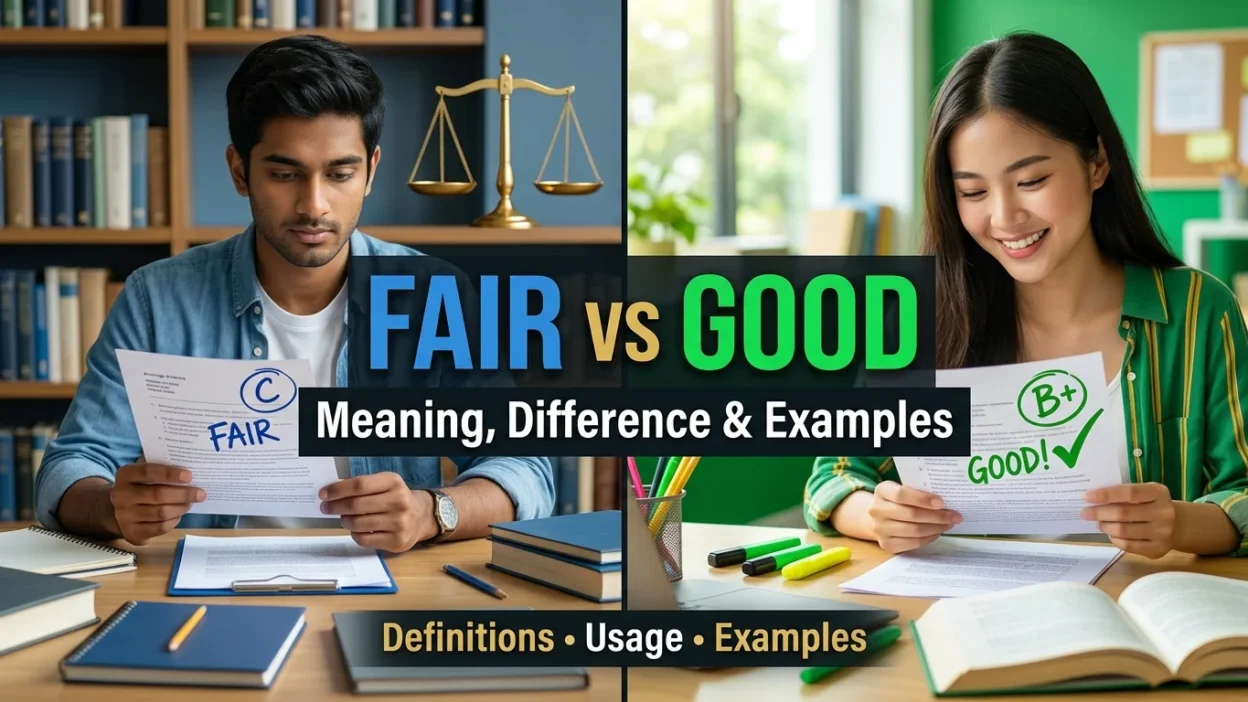
The words “fair” and “good” are commonly used to describe quality, performance, behavior, and situations. However, they do not always mean the same thing. Understanding the difference between fair and good can help you choose the right word in everyday conversations, academic writing, workplace communication, and English exams.
The main difference is that fair usually describes something that is acceptable, moderate, reasonable, or just, while good generally describes something positive, satisfactory, or of a desirable quality. For example, if you receive a fair grade, your performance may be average or acceptable. If you receive a good grade, your performance is usually better. However, the exact meaning depends on the context. A fair decision can also mean a just and unbiased decision, while a good decision means one that produces a positive result. Both words are useful, but they express different ideas. Learning when to use each word will make your English clearer and more natural.
Quick Answer: Fair vs Good
Fair usually means average, acceptable, reasonable, or just. Good generally means positive, satisfactory, or of a desirable quality. For example, a fair test result may be average, while a good result indicates stronger performance. When discussing fairness, however, fair means impartial or just, whereas good describes something positively.
Why Do People Confuse Fair and Good?
People often confuse these words because both can describe something that is acceptable or satisfactory. In some situations, their meanings overlap, but they are not interchangeable in every sentence.
Here are three common reasons for the confusion:
- Similar contexts: Both words can describe work, performance, health, weather, and experiences.
- Different levels of quality: Fair often suggests an average or moderate level, while good usually expresses a more positive judgment.
- Different meanings: Fair can mean just or unbiased, a meaning that good does not automatically express.
For example:
- “My English is fair.” This suggests that your English is acceptable but may need improvement.
- “My English is good.” This suggests that you have a reasonably strong command of English.
- “The teacher was fair.” This means the teacher treated people justly.
- “The teacher was good.” This suggests that the teacher was effective, helpful, or otherwise positive.
The context determines which word communicates your intended meaning.
What Does Fair Mean?
Fair is an adjective with several meanings. It can describe something that is average, reasonable, impartial, or just.
1. Fair Means Average or Acceptable
When describing quality or performance, fair often indicates a moderate or acceptable level that is neither especially good nor necessarily bad.
Examples:
- My exam result was fair.
- The restaurant serves fair-quality food.
- Her performance in the competition was fair.
- I have a fair understanding of the subject.
2. Fair Means Just or Unbiased
Fair can also describe someone who treats people equally and makes reasonable decisions without favoritism.
Examples:
- The judge made a fair decision.
- Every student deserves a fair chance.
- Our manager is fair to all employees.
- The rules should be fair to everyone.
3. Fair Means Reasonable
Fair may describe a price, offer, or arrangement that seems reasonable under the circumstances.
Examples:
- The seller offered a fair price.
- That seems like a fair agreement.
- We received fair compensation for our work.
When Should You Use Fair?
Use fair when you want to describe something as moderate, acceptable, just, unbiased, or reasonable. Remember that fair does not always mean average; in sentences about justice or equal treatment, it has a different meaning.
What Does Good Mean?
Good is an adjective used to describe something positive, satisfactory, useful, effective, or of a desirable quality.
1. Good Means Positive Quality
Use good when something meets expectations or has qualities that make it desirable.
Examples:
- She wrote a good essay.
- This is a good book for beginners.
- We had a good experience at the hotel.
- He is a good student.
2. Good Means Effective or Useful
Good can describe something that works well or helps achieve a purpose.
Examples:
- This is a good solution to the problem.
- Walking is good for your health.
- She gave me good advice.
- That is a good way to learn English.
3. Good Means Morally Right or Kind
Good can also describe someone who behaves kindly, honestly, or morally.
Examples:
- He is a good person.
- She did a good thing by helping her neighbor.
- The children were good during the visit.
When Should You Use Good?
Use good when you want to express a positive judgment about quality, performance, usefulness, behavior, or results. It generally communicates a more favorable evaluation than fair does when both words describe levels of performance.
Fair vs Good: Comparison Table
| Feature | Fair | Good |
|---|---|---|
| Main meaning | Average, acceptable, just, or reasonable | Positive, satisfactory, or desirable |
| Quality level | Often moderate or average | Usually more positive |
| Performance | Acceptable but may need improvement | Strong or satisfactory performance |
| Behavior | Just and unbiased | Kind, appropriate, or positive |
| Price | Reasonable | Favorable or worthwhile |
| Example | My result was fair. | My result was good. |
| Common synonyms | Reasonable, impartial, moderate | Great, positive, satisfactory |
| Overall impression | Depends on context; often moderate | Generally favorable |
Important: This comparison applies when fair and good describe levels of quality. When fair means just or unbiased, it is not simply a lower level of good.
When Should You Use Fair vs Good?
Choosing between fair and good depends on what you want to communicate.
Use Fair When Describing Average Performance
Choose fair when something is acceptable but not especially impressive.
- My presentation was fair.
- The student’s progress has been fair.
- The weather was fair enough for a short walk.
Use Fair When Talking About Justice
Choose fair when discussing equal treatment, impartiality, or reasonable decisions.
- Everyone should receive a fair opportunity.
- The referee made a fair call.
- We need a fair system for evaluating employees.
Use Good When Describing Quality
Choose good when something is positive or meets a desirable standard.
- She gave a good presentation.
- This restaurant serves good food.
- He achieved good results in his exams.
Use Good When Describing Benefits
Choose good when something is helpful or beneficial.
- Exercise is good for your health.
- Reading is good for vocabulary development.
- A good night’s sleep can help you feel refreshed.
12 Examples of Fair vs Good in Sentences
These examples show how the meaning changes depending on the word you choose.
- Exam results: My exam result was fair, but my friend’s result was good.
- Writing: His essay was fair, while hers was good.
- Teaching: Our teacher is fair because she treats every student equally.
- Food: The food was good, and everyone enjoyed the meal.
- Pricing: The shop offered a fair price for the used laptop.
- Performance: Her performance was fair, but she can improve with practice.
- Advice: My older brother gave me good advice about my career.
- Competition: Every participant deserves a fair chance to win.
- Weather: We had fair weather during our trip.
- Health: Regular exercise is good for your health.
- Work: The manager gave me a fair evaluation of my work.
- Character: He is a good person who always tries to help others.
More Examples in Everyday Conversations
- “How was your interview?” — “It was fair.” This suggests an acceptable or moderate experience.
- “How was your interview?” — “It was good.” This communicates a more positive impression.
- “Is this price reasonable?” — “Yes, it is fair.” This means the price seems justified.
- “Is this a useful book?” — “Yes, it is good.” This means the book is worthwhile or helpful.
Common Mistakes When Using Fair and Good
Even English learners who understand both words sometimes use them incorrectly.
Mistake 1: Treating Fair and Good as Exact Synonyms
Incorrect assumption: Fair and good always mean the same thing.
Better understanding: Fair often means moderate or just, while good generally communicates a positive quality.
Mistake 2: Using Good When You Mean Unbiased
Less precise: “The judge was good to both sides.”
Clearer: “The judge was fair to both sides.”
The second sentence specifically emphasizes impartial treatment.
Mistake 3: Assuming Fair Always Means Bad
Fair does not necessarily mean poor or bad. It can describe acceptable quality, a reasonable price, or a just decision.
Example: “The employee received fair compensation.”
This sentence does not suggest that the compensation was bad.
Mistake 4: Assuming Good Always Means Excellent
Good is positive, but it does not necessarily mean outstanding or perfect.
Example: “She received a good grade.”
This communicates positive performance without claiming that she received the highest possible grade.
Mistake 5: Ignoring Context
The word fair in “a fair decision” means just, while fair in “fair performance” often means moderate.
Always consider the surrounding words before deciding which meaning applies.
What Is an Easy Memory Trick for Fair vs Good?
Use this simple memory trick:
- Fair = reasonable, equal, or average.
- Good = positive, useful, or desirable.
Think of an exam:
- A fair result is generally acceptable or moderate.
- A good result is a positive achievement.
Now think of a classroom:
- A fair teacher treats students impartially.
- A good teacher teaches effectively and helps students learn.
Remember that these are common patterns, not absolute rules. Context can change the meaning of fair.
Fair vs Good in American and British English
Both fair and good are standard English words used in American and British English. Their core meanings are largely the same in both varieties.
| Usage | American English | British English |
|---|---|---|
| Fair performance | Common | Common |
| Good performance | Common | Common |
| Fair price | Common | Common |
| Fair treatment | Common | Common |
| Good quality | Common | Common |
There is no major spelling difference between the two words in American and British English.
However, the interpretation of a particular rating may depend on the situation. For example, a school, workplace, or survey might use fair and good as specific rating categories. In those cases, follow the definitions provided by that organization.
Similar Words: Fair, Good, Average, and Excellent
Understanding related words makes it easier to describe quality accurately.
- Poor: Below an acceptable standard.
- Fair: Often moderate, average, or acceptable; can also mean just.
- Average: Typical or around the usual level.
- Good: Positive or satisfactory quality.
- Excellent: Extremely high quality or outstanding performance.
- Great: Very good or impressive, often in a more enthusiastic tone.
For example, imagine a restaurant review:
- Poor: The food was disappointing.
- Fair: The food was acceptable but ordinary.
- Average: The food was typical for this type of restaurant.
- Good: The food was enjoyable and well prepared.
- Excellent: The food was outstanding.
These terms do not form a perfectly fixed ranking in every context. In particular, fair can describe justice rather than quality.
Final Verdict: Is Fair Better Than Good?
When describing performance or quality, good is generally more positive than fair. A fair result is often acceptable or average, whereas a good result suggests stronger performance or a more favorable outcome.
However, fair is the better word when you mean impartial, just, or reasonable. A fair decision is not necessarily a good decision in every other respect, and a good decision is not necessarily fair to everyone affected.
Choose the word that matches your intended meaning rather than assuming one is always better than the other.
Frequently Asked Questions
1. Is fair better than good?
Usually not when describing quality or performance. Good generally expresses a more positive evaluation, while fair often means acceptable or moderate. However, fair is the appropriate word when you mean just, unbiased, or reasonable.
2. Does fair mean average?
Fair often means average, moderate, or acceptable when describing performance or quality. However, it can also mean just, impartial, or reasonable. The meaning depends on the context in which the word is used.
3. What is the difference between a fair grade and a good grade?
A fair grade usually suggests acceptable or moderate performance, while a good grade generally indicates stronger performance. The exact difference depends on the grading system used by the school or institution.
4. Can fair and good mean the same thing?
Their meanings can overlap when describing something acceptable or satisfactory. However, they are not exact synonyms. Fair can emphasize moderation or justice, while good generally expresses a positive quality.
5. Is fair a positive or negative word?
Fair can be positive, neutral, or mildly critical depending on the context. A fair decision is usually a positive description of impartiality, while fair performance may suggest an average or moderate result.
6. What is the difference between fair and good quality?
Fair quality usually suggests an acceptable or moderate standard. Good quality suggests a more desirable or satisfactory standard. For example, a product of fair quality may be usable, while a product of good quality may perform more reliably.
7. Should I use fair or good in a performance review?
Use fair when the performance is moderate or acceptable, or when you want to emphasize impartial evaluation. Use good when the performance is positive and meets a desirable standard. For professional reviews, specific evidence is more helpful than either word alone.
Remember This
- Fair = average, acceptable, reasonable, or just.
- Good = positive, satisfactory, useful, or desirable.
- Use fair to emphasize impartiality or reasonable treatment.
- Use good to express a favorable judgment about quality or performance.
- Always consider the context because fair has more than one meaning.
Conclusion
Understanding the difference between fair and good helps you communicate more accurately in everyday English. Although both words can describe something acceptable, fair often suggests a moderate level of quality, a reasonable arrangement, or impartial treatment. Good generally expresses a positive judgment about quality, performance, behavior, or usefulness.
The easiest way to remember the difference is to connect fair with fairness or an acceptable standard and good with positive quality. A fair result may be satisfactory without being impressive, while a good result usually reflects stronger performance. When discussing justice, however, fair has a meaning of its own. By choosing the word that best matches your intended message, you can make your conversations, writing, and evaluations clearer and more natural.

John Tyler is a dream researcher and content writer at SleepCout, sharing insightful articles about coded dreams, dream meanings, symbolism, sleep psychology, and practical guidance to help readers understand their dreams.