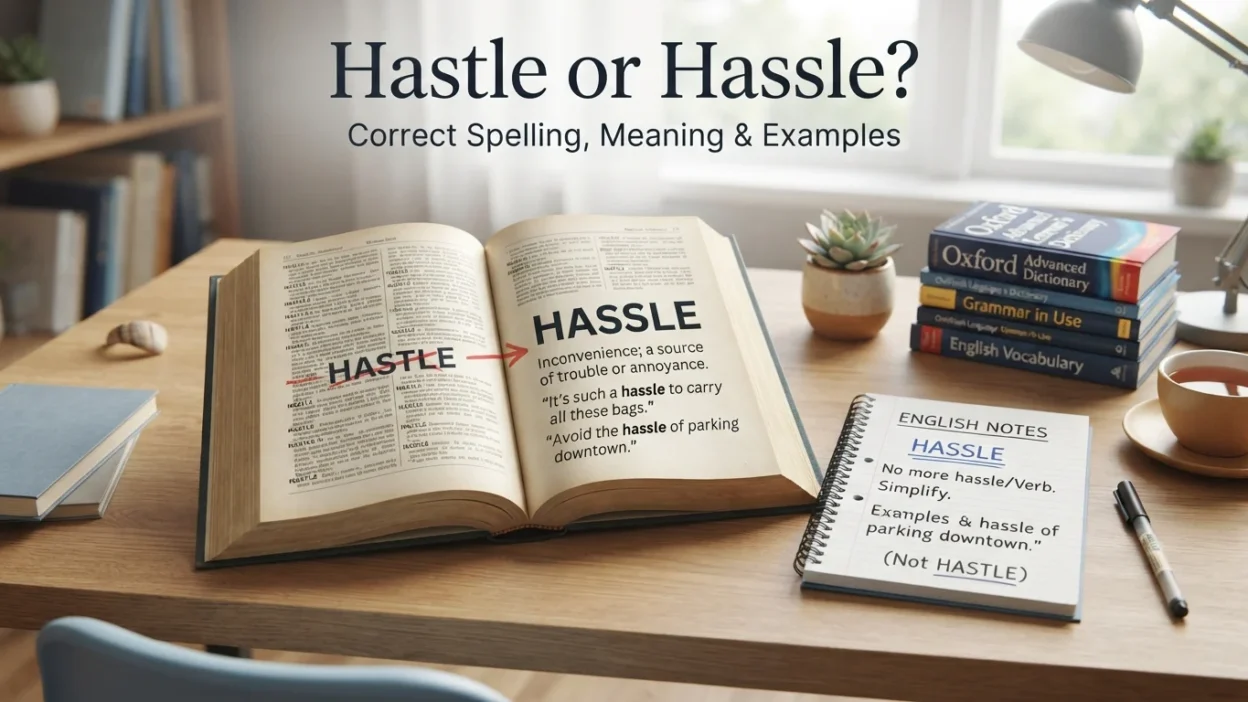
If you are wondering if “hastle” or “hassle” is correct, the answer is hassle. Hassle is the standard English word, while hastle is a common spelling mistake. The word hassle can be used as a noun meaning trouble, difficulty, or annoying inconvenience, and as a verb meaning to bother, annoy, or make something unnecessarily difficult.
This spelling confusion is understandable because hassle is pronounced in a way that can make the middle letters easy to mix up. If you are writing an email, school assignment, article, message, or professional document, use hassle, not hastle. Understanding its meaning and seeing it in context can make the correct spelling much easier to remember.
Quick Answer
Hassle is the correct spelling. Hastle is not the standard spelling of this English word. Hassle can mean an annoying difficulty or inconvenience, as in “Getting a refund was a hassle.” It can also be a verb: “I don’t want to hassle you.”
Why Do People Confuse “Hastle” and “Hassle”?
People often confuse these spellings because they look and sound similar.
The correct spelling contains “ss”:
Hassle ✅
The incorrect spelling usually replaces one of the s letters with t:
Hastle ❌
Another reason for the confusion is that English spelling does not always perfectly match pronunciation. When people hear the word hassle, they may remember its sound rather than its exact spelling.
If you are unsure, remember that the standard word is always hassle.
What Is the Correct Word: Hassle?
Hassle is the correct English word.
It can function as both a noun and a verb.
Hassle as a noun
As a noun, hassle means an annoying problem, inconvenience, or difficult situation.
Example:
Finding a parking space was a real hassle.
Here, hassle means something troublesome or inconvenient.
Hassle as a verb
As a verb, hassle means to bother, annoy, or cause someone unnecessary trouble.
Example:
I don’t want to hassle you with unnecessary questions.
It can also describe repeatedly pressuring or troubling someone.
What Is “Hastle”?
Hastle is generally a misspelling of hassle.
If you mean an annoying problem, inconvenience, or something that bothers you, the correct word is hassle.
For example:
- ❌ It was a big hastle.
- ✅ It was a big hassle.
- ❌ Don’t hastle me.
- ✅ Don’t hassle me.
In standard English writing, use hassle.
Hastle vs Hassle: Comparison Table
| Word | Correct? | Meaning | Example |
|---|---|---|---|
| Hassle | ✅ Yes | Trouble, inconvenience, or annoyance | Moving house can be a hassle. |
| Hastle | ❌ No | Usually a misspelling of hassle | Avoid this spelling in standard English. |
When Should You Use “Hassle”?
Use hassle when you are talking about something that causes inconvenience, difficulty, annoyance, or unnecessary trouble.
Use “hassle” as a noun
Traveling during the holiday season can be a hassle.
Returning the product was more of a hassle than I expected.
I don’t want the hassle of changing hotels.
Use “hassle” as a verb
Please don’t hassle your brother.
The salesperson kept hassling me to buy something.
I don’t want to hassle you while you’re busy.
10+ Examples of “Hassle”
Here are some natural examples:
- Getting a visa can sometimes be a hassle.
- I don’t want the hassle of driving in heavy traffic.
- Moving to a new apartment was a huge hassle.
- Returning the package turned into a hassle.
- Why are you hassling me about this?
- She doesn’t want to hassle her parents for money.
- Online shopping saves me the hassle of going to the store.
- Finding a reliable plumber was a real hassle.
- The paperwork was more hassle than it was worth.
- I had to deal with a lot of hassle at the airport.
- Don’t hassle him while he is working.
- Using this app makes the process much less of a hassle.
Common Mistakes with “Hassle”
1. Writing “hastle”
❌ Hastle
✅ Hassle
The standard spelling has ss, not st.
2. Using “hassle” when you mean “hustle”
Hassle and hustle are different words.
- Hassle = trouble or bother
- Hustle = move quickly, work energetically, or obtain something through energetic activity
Example:
The paperwork was a hassle.
We had to hustle to catch the train.
3. Confusing “hassle” with “hasty”
These words are also unrelated.
- Hassle = annoyance or inconvenience
- Hasty = done too quickly
Example:
Moving all the furniture was a hassle.
He made a hasty decision.
Memory Trick: How to Remember “Hassle”
Think:
Hassle = Stress + trouble
And remember the spelling:
HA + SSLE → HASSLE
The important part is the double S:
H A S S L E
You can also remember:
A hassle has two S’s.
So when you mean trouble or inconvenience, write hassle.
American vs British English
Hassle is used in both American English and British English.
There is no standard American-versus-British spelling difference here.
Examples:
American English:
Dealing with the paperwork was a hassle.
British English:
Dealing with the paperwork was a hassle.
The spelling hassle is standard in both varieties.
Similar Words to “Hassle”
Depending on the context, you can use several related words.
- Trouble — difficulty or problems
- Problem — something that needs to be solved
- Inconvenience — something that causes difficulty or disruption
- Annoyance — something irritating
- Nuisance — something troublesome or irritating
- Bother — something that causes annoyance or effort
- Difficulty — something that is hard to deal with
- Aggravation — something that causes frustration or annoyance
For example:
Getting a refund was a hassle.
You could also say:
Getting a refund was a bother.
or:
Getting a refund was an inconvenience.
The exact choice depends on the context and tone.
Final Verdict: Hastle or Hassle?
Hassle is the correct spelling.
Hastle is a common misspelling and should generally be avoided in formal and standard English writing.
Remember:
Hassle = correct ✅
Hastle = incorrect ❌
When you mean trouble, inconvenience, annoyance, or bother, always write hassle.
Frequently Asked Questions
Is “hastle” a correct word?
No. Hastle is generally a misspelling of hassle when referring to trouble, inconvenience, or annoyance.
Is “hassle” the correct spelling?
Yes. Hassle is the standard spelling.
What does “hassle” mean?
Hassle means trouble, inconvenience, annoyance, or difficulty. As a verb, it can mean to bother, annoy, or pressure someone.
What is the difference between hassle and trouble?
Both words can describe difficulty or problems. Hassle often suggests annoying inconvenience or unnecessary effort, while trouble is broader and can describe many kinds of problems.
Is “hassle” a noun or a verb?
It can be both.
As a noun:
The paperwork was a hassle.
As a verb:
Don’t hassle me.
Is “hassle” used in American English?
Yes. Hassle is common in American English and is also standard in British English.
Is “hassle” the same as “hustle”?
No. Hassle means trouble, annoyance, or inconvenience. Hustle can mean moving quickly, working energetically, or making a determined effort.
How do you remember the spelling of hassle?
Remember that hassle has two S’s: H-A-S-S-L-E.
Remember This
- ✅ Hassle is correct.
- ❌ Hastle is a misspelling in this context.
- Hassle can be a noun or a verb.
- As a noun, it means trouble, inconvenience, or annoyance.
- As a verb, it means to bother, annoy, or pressure someone.
- Hassle is used in both American and British English.
- Remember: “Hassle has two S’s.”
Conclusion
If you have been wondering whether to write hastle or hassle, choose hassle. It is the standard English spelling for a situation that causes trouble, inconvenience, annoyance, or unnecessary effort. It can also be used as a verb when someone is being bothered or pressured.
The easiest way to avoid this common spelling mistake is to remember the double s in hassle. Whether you are writing casually or formally, hassle is the form you should use when describing an annoying problem or inconvenience.

John Tyler is a dream researcher and content writer at SleepCout, sharing insightful articles about coded dreams, dream meanings, symbolism, sleep psychology, and practical guidance to help readers understand their dreams.