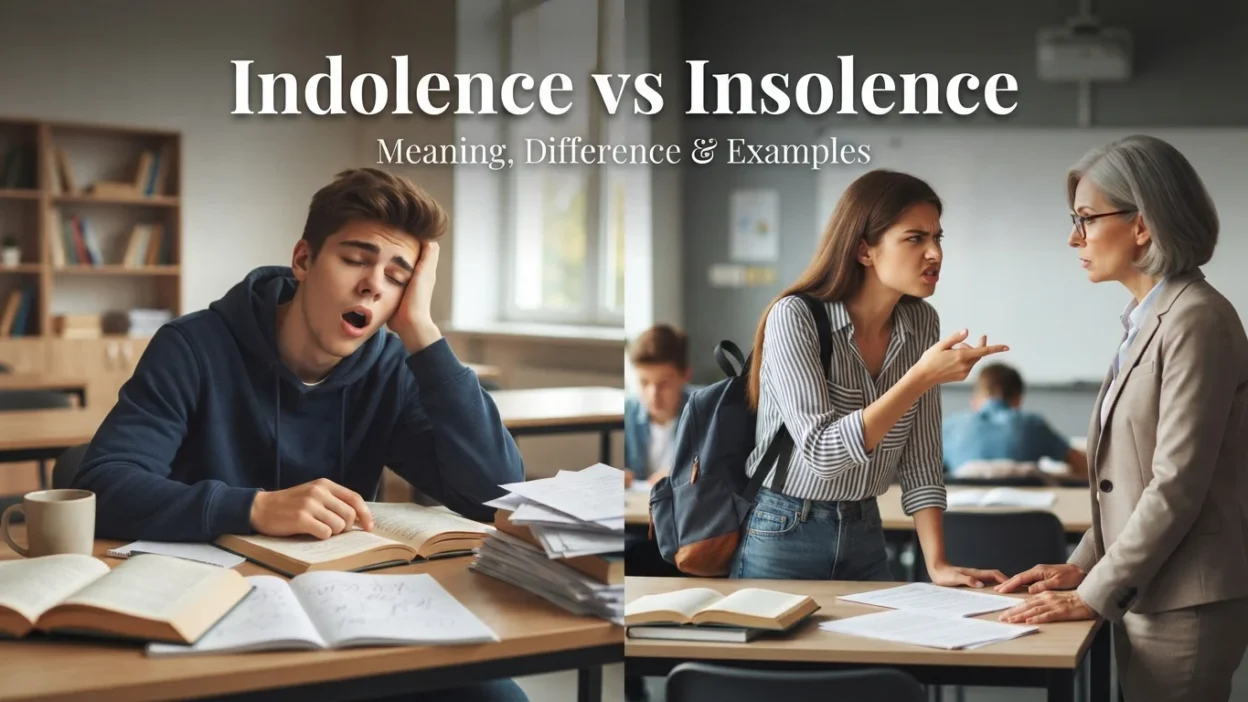
English has many words that look and sound similar but have completely different meanings. Indolence and insolence are a good example. Both are nouns, both begin with “in-,” and both describe negative qualities, so it is easy to mix them up. However, they refer to very different kinds of behavior.
Indolence means laziness or an unwillingness to make an effort, while insolence means rude, disrespectful, or boldly impudent behavior. In simple terms, an indolent person avoids work, while an insolent person shows disrespect toward others. Understanding this distinction can help you choose the correct word in writing and conversation.
Quick Answer
Indolence means laziness, inactivity, or an unwillingness to work or make an effort. Insolence means rude, disrespectful, or boldly impudent behavior. Remember: indolence is about avoiding effort; insolence is about showing disrespect. Their similar spelling can cause confusion, but their meanings are completely different.
Why Do People Confuse Indolence and Insolence?
People often confuse these words because they have similar spellings and pronunciation patterns:
- Indolence → laziness or lack of effort
- Insolence → disrespect or rudeness
Both words describe undesirable behavior, but they focus on different things.
For example:
- His indolence prevented him from finishing his work.
- His insolence offended his teacher.
The first sentence is about not making enough effort. The second is about being disrespectful.
What Does Indolence Mean?
Indolence is a noun meaning laziness, inactivity, or a tendency to avoid work or effort.
An indolent person may prefer doing nothing rather than completing a task. The word is often used in formal or literary English.
Simple Definition of Indolence
Indolence = laziness or unwillingness to make an effort.
Examples of Indolence
- His indolence caused him to miss several deadlines.
- The manager was frustrated by the employee’s indolence.
- She overcame her indolence and started studying regularly.
- Too much comfort can sometimes encourage indolence.
Related Words
Words related to indolence include:
- Laziness
- Idleness
- Inactivity
- Sloth
- Lethargy
- Inertia
- Lack of effort
What Does Insolence Mean?
Insolence is a noun meaning rude, disrespectful, or boldly impudent behavior, especially toward someone who deserves or expects respect.
An insolent person may speak or behave in a disrespectful way toward a teacher, parent, supervisor, official, or another person.
Simple Definition of Insolence
Insolence = disrespectful or offensively bold behavior.
Examples of Insolence
- The teacher was shocked by the student’s insolence.
- His insolence toward his supervisor caused problems at work.
- The officer would not tolerate such insolence.
- Her answer was considered an act of insolence.
Related Words
Words related to insolence include:
- Rudeness
- Disrespect
- Impudence
- Arrogance
- Impertinence
- Audacity
- Defiance
Indolence vs. Insolence: What’s the Difference?
| Word | Meaning | Focus | Example |
|---|---|---|---|
| Indolence | Laziness or lack of effort | Work and effort | His indolence kept him from finishing the project. |
| Insolence | Rudeness or disrespect | Behavior toward others | His insolence angered his teacher. |
The easiest distinction is:
Indolence = “I don’t want to work.”
Insolence = “I don’t respect you.”
When Should You Use Indolence?
Use indolence when you are talking about someone’s lack of effort, laziness, or unwillingness to work.
Correct Examples
- The student’s indolence affected his grades.
- His indolence made it difficult to complete the assignment.
- She was criticized for her indolence.
- The company suffered because of the team’s indolence.
If the main idea is laziness, choose indolence.
When Should You Use Insolence?
Use insolence when you are describing disrespectful, rude, or impudent behavior.
Correct Examples
- The manager was offended by the employee’s insolence.
- The child’s insolence surprised his parents.
- She was punished for her insolence toward the teacher.
- His insolence was unacceptable during the meeting.
If the main idea is disrespect, choose insolence.
10+ Examples of Indolence and Insolence
- His indolence prevented him from completing his homework.
- He was too lazy or unwilling to make an effort.
- The student’s insolence upset the teacher.
- The student behaved disrespectfully.
- Indolence can make it difficult to achieve long-term goals.
- The sentence focuses on lack of effort.
- The supervisor would not tolerate the employee’s insolence.
- The employee was rude or disrespectful.
- Her indolence became obvious when she repeatedly avoided her responsibilities.
- She was not making an effort.
- His insolence shocked everyone at the meeting.
- His behavior was offensively disrespectful.
- The coach criticized the players for their indolence.
- The players were not putting in enough effort.
- The student apologized for his insolence.
- He apologized for being disrespectful.
- His indolence caused him to fall behind his classmates.
- His lack of effort caused the problem.
- Her insolence toward the principal resulted in disciplinary action.
- She behaved disrespectfully toward an authority figure.
- Overcoming indolence requires consistent effort.
- The focus is on laziness.
- The customer’s insolence made the situation more difficult.
- The focus is on rude behavior.
Common Mistakes
Mistake 1: Using Insolence to Mean Laziness
❌ His insolence kept him from doing his homework.
If you mean that he was lazy, use indolence.
✅ His indolence kept him from doing his homework.
Mistake 2: Using Indolence to Mean Rudeness
❌ The teacher was angry about the student’s indolence toward her.
If the student was disrespectful, insolence is the appropriate word.
✅ The teacher was angry about the student’s insolence toward her.
Mistake 3: Thinking They Are Synonyms
Although both words can describe negative behavior, they are not synonyms.
- Indolence concerns effort and activity.
- Insolence concerns respect and behavior toward others.
Memory Trick: How to Remember the Difference
Try this simple trick:
Indolence → Idle → Laziness
The words indolence and idle can remind you of a person who is not working.
Insolence → Insult → Disrespect
The beginning of insolence can remind you of an insult, which helps connect it with rude or disrespectful behavior.
So remember:
Indolence = idle behavior
Insolence = insulting/disrespectful behavior
American vs. British English
There is no major difference in meaning between American and British English for these two words.
Both indolence and insolence are understood in both varieties of English:
- Indolence means laziness or lack of effort.
- Insolence means rude or disrespectful behavior.
Both words are somewhat formal compared with everyday alternatives such as laziness and rudeness. In casual conversation, people are more likely to say “lazy” or “rude.”
Similar Words
Words Similar to Indolence
- Laziness
- Idleness
- Sloth
- Inactivity
- Lethargy
- Inertia
These words relate to lack of activity, effort, or motivation, although their exact meanings can differ.
Words Similar to Insolence
- Rudeness
- Disrespect
- Impudence
- Impertinence
- Arrogance
- Audacity
These words relate to disrespectful, bold, or inappropriate behavior, but they are not always interchangeable.
Final Verdict
Indolence and insolence are completely different words.
Use indolence when you mean laziness or a lack of effort. Use insolence when you mean rudeness, disrespect, or impudent behavior.
The simplest way to remember them is:
Indolence = laziness.
Insolence = disrespect.
Frequently Asked Questions
Is indolence the same as laziness?
Yes. Indolence means laziness, idleness, or an unwillingness to make an effort. It is a more formal word than the everyday term laziness.
Is insolence the same as disrespect?
In many contexts, yes. Insolence refers to rude, disrespectful, or boldly impudent behavior, particularly toward someone in a position of authority.
What is the difference between indolence and insolence?
Indolence is about avoiding effort or work, while insolence is about behaving rudely or disrespectfully toward others.
Can a person be both indolent and insolent?
Yes. A person could be indolent because they avoid doing their work and insolent because they respond rudely when someone criticizes them.
Is indolence a negative word?
Yes. Indolence generally has a negative meaning because it describes excessive laziness, inactivity, or unwillingness to make an effort.
Is insolence a formal word?
Yes. Insolence is relatively formal and is more common in serious, professional, literary, or written contexts than in casual everyday conversation.
What is an easy synonym for insolence?
Rudeness or disrespect are simple synonyms that make the meaning of insolence easy to understand.
Remember This
Indolence is connected with idleness and laziness.
Insolence is connected with insults and disrespect.
If someone refuses to work, think indolence. If someone behaves rudely toward another person, think insolence.
Conclusion
Although indolence and insolence look and sound similar, they describe two different behaviors. Indolence refers to laziness, idleness, or a lack of effort, while insolence refers to rude, disrespectful, or impudent behavior. Knowing this difference makes it much easier to use each word correctly.
A useful memory trick is to connect indolence with idle and insolence with insult. When you remember indolence = laziness and insolence = disrespect, you can quickly choose the right word in both writing and conversation.

John Tyler is a dream researcher and content writer at SleepCout, sharing insightful articles about coded dreams, dream meanings, symbolism, sleep psychology, and practical guidance to help readers understand their dreams.