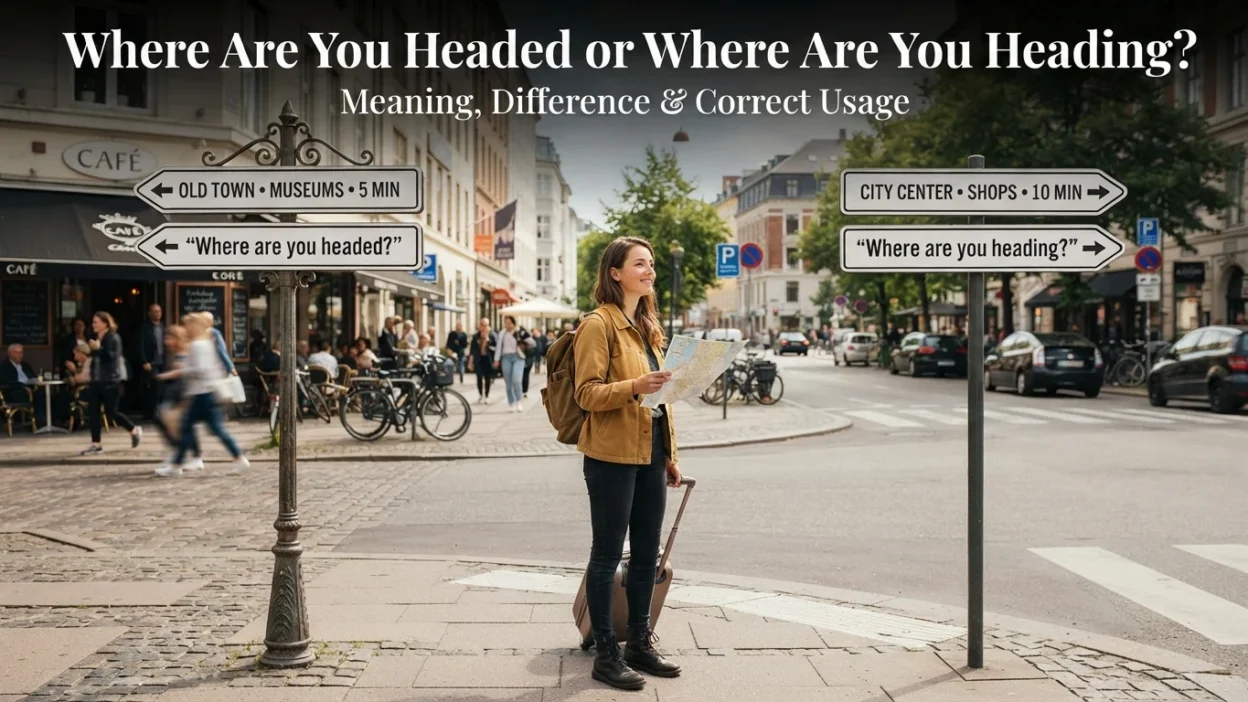
If you want to ask someone about their destination, both “Where are you headed?” and “Where are you heading?” are correct and natural English expressions. They have essentially the same meaning: “Where are you going?” or “What is your destination?” The difference is mainly one of style and nuance rather than grammar.
Both expressions are commonly used in everyday conversations. “Where are you headed?” can sound slightly more concise and conversational, while “Where are you heading?” emphasizes the action or direction of going somewhere. Neither expression is incorrect, and your choice usually depends on personal preference and context.
Quick Answer
“Where are you headed?” and “Where are you heading?” are both correct. Both ask about someone’s destination or where they are going. “Headed” is a past participle functioning adjectivally in this expression, while “heading” is the present participle of “head.” In everyday English, the two phrases are usually interchangeable.
Why Do People Confuse “Where Are You Headed” and “Where Are You Heading”?
The confusion happens because headed and heading are different grammatical forms of the same verb, head.
The verb head can mean “to go toward a particular place or direction.”
For example:
- We are heading home.
- We are headed home.
- Where are you heading?
- Where are you headed?
All four sentences communicate the idea of moving toward a destination.
The main difference is grammatical structure:
- Heading is the present participle used in the present continuous.
- Headed is the past participle used in the expression be headed.
What Does “Head” Mean Here?
In these expressions, head does not refer to the part of your body.
As a verb, head can mean to move or travel toward a particular place or direction.
For example:
We are heading toward the station.
This means:
We are going toward the station.
You can also use head without mentioning a specific destination:
Where are you heading?
This simply asks where the person is going.
“Where Are You Headed”: Meaning and Usage
“Where are you headed?” means “Where are you going?” or “What is your destination?”
Here, headed follows the verb are.
Examples:
- Where are you headed?
- Where are you headed after work?
- Where are you headed this evening?
- Where are you headed now?
This expression is especially natural in informal conversations.
Examples
“Where are you headed?”
“I’m headed to the library.”
“Where are you headed after lunch?”
“I’m headed back to the office.”
The expression can also refer to a general direction:
Where are you headed with that box?
Depending on context, this could mean “Where are you taking that box?”
“Where Are You Heading”: Meaning and Usage
“Where are you heading?” also means “Where are you going?”
Here, heading is the present participle of the verb head, used in the present continuous tense.
Examples:
- Where are you heading?
- Where are you heading after school?
- Where are you heading this weekend?
- Where are you heading next?
It emphasizes the action or movement toward a destination.
For example:
Where are you heading?
I’m heading to the airport.
This is completely natural English.
Where Are You Headed vs Where Are You Heading: Comparison Table
| Expression | Meaning | Grammar | Common Use | Correct? |
|---|---|---|---|---|
| Where are you headed? | Where are you going? | Be + past participle | Casual conversation | Yes |
| Where are you heading? | Where are you going? | Present continuous | Casual/general conversation | Yes |
| Where are you going? | What is your destination? | Present continuous | Very common | Yes |
| Where are you heading to? | Where are you going? | Present continuous + preposition | Informal | Yes, though “to” is often unnecessary |
When Should You Use Each?
Use “Where Are You Headed?” When…
Use “Where are you headed?” when you want a short, natural way to ask about someone’s destination.
For example:
You look like you’re in a hurry. Where are you headed?
It works especially well in casual speech.
Use “Where Are You Heading?” When…
Use “Where are you heading?” when you want to focus slightly more on the person’s movement or direction.
For example:
Where are you heading after the meeting?
It is also perfectly natural in everyday conversation.
Can You Use Either One?
Yes.
In most situations, you can replace one with the other without changing the basic meaning.
Where are you headed?
and
Where are you heading?
both normally mean:
Where are you going?
10+ Examples of “Where Are You Headed?”
- Where are you headed this morning?
- Where are you headed after work?
- Where are you headed so quickly?
- Where are you headed for lunch?
- Where are you headed this weekend?
- Where are you headed with that suitcase?
- Where are you headed after the party?
- Where are you headed now?
- Where are you headed on your vacation?
- Where are you headed next?
- Where are you headed in such a hurry?
- Where are you headed after class?
Example Conversation
Tom: Where are you headed?
Sarah: I’m headed to the supermarket.
Tom: Can I come with you?
This sounds natural and conversational.
10+ Examples of “Where Are You Heading?”
- Where are you heading?
- Where are you heading after school?
- Where are you heading this afternoon?
- Where are you heading next?
- Where are you heading for dinner?
- Where are you heading so early?
- Where are you heading after the meeting?
- Where are you heading with all those books?
- Where are you heading this weekend?
- Where are you heading on your trip?
- Where are you heading in such a hurry?
- Where are you heading after work?
Example Conversation
Mike: Where are you heading?
John: I’m heading home.
Mike: Can I walk with you?
Again, this is completely natural.
Common Mistakes
Mistake 1: Thinking “Headed” Is Always Past Tense
Some learners assume that headed must refer to the past because it looks like a past-tense form.
But in:
Where are you headed?
headed does not mean that the person went somewhere in the past.
The whole expression refers to the person’s current destination or direction.
Mistake 2: Thinking Only “Heading” Is Correct
This is incorrect.
Both are standard expressions:
Where are you headed? ✓
Where are you heading? ✓
Mistake 3: Adding “To” Unnecessarily
You may hear:
Where are you heading to?
This is common in informal English and is generally understood. However, “Where are you heading?” is simpler and more standard in careful writing.
Compare:
Where are you heading? ✓
Where are you heading to? ✓ Informal/common
Mistake 4: Using “Head” as a Noun
In these sentences, head is a verb.
We are heading home.
Here, heading means “going.”
Memory Trick
A simple way to remember the difference is:
Heading = going toward
Headed = going toward / destined for
Think of these examples:
I am heading to school.
I am headed to school.
Both mean that I am going to school.
So if you’re asking someone about their destination, “Where are you headed?” and “Where are you heading?” are both safe choices.
American vs British English
Both “Where are you headed?” and “Where are you heading?” are used in American and British English.
There is no major American-versus-British grammar difference that makes one expression correct and the other incorrect.
You may also hear:
Where are you going?
This is the most direct and universally familiar version.
The choice among going, heading, and headed is often about conversational style rather than regional grammar.
Similar Words and Expressions
Several expressions can communicate a similar idea:
Where Are You Going?
The simplest and most common option.
Where are you going?
Where Are You Off To?
A friendly, informal expression.
Where are you off to?
Where Are You Bound?
This can mean where someone is traveling or destined to go.
Where are you bound?
It sounds more formal or literary than the other choices.
Where Are You Going Next?
This asks about someone’s next destination.
Where are you going next?
What Is Your Destination?
This is much more formal and is common in official or travel-related contexts.
Final Verdict
“Where are you headed?” and “Where are you heading?” are both correct.
They generally mean the same thing: “Where are you going?”
Use “Where are you headed?” for a concise, conversational question about someone’s destination. Use “Where are you heading?” when you want to emphasize the person’s movement or direction. In ordinary conversation, the difference is very small.
If you’re unsure which one to use, either is perfectly natural.
FAQs
Is “Where are you headed?” grammatically correct?
Yes. “Where are you headed?” is grammatically correct and commonly used to ask someone about their destination or where they are going.
Is “Where are you heading?” correct English?
Yes. “Where are you heading?” is also completely correct. It means essentially the same thing as “Where are you headed?”
Is “Where are you headed?” better than “Where are you heading?”
Neither is universally better. Both are natural. “Where are you headed?” can sound slightly shorter and more conversational, while “Where are you heading?” emphasizes the action of going.
Does “headed” mean past tense in “Where are you headed?”
No. In “Where are you headed?”, “headed” is used with are to describe someone’s current direction or destination. It does not mean that the person went somewhere in the past.
Can I say “Where are you heading to?”
Yes. “Where are you heading to?” is common in informal speech. However, “Where are you heading?” is more concise because “where” already asks about the destination.
Is “Where are you going?” the same as “Where are you headed?”
Usually, yes. All three expressions can ask about someone’s destination. “Where are you going?” is the most direct and widely familiar version.
Which is more natural: “Where are you headed?” or “Where are you heading?”
Both are natural. The choice depends mainly on personal style and context. Neither should be considered grammatically wrong.
Remember This
- Where are you headed? = Where are you going?
- Where are you heading? = Where are you going?
- Both are correct.
- Heading is the present participle of head.
- Headed is the past participle used with be.
- Where are you heading? is concise and natural.
- Where are you headed? is also concise and natural.
- Where are you going? is the simplest alternative.
The important point is that you do not need to worry about choosing a “correct” expression between these two. Both “Where are you headed?” and “Where are you heading?” are standard English and can naturally be used when asking about someone’s destination.
In everyday conversation, choose whichever sounds more natural to you. If you’re learning English, remember that head can mean “go toward a place,” so both heading and headed can describe movement toward a destination.

John Tyler is a dream researcher and content writer at SleepCout, sharing insightful articles about coded dreams, dream meanings, symbolism, sleep psychology, and practical guidance to help readers understand their dreams.